
More C Concepts Operator overloading Friend Function This
- Slides: 23
More C++ Concepts • Operator overloading • Friend Function • This Operator • Inline Function 1
Operator overloading • Programmer can use some operator symbols to define special member functions of a class • Provides convenient notations for object behaviors 2
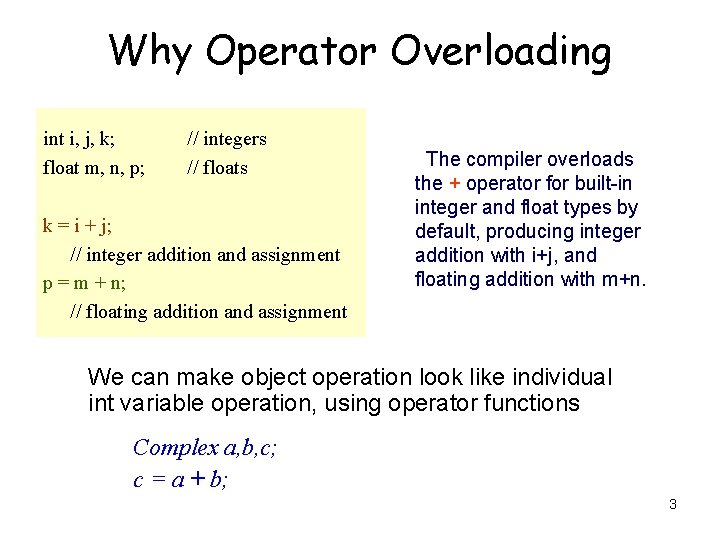
Why Operator Overloading int i, j, k; float m, n, p; // integers // floats k = i + j; // integer addition and assignment p = m + n; // floating addition and assignment The compiler overloads the + operator for built-in integer and float types by default, producing integer addition with i+j, and floating addition with m+n. We can make object operation look like individual int variable operation, using operator functions Complex a, b, c; c = a + b; 3
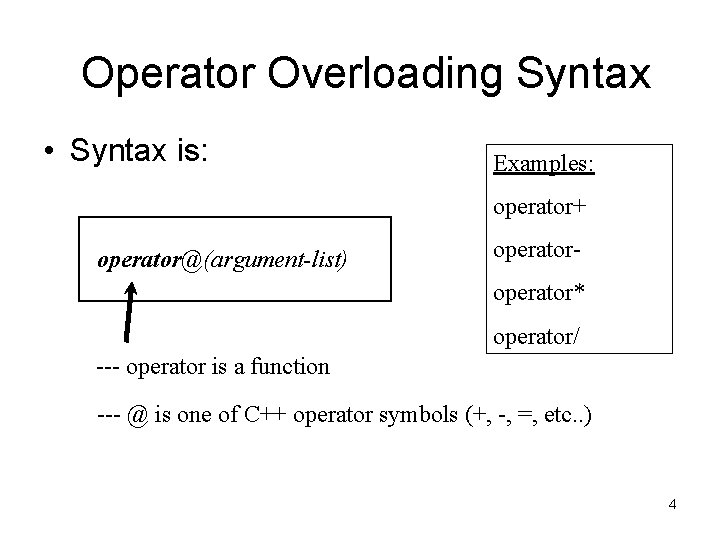
Operator Overloading Syntax • Syntax is: Examples: operator+ operator@(argument-list) operator* operator/ --- operator is a function --- @ is one of C++ operator symbols (+, -, =, etc. . ) 4
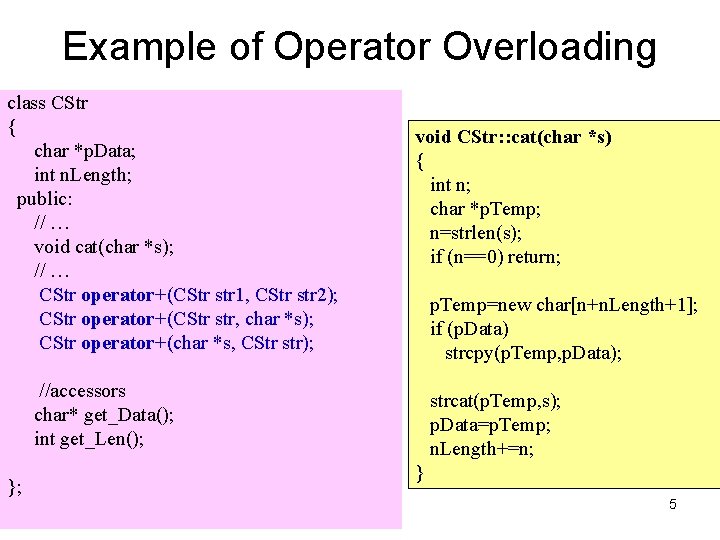
Example of Operator Overloading class CStr { char *p. Data; int n. Length; public: // … void cat(char *s); // … CStr operator+(CStr str 1, CStr str 2); CStr operator+(CStr str, char *s); CStr operator+(char *s, CStr str); void CStr: : cat(char *s) { int n; char *p. Temp; n=strlen(s); if (n==0) return; p. Temp=new char[n+n. Length+1]; if (p. Data) strcpy(p. Temp, p. Data); //accessors char* get_Data(); int get_Len(); }; strcat(p. Temp, s); p. Data=p. Temp; n. Length+=n; } 5
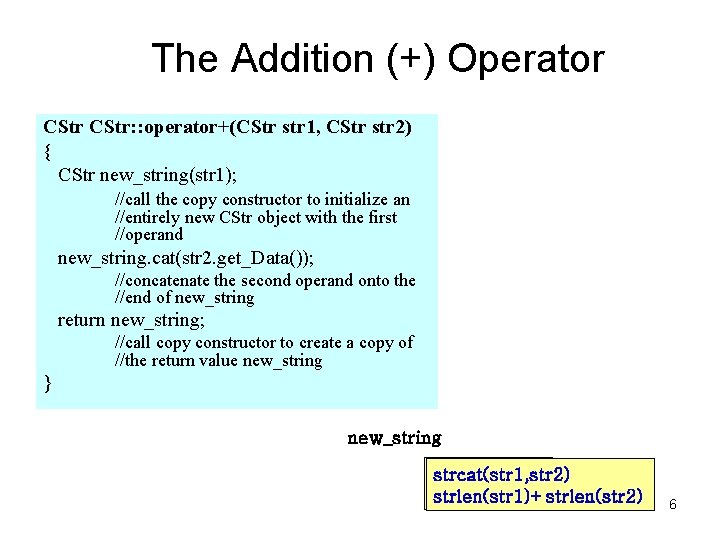
The Addition (+) Operator CStr: : operator+(CStr str 1, CStr str 2) { CStr new_string(str 1); //call the copy constructor to initialize an //entirely new CStr object with the first //operand new_string. cat(str 2. get_Data()); //concatenate the second operand onto the //end of new_string return new_string; //call copy constructor to create a copy of //the return value new_string } new_string str 1 strcat(str 1, str 2) strlen(str 1)+strlen(str 2) 6
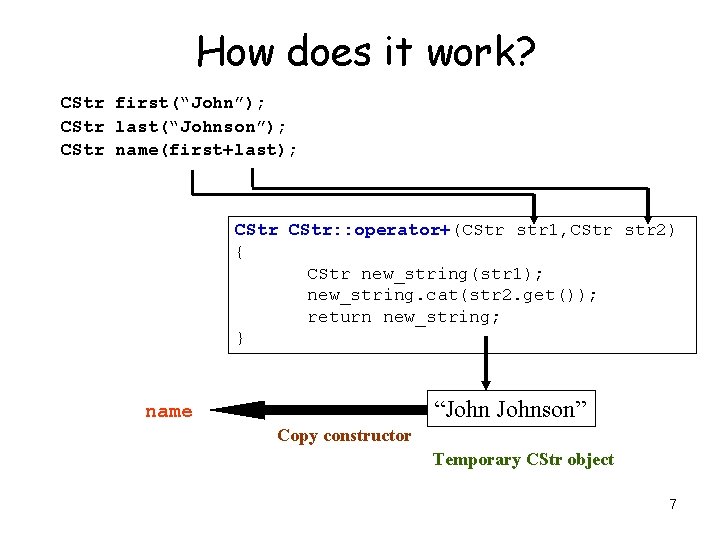
How does it work? CStr first(“John”); CStr last(“Johnson”); CStr name(first+last); CStr: : operator+(CStr str 1, CStr str 2) { CStr new_string(str 1); new_string. cat(str 2. get()); return new_string; } “Johnson” name Copy constructor Temporary CStr object 7
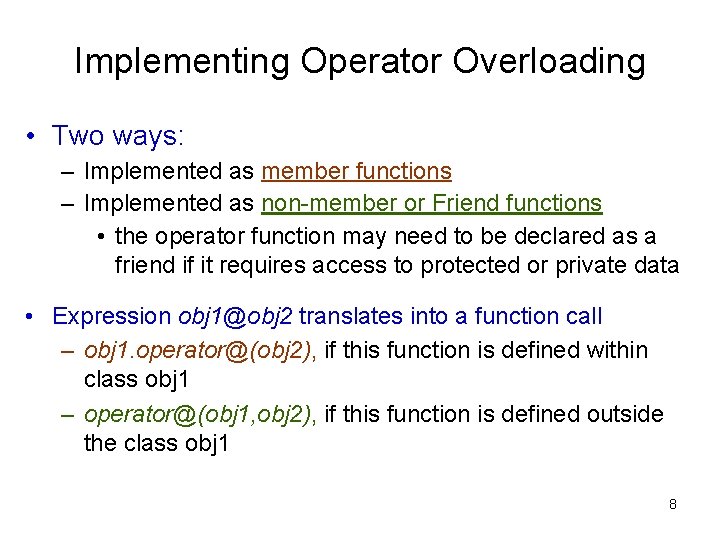
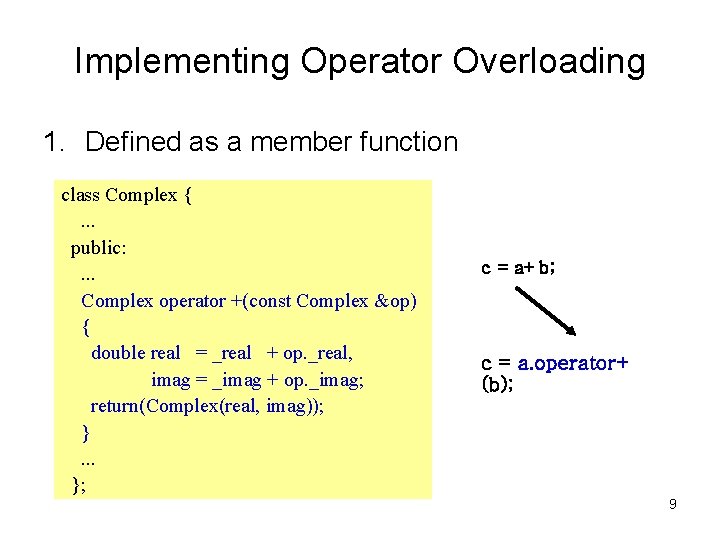
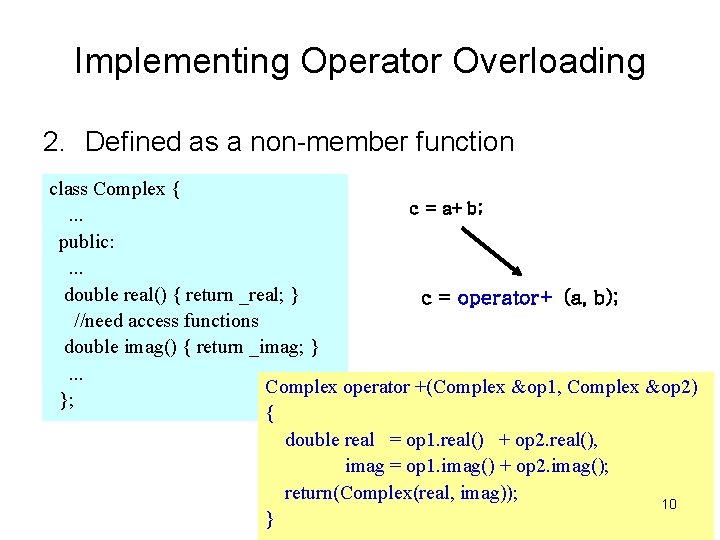
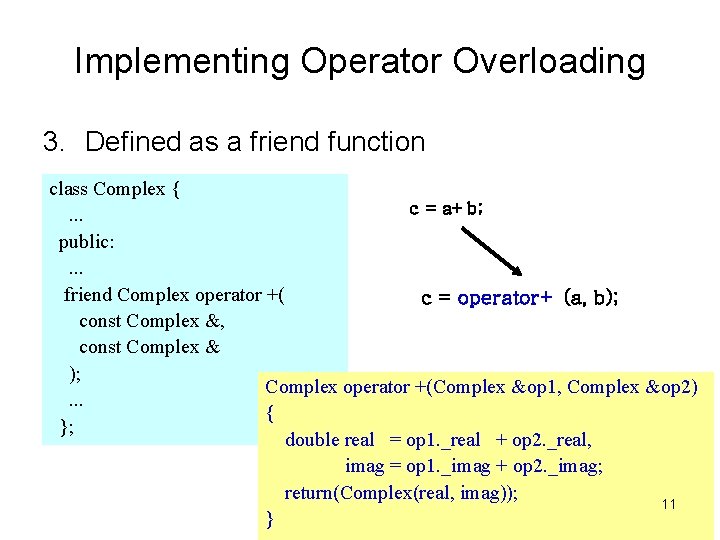
Implementing Operator Overloading • Two ways: – Implemented as member functions – Implemented as non-member or Friend functions • the operator function may need to be declared as a friend if it requires access to protected or private data • Expression obj 1@obj 2 translates into a function call – obj 1. operator@(obj 2), if this function is defined within class obj 1 – operator@(obj 1, obj 2), if this function is defined outside the class obj 1 8
Implementing Operator Overloading 1. Defined as a member function class Complex {. . . public: . . . Complex operator +(const Complex &op) { double real = _real + op. _real, imag = _imag + op. _imag; return(Complex(real, imag)); }. . . }; c = a+b; c = a. operator+ (b); 9
Implementing Operator Overloading 2. Defined as a non-member function class Complex { c = a+b; . . . public: . . . double real() { return _real; } c = operator+ (a, b); //need access functions double imag() { return _imag; }. . . Complex operator +(Complex &op 1, Complex &op 2) }; { double real = op 1. real() + op 2. real(), imag = op 1. imag() + op 2. imag(); return(Complex(real, imag)); 10 }
Implementing Operator Overloading 3. Defined as a friend function class Complex { c = a+b; . . . public: . . . friend Complex operator +( c = operator+ (a, b); const Complex &, const Complex & ); Complex operator +(Complex &op 1, Complex &op 2). . . { }; double real = op 1. _real + op 2. _real, imag = op 1. _imag + op 2. _imag; return(Complex(real, imag)); 11 }
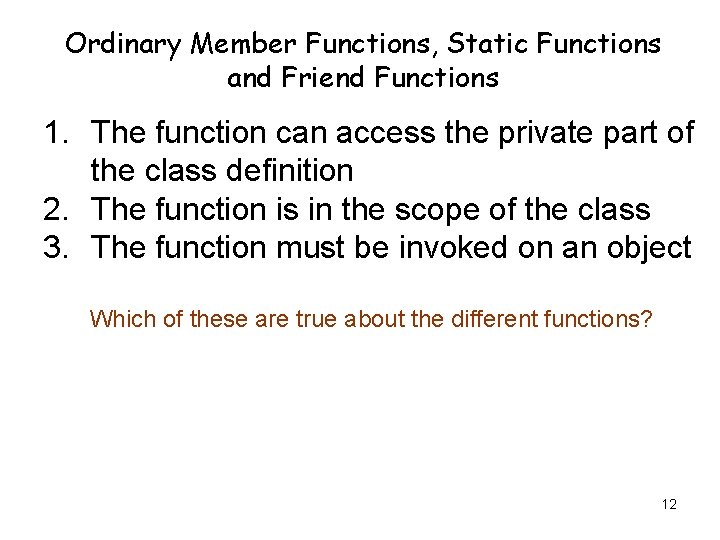
Ordinary Member Functions, Static Functions and Friend Functions 1. The function can access the private part of the class definition 2. The function is in the scope of the class 3. The function must be invoked on an object Which of these are true about the different functions? 12
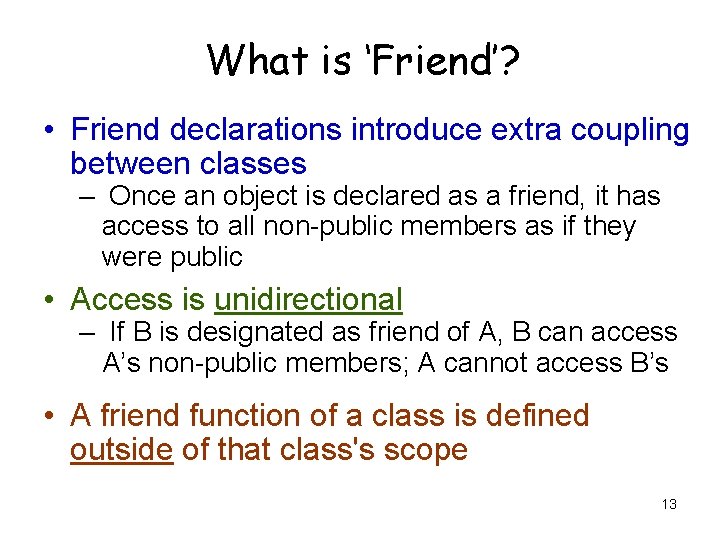
What is ‘Friend’? • Friend declarations introduce extra coupling between classes – Once an object is declared as a friend, it has access to all non-public members as if they were public • Access is unidirectional – If B is designated as friend of A, B can access A’s non-public members; A cannot access B’s • A friend function of a class is defined outside of that class's scope 13
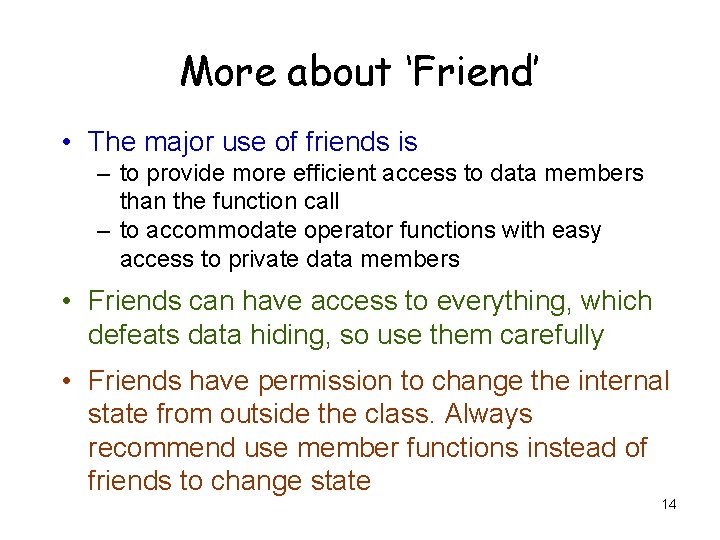
More about ‘Friend’ • The major use of friends is – to provide more efficient access to data members than the function call – to accommodate operator functions with easy access to private data members • Friends can have access to everything, which defeats data hiding, so use them carefully • Friends have permission to change the internal state from outside the class. Always recommend use member functions instead of friends to change state 14
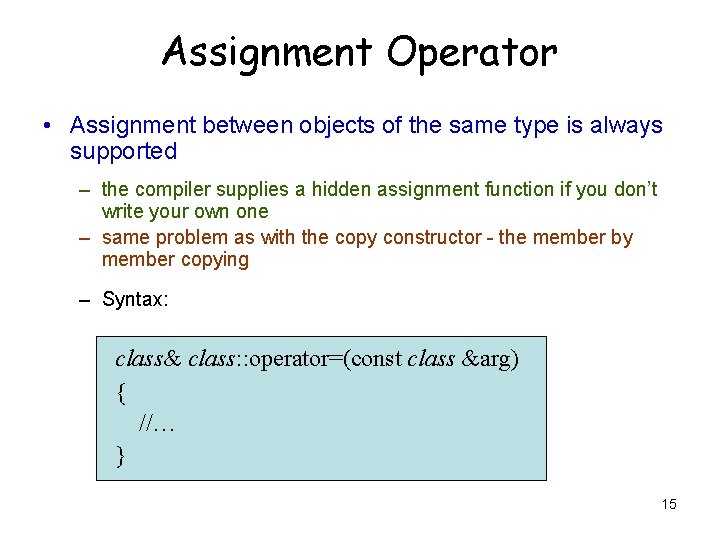
Assignment Operator • Assignment between objects of the same type is always supported – the compiler supplies a hidden assignment function if you don’t write your own one – same problem as with the copy constructor - the member by member copying – Syntax: class& class: : operator=(const class &arg) { //… } 15
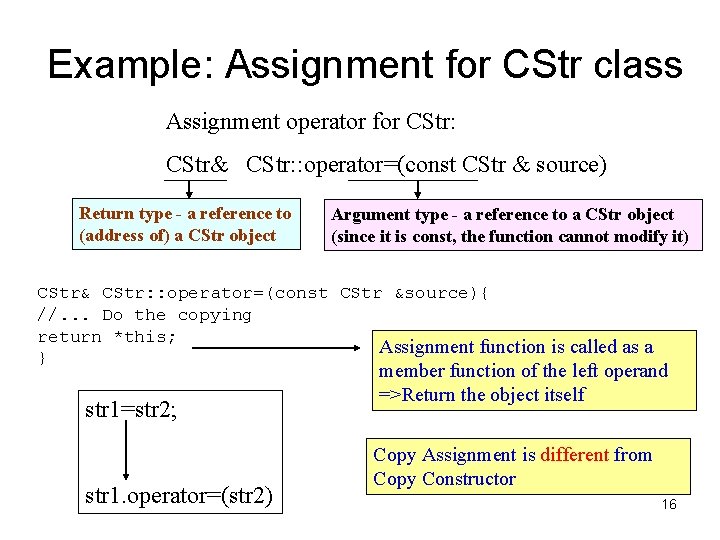
Example: Assignment for CStr class Assignment operator for CStr: CStr& CStr: : operator=(const CStr & source) Return type - a reference to (address of) a CStr object Argument type - a reference to a CStr object (since it is const, the function cannot modify it) CStr& CStr: : operator=(const CStr &source){ //. . . Do the copying return *this; Assignment function is called as a } str 1=str 2; str 1. operator=(str 2) member function of the left operand =>Return the object itself Copy Assignment is different from Copy Constructor 16
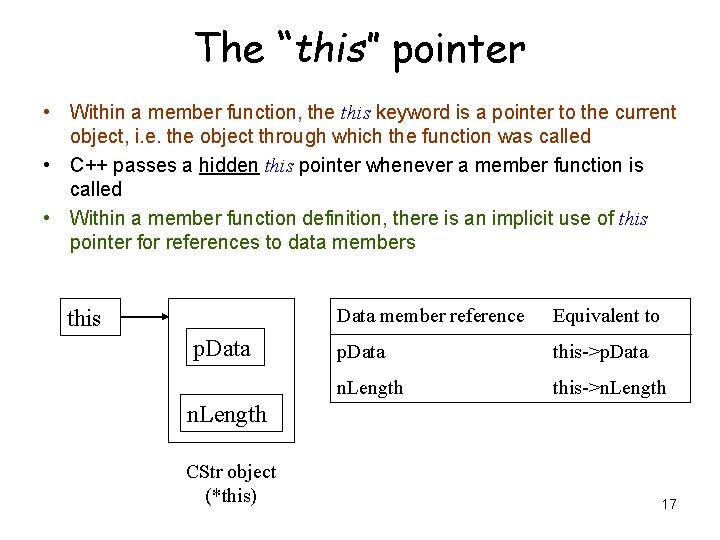
The “this” pointer • Within a member function, the this keyword is a pointer to the current object, i. e. the object through which the function was called • C++ passes a hidden this pointer whenever a member function is called • Within a member function definition, there is an implicit use of this pointer for references to data members this p. Data member reference Equivalent to p. Data this->p. Data n. Length this->n. Length CStr object (*this) 17
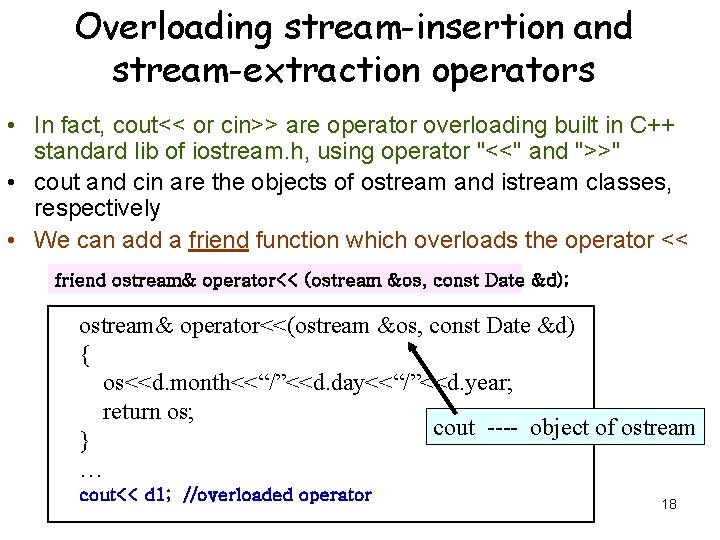
Overloading stream-insertion and stream-extraction operators • In fact, cout<< or cin>> are operator overloading built in C++ standard lib of iostream. h, using operator "<<" and ">>" • cout and cin are the objects of ostream and istream classes, respectively • We can add a friend function which overloads the operator << friend ostream& operator<< (ostream &os, const Date &d); ostream& operator<<(ostream &os, const Date &d) { os<<d. month<<“/”<<d. day<<“/”<<d. year; return os; cout ---- object of ostream } … cout<< d 1; //overloaded operator 18
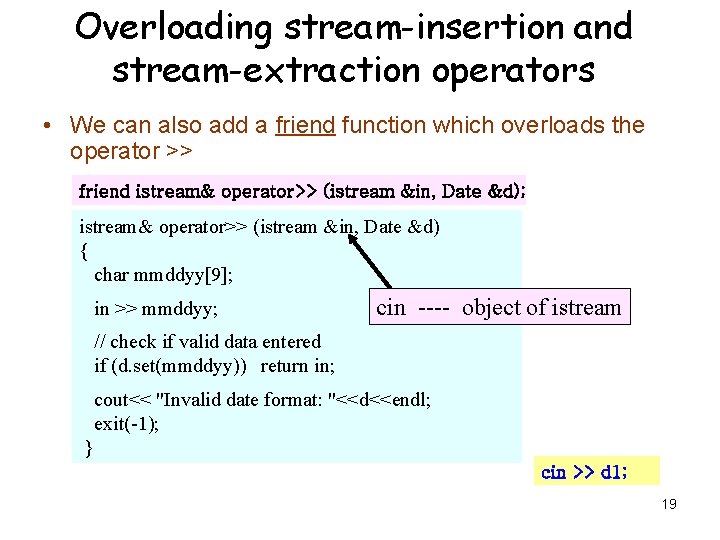
Overloading stream-insertion and stream-extraction operators • We can also add a friend function which overloads the operator >> friend istream& operator>> (istream &in, Date &d); istream& operator>> (istream &in, Date &d) { char mmddyy[9]; in >> mmddyy; cin ---- object of istream // check if valid data entered if (d. set(mmddyy)) return in; cout<< "Invalid date format: "<<d<<endl; exit(-1); } cin >> d 1; 19
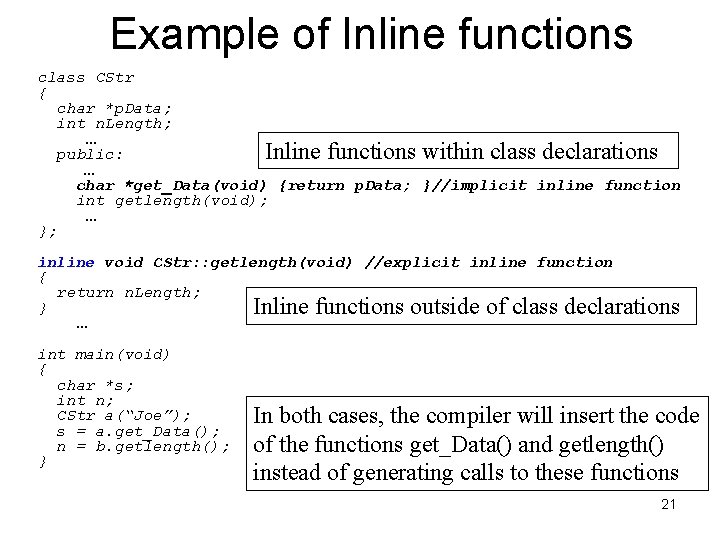
Inline functions • An inline function is one in which the function code replaces the function call directly. • Inline class member functions – if they are defined as part of the class definition, implicit – if they are defined outside of the class definition, explicit, I. e. using the keyword, inline. • Inline functions should be short (preferable one-liners). – Why? Because the use of inline function results in duplication of the code of the function for each invocation of the inline function 20
Example of Inline functions class CStr { char *p. Data; int n. Length; … Inline functions within class declarations public: … char *get_Data(void) {return p. Data; }//implicit inline function int getlength(void); … }; inline void CStr: : getlength(void) //explicit inline function { return n. Length; } Inline functions outside of class declarations … int main(void) { char *s; int n; CStr a(“Joe”); In both cases, the compiler will insert the code s = a. get_Data(); n = b. getlength(); of the functions get_Data() and getlength() } instead of generating calls to these functions 21
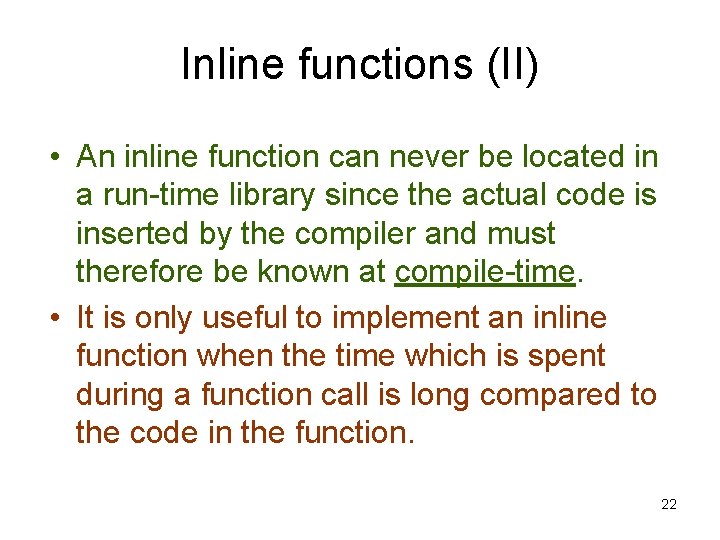
Inline functions (II) • An inline function can never be located in a run-time library since the actual code is inserted by the compiler and must therefore be known at compile-time. • It is only useful to implement an inline function when the time which is spent during a function call is long compared to the code in the function. 22
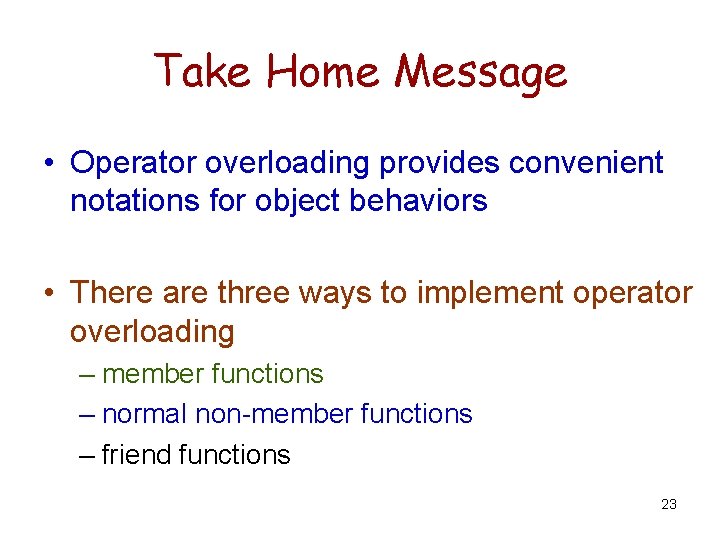
Take Home Message • Operator overloading provides convenient notations for object behaviors • There are three ways to implement operator overloading – member functions – normal non-member functions – friend functions 23