
More Binary How does a computer represent everything
More Binary How does a computer represent everything using just zeros and ones?
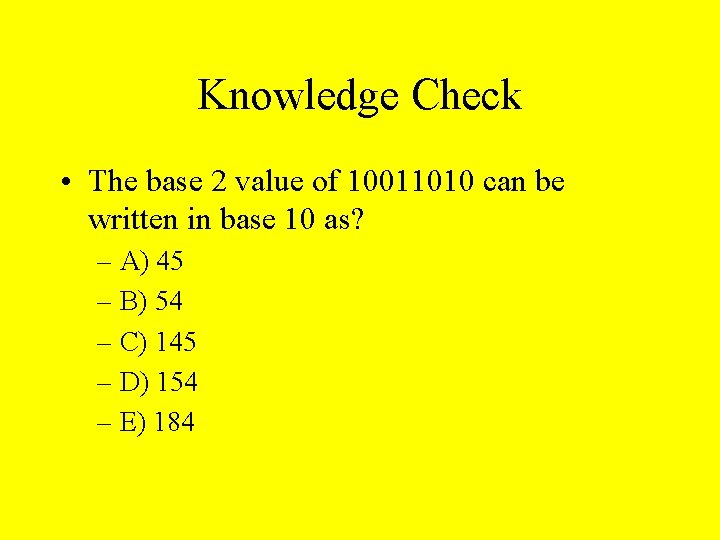
Knowledge Check • The base 2 value of 10011010 can be written in base 10 as? – A) 45 – B) 54 – C) 145 – D) 154 – E) 184
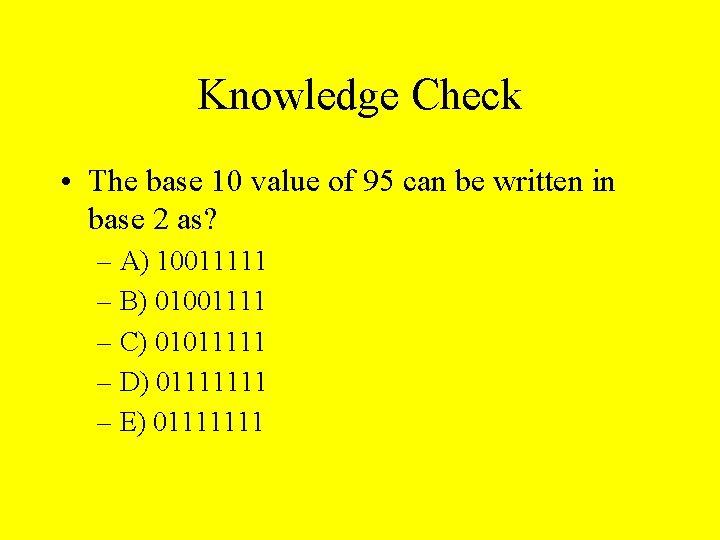
Knowledge Check • The base 10 value of 95 can be written in base 2 as? – A) 10011111 – B) 01001111 – C) 01011111 – D) 01111111 – E) 01111111
Once you know binary…

You can write great jokes There are 10 kinds of people in the world, those who know binary and those who do not! Get your Xmas shopping done!
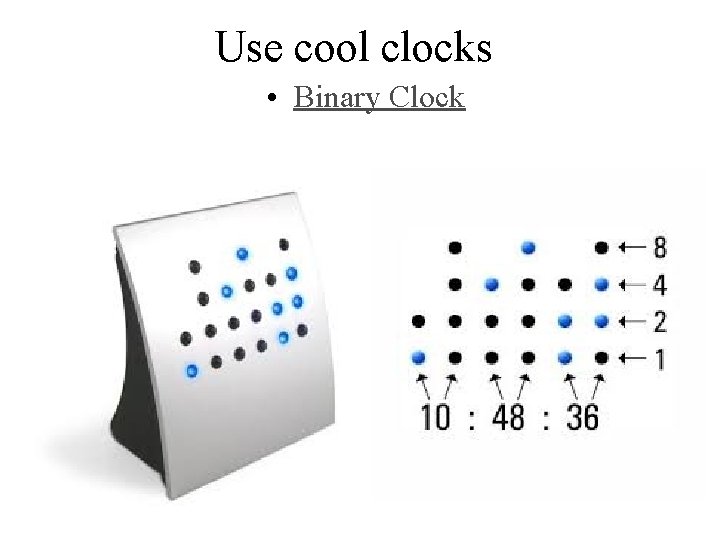
Use cool clocks • Binary Clock
More importantly you can start to figure out how a computer remembers all the things it needs to remember using only zeros and ones.
Computer must reduce everything to 0’s and 1’s • A zero or a one by itself is called a bit. • Any combination of zeros and ones can be expressed as a number of bits. For example… • • • 0 = 1 bit 1 = 1 bit 0011 = 4 bits 1010 = 4 bits 000000 = 6 bits 111000 = 6 bits
How many bits a computer is allowed to use determines how many unique things it can remember. – 1 bit = Computer can remember 2 unique things because it can create two unique binary numbers. • 0 or 1 – 2 bits = Computer can remember 4 unique things because it can create four unique binary numbers. • 00, 01, 10, 11 – 3 bits= Computer can remember 8 unique things because it can create eight unique binary numbers. • 000, 001, 010, 011, 100, 101, 110, 111 – 4 bits = Etc.
How Many Unique Binary Numbers Shortcut One • The unique amount of numbers you can make given a number of columns in base 2 is the same as the next column to the left. – Example: • How many unique binary numbers can you make using the first 3 columns in base 2? • Answer = 8 – First four base 2 columns = … 8, 4, 2, 1 – The fourth column is base 2 is 8, so you can come up with 8 unique binary numbers using the first 3 columns in base two.
Knowledge Check • How many unique base two numbers can be made using the first 8 columns of base two? – A) 9 – B) 8 – C) 32 – D) 128 – E) 256
8 bits = 1 byte • Computers love to do things in byte size chunks
Memorize This – 8 bits = 1 byte = 28 • Computer can create 256 unique binary numbers • Computer can remember 256 unique things – The 9 th column of base two is 256 – 16 bits = 2 bytes = 216 • Computer can create 65, 536 unique binary numbers • Computer can remember 65, 536 unique things – The 17 th column of base two is 65, 536 – 24 bits = 3 bytes = 224 • Computer can create 16, 777, 216 unique binary numbers • Computer can remember 16, 777, 216 unique things – The 25 th column of base two is 16, 777, 216 – 32 bits = 4 bytes = 232 • Computer can create 4, 294, 967, 296 unique binary numbers • Computer can remember 4, 294, 967, 296 unique things – The 33 th column of base two is 4, 294, 967, 296
So the computer can remember a bunch of zeros and ones… …but how does it remember text, sounds, and colors? It must remember everything as only zeros and ones. For instance for text early computers used…
ASCII • American Standard Code Information Interchange • Allowed computer makers to represent the characters on a keyboard as the same zeros and ones
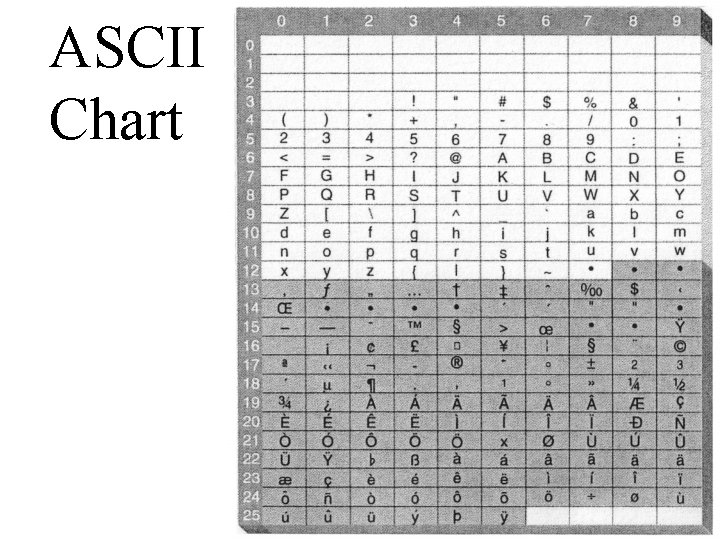
ASCII Chart
Modern computers use Unicode for text • Unicode is short for Universal Code • Unicode is a 16 bit (or two byte) code • If you let the computer use 16 bits to remember information it can remember 65, 536 different things instead of just 256. • With 65, 536 items I can represent most of the worlds common languages. – http: //isthingon. org/unicode/
What about color?
What about sound?
- Slides: 19