
More basics of DFT Kieron Burke and friends
More basics of DFT Kieron Burke and friends UC Irvine Physics and Chemistry APS tutorial 1
References for ground-state DFT – ABC of DFT, by KB and Rudy Magyar, http: //dft. uci. edu – A Primer in Density Functional Theory, edited by C. Fiolhais et al. (Springer-Verlag, NY, 2003) – Density Functional Theory , Dreizler and Gross, (Springer-Verlag, Berlin, 1990) – Density Functional Theory of Atoms and Molecules, Parr and Yang (Oxford, New York, 1989) – A Chemist’s Guide to Density Functional Theory , Koch and Holthausen (Wiley-VCH, Weinheim, 2000) APS tutorial 2

What we’ll cover • Simplest possible example of a functional • Essentials of KS-DFT, and functional zoo • Important conditions not met by standard functionals: Self-interaction and derivative discontinuity • Exact exchange • Quiz APS tutorial 3
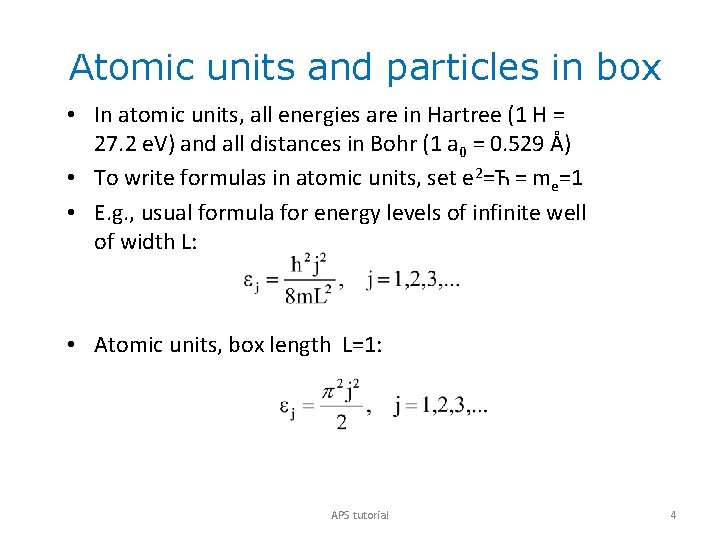
Atomic units and particles in box • In atomic units, all energies are in Hartree (1 H = 27. 2 e. V) and all distances in Bohr (1 a 0 = 0. 529 Å) • To write formulas in atomic units, set e 2=Ћ = me=1 • E. g. , usual formula for energy levels of infinite well of width L: • Atomic units, box length L=1: APS tutorial 4
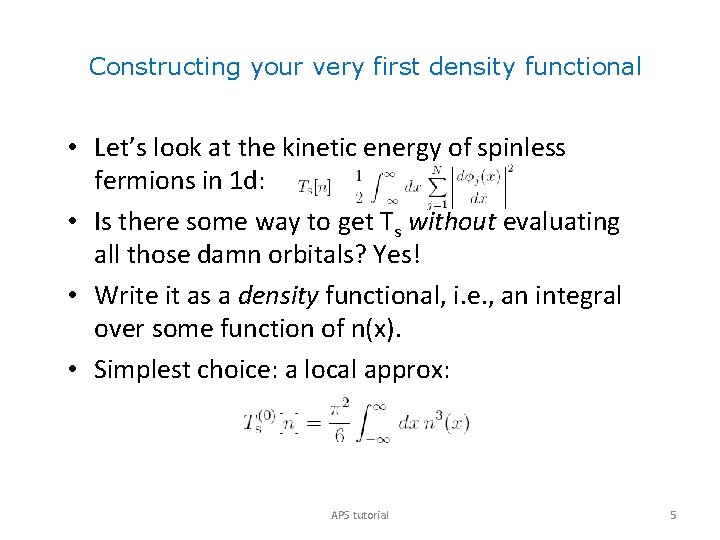
Constructing your very first density functional • Let’s look at the kinetic energy of spinless fermions in 1 d: • Is there some way to get Ts without evaluating all those damn orbitals? Yes! • Write it as a density functional, i. e. , an integral over some function of n(x). • Simplest choice: a local approx: APS tutorial 5
![Particles in box • Accuracy APS tutorial N Ts[0] Ts %err 1 4. 112](http://slidetodoc.com/presentation_image_h2/b42be55742790988e375412125cbd745/image-6.jpg "Particles in box • Accuracy APS tutorial N Ts[0] Ts %err 1 4. 112")
Particles in box • Accuracy APS tutorial N Ts[0] Ts %err 1 4. 112 4. 934 -17 2 21. 79 24. 67 -12 3 62. 92 69. 09 -9 6
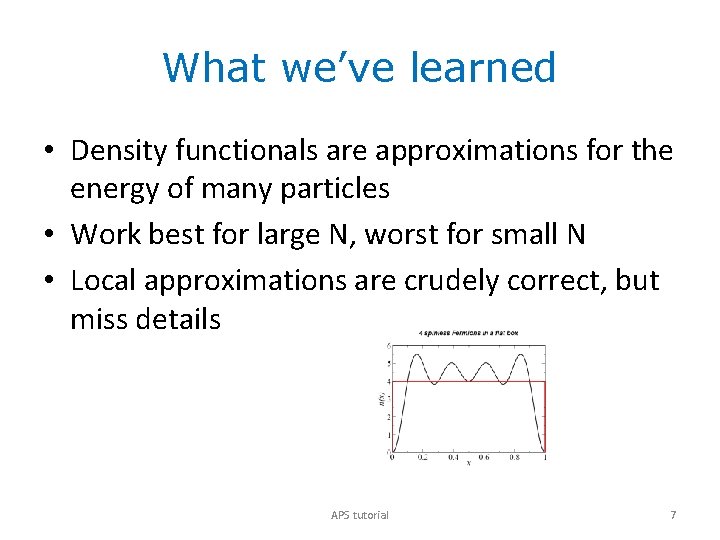
What we’ve learned • Density functionals are approximations for the energy of many particles • Work best for large N, worst for small N • Local approximations are crudely correct, but miss details APS tutorial 7
![Essence of Kohn-Sham DFT • Even with exact Exc[n], only get E 0 and](http://slidetodoc.com/presentation_image_h2/b42be55742790988e375412125cbd745/image-8.jpg "Essence of Kohn-Sham DFT • Even with exact Exc[n], only get E 0 and")
Essence of Kohn-Sham DFT • Even with exact Exc[n], only get E 0 and n(r) (and I). So other properties may not be right. • Results only as good as functional used. • Vast amount of information from E 0 alone, such as geometries, vibrations, bond energies… • Well-fitted functionals are accurate for limited set • Non-empirical functionals less so, but more reliable for a broader range, and errors understandable APS tutorial 8

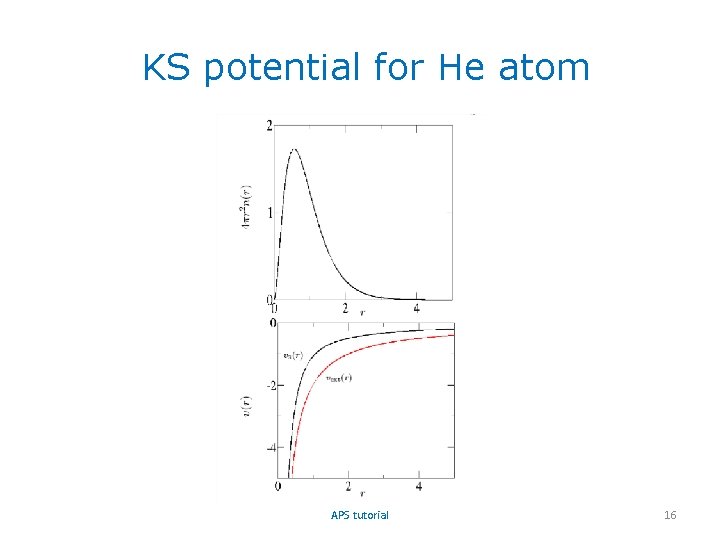
He atom in Kohn-Sham DFT Everything has (at most) one KS potential Dashed-line: EXACT KS potential APS tutorial 9

Functionals in common use • Local density approximation (LDA) – Uses only n(r) at a point. • Generalized gradient approx (GGA) – Uses both n(r) and | n(r)| – More accurate, corrects overbinding of LDA – Examples are PBE and BLYP • Hybrid: – Mixes some fraction of HF – Examples are B 3 LYP and PBE 0 APS tutorial 10
Functional soup • Good: choose one functional of each kind and stick with it (e. g. , LDA or PBE or B 3 LYP). • Bad: Run several functionals, and pick ‘best’ answer. • Ugly: Design your own functional with 2300 parameters. APS tutorial 11
Functional Zoology • Empirical • Non-empirical – GGA: BLYP – Hybrid: B 3 LYP – GGA: PBE – Meta-GGA: TPSS – Hybrid: PBE 0 • Names: – B=B 88 exchange – LYP=Lee-Yang-Parr corelation APS tutorial 12

What we’ll cover • Simplest possible example of a functional • Essentials of KS-DFT, and functional zoo • Important conditions not met by standard functionals: Self-interaction and derivative discontinuity • Exact exchange • Quiz APS tutorial 13

What we’ll cover • Simplest possible example of a functional • Essentials of KS-DFT, and functional zoo • Important conditions not met by standard functionals: Self-interaction and derivative discontinuity • Exact exchange • Quiz APS tutorial 14
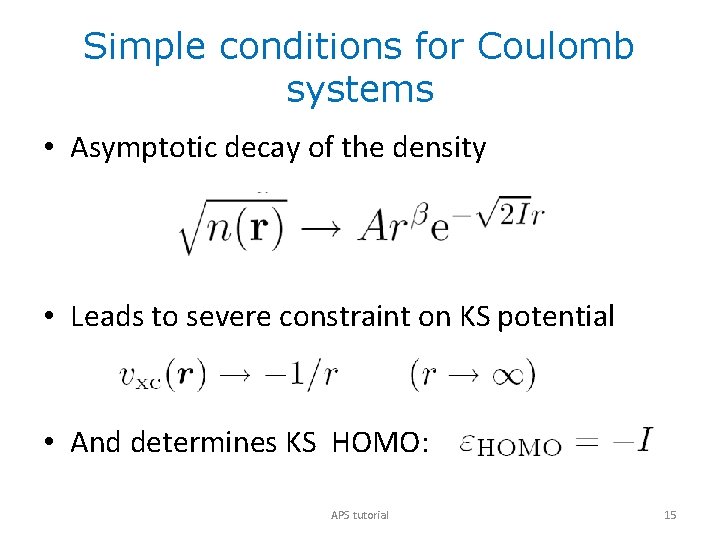
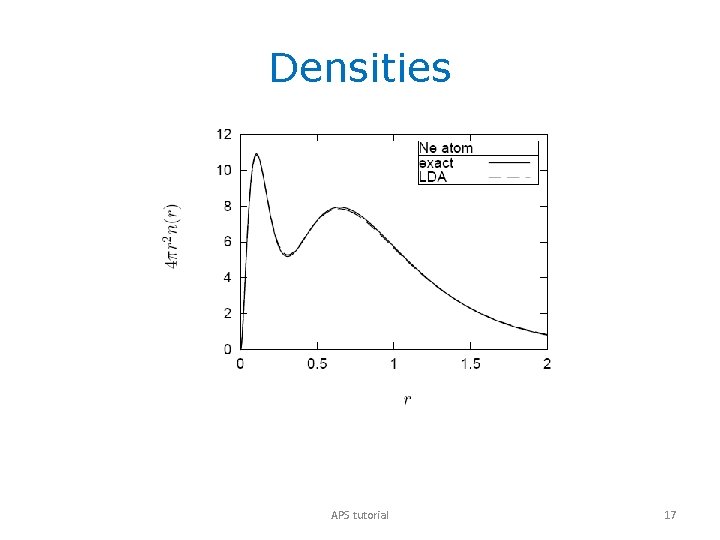
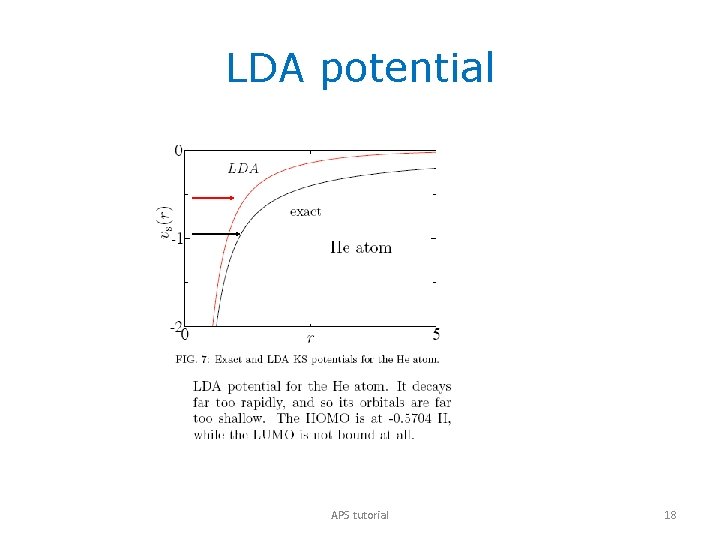
Simple conditions for Coulomb systems • Asymptotic decay of the density • Leads to severe constraint on KS potential • And determines KS HOMO: APS tutorial 15
KS potential for He atom APS tutorial 16
Densities APS tutorial 17
LDA potential APS tutorial 18
Self interaction • Violated by most semilocal functionals (unless built in) APS tutorial 19
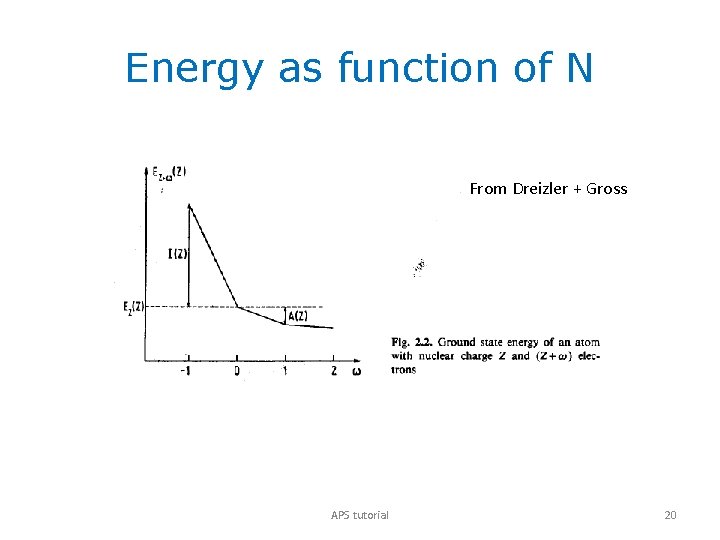
Energy as function of N From Dreizler + Gross APS tutorial 20
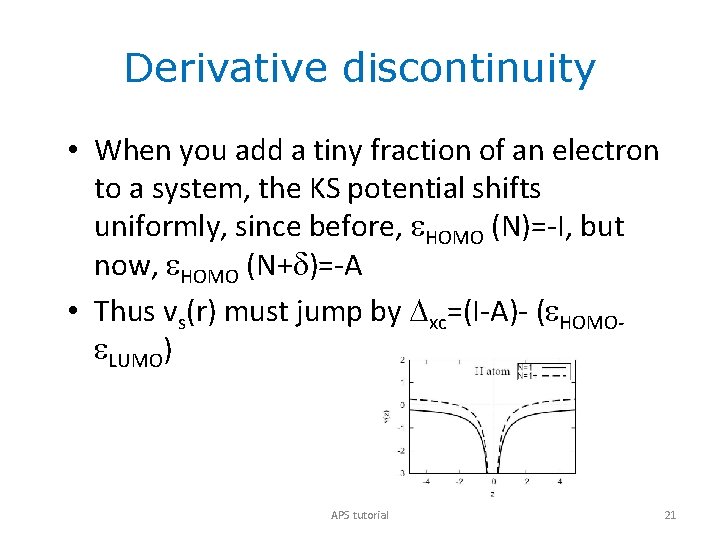
Derivative discontinuity • When you add a tiny fraction of an electron to a system, the KS potential shifts uniformly, since before, HOMO (N)=-I, but now, HOMO (N+d)=-A • Thus vs(r) must jump by Dxc=(I-A)- ( HOMO LUMO) APS tutorial 21
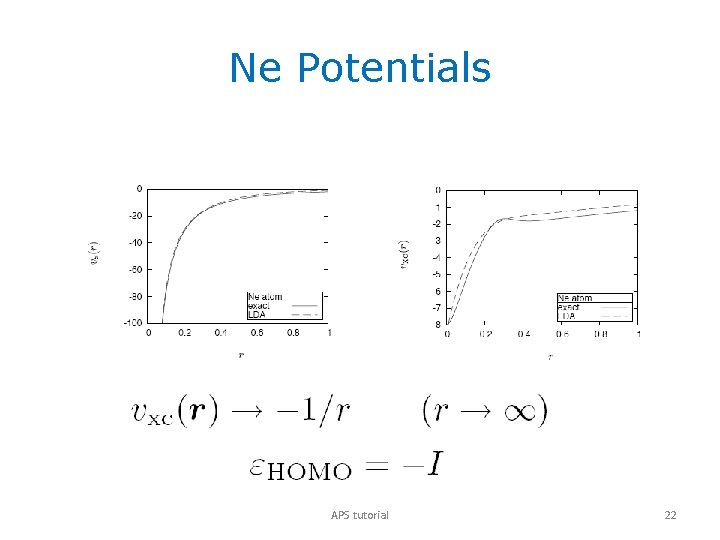
Ne Potentials APS tutorial 22
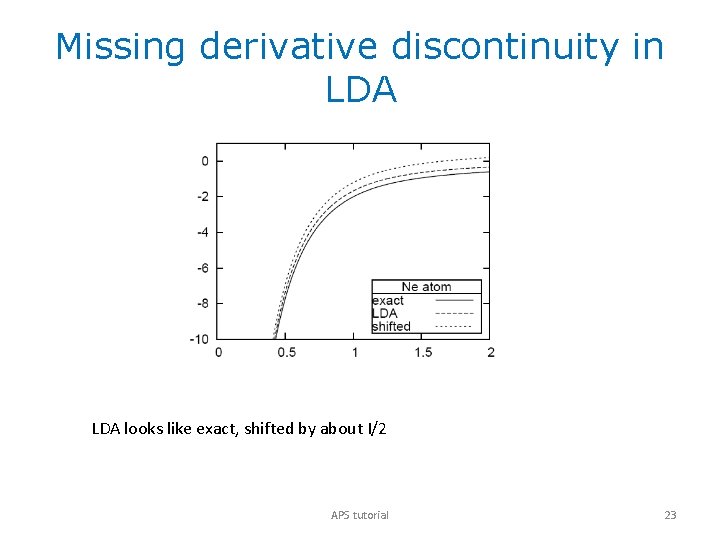
Missing derivative discontinuity in LDA looks like exact, shifted by about I/2 APS tutorial 23

What we’ll cover • Simplest possible example of a functional • Essentials of KS-DFT, and functional zoo • Important conditions not met by standard functionals: Self-interaction and derivative discontinuity • Exact exchange • Quiz APS tutorial 24

What we’ll cover • Simplest possible example of a functional • Essentials of KS-DFT, and functional zoo • Important conditions not met by standard functionals: Self-interaction and derivative discontinuity • Exact exchange • Quiz APS tutorial 25
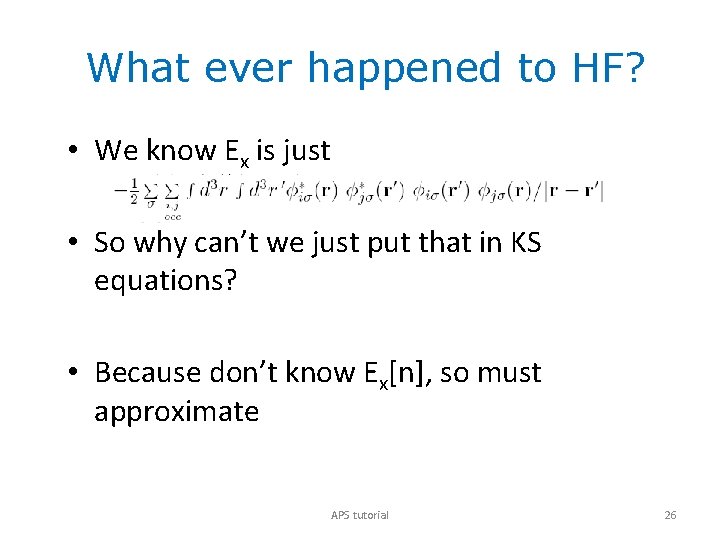
What ever happened to HF? • We know Ex is just • So why can’t we just put that in KS equations? • Because don’t know Ex[n], so must approximate APS tutorial 26
OEP See RMP , Kuemmel and Kronik • Way to handle orbital-dependent functionals in KS scheme, i. e. , with single multiplicative KS potential • Still density functionals, since orbitals uniquely determined by density • Often called OPM • Several schemes to implement, all much more expensive than regular KS-DFT • Can improve other properties: – No self-interaction error – Potentials and orbital energies much better – Approximates derivative discontinuity APS tutorial 27
![HF versus EXX • HF minimizes Ex [{fi}] over all possible wavefunctions • EXX](http://slidetodoc.com/presentation_image_h2/b42be55742790988e375412125cbd745/image-28.jpg "HF versus EXX • HF minimizes Ex [{fi}] over all possible wavefunctions • EXX")
HF versus EXX • HF minimizes Ex [{fi}] over all possible wavefunctions • EXX includes additional constraint of common potential (i. e. , KS) • Yield almost identical total energies, with HF an eensty bit lower. • Occupied orbital energies very similar, but big difference in unoccupied orbitals APS tutorial 28
A tale of three gaps • Fundamental gap: – Δ = I – A =24. 6 e. V for He • Kohn-Sham gap: – Δs = HOMO- LUMO = 21. 16 e. V • Derivative discontinuity: Dxc= Δ-Δs • Lowest optical transition: – wmin= E(1 s, 2 p)-E(1 s 2) = 21. 22 e. V • NOTE: All same if non-interacting, all different when interacting • Of course, HOMO(LDA)=15. 5 e. V APS tutorial 29
Quiz 1. Do local functionals do better for: A. small N, B. large N ? 2. How many empirical parameters are too many? A. 1; B. 10. , C. 100+ 3. GGA’s have no self-interaction error, True or false? 4. The Kohn-Sham gap would equal the true gap if only we had the exact functional? 5. Why not use Ex in small calculations to improve geometries, etc. ? APS tutorial 30
What we’ve learned, maybe • Ground-state density determines all properties of system, in principle, but in practice, only really get energy and density (which is 90% of what you want). • Local density functional theories give roughly correct answers, but are too inaccurate to be helpful in quantum chemistry. • The commonly-used functionals in chemistry are wellfounded and have few parameters. • There are known exact properties of the density in real atoms. • There are subtle and bizarre effects in the KS potential because real electrons do interact. • Exact exchange is expensive, and we don’t have a correlation functional to go with it, but it improves some properties. APS tutorial 31
- Slides: 31