
More Arrays 111504 CS 150 Introduction to Computer

- Slides: 11
More Arrays 11/15/04 CS 150 Introduction to Computer Science 1 1
Last Time S We o S Learnt how to pass arrays to functions Today we will o Start talking about sorting arrays 11/15/04 CS 150 Introduction to Computer Science 1 2
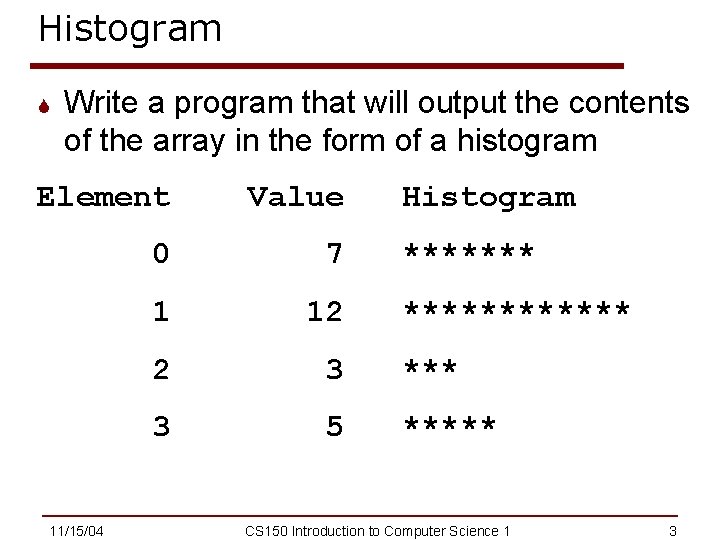
Histogram S Write a program that will output the contents of the array in the form of a histogram Element Value 0 7 1 12 2 3 *** 3 5 ***** 11/15/04 Histogram ************ CS 150 Introduction to Computer Science 1 3
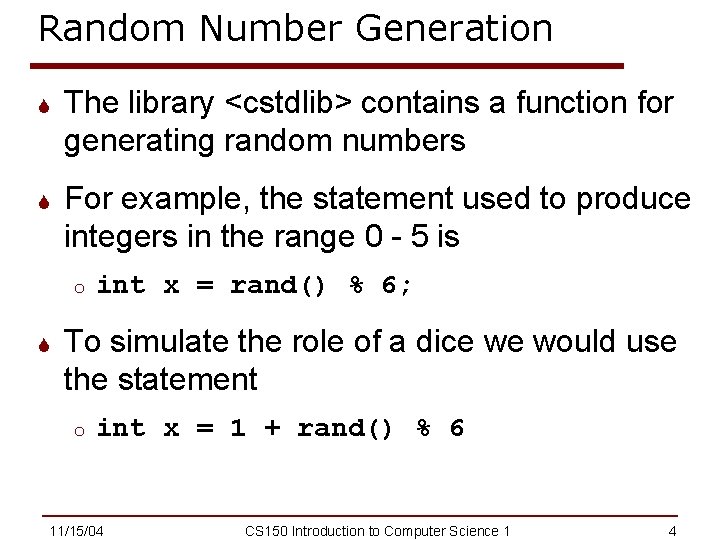
Random Number Generation S The library <cstdlib> contains a function for generating random numbers S For example, the statement used to produce integers in the range 0 - 5 is o S int x = rand() % 6; To simulate the role of a dice we would use the statement o int x = 1 + rand() % 6 11/15/04 CS 150 Introduction to Computer Science 1 4
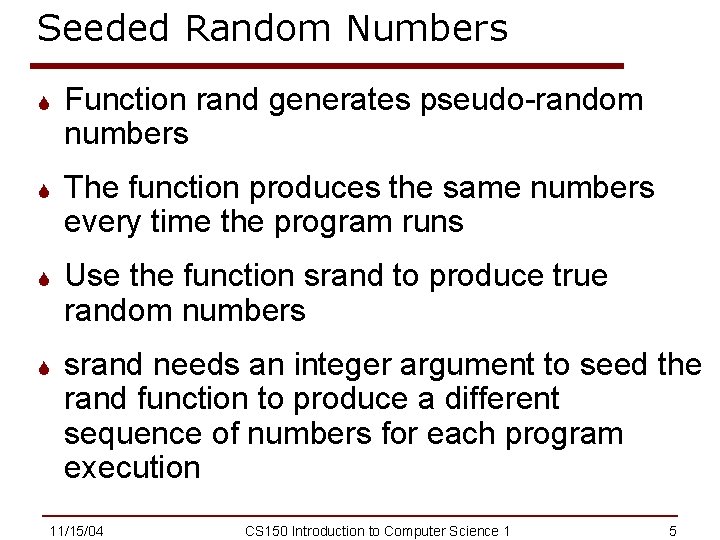
Seeded Random Numbers S Function rand generates pseudo-random numbers S The function produces the same numbers every time the program runs S Use the function srand to produce true random numbers S srand needs an integer argument to seed the rand function to produce a different sequence of numbers for each program execution 11/15/04 CS 150 Introduction to Computer Science 1 5
What Does the Program Do? int main() { unsigned seed; cout << “Enter seed” << endl; cin >> seed; srand(seed); for( int i=1; i<=10; i++ ) cout << setw(10) << (1+rand()%6); return 0; }11/15/04 CS 150 Introduction to Computer Science 1 6
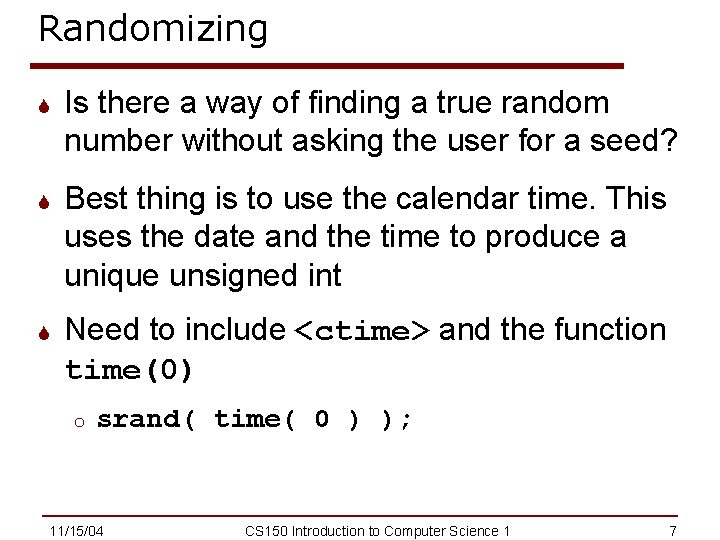
Randomizing S Is there a way of finding a true random number without asking the user for a seed? S Best thing is to use the calendar time. This uses the date and the time to produce a unique unsigned int S Need to include <ctime> and the function time(0) o srand( time( 0 ) ); 11/15/04 CS 150 Introduction to Computer Science 1 7
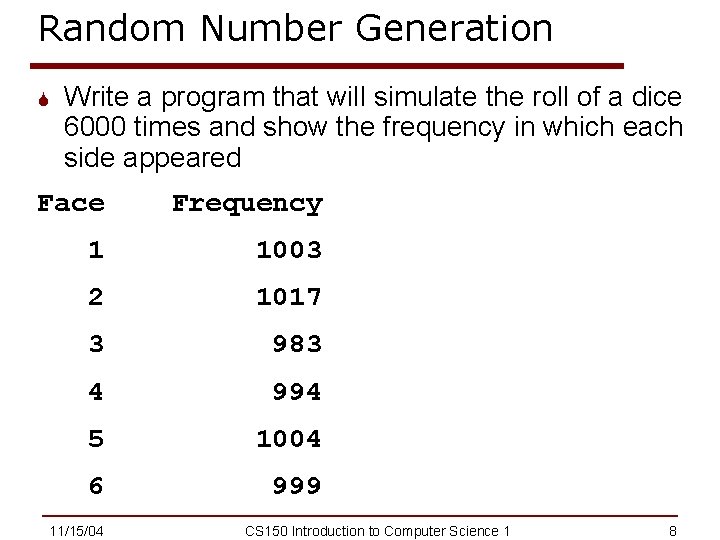
Random Number Generation S Write a program that will simulate the roll of a dice 6000 times and show the frequency in which each side appeared Face Frequency 1 1003 2 1017 3 983 4 994 5 1004 6 999 11/15/04 CS 150 Introduction to Computer Science 1 8
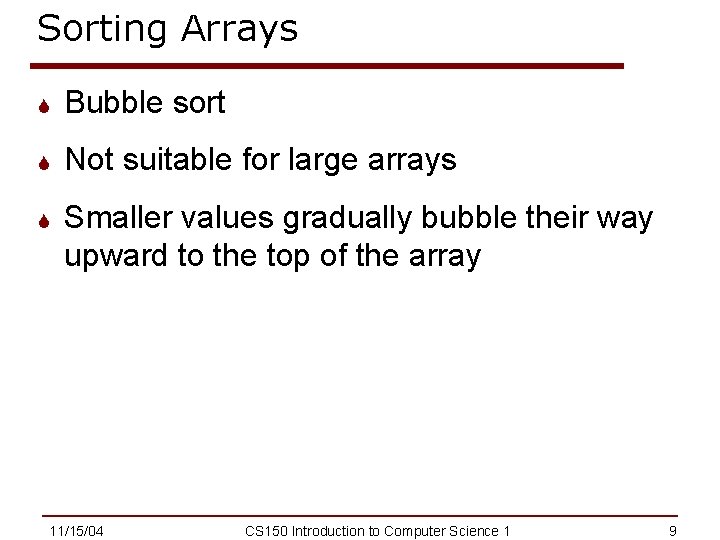
Sorting Arrays S Bubble sort S Not suitable for large arrays S Smaller values gradually bubble their way upward to the top of the array 11/15/04 CS 150 Introduction to Computer Science 1 9
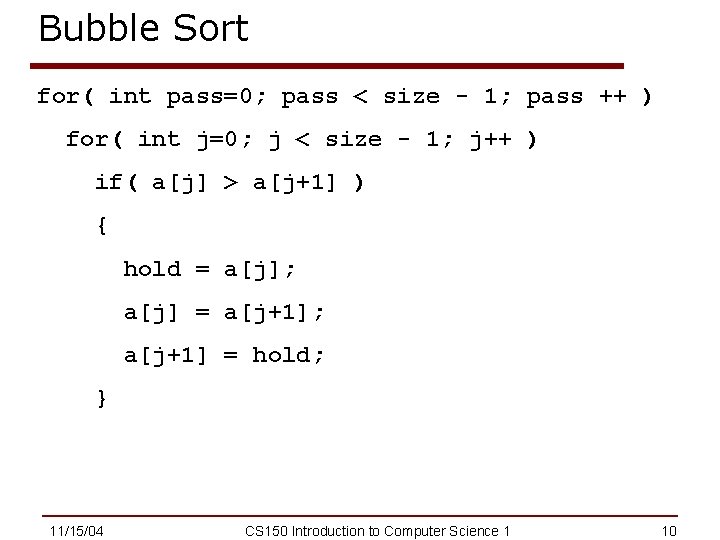
Bubble Sort for( int pass=0; pass < size - 1; pass ++ ) for( int j=0; j < size - 1; j++ ) if( a[j] > a[j+1] ) { hold = a[j]; a[j] = a[j+1]; a[j+1] = hold; } 11/15/04 CS 150 Introduction to Computer Science 1 10
Summary S S In today’s lecture we covered o Random numbers o Sorting arrays (bubble sort) Readings o P. 276 - p. 278: Bubble sort o P. 262 - p. 264: Histograms o P. 182 - p. 188: Random number generation 11/15/04 CS 150 Introduction to Computer Science 1 11