
More Algorithm Analysis Computer Science Department University of
- Slides: 34
More Algorithm Analysis Computer Science Department University of Central Florida COP 3502 – Computer Science I
Big-O Notation n What is Big O? n Big O comes from Big-O Notation n n In C. S. , we want to know how efficient an algorithm is…how “fast” it is More specifically…we want to know how the performance of an algorithm responds to changes in problem size The goal is to provide a qualitative insight on the # of operations for a problem size of n elements. And this total # of operations can be described with a mathematical expression in terms of n. § This expression is known as Big-O © Jonathan Cazalas More Algorithm Analysis page 2
More Algorithm Analysis n Examples of Analyzing Code: n We now go over many examples of code fragments n Each of these functions will be analyzed for their runtime in terms of the variable n n Utilizing the idea of Big-O, n © Jonathan Cazalas determine the Big-O running time of each More Algorithm Analysis page 3
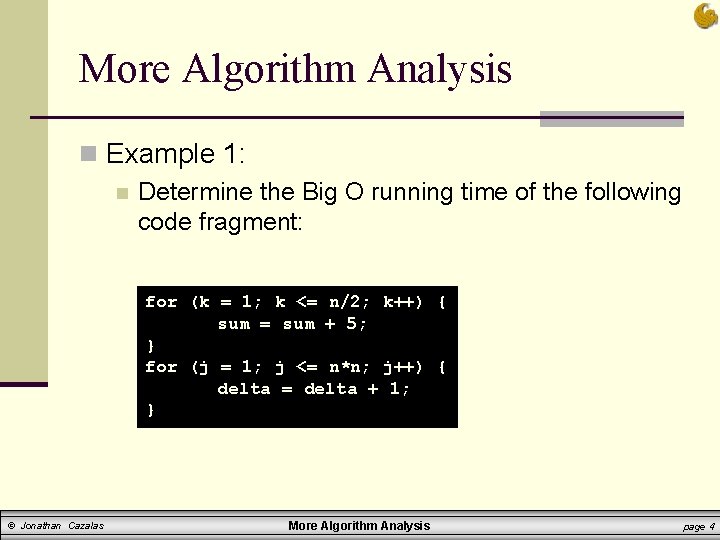
More Algorithm Analysis n Example 1: n Determine the Big O running time of the following code fragment: for (k = 1; k <= n/2; k++) { sum = sum + 5; } for (j = 1; j <= n*n; j++) { delta = delta + 1; } © Jonathan Cazalas More Algorithm Analysis page 4
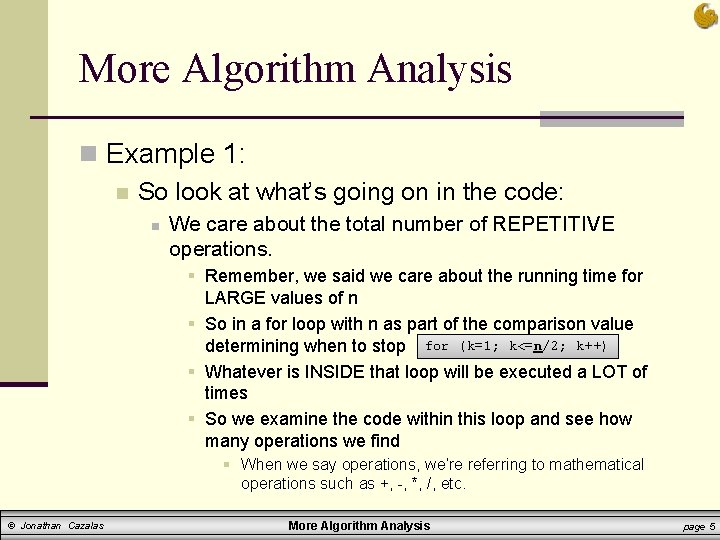
More Algorithm Analysis n Example 1: n So look at what’s going on in the code: n We care about the total number of REPETITIVE operations. § Remember, we said we care about the running time for LARGE values of n § So in a for loop with n as part of the comparison value determining when to stop for (k=1; k<=n/2; k++) § Whatever is INSIDE that loop will be executed a LOT of times § So we examine the code within this loop and see how many operations we find § When we say operations, we’re referring to mathematical operations such as +, -, *, /, etc. © Jonathan Cazalas More Algorithm Analysis page 5
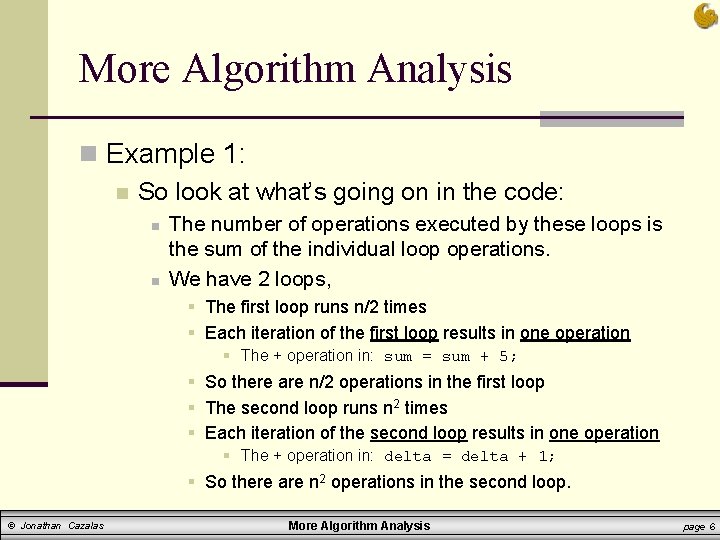
More Algorithm Analysis n Example 1: n So look at what’s going on in the code: n n The number of operations executed by these loops is the sum of the individual loop operations. We have 2 loops, § The first loop runs n/2 times § Each iteration of the first loop results in one operation § The + operation in: sum = sum + 5; § So there are n/2 operations in the first loop § The second loop runs n 2 times § Each iteration of the second loop results in one operation § The + operation in: delta = delta + 1; § So there are n 2 operations in the second loop. © Jonathan Cazalas More Algorithm Analysis page 6
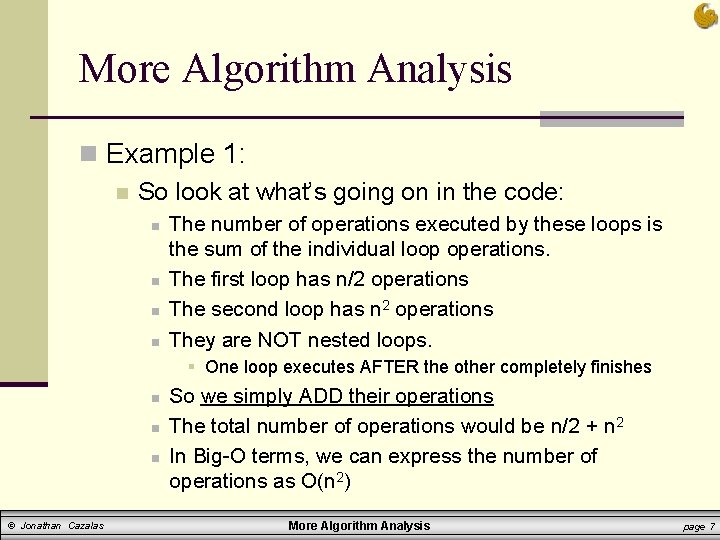
More Algorithm Analysis n Example 1: n So look at what’s going on in the code: n n The number of operations executed by these loops is the sum of the individual loop operations. The first loop has n/2 operations The second loop has n 2 operations They are NOT nested loops. § One loop executes AFTER the other completely finishes n n n © Jonathan Cazalas So we simply ADD their operations The total number of operations would be n/2 + n 2 In Big-O terms, we can express the number of operations as O(n 2) More Algorithm Analysis page 7
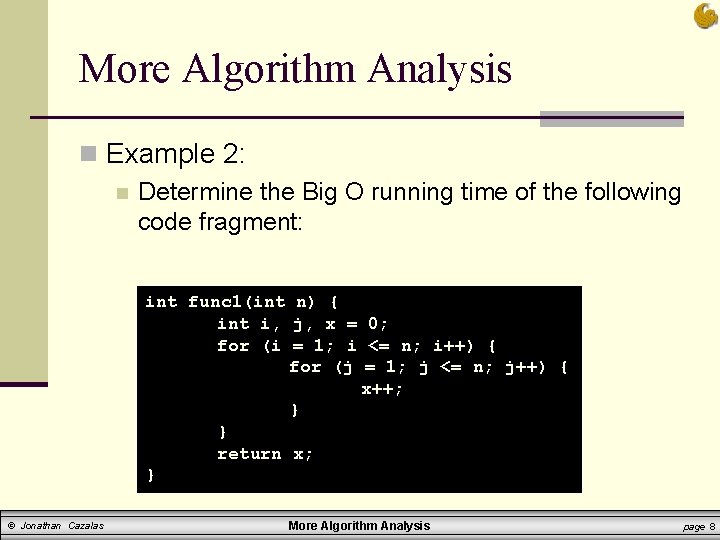
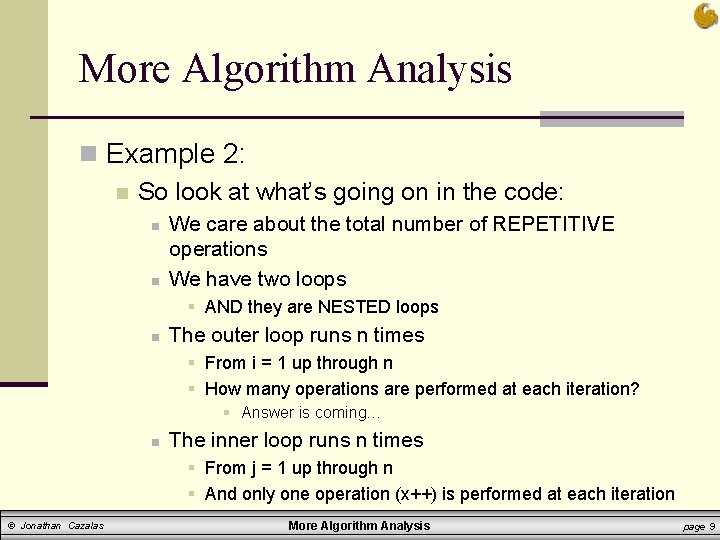
More Algorithm Analysis n Example 2: n Determine the Big O running time of the following code fragment: int func 1(int n) { int i, j, x = 0; for (i = 1; i <= n; i++) { for (j = 1; j <= n; j++) { x++; } } return x; } © Jonathan Cazalas More Algorithm Analysis page 8
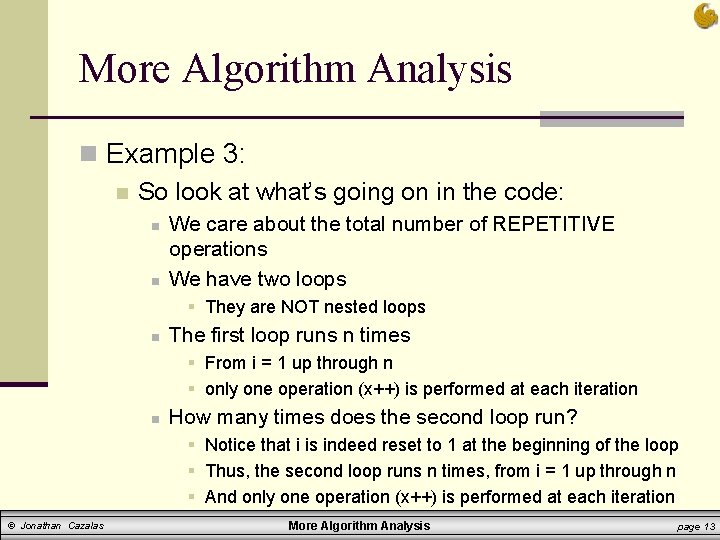
More Algorithm Analysis n Example 2: n So look at what’s going on in the code: n n We care about the total number of REPETITIVE operations We have two loops § AND they are NESTED loops n The outer loop runs n times § From i = 1 up through n § How many operations are performed at each iteration? § Answer is coming… n The inner loop runs n times § From j = 1 up through n § And only one operation (x++) is performed at each iteration © Jonathan Cazalas More Algorithm Analysis page 9
More Algorithm Analysis n Example 2: n So look at what’s going on in the code: n Let’s look at a couple of iterations of the OUTER loop: § When i = 1, what happens? § The inner loop runs n times § Resulting in n operations from the inner loop § Then, i gets incremented and it becomes equal to 2 § When i = 2, what happens? § Again, the inner loop runs n times § Again resulting in n operations from the inner loop n We notice the following: § For EACH iteration of the OUTER loop, § The INNER loop runs n times § Resulting in n operations © Jonathan Cazalas More Algorithm Analysis page 10
More Algorithm Analysis n Example 2: n So look at what’s going on in the code: n And how many times does the outer loop run? § n times n n So the outer loop runs n times And for each of those n times, the inner loop also runs n times § Resulting in n operations n n © Jonathan Cazalas So we have n operations per iteration of OUTER loop And outer loop runs n times Finally, we have n*n as the number of operations We approximate the running time as O(n 2) More Algorithm Analysis page 11
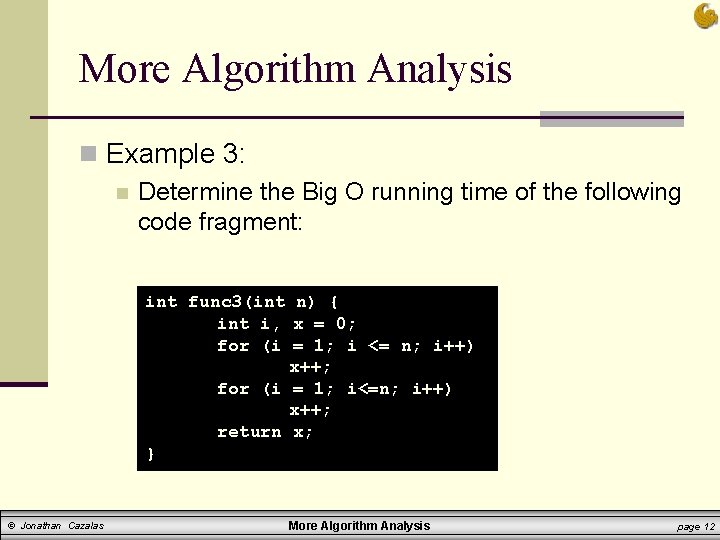
More Algorithm Analysis n Example 3: n Determine the Big O running time of the following code fragment: int func 3(int n) { int i, x = 0; for (i = 1; i <= n; i++) x++; for (i = 1; i<=n; i++) x++; return x; } © Jonathan Cazalas More Algorithm Analysis page 12
More Algorithm Analysis n Example 3: n So look at what’s going on in the code: n n We care about the total number of REPETITIVE operations We have two loops § They are NOT nested loops n The first loop runs n times § From i = 1 up through n § only one operation (x++) is performed at each iteration n How many times does the second loop run? § Notice that i is indeed reset to 1 at the beginning of the loop § Thus, the second loop runs n times, from i = 1 up through n § And only one operation (x++) is performed at each iteration © Jonathan Cazalas More Algorithm Analysis page 13
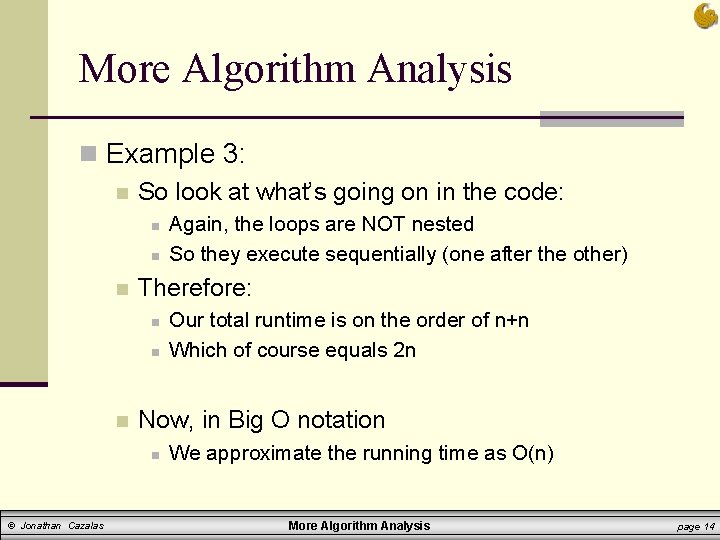
More Algorithm Analysis n Example 3: n So look at what’s going on in the code: n n n Therefore: n n n Our total runtime is on the order of n+n Which of course equals 2 n Now, in Big O notation n © Jonathan Cazalas Again, the loops are NOT nested So they execute sequentially (one after the other) We approximate the running time as O(n) More Algorithm Analysis page 14
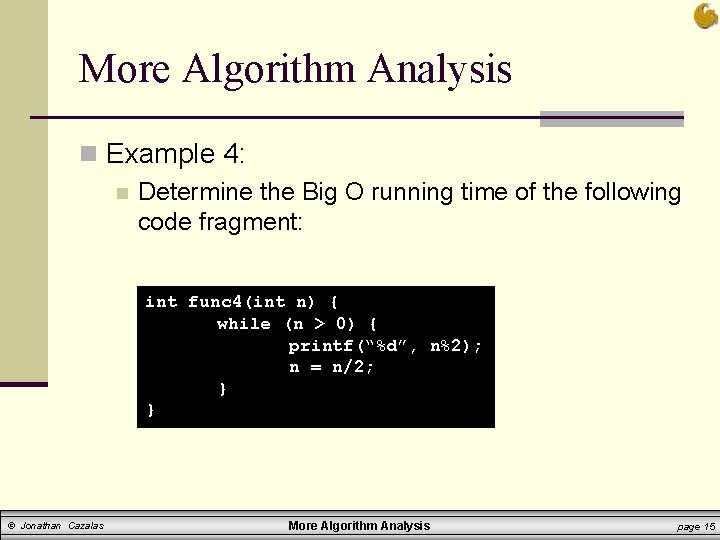
More Algorithm Analysis n Example 4: n Determine the Big O running time of the following code fragment: int func 4(int n) { while (n > 0) { printf(“%d”, n%2); n = n/2; } } © Jonathan Cazalas More Algorithm Analysis page 15
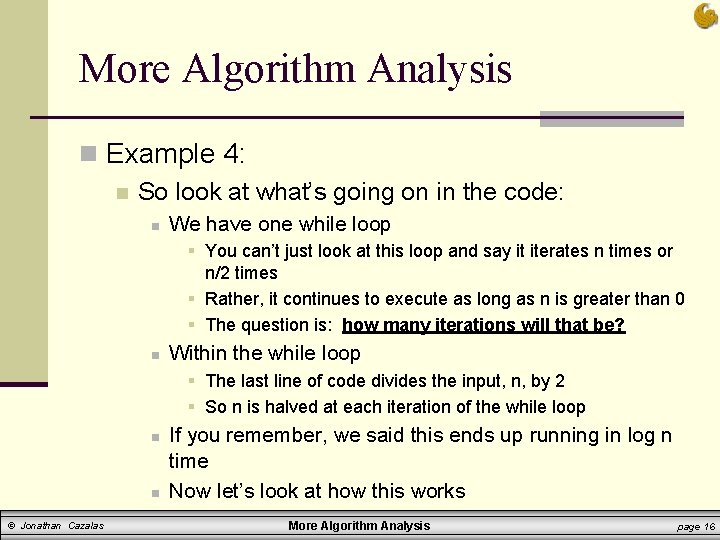
More Algorithm Analysis n Example 4: n So look at what’s going on in the code: n We have one while loop § You can’t just look at this loop and say it iterates n times or n/2 times § Rather, it continues to execute as long as n is greater than 0 § The question is: how many iterations will that be? n Within the while loop § The last line of code divides the input, n, by 2 § So n is halved at each iteration of the while loop n n © Jonathan Cazalas If you remember, we said this ends up running in log n time Now let’s look at how this works More Algorithm Analysis page 16
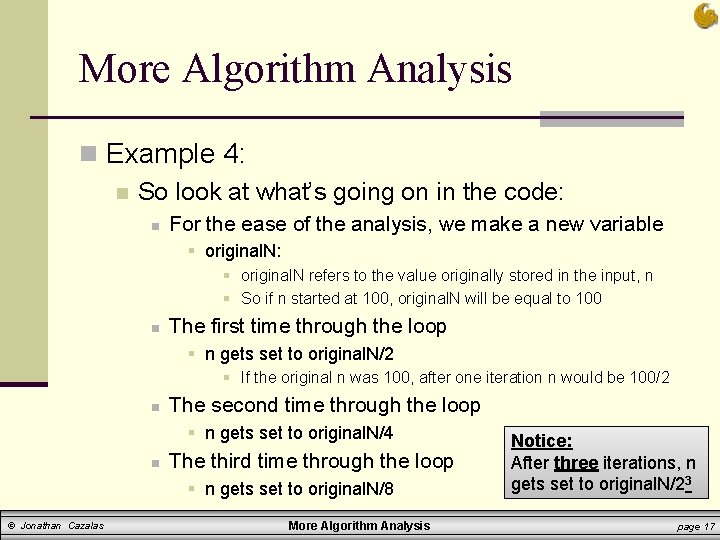
More Algorithm Analysis n Example 4: n So look at what’s going on in the code: n For the ease of the analysis, we make a new variable § original. N: § original. N refers to the value originally stored in the input, n § So if n started at 100, original. N will be equal to 100 n The first time through the loop § n gets set to original. N/2 § If the original n was 100, after one iteration n would be 100/2 n The second time through the loop § n gets set to original. N/4 n The third time through the loop § n gets set to original. N/8 © Jonathan Cazalas More Algorithm Analysis Notice: After three iterations, n gets set to original. N/23 page 17
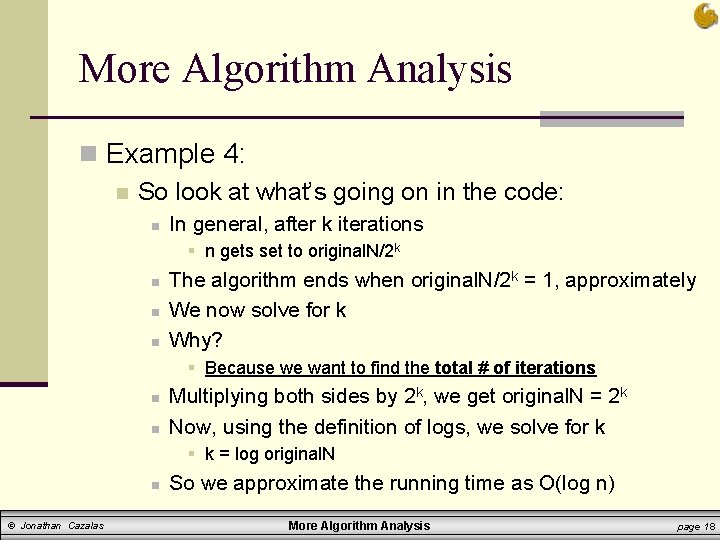
More Algorithm Analysis n Example 4: n So look at what’s going on in the code: n In general, after k iterations § n gets set to original. N/2 k n n n The algorithm ends when original. N/2 k = 1, approximately We now solve for k Why? § Because we want to find the total # of iterations n n Multiplying both sides by 2 k, we get original. N = 2 k Now, using the definition of logs, we solve for k § k = log original. N n © Jonathan Cazalas So we approximate the running time as O(log n) More Algorithm Analysis page 18
Brief Interlude: Human Stupidity © Jonathan Cazalas More Algorithm Analysis page 19
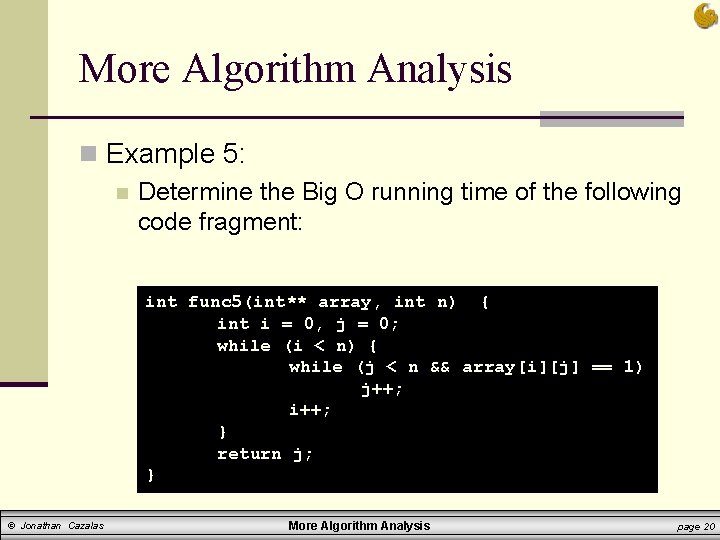
More Algorithm Analysis n Example 5: n Determine the Big O running time of the following code fragment: int func 5(int** array, int n) { int i = 0, j = 0; while (i < n) { while (j < n && array[i][j] == 1) j++; i++; } return j; } © Jonathan Cazalas More Algorithm Analysis page 20
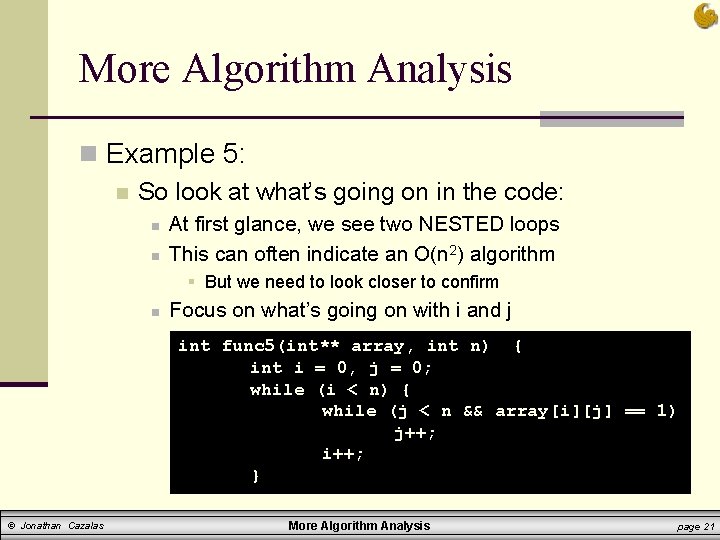
More Algorithm Analysis n Example 5: n So look at what’s going on in the code: n n At first glance, we see two NESTED loops This can often indicate an O(n 2) algorithm § But we need to look closer to confirm n Focus on what’s going on with i and j int func 5(int** array, int n) { int i = 0, j = 0; while (i < n) { while (j < n && array[i][j] == 1) j++; i++; } © Jonathan Cazalas More Algorithm Analysis page 21
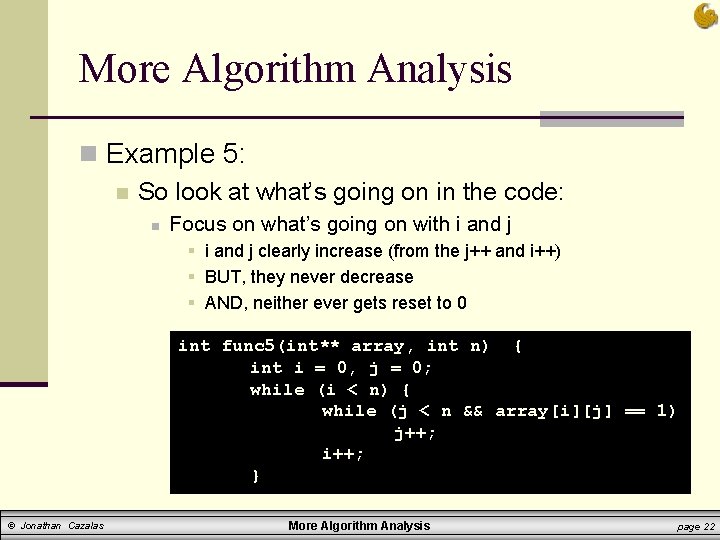
More Algorithm Analysis n Example 5: n So look at what’s going on in the code: n Focus on what’s going on with i and j § i and j clearly increase (from the j++ and i++) § BUT, they never decrease § AND, neither ever gets reset to 0 int func 5(int** array, int n) { int i = 0, j = 0; while (i < n) { while (j < n && array[i][j] == 1) j++; i++; } © Jonathan Cazalas More Algorithm Analysis page 22
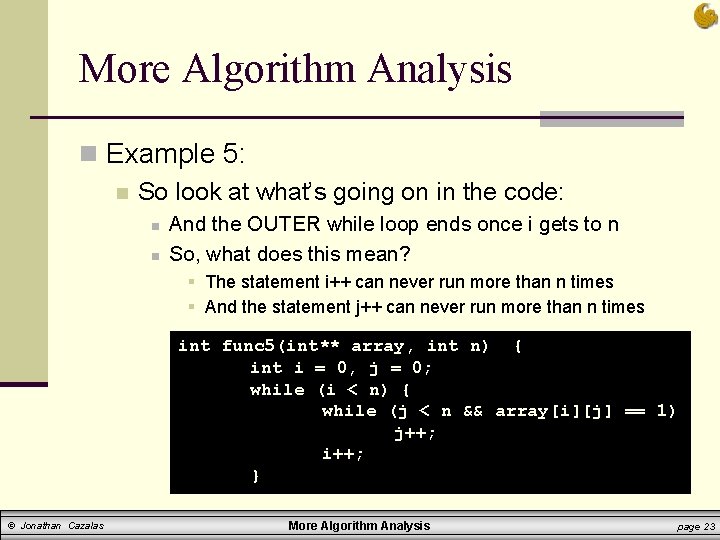
More Algorithm Analysis n Example 5: n So look at what’s going on in the code: n n And the OUTER while loop ends once i gets to n So, what does this mean? § The statement i++ can never run more than n times § And the statement j++ can never run more than n times int func 5(int** array, int n) { int i = 0, j = 0; while (i < n) { while (j < n && array[i][j] == 1) j++; i++; } © Jonathan Cazalas More Algorithm Analysis page 23
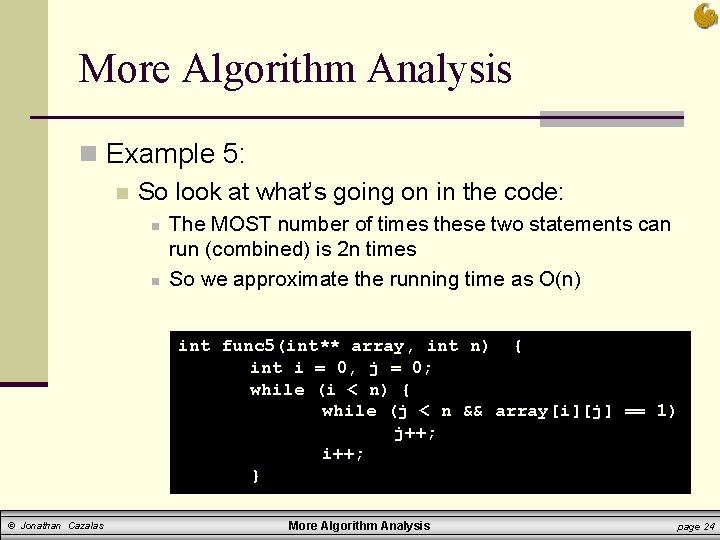
More Algorithm Analysis n Example 5: n So look at what’s going on in the code: n n The MOST number of times these two statements can run (combined) is 2 n times So we approximate the running time as O(n) int func 5(int** array, int n) { int i = 0, j = 0; while (i < n) { while (j < n && array[i][j] == 1) j++; i++; } © Jonathan Cazalas More Algorithm Analysis page 24
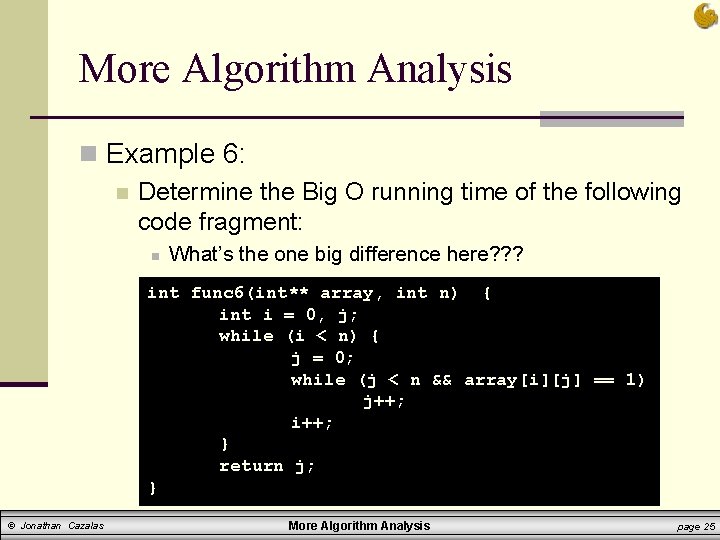
More Algorithm Analysis n Example 6: n Determine the Big O running time of the following code fragment: n What’s the one big difference here? ? ? int func 6(int** array, int n) { int i = 0, j; while (i < n) { j = 0; while (j < n && array[i][j] == 1) j++; i++; } return j; } © Jonathan Cazalas More Algorithm Analysis page 25
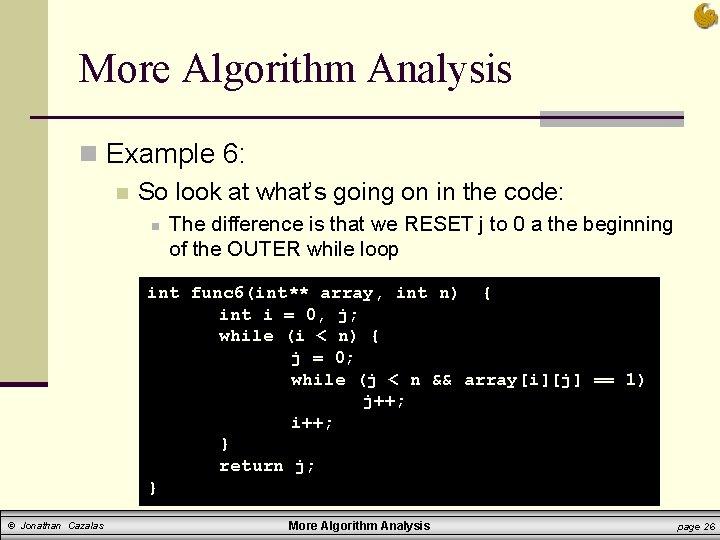
More Algorithm Analysis n Example 6: n So look at what’s going on in the code: n The difference is that we RESET j to 0 a the beginning of the OUTER while loop int func 6(int** array, int n) { int i = 0, j; while (i < n) { j = 0; while (j < n && array[i][j] == 1) j++; i++; } return j; } © Jonathan Cazalas More Algorithm Analysis page 26
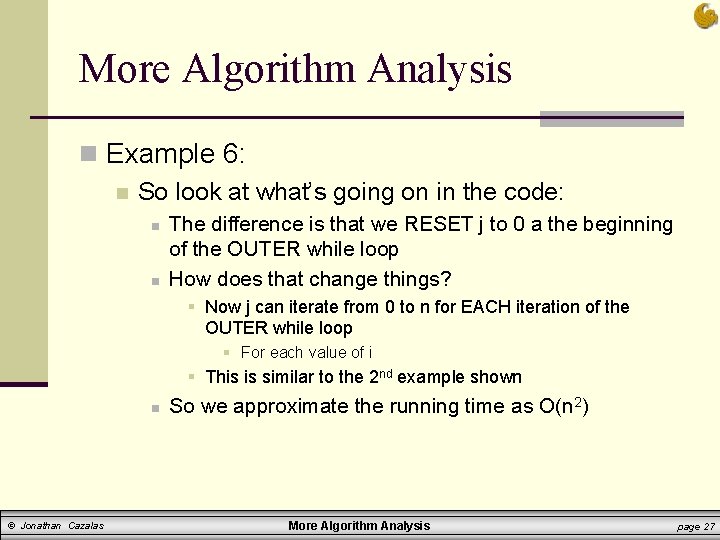
More Algorithm Analysis n Example 6: n So look at what’s going on in the code: n n The difference is that we RESET j to 0 a the beginning of the OUTER while loop How does that change things? § Now j can iterate from 0 to n for EACH iteration of the OUTER while loop § For each value of i § This is similar to the 2 nd example shown n © Jonathan Cazalas So we approximate the running time as O(n 2) More Algorithm Analysis page 27
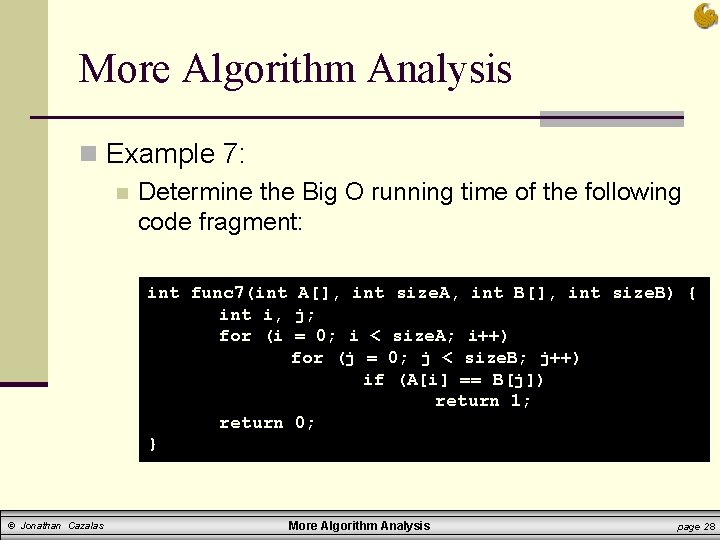
More Algorithm Analysis n Example 7: n Determine the Big O running time of the following code fragment: int func 7(int A[], int size. A, int B[], int size. B) { int i, j; for (i = 0; i < size. A; i++) for (j = 0; j < size. B; j++) if (A[i] == B[j]) return 1; return 0; } © Jonathan Cazalas More Algorithm Analysis page 28
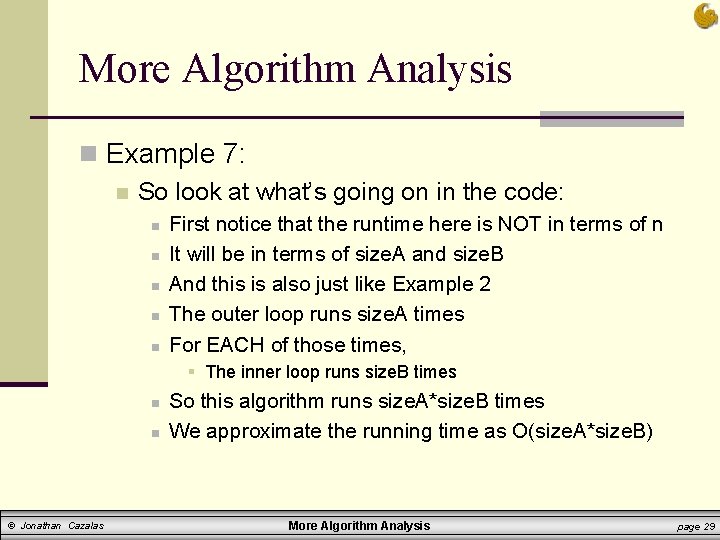
More Algorithm Analysis n Example 7: n So look at what’s going on in the code: n n n First notice that the runtime here is NOT in terms of n It will be in terms of size. A and size. B And this is also just like Example 2 The outer loop runs size. A times For EACH of those times, § The inner loop runs size. B times n n © Jonathan Cazalas So this algorithm runs size. A*size. B times We approximate the running time as O(size. A*size. B) More Algorithm Analysis page 29
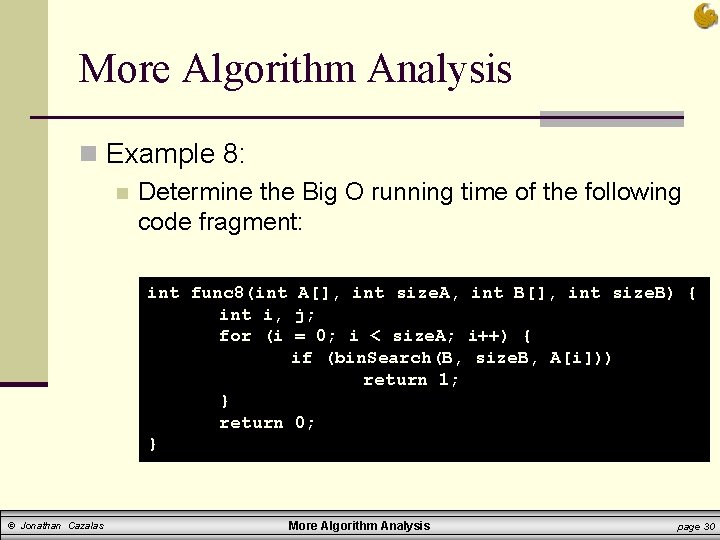
More Algorithm Analysis n Example 8: n Determine the Big O running time of the following code fragment: int func 8(int A[], int size. A, int B[], int size. B) { int i, j; for (i = 0; i < size. A; i++) { if (bin. Search(B, size. B, A[i])) return 1; } return 0; } © Jonathan Cazalas More Algorithm Analysis page 30
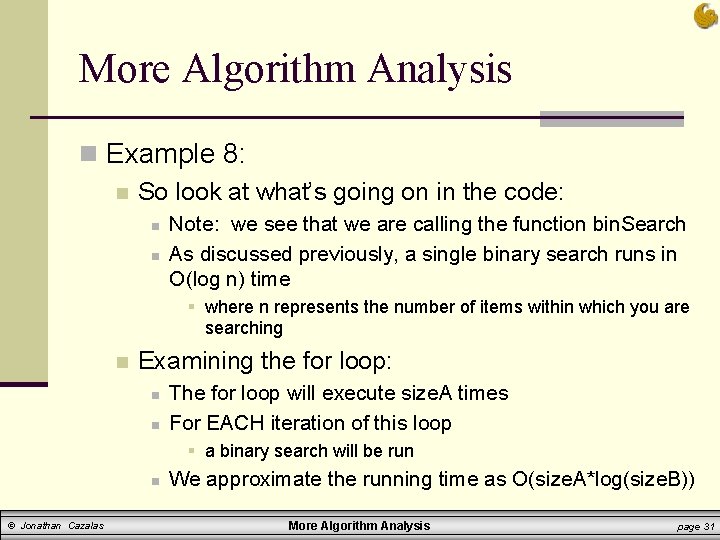
More Algorithm Analysis n Example 8: n So look at what’s going on in the code: n n Note: we see that we are calling the function bin. Search As discussed previously, a single binary search runs in O(log n) time § where n represents the number of items within which you are searching n Examining the for loop: n n The for loop will execute size. A times For EACH iteration of this loop § a binary search will be run n © Jonathan Cazalas We approximate the running time as O(size. A*log(size. B)) More Algorithm Analysis page 31
More Algorithm Analysis WASN’T THAT SWEET! © Jonathan Cazalas More Algorithm Analysis page 32
Daily Demotivator © Jonathan Cazalas More Algorithm Analysis page 33
More Algorithm Analysis Computer Science Department University of Central Florida COP 3502 – Computer Science I