
More Addition and Subtraction Partitioning and column addition
More Addition and Subtraction Partitioning and column addition Objectives Day 1 Add 2 -digit numbers by partitioning Add two 3 -digit numbers using compact written addition Day 2 Add 2 -digit numbers by partitioning Add three 3 -digit numbers using compact written addition Day 3 Add three 2 -digit numbers by partitioning. Add three and four 2 -digit numbers using expanded/compact addition © hamilton-trust. org. uk 1 Year 3/4

More Addition and Subtraction Partitioning and column addition Short Mental Workouts Day 1 Adding multiples of 10 Day 2 Add three 1 -digit numbers Day 3 Add 3 or 4 numbers © hamilton-trust. org. uk 2 Year 3/4
More Addition and Subtraction Partitioning and column addition Short Mental Workout Adding multiples of 10 © hamilton-trust. org. uk 3 Year 3/4
More Addition and Subtraction Partitioning and column addition Short Mental Workout Add three 1 -digit numbers © hamilton-trust. org. uk 4 Year 3/4
More Addition and Subtraction Partitioning and column addition Short Mental Workout Add 3 or 4 numbers © hamilton-trust. org. uk 5 Year 3/4
More Addition and Subtraction Partitioning and column addition Objectives Day 1 Add 2 -digit numbers by partitioning Add two 3 -digit numbers using compact written addition © hamilton-trust. org. uk 6 Year 3/4

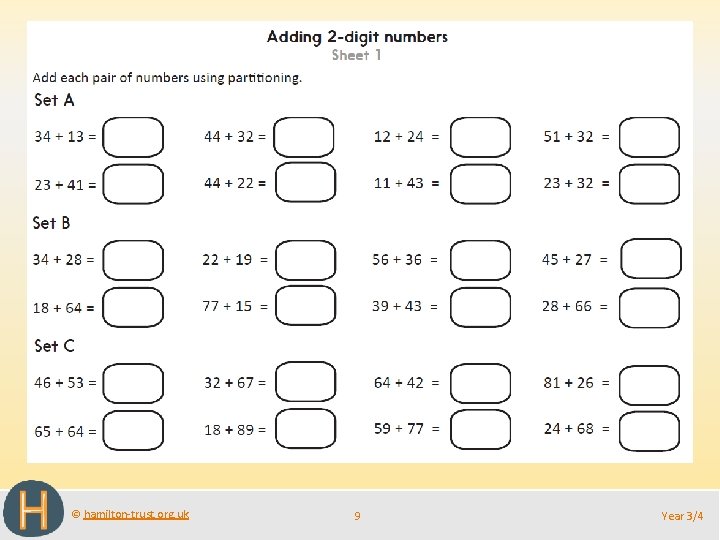
Day 1: Add 2 -digit numbers by partitioning; Add two 3 -digit numbers using compact written addition 5 70 In pairs use the place value cards to make 57 and 25. 2 50 We can record it like this: We are going to add the 57 +numbers 25 = 50 +by 20 partitioning. +7+5 = 70 + 12 = 82 Add the 10 s, Put the tens and the Then ones the 1 s. 50 + 20. . cards together… 7 + 5… 5 0 7 20 0 © hamilton-trust. org. uk 71 25 7 Then recombine. 70 + 12 = 8 2 Year 3/4

Day 1: Add 2 -digit numbers by partitioning; Add two 3 -digit numbers using compact written addition Which cards will you use to make the numbers? Now in pairs use the place value cards to find 48 + 34. Why is this strategy called How will partitioning you and recombining? partition the numbers to add? We can record it like this: How will you record this addition? © hamilton-trust. org. uk 48 + 34 = 40 + 30 + 8 + 4 = 70 + 12 = 82 8 Year 3/4
© hamilton-trust. org. uk 9 Year 3/4

Day 1: Add two 3 -digit numbers using compact written addition Let’s revise adding 3 -digit numbers using compact addition to find 654 + 218 1 Set the numbers out neatly in columns, leaving a space above the line for any extra 10 s or 100 s. 872 Add the 1 s: 4 + 8 = ? Add the 10 s. Don’t forget the extra one! Finally add the 100 s. © hamilton-trust. org. uk 10 Year 3/4
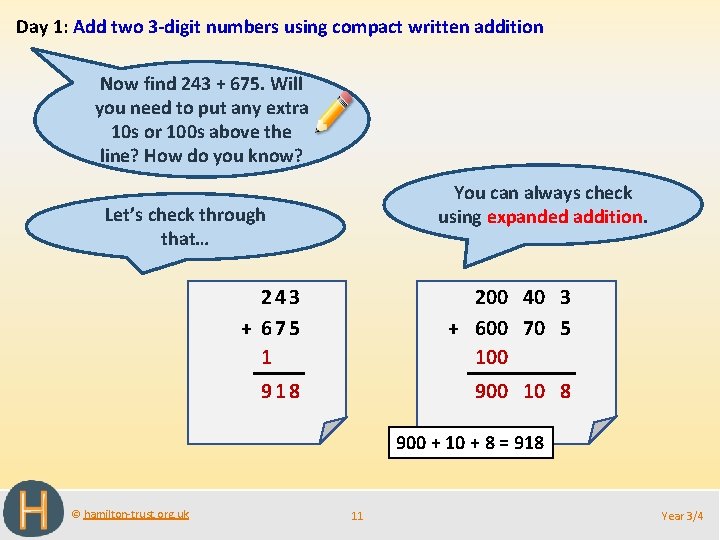
Day 1: Add two 3 -digit numbers using compact written addition Now find 243 + 675. Will you need to put any extra 10 s or 100 s above the line? How do you know? You can always check using expanded addition. Let’s check through that… 243 + 675 1 200 40 3 + 600 70 5 100 918 900 10 8 900 + 10 + 8 = 918 © hamilton-trust. org. uk 11 Year 3/4
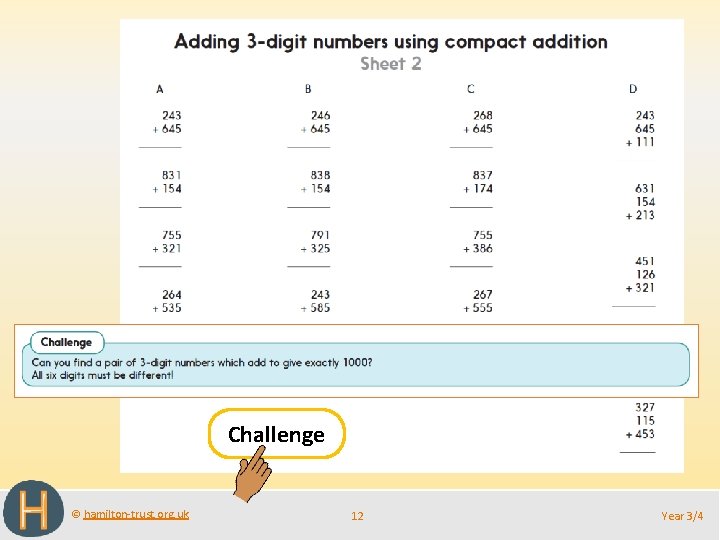
Challenge © hamilton-trust. org. uk 12 Year 3/4

More Addition and Subtraction Partitioning and column addition Objectives Day 2 Add 2 -digit numbers by partitioning Add three 3 -digit numbers using compact written addition © hamilton-trust. org. uk 13 Year 3/4

Day 2: Add 2 -digit numbers by partitioning; Add three 3 -digit numbers using compact written addition. Y 3 – use place value cards to We want to find make the two numbers and 354 + 138. find the total. Y 4 – use column addition. Now someone from Y 4 talk us through the compact method. Let’s go through that using expanded addition. 300 50 4 + 100 30 8 10 354 + 138 1 400 90 2 492 400 + 90 + 2 = 492 © hamilton-trust. org. uk 14 Year 3/4
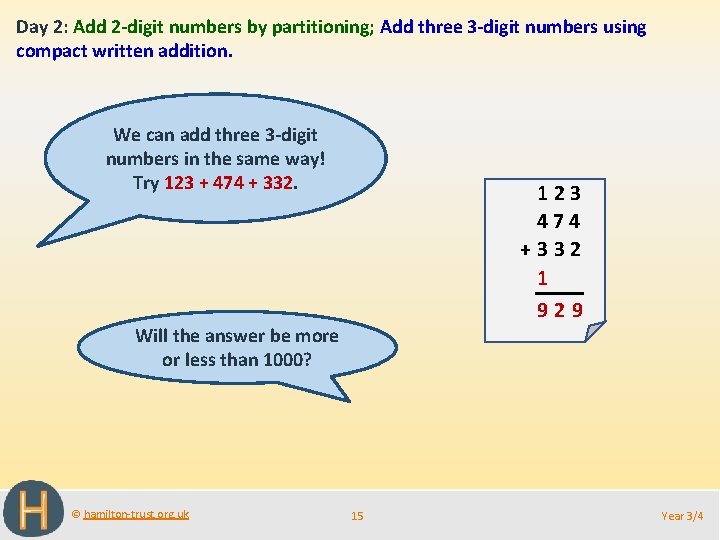
Day 2: Add 2 -digit numbers by partitioning; Add three 3 -digit numbers using compact written addition. We can add three 3 -digit numbers in the same way! Try 123 + 474 + 332. 123 474 +332 1 929 Will the answer be more or less than 1000? © hamilton-trust. org. uk 15 Year 3/4
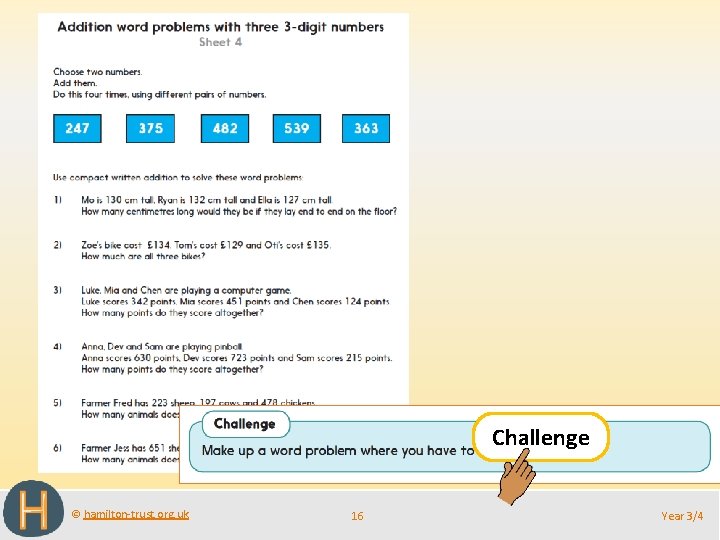
Challenge © hamilton-trust. org. uk 16 Year 3/4

Day 2: Add 2 -digit numbers by partitioning. 7 03 5 50 What is going to happen to the 10 s this time? Now with your partner find 73 + 55. 8 1 02 0 73 + 55 = 70 + 50 + 3 + 5 = 120 + 8 = 128 The answer was more than 100! Record how you do this on your whiteboards. © hamilton-trust. org. uk 17 Year 3/4

Day 2: Add 2 -digit numbers by partitioning. 5 08 Now with your partner try 58 + 65. Will the answer be more than 100? 58 + 65 = 50 + 60 + 8 + 5 = 110 + 13 = 123 © hamilton-trust. org. uk 6 05 Record how to do this on your whiteboards. 18 Year 3/4
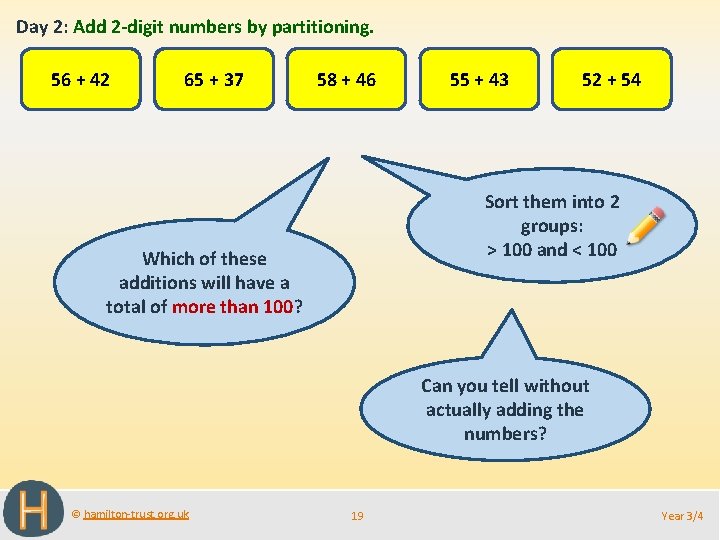
Day 2: Add 2 -digit numbers by partitioning. 56 + 42 65 + 37 58 + 46 55 + 43 52 + 54 Sort them into 2 groups: > 100 and < 100 Which of these additions will have a total of more than 100? Can you tell without actually adding the numbers? © hamilton-trust. org. uk 19 Year 3/4
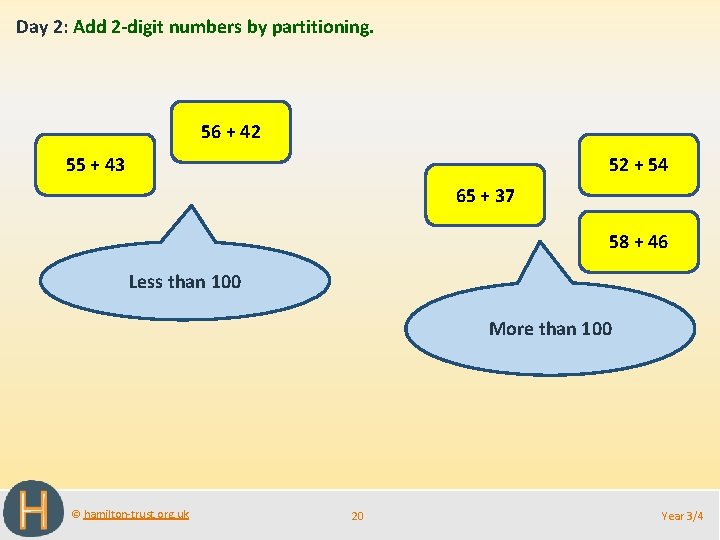
Day 2: Add 2 -digit numbers by partitioning. 56 + 42 52 + 54 55 + 43 65 + 37 58 + 46 Less than 100 More than 100 © hamilton-trust. org. uk 20 Year 3/4
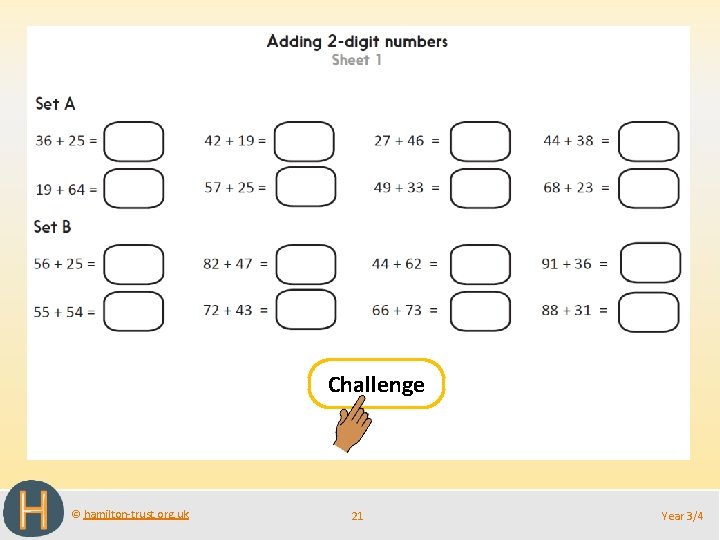
Challenge © hamilton-trust. org. uk 21 Year 3/4
More Addition and Subtraction Partitioning and column addition Objectives Day 3 Add three 2 -digit numbers by partitioning. Add three and four 2 -digit numbers using expanded/compact addition © hamilton-trust. org. uk 22 Year 3/4
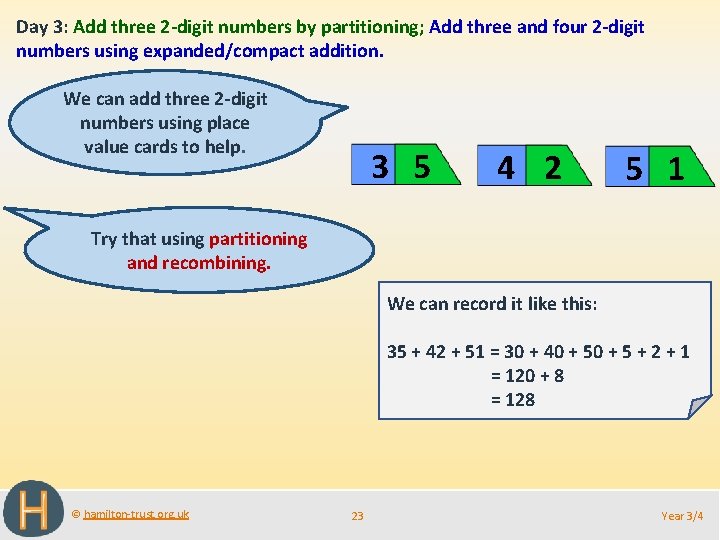
Day 3: Add three 2 -digit numbers by partitioning; Add three and four 2 -digit numbers using expanded/compact addition. We can add three 2 -digit numbers using place value cards to help. 3 50 4 02 5 10 Try that using partitioning and recombining. We can record it like this: 35 + 42 + 51 = 30 + 40 + 5 + 2 + 1 = 120 + 8 = 128 © hamilton-trust. org. uk 23 Year 3/4
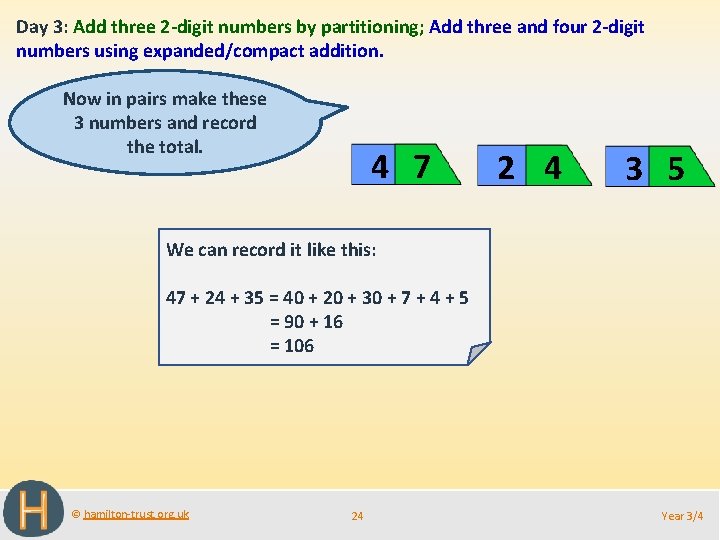
Day 3: Add three 2 -digit numbers by partitioning; Add three and four 2 -digit numbers using expanded/compact addition. Now in pairs make these 3 numbers and record the total. 4 70 2 04 3 50 We can record it like this: 47 + 24 + 35 = 40 + 20 + 30 + 7 + 4 + 5 = 90 + 16 = 106 © hamilton-trust. org. uk 24 Year 3/4
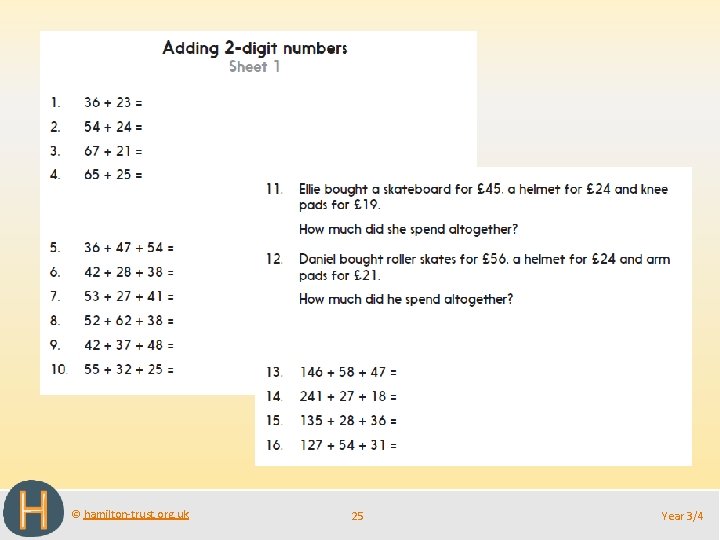
© hamilton-trust. org. uk 25 Year 3/4
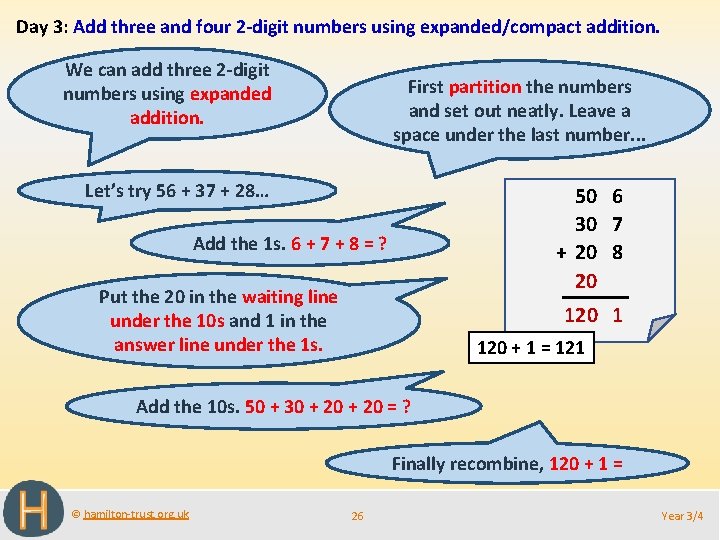
Day 3: Add three and four 2 -digit numbers using expanded/compact addition. We can add three 2 -digit numbers using expanded addition. First partition the numbers and set out neatly. Leave a space under the last number. . . Let’s try 56 + 37 + 28… 50 6 30 7 + 20 8 20 Add the 1 s. 6 + 7 + 8 = ? Put the 20 in the waiting line under the 10 s and 1 in the answer line under the 1 s. 120 1 120 + 1 = 121 Add the 10 s. 50 + 30 + 20 = ? Finally recombine, 120 + 1 = © hamilton-trust. org. uk 26 Year 3/4
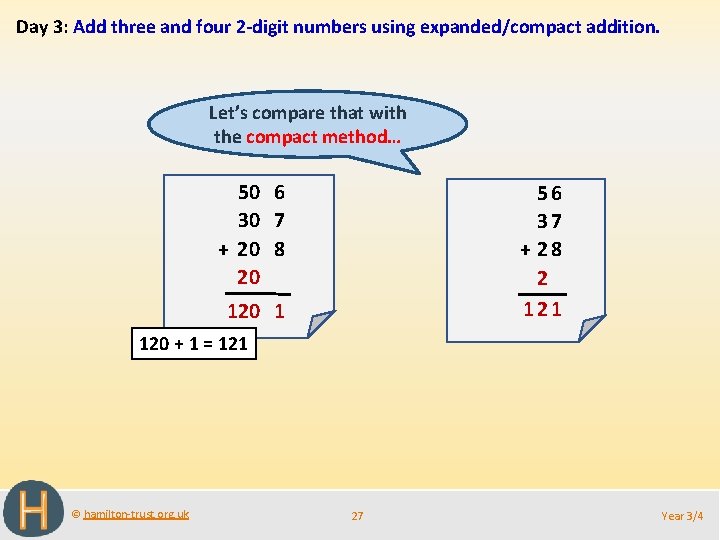
Day 3: Add three and four 2 -digit numbers using expanded/compact addition. Let’s compare that with the compact method… 50 6 30 7 + 20 8 20 56 37 + 28 2 121 120 + 1 = 121 © hamilton-trust. org. uk 27 Year 3/4
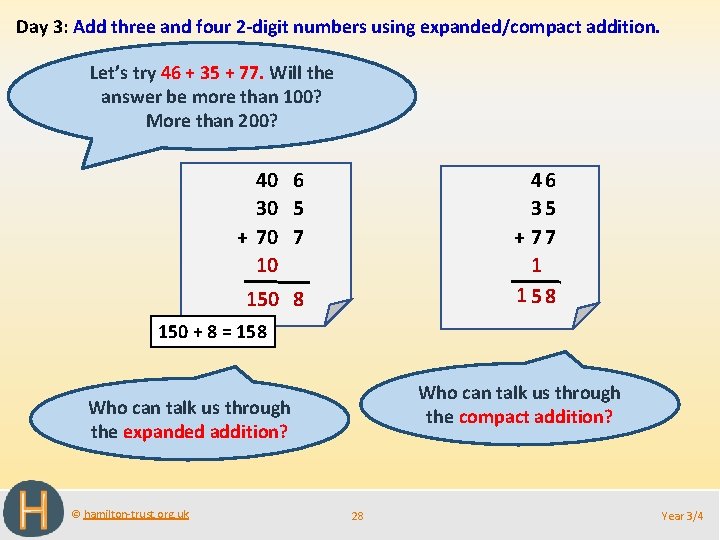
Day 3: Add three and four 2 -digit numbers using expanded/compact addition. Let’s try 46 + 35 + 77. Will the answer be more than 100? More than 200? 40 6 30 5 + 70 7 10 46 35 + 77 1 158 150 + 8 = 158 Who can talk us through the compact addition? Who can talk us through the expanded addition? © hamilton-trust. org. uk 28 Year 3/4
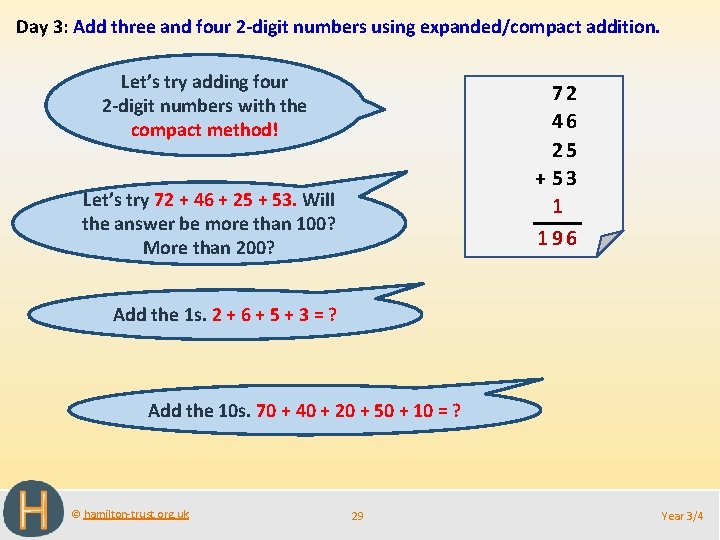
Day 3: Add three and four 2 -digit numbers using expanded/compact addition. Let’s try adding four 2 -digit numbers with the compact method! 72 46 25 + 53 1 196 Let’s try 72 + 46 + 25 + 53. Will the answer be more than 100? More than 200? Add the 1 s. 2 + 6 + 5 + 3 = ? Add the 10 s. 70 + 40 + 20 + 50 + 10 = ? © hamilton-trust. org. uk 29 Year 3/4
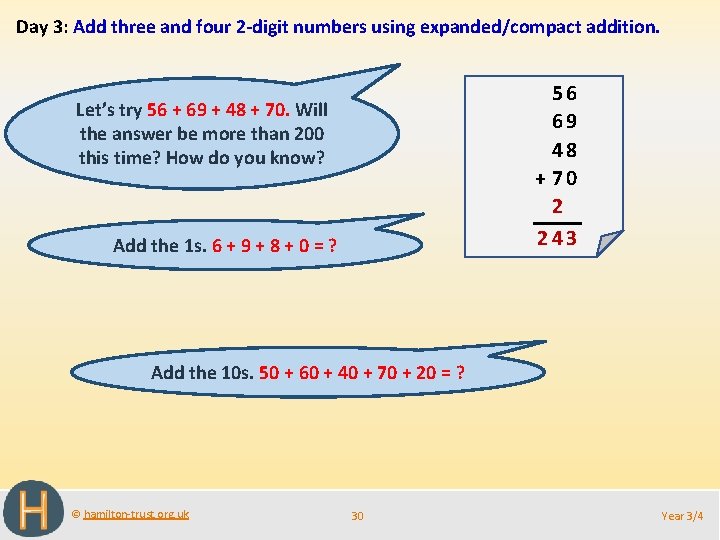
Day 3: Add three and four 2 -digit numbers using expanded/compact addition. 56 69 48 + 70 2 243 Let’s try 56 + 69 + 48 + 70. Will the answer be more than 200 this time? How do you know? Add the 1 s. 6 + 9 + 8 + 0 = ? Add the 10 s. 50 + 60 + 40 + 70 + 20 = ? © hamilton-trust. org. uk 30 Year 3/4
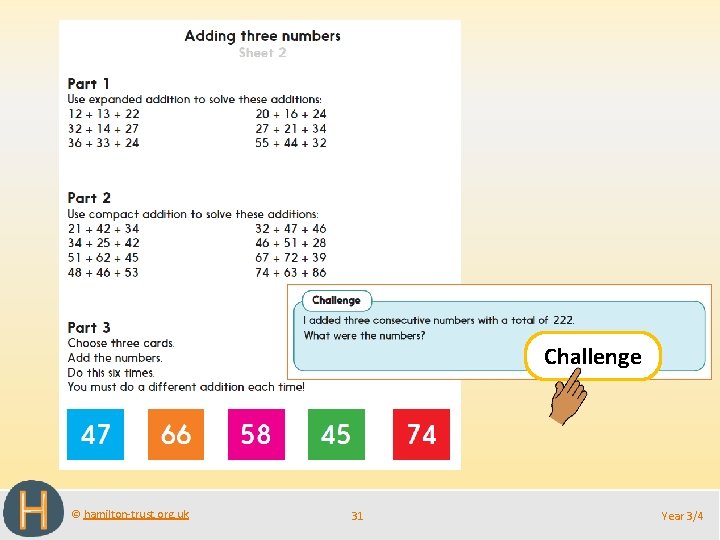
Challenge © hamilton-trust. org. uk 31 Year 3/4
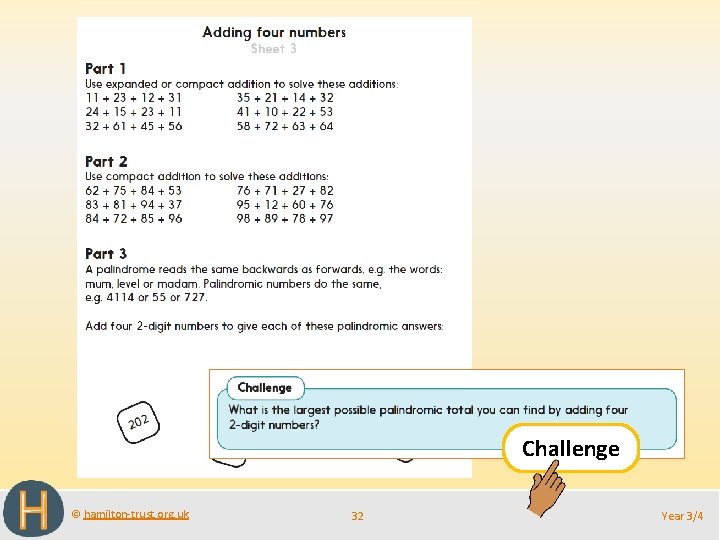
Challenge © hamilton-trust. org. uk 32 Year 3/4
More Addition and Subtraction Partitioning and column addition Well Done! You’ve completed this unit. Objectives Day 1 Add 2 -digit numbers by partitioning Add two 3 -digit numbers using compact written addition Day 2 Add 2 -digit numbers by partitioning Add three 3 -digit numbers using compact written addition Day 3 Add three 2 -digit numbers by partitioning. Add three and four 2 -digit numbers using expanded/compact addition © hamilton-trust. org. uk 33 Year 3/4
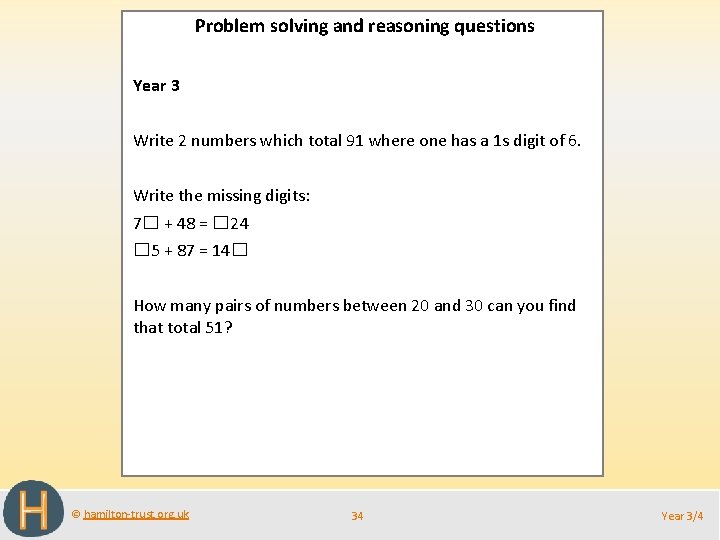
Problem solving and reasoning questions Year 3 Write 2 numbers which total 91 where one has a 1 s digit of 6. Write the missing digits: 7☐ + 48 = ☐ 24 ☐ 5 + 87 = 14☐ How many pairs of numbers between 20 and 30 can you find that total 51? © hamilton-trust. org. uk 34 Year 3/4
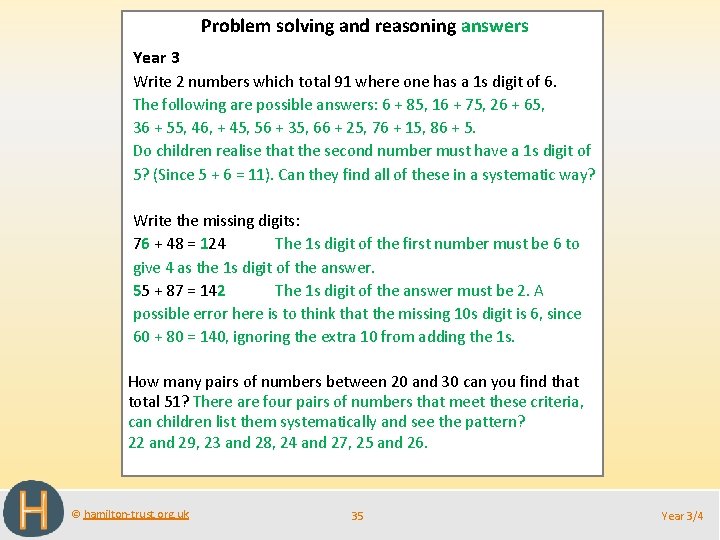
Problem solving and reasoning answers Year 3 Write 2 numbers which total 91 where one has a 1 s digit of 6. The following are possible answers: 6 + 85, 16 + 75, 26 + 65, 36 + 55, 46, + 45, 56 + 35, 66 + 25, 76 + 15, 86 + 5. Do children realise that the second number must have a 1 s digit of 5? (Since 5 + 6 = 11). Can they find all of these in a systematic way? Write the missing digits: 76 + 48 = 124 The 1 s digit of the first number must be 6 to give 4 as the 1 s digit of the answer. 55 + 87 = 142 The 1 s digit of the answer must be 2. A possible error here is to think that the missing 10 s digit is 6, since 60 + 80 = 140, ignoring the extra 10 from adding the 1 s. How many pairs of numbers between 20 and 30 can you find that total 51? There are four pairs of numbers that meet these criteria, can children list them systematically and see the pattern? 22 and 29, 23 and 28, 24 and 27, 25 and 26. © hamilton-trust. org. uk 35 Year 3/4
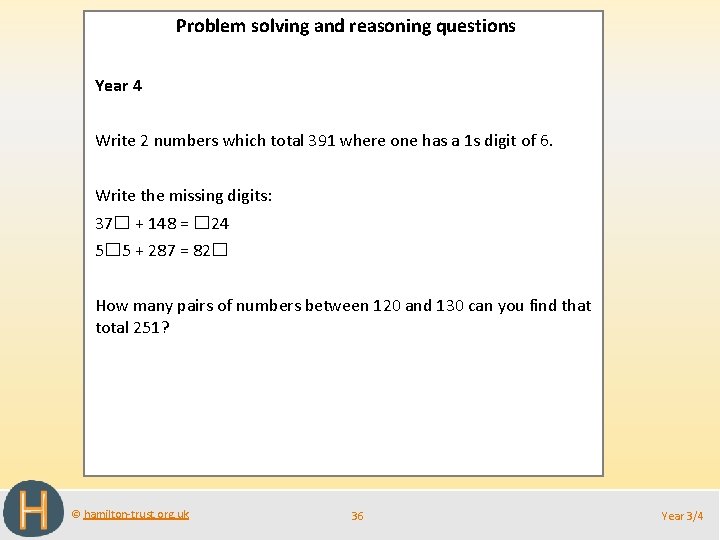
Problem solving and reasoning questions Year 4 Write 2 numbers which total 391 where one has a 1 s digit of 6. Write the missing digits: 37☐ + 148 = ☐ 24 5☐ 5 + 287 = 82☐ How many pairs of numbers between 120 and 130 can you find that total 251? © hamilton-trust. org. uk 36 Year 3/4
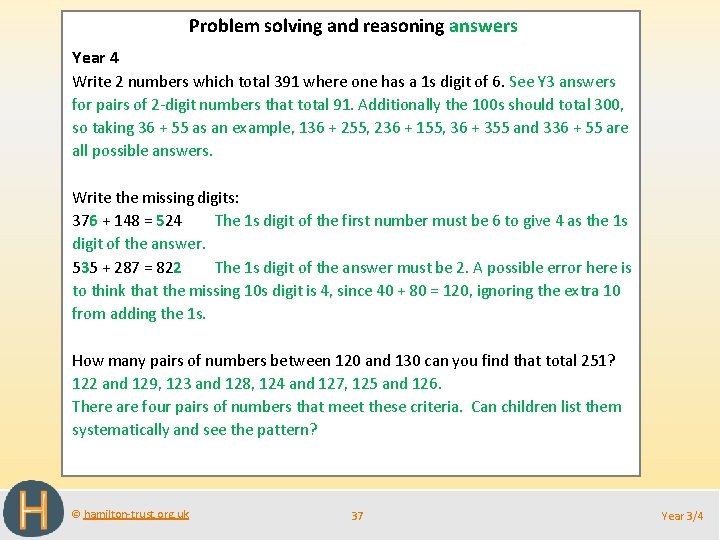
Problem solving and reasoning answers Year 4 Write 2 numbers which total 391 where one has a 1 s digit of 6. See Y 3 answers for pairs of 2 -digit numbers that total 91. Additionally the 100 s should total 300, so taking 36 + 55 as an example, 136 + 255, 236 + 155, 36 + 355 and 336 + 55 are all possible answers. Write the missing digits: 376 + 148 = 524 The 1 s digit of the first number must be 6 to give 4 as the 1 s digit of the answer. 535 + 287 = 822 The 1 s digit of the answer must be 2. A possible error here is to think that the missing 10 s digit is 4, since 40 + 80 = 120, ignoring the extra 10 from adding the 1 s. How many pairs of numbers between 120 and 130 can you find that total 251? 122 and 129, 123 and 128, 124 and 127, 125 and 126. There are four pairs of numbers that meet these criteria. Can children list them systematically and see the pattern? © hamilton-trust. org. uk 37 Year 3/4
- Slides: 37