
More about Alpha Beta and Gamma Last Lesson
More about Alpha, Beta and Gamma Last Lesson: Changes in the Nucleus This Lesson: More about Alpha, Beta and Gamma Do now activity: 1. What are the 3 types of radiation. 2. What particle is released during Alpha decay? 3. What is an Isotope? 4. Calculate how many Neutrons Argon has? Next Lesson: Half Life 31 October 2021
Progress indicators GOOD PROGRESS: - State if the three types of nuclear radiation are ionising. - Rank the 3 types of nuclear radiation in order of their penetrating power. / Describe the path of radiation types through an electric and magnetic field. OUTSTANDING PROGRESS: - Describe in detail how each nuclear radiation can be used around us and in industry.
Ionisation What is Ionization? Ionizing radiation is radiation with enough energy so that during an interaction with an atom, it can remove tightly bound electrons from the orbit of an atom, causing the atom to become charged or ionized.
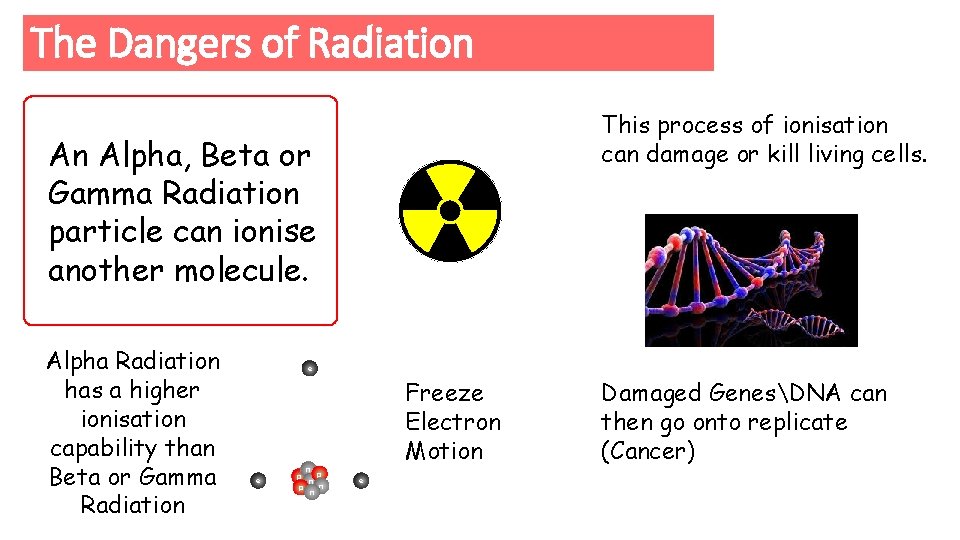
The Dangers of Radiation This process of ionisation can damage or kill living cells. An Alpha, Beta or Gamma Radiation particle can ionise another molecule. Alpha Radiation has a higher ionisation capability than Beta or Gamma Radiation e e n p p n n p n Freeze Electron Motion e Damaged GenesDNA can then go onto replicate (Cancer)
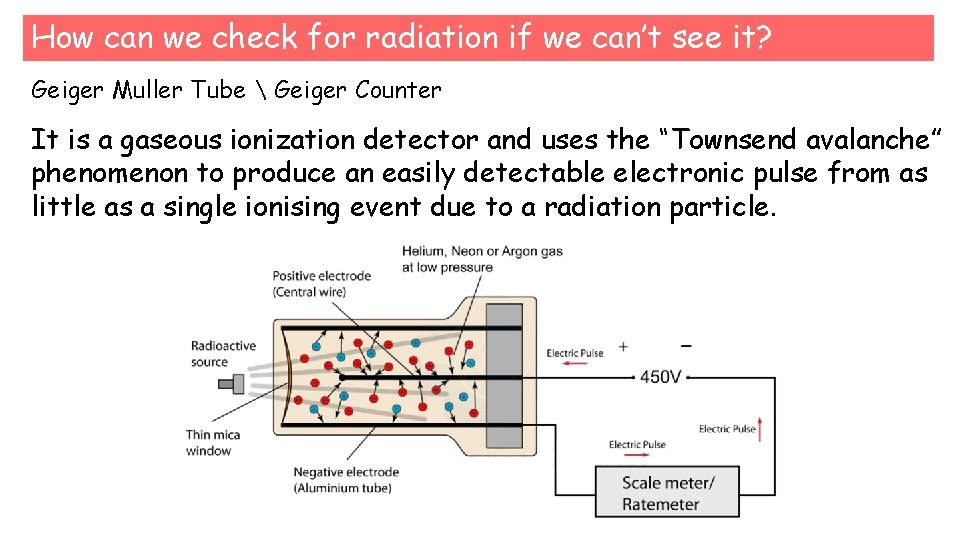
How can we check for radiation if we can’t see it? Geiger Muller Tube Geiger Counter It is a gaseous ionization detector and uses the “Townsend avalanche” phenomenon to produce an easily detectable electronic pulse from as little as a single ionising event due to a radiation particle.
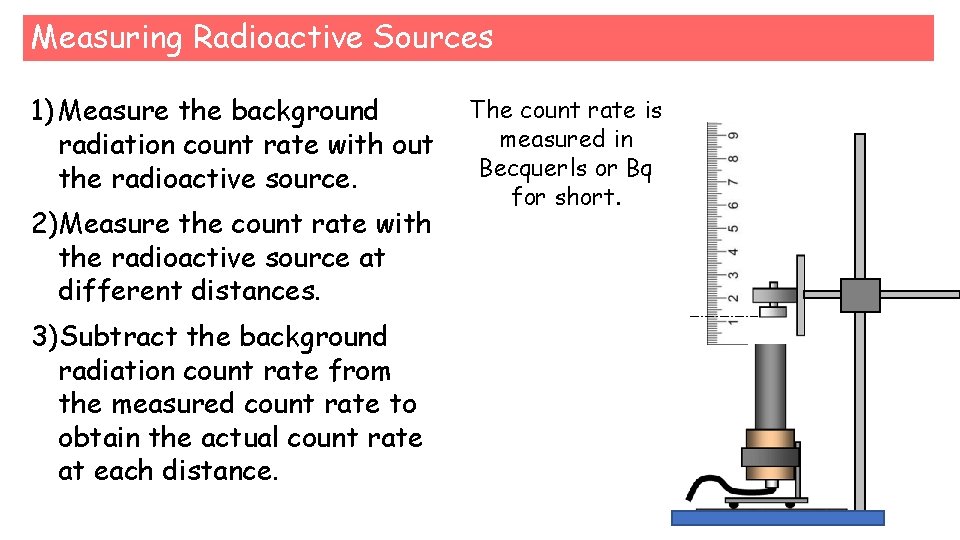
Measuring Radioactive Sources 1) Measure the background radiation count rate with out the radioactive source. 2)Measure the count rate with the radioactive source at different distances. 3)Subtract the background radiation count rate from the measured count rate to obtain the actual count rate at each distance. The count rate is measured in Becquerls or Bq for short.
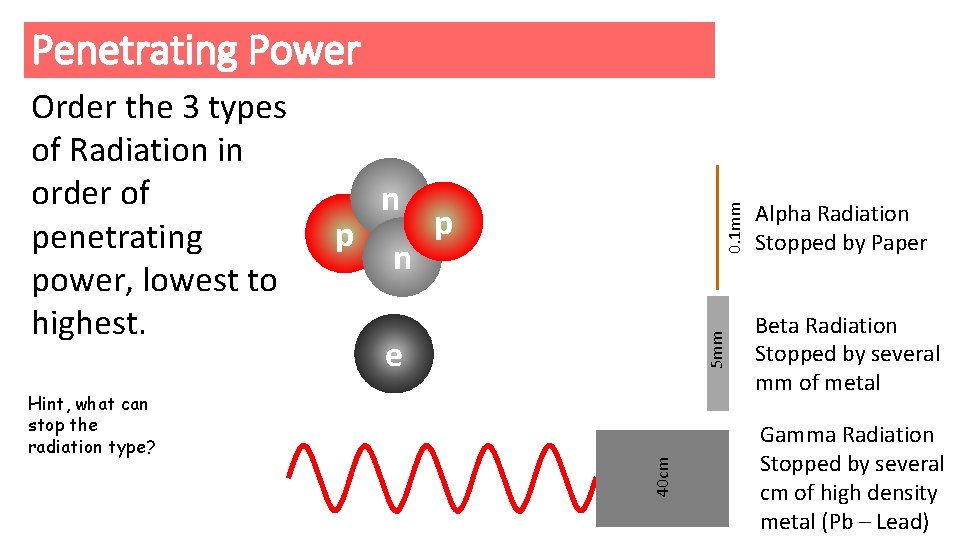
Penetrating Power Hint, what can stop the radiation type? 0. 1 mm n p 5 mm p n e 40 cm Order the 3 types of Radiation in order of penetrating power, lowest to highest. Alpha Radiation Stopped by Paper Beta Radiation Stopped by several mm of metal Gamma Radiation Stopped by several cm of high density metal (Pb – Lead)
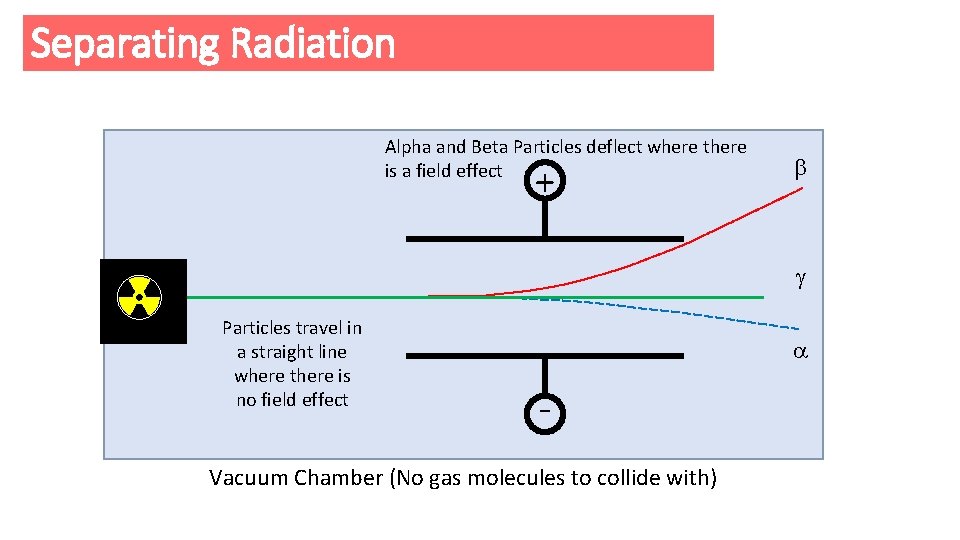
Separating Radiation Alpha and Beta Particles deflect where there is a field effect + n p en p - Particles travel in a straight line where there is no field effect Vacuum Chamber (No gas molecules to collide with)
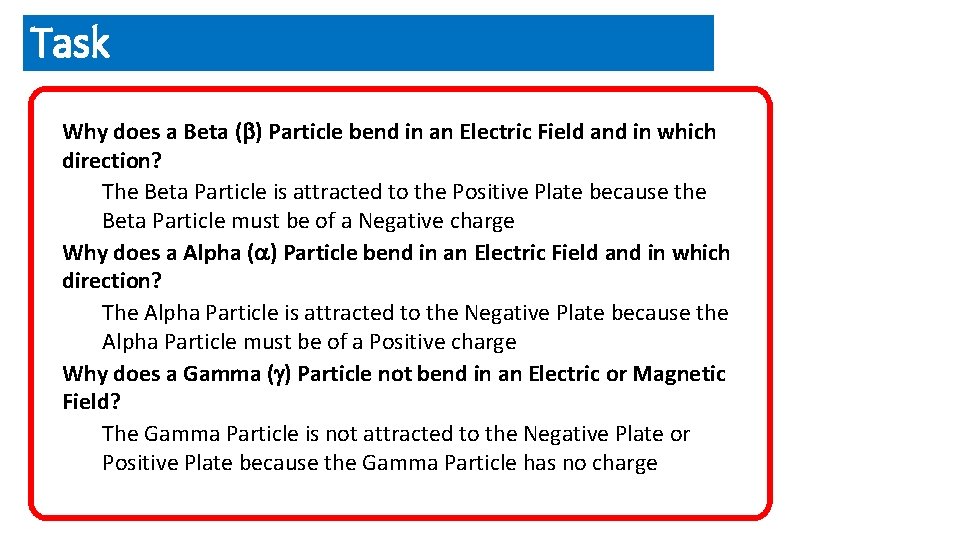
Task Why does a Beta ( ) Particle bend in an Electric Field and in which direction? The Beta Particle is attracted to the Positive Plate because the Beta Particle must be of a Negative charge Why does a Alpha ( ) Particle bend in an Electric Field and in which direction? The Alpha Particle is attracted to the Negative Plate because the Alpha Particle must be of a Positive charge Why does a Gamma ( ) Particle not bend in an Electric or Magnetic Field? The Gamma Particle is not attracted to the Negative Plate or Positive Plate because the Gamma Particle has no charge
How can we use Radiation? What things do we use radiation for? • • Smoke Detectors Thickness Checking Tracers (Medical and Industrial) Sterilization of materials So how do they work? • Ionization • Absorption
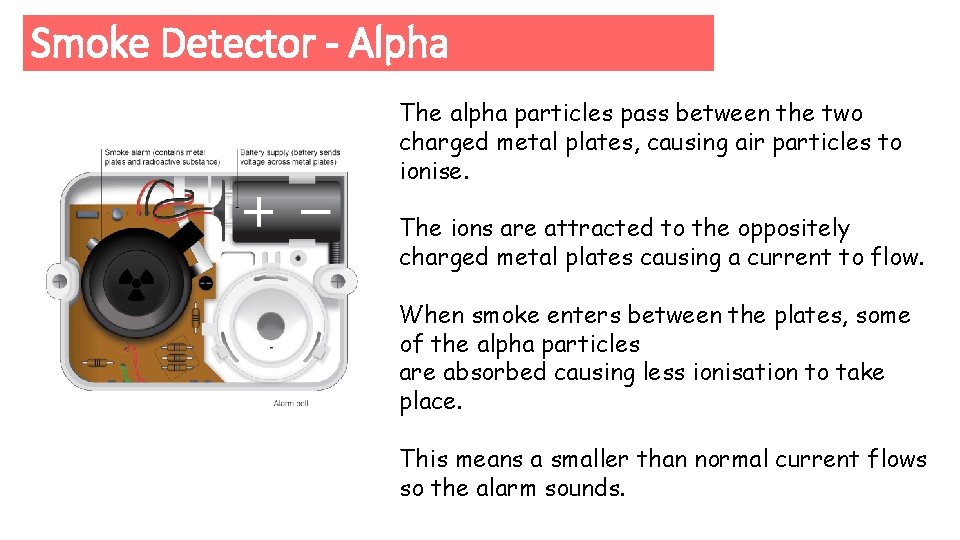
Smoke Detector - Alpha The alpha particles pass between the two charged metal plates, causing air particles to ionise. The ions are attracted to the oppositely charged metal plates causing a current to flow. When smoke enters between the plates, some of the alpha particles are absorbed causing less ionisation to take place. This means a smaller than normal current flows so the alarm sounds.
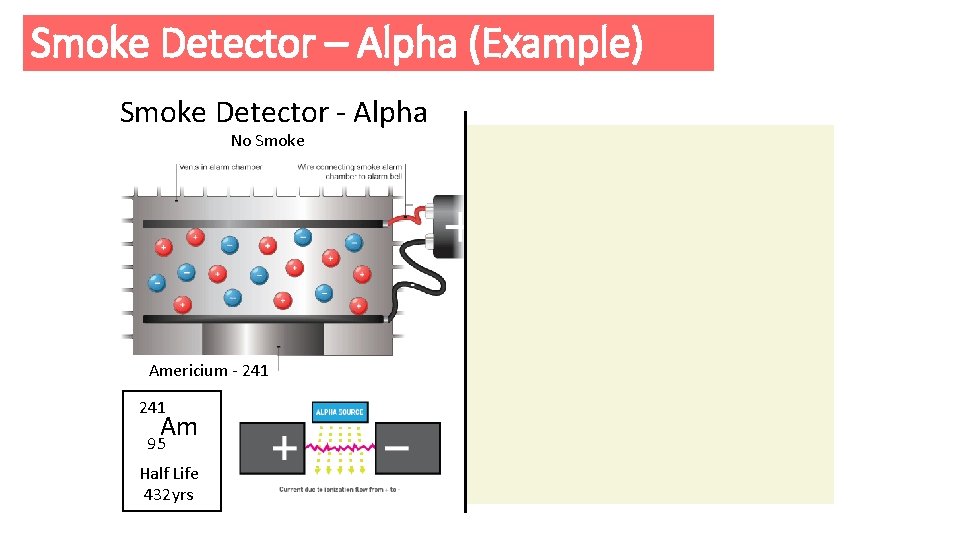
Smoke Detector – Alpha (Example) Smoke Detector - Alpha No Smoke Americium - 241 Am 95 Half Life 432 yrs Smoke Americium - 241
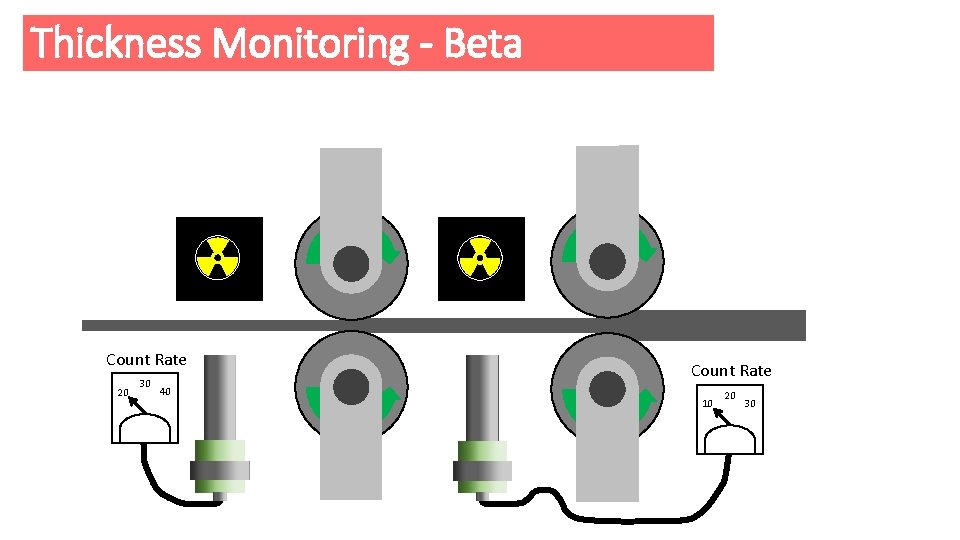
Thickness Monitoring - Beta e Count Rate 20 30 40 e Count Rate 10 20 30
Thickness Monitoring - Beta • The amount of Beta radiation passing through the foil depends on the thickness of the foil. • The detector measures the amount of radiation passing through the foil. If the foil is too thick the detector reading drops and the detector sends a signal to increase the pressure of the rollers on the metal sheet, this makes the foil thinner again. • Gamma radiation isn't used because it would all pass through the foil unaffected. • Alpha radiation isn't used as it would all be stopped by the foil
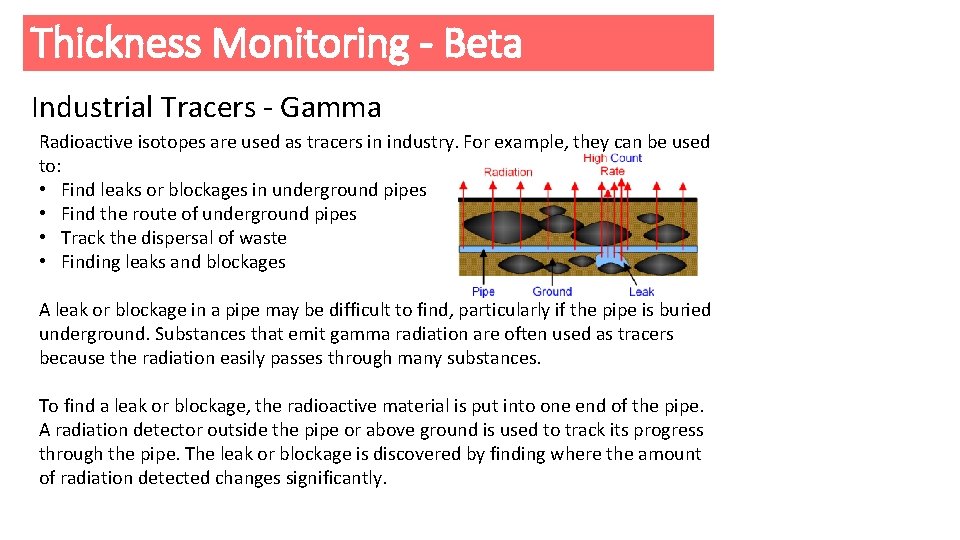
Thickness Monitoring - Beta Industrial Tracers - Gamma Radioactive isotopes are used as tracers in industry. For example, they can be used to: • Find leaks or blockages in underground pipes • Find the route of underground pipes • Track the dispersal of waste • Finding leaks and blockages A leak or blockage in a pipe may be difficult to find, particularly if the pipe is buried underground. Substances that emit gamma radiation are often used as tracers because the radiation easily passes through many substances. To find a leak or blockage, the radioactive material is put into one end of the pipe. A radiation detector outside the pipe or above ground is used to track its progress through the pipe. The leak or blockage is discovered by finding where the amount of radiation detected changes significantly.
Task Describe briefly how Alpha ( ) Particles are used in a smoke detector. The alpha particles pass between the two charged metal plates, causing air particles to ionise. When smoke enters between the plates, some of the alpha particles are absorbed causing less ionisation to take place Describe briefly how Beta ( ) Particles are used to monitor foil thickness The detector measures the amount of radiation passing through the foil. If the foil is too thick the detector reading drops, if the foil is too thin the detector reading increases. Describe briefly how Gamma ( ) Particles are used to detect leaks The radioactive material is put into one end of the pipe. A radiation detector outside the pipe is used to track its progress through the pipe. The leak or blockage is discovered by finding where the amount of radiation detected changes significantly.
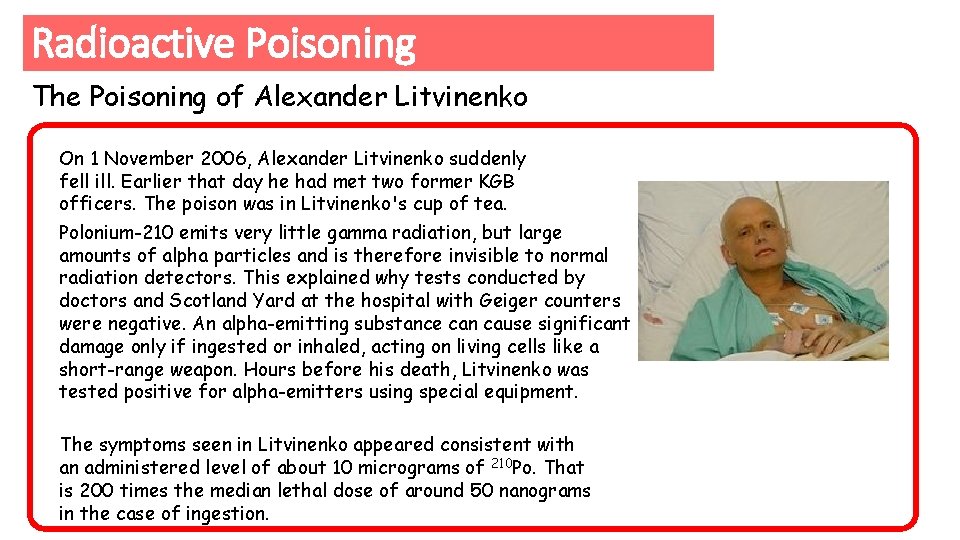
Radioactive Poisoning The Poisoning of Alexander Litvinenko On 1 November 2006, Alexander Litvinenko suddenly fell ill. Earlier that day he had met two former KGB officers. The poison was in Litvinenko's cup of tea. Polonium-210 emits very little gamma radiation, but large amounts of alpha particles and is therefore invisible to normal radiation detectors. This explained why tests conducted by doctors and Scotland Yard at the hospital with Geiger counters were negative. An alpha-emitting substance can cause significant damage only if ingested or inhaled, acting on living cells like a short-range weapon. Hours before his death, Litvinenko was tested positive for alpha-emitters using special equipment. The symptoms seen in Litvinenko appeared consistent with an administered level of about 10 micrograms of 210 Po. That is 200 times the median lethal dose of around 50 nanograms in the case of ingestion.
Plenary Using the information from this lesson and the example of Alexander Litvinenko, describe the risks caused by alpha radiation inside and outside the human body.
- Slides: 18