
Morbidity and Mortality report MICU Bliss 11 I
Morbidity and Mortality report MICU Bliss 11 I Veena Panduranga Juliana Alvarez-Argote
Neuroleptic malignant syndrome
Learning Objectives n n Describe a case of neuroleptic malignant syndrome Review the pathophysiology, diagnosis, and management of neuroleptic malignant syndrome
Overview n n n Life-threatening, idiosyncratic reaction to medications affecting central dopaminergic neurotransmission. Early recognition is critical to prevent morbidity and death First reported case in 1956 with chlorpromazine Berman. Neurohospitalist. 2011 January
Overview n n Dopamine depletion Dopamine receptor blockers: ¨ n Cessation of dopaminergic medications: ¨ n Virtually all antipsychotics, including atypical antipsychotics levodopa, amantadine, tolcapone Incidence: 0. 02% to 2% of pts on neuroleptics Adnet et al. Br J Anaest. 2000
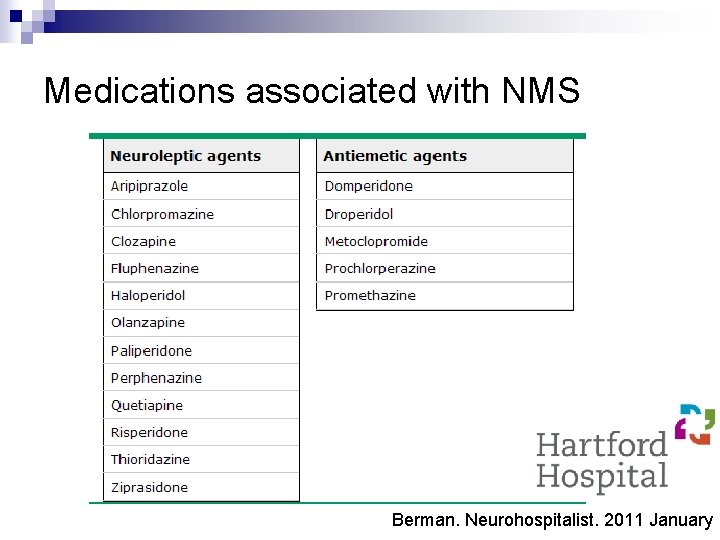
Medications associated with NMS Berman. Neurohospitalist. 2011 January
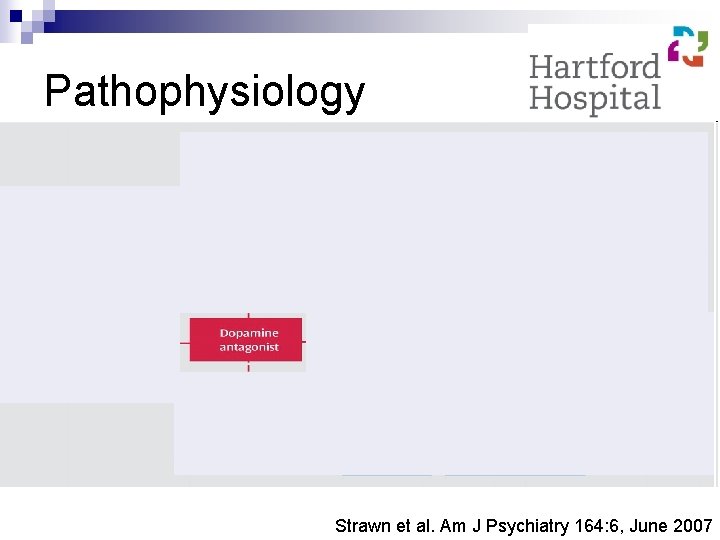
Pathophysiology Strawn et al. Am J Psychiatry 164: 6, June 2007
Clinical presentation n n Within 2 weeks after exposure Most cases hours to days after exposure Muscular rigidity followed by hyperthermia in several hours, along with wide range of altered mental status ¨ Drowsiness, agitation, confusion, delirium, coma Autonomic dysfunction: labile BP, tachypnea, tachycardia, sialorrhea, diaphoresis, flushing, skin pallor, incontinence Berman. Neurohospitalist. 2011 January
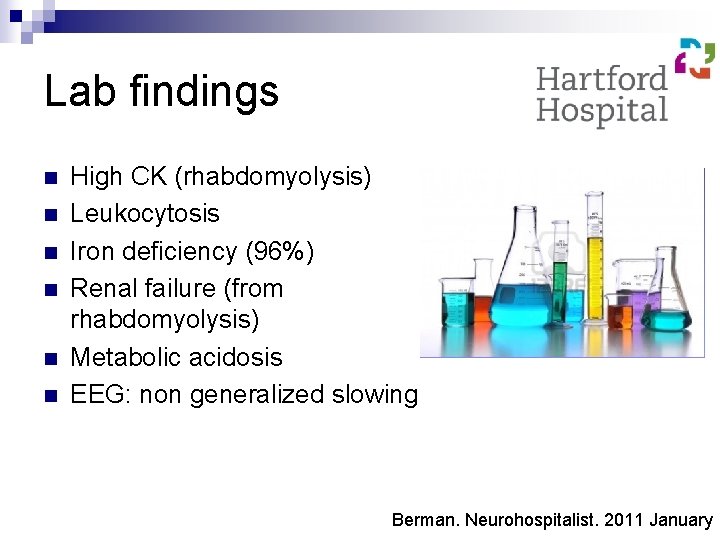
Lab findings n n n High CK (rhabdomyolysis) Leukocytosis Iron deficiency (96%) Renal failure (from rhabdomyolysis) Metabolic acidosis EEG: non generalized slowing Berman. Neurohospitalist. 2011 January
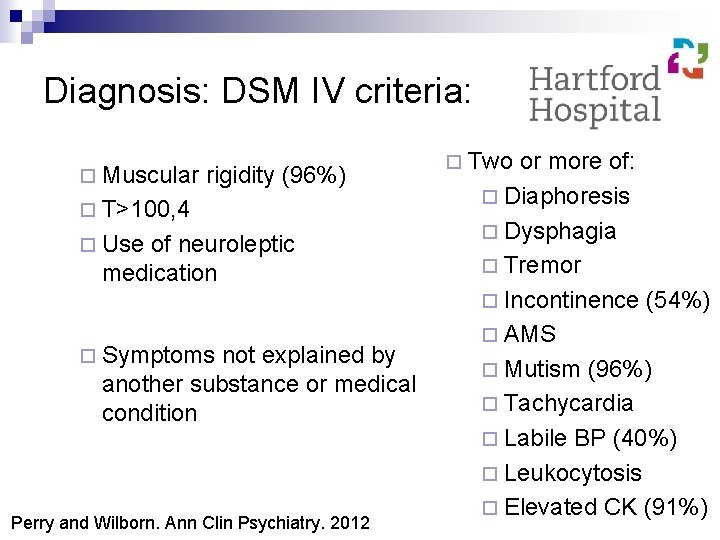
Diagnosis: DSM IV criteria: ¨ Muscular rigidity (96%) ¨ T>100, 4 ¨ Use of neuroleptic medication ¨ Two or more of: ¨ Diaphoresis ¨ Dysphagia ¨ Tremor ¨ Incontinence (54%) ¨ Symptoms not explained by another substance or medical condition ¨ AMS ¨ Mutism (96%) ¨ Tachycardia ¨ Labile BP (40%) ¨ Leukocytosis Perry and Wilborn. Ann Clin Psychiatry. 2012 ¨ Elevated CK (91%)
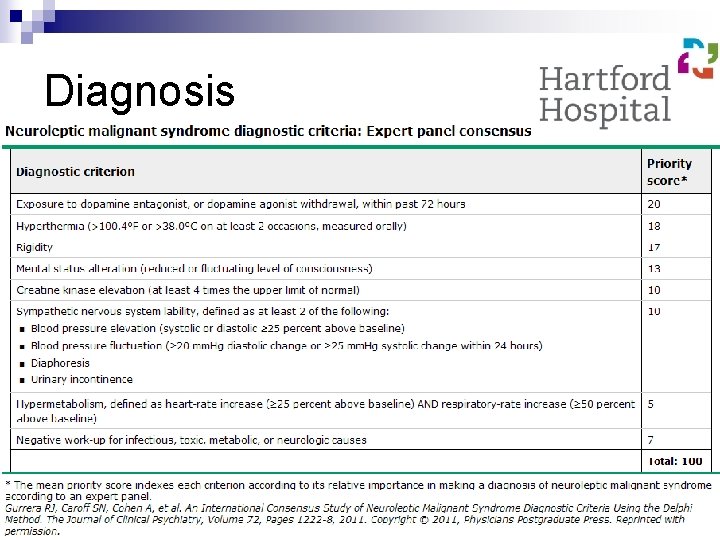
Diagnosis n DSM IV criteria: ¨ Severe muscular rigidity and high temperature, associated with use of neuroleptic medication ¨ Two or more of: diaphoresis, dysphagia, tremor, incontinence, AMS, mutism, tachycardia, labile BP, leukocytosis, elevated CK ¨ Symptoms not explained by another substance or medical condition
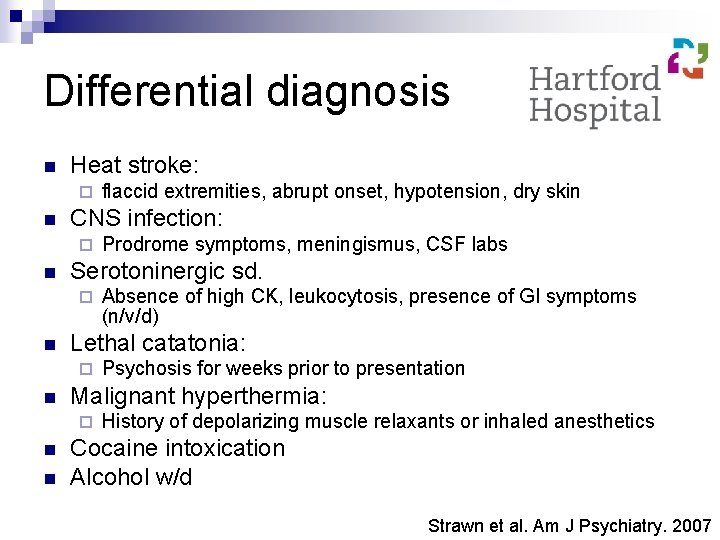
Differential diagnosis n Heat stroke: ¨ n CNS infection: ¨ n n Psychosis for weeks prior to presentation Malignant hyperthermia: ¨ n Absence of high CK, leukocytosis, presence of GI symptoms (n/v/d) Lethal catatonia: ¨ n Prodrome symptoms, meningismus, CSF labs Serotoninergic sd. ¨ n flaccid extremities, abrupt onset, hypotension, dry skin History of depolarizing muscle relaxants or inhaled anesthetics Cocaine intoxication Alcohol w/d Strawn et al. Am J Psychiatry. 2007
Management n n n n Neurologic emergency ¨ Many will need ICU level of care Stop neuroleptic Restart dopaminergic meds in withdrawal (levodopa) Aggressive hydration (if high CK, AKI) Control temperature Bicarb for AKI Cardio respiratory support Adnet et al. Br J Anaest. 2000 Reulbach et al. Critical Care 2007
Management n Bromocriptine: dopaminergic ¨ PO or NGT ¨ 2. 5 mg BID or TID ¨ increase up to 45 mg/d ¨ Monitor liver function n Benzodiazepines: ¨ ¨ ¨ Reasonable first line 1 -2 mg IV/IM q 4 -6 h Mild/moderate cases or primarily catatonic symptoms Strawn et al. Am J Psychiatry. 2007 Reulbach et al. Critical Care. 2007
Management n n n Amantadine: anticholinergic ¨ 100 mg PO/NGT q 8 h ¨ Moderate cases Dantrolene: muscle relaxant, inhibits calcium release from sarcoplasmic reticulum ¨ Severe cases (T >104, HR >120) ¨ 2. 5 mg/Kg + 1 mg/Kg q 6 h IV ¨ Increase up to 10 mg/Kg/d ¨ Stop once symptoms resolving (resp failure/hepatotoxicity) ECT: ¨ Cases with no response to medications/supportive care Strawn et al. Am J Psychiatry. 2007 Reulbach et al. Critical Care. 2007
Complications n n n Renal failure DIC Rhabdomyolysis MI Asp. PNA Seizures, arrhythmias (lyte abnormalities) Reulbach et al. Critical Care 2007
When to restart neuroleptics n n n Wait 2 weeks for PO antipsychotics Wait 5 weeks for depot forms Change neuroleptic med Switch from typical to atypical Start at low doses, titrate slowly Neuroleptic Malignant Syndrome Information Service. 2011. http: //www. nmsis. org
Prognosis n Mortality ~40% before 1984 ¨ Mortality greatly reduced (~10%) when recognized and treated early n n n Recurrence of NMS in 30 -50% cases after restarting neuroleptics Complete recovery in first 2 days to 2 weeks Mortality 2/2 arrhythmia, DIC, renal or CV complications Bottoni. Hospital physician. 2002
Take home points… n n n NMS is a rare but severe reaction to dopamine blocking agents or withdrawal to dopaminergic agents Early recognition is critical in preventing significant morbidity and mortality Main manifestations are muscular rigidity, hyperthermia and history of medication intake or abrupt cessation Main management consists of stopping offending agent/restarting dopaminergic, aggressive hydration and temperature control Medications for NMS treatment include benzos, dantrolene, Many will require ICU level 2/2 cardiorespiratory decompensation

Thank you!
- Slides: 20