
Morality as a Social Contract Why Be Moral
Morality as a Social Contract
Why Be Moral? § We’ve looked at the idea that we are always motivated to promote our own self interest § Psychological egoism § And that we ought to maximise our own good, or advantage § Ethical egoism
Egoism and morality § Perhaps it is in the egoist’s long term self interest to ‘play by the rules’ § ‘enlightened self interest’ or ‘enlightened egoism’ § Is it, though? § Let’s try an experiment: § The Prisoner’s Dilemma
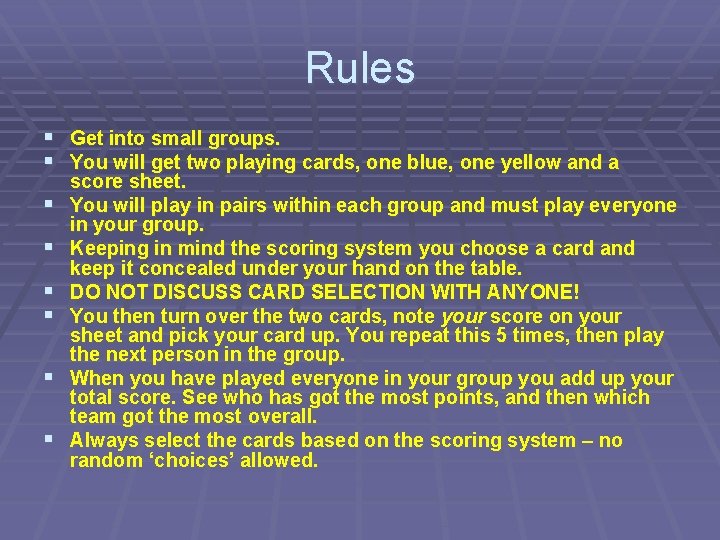
Rules § Get into small groups. § You will get two playing cards, one blue, one yellow and a § § § score sheet. You will play in pairs within each group and must play everyone in your group. Keeping in mind the scoring system you choose a card and keep it concealed under your hand on the table. DO NOT DISCUSS CARD SELECTION WITH ANYONE! You then turn over the two cards, note your score on your sheet and pick your card up. You repeat this 5 times, then play the next person in the group. When you have played everyone in your group you add up your total score. See who has got the most points, and then which team got the most overall. Always select the cards based on the scoring system – no random ‘choices’ allowed.

Scoring System If you play And your opponent plays You will score blue +3 blue yellow -2 yellow blue +5 yellow 0
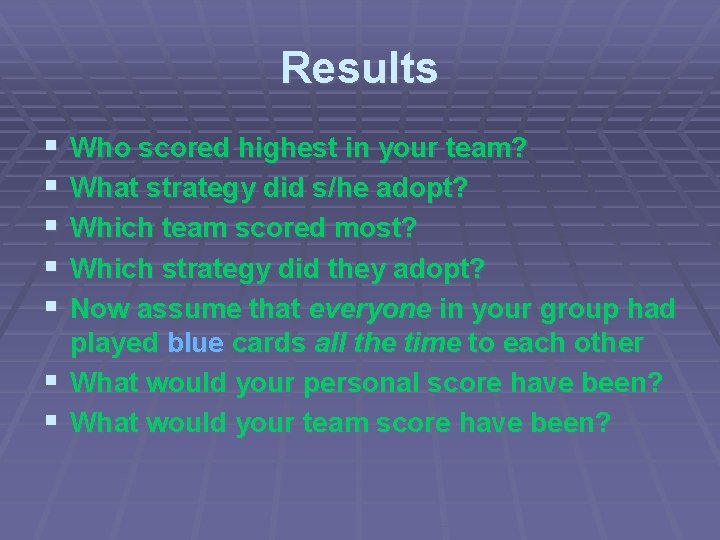
Results § § § Who scored highest in your team? What strategy did s/he adopt? Which team scored most? Which strategy did they adopt? Now assume that everyone in your group had played blue cards all the time to each other § What would your personal score have been? § What would your team score have been?
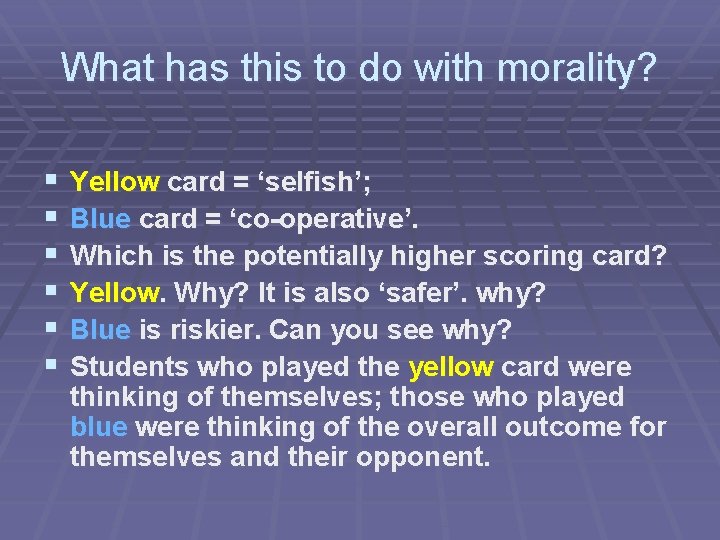
What has this to do with morality? § § § Yellow card = ‘selfish’; Blue card = ‘co-operative’. Which is the potentially higher scoring card? Yellow. Why? It is also ‘safer’. why? Blue is riskier. Can you see why? Students who played the yellow card were thinking of themselves; those who played blue were thinking of the overall outcome for themselves and their opponent.
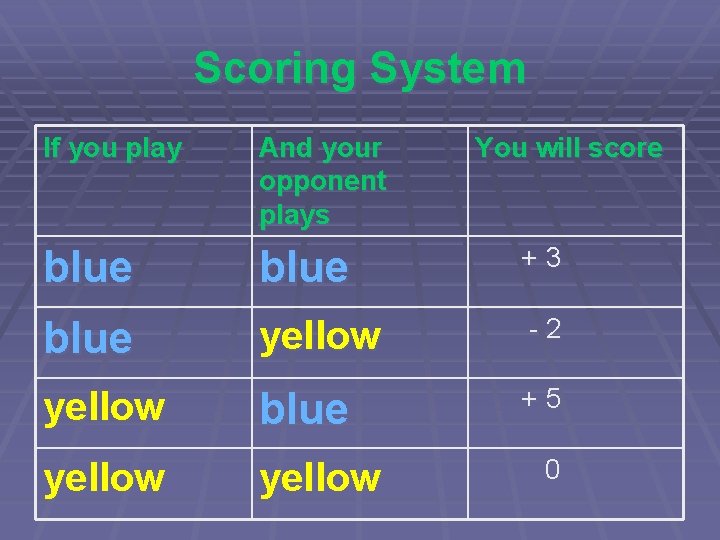
Scoring System If you play And your opponent plays You will score blue +3 blue yellow -2 yellow blue +5 yellow 0
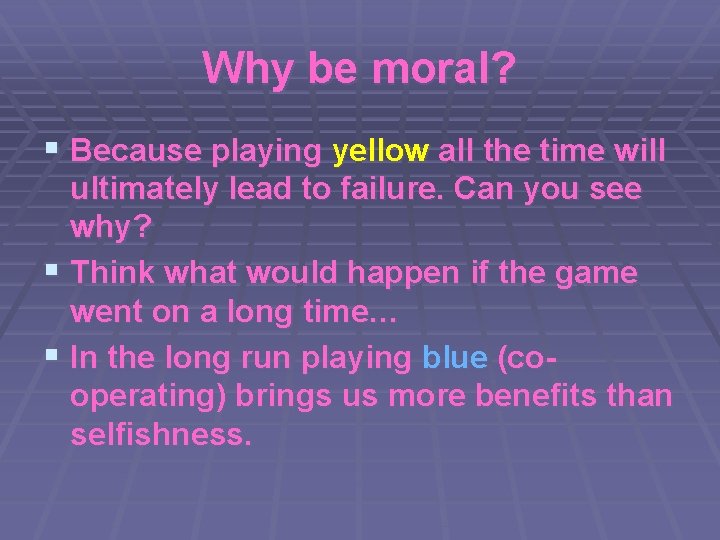
Why be moral? § Because playing yellow all the time will ultimately lead to failure. Can you see why? § Think what would happen if the game went on a long time… § In the long run playing blue (cooperating) brings us more benefits than selfishness.
Are there any situations like this in real life? § Situations in which it appears to be in our interest to be selfish/immoral but where the consequences of everyone acting this way would be damaging to our self interest. § Queue jumping § Stealing library books

Taking it further. . § What are the origins of morality? § Is this ‘enlightened self interest’ really what morality is? § Why is it called ‘the prisoner’s dilemma’?
Social Contract § Enlightened egoists come to realise that they need to make a contract with others. This limits threats from others and maximises the benefits of being in a team. § In this sense morality is a convention – an agreement on a set of rules that is to our mutual advantage. It’s a contract or ‘covenant’. § I need peace, stability, security – and this delivers it.
Imagining a contract § Some might object that we have never signed § § a contract like this! But we might argue hypothetically that we would agree to moral conventions to maximise our interests. Advantage: We can reconsider current moral rules and see if they are still agreed by us (are they in our interests) Contracts are not good in themselves; just the best way to achieve our interests. But. .
But. . § Objection: Would the egoist be tempted to § § § cheat on any contracts if he could get away with it? (playing the yellow card) Objection: Do we all actually agree on what a good life is? Do we actually have shared interests? We will look at 3 philosopher’s versions of the social contract. John Rawls Thomas Hobbes John Locke
The Veil of Ignorance § If you were going to commit yourself in advance to a set of § § § rules for all, what would you choose? Imagine yourself behind a veil of ignorance. Behind this veil, you know nothing of yourself and your natural abilities, or your position in society. You know nothing of anyone’s sex, race, nationality, or individual tastes – including your own. Behind such a veil of ignorance all individuals are simply known to be rational, free, and equal. You do know that in the "real world", there will be a wide variety in the natural distribution of natural assets and abilities, and that there will be differences of sex, race, and culture that will distinguish groups of people from each other. Why has Rawls set the situation up like this? What sort of rules for society would you design?
Consider: What about ‘free riders’? Which is most important to aim at, liberty or equality? Where should the emphasis lie – with the good of the community, or the rights of the individual? What about the poorest, or least fortunate?
Result? § Rawls’ view: § Rawls thought any rational contract designed § § like this would base itself on three principles: Equal opportunities Liberty for all Difference principle (any arrangements must still benefit everyone, overall) Did you come to the same conclusion?
What problems might there be with Rawls’ version of the SC? § Western, left liberal and individualist § Treats morality as if it were just a legal contract § The 3 principles may be in conflict – can you see how?
- Slides: 19