
Moral Reasoning Schemas and Views on Science Technology
- Slides: 14
Moral Reasoning Schemas and Views on Science, Technology and Society in Biomedical Graduate Students and Faculty Ann M. Peiffer, J. Charles Eldridge, and Nancy L. Jones Project Funding NSF 0530028 to NLJ & CE; WFU Graduate School; & NIH NS 544722 to AMP
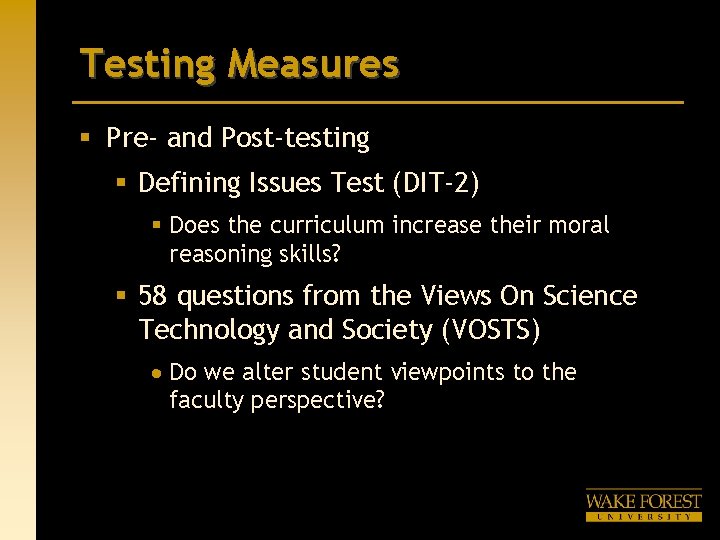
Testing Measures § Pre- and Post-testing § Defining Issues Test (DIT-2) § Does the curriculum increase their moral reasoning skills? § 58 questions from the Views On Science Technology and Society (VOSTS) Do we alter student viewpoints to the faculty perspective?
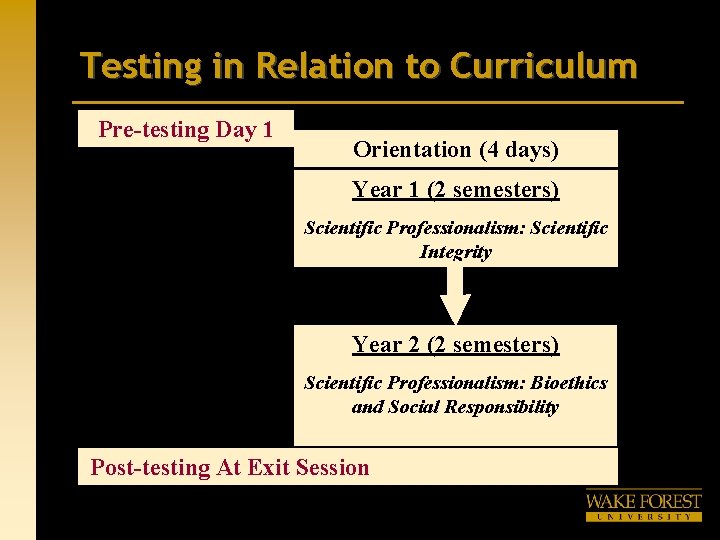
Testing in Relation to Curriculum Pre-testing Day 1 Orientation (4 days) Year 1 (2 semesters) Scientific Professionalism: Scientific Integrity Year 2 (2 semesters) Scientific Professionalism: Bioethics and Social Responsibility Post-testing At Exit Session
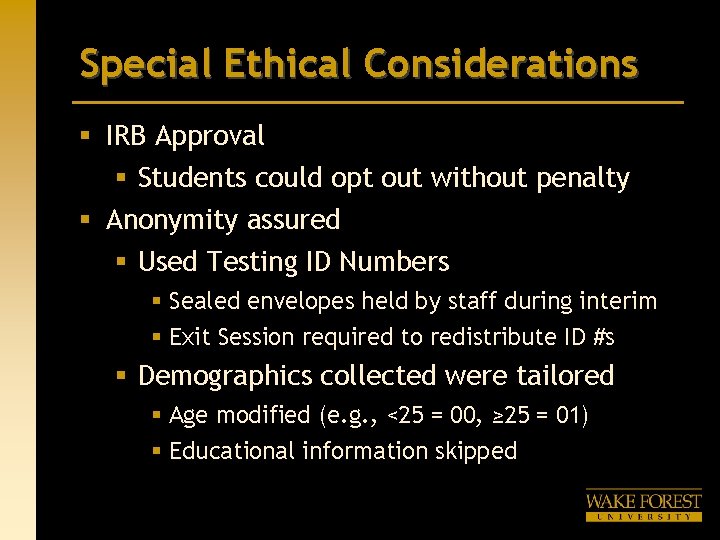
Special Ethical Considerations § IRB Approval § Students could opt out without penalty § Anonymity assured § Used Testing ID Numbers § Sealed envelopes held by staff during interim § Exit Session required to redistribute ID #s § Demographics collected were tailored § Age modified (e. g. , <25 = 00, ≥ 25 = 01) § Educational information skipped
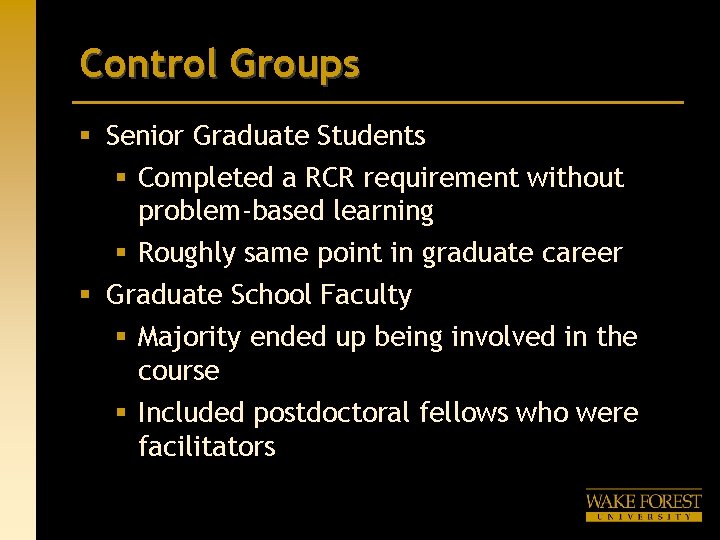
Control Groups § Senior Graduate Students § Completed a RCR requirement without problem-based learning § Roughly same point in graduate career § Graduate School Faculty § Majority ended up being involved in the course § Included postdoctoral fellows who were facilitators
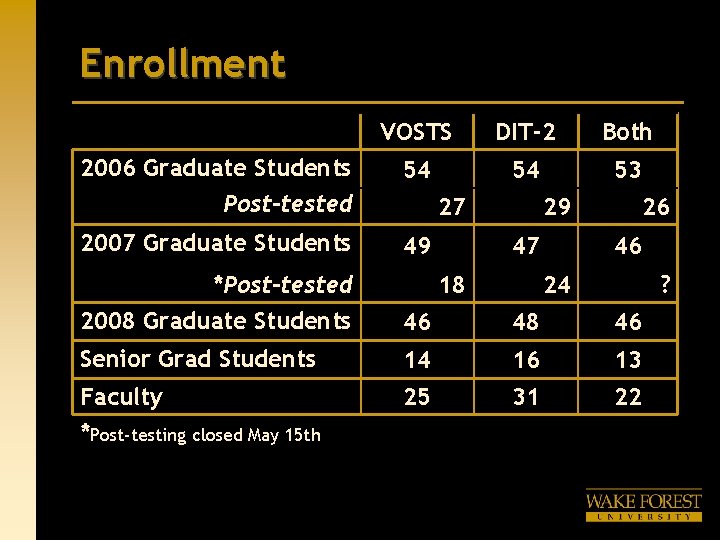
Enrollment 2006 Graduate Students VOSTS DIT-2 Both 54 54 53 Post-tested 2007 Graduate Students 27 49 29 47 18 26 46 *Post-tested 2008 Graduate Students 24 ? 46 48 46 Senior Grad Students 14 16 13 Faculty *Post-testing closed May 15 th 25 31 22
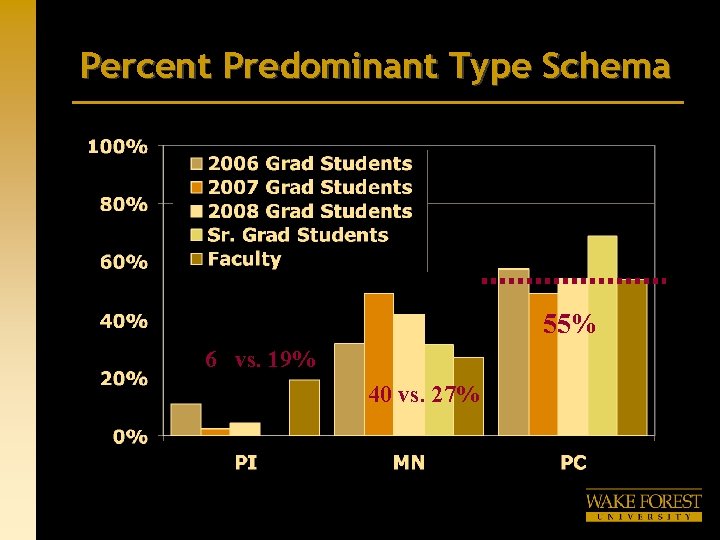
Percent Predominant Type Schema 55% 6 vs. 19% 40 vs. 27%
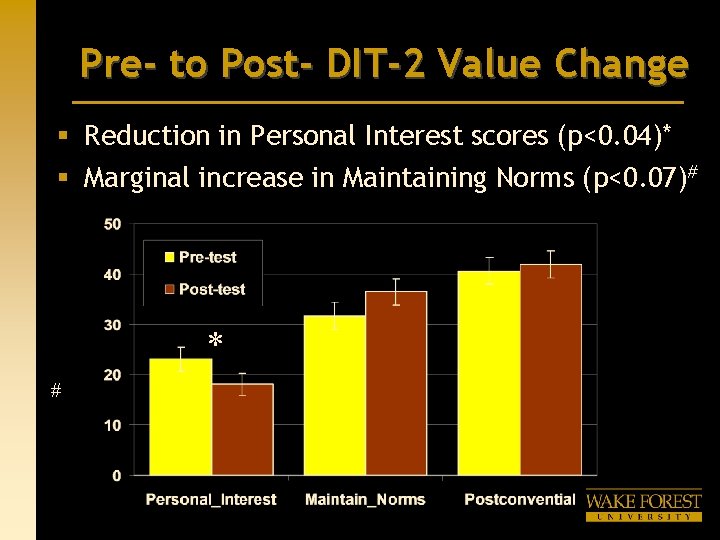
Pre- to Post- DIT-2 Value Change § Reduction in Personal Interest scores (p<0. 04)* § Marginal increase in Maintaining Norms (p<0. 07)# * #
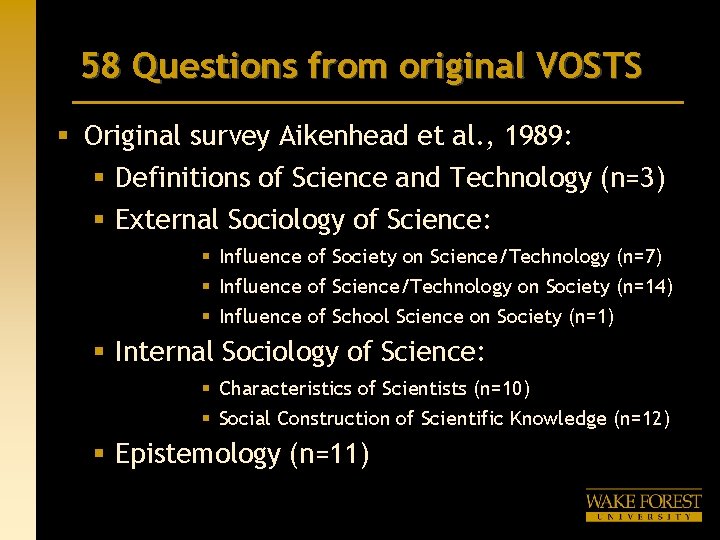
58 Questions from original VOSTS § Original survey Aikenhead et al. , 1989: § Definitions of Science and Technology (n=3) § External Sociology of Science: § Influence of Society on Science/Technology (n=7) § Influence of Science/Technology on Society (n=14) § Influence of School Science on Society (n=1) § Internal Sociology of Science: § Characteristics of Scientists (n=10) § Social Construction of Scientific Knowledge (n=12) § Epistemology (n=11)
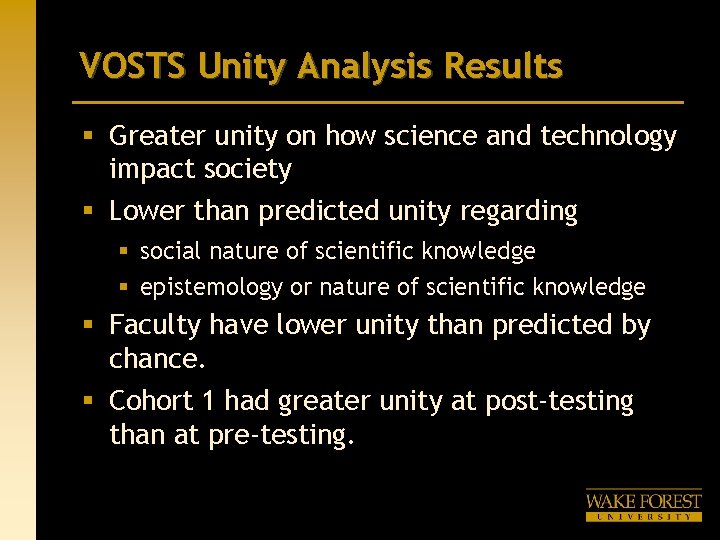
VOSTS Unity Analysis Results § Greater unity on how science and technology impact society § Lower than predicted unity regarding § social nature of scientific knowledge § epistemology or nature of scientific knowledge § Faculty have lower unity than predicted by chance. § Cohort 1 had greater unity at post-testing than at pre-testing.
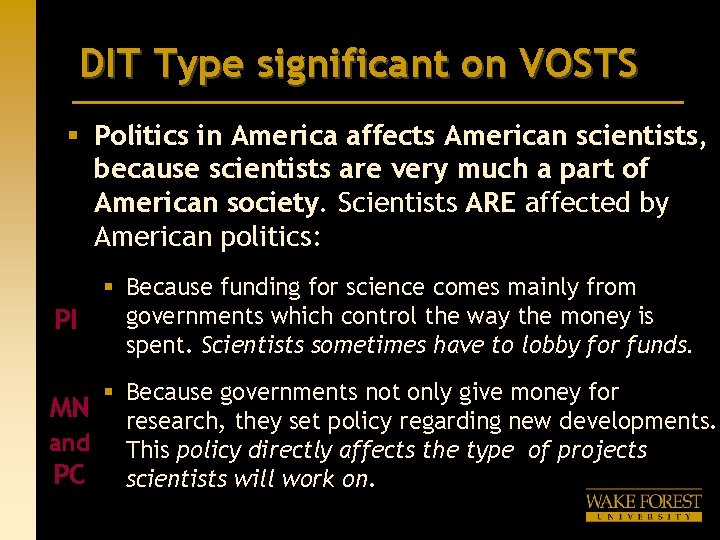
DIT Type significant on VOSTS § Politics in America affects American scientists, because scientists are very much a part of American society. Scientists ARE affected by American politics: PI § Because funding for science comes mainly from governments which control the way the money is spent. Scientists sometimes have to lobby for funds. § Because governments not only give money for MN research, they set policy regarding new developments. and This policy directly affects the type of projects PC scientists will work on.
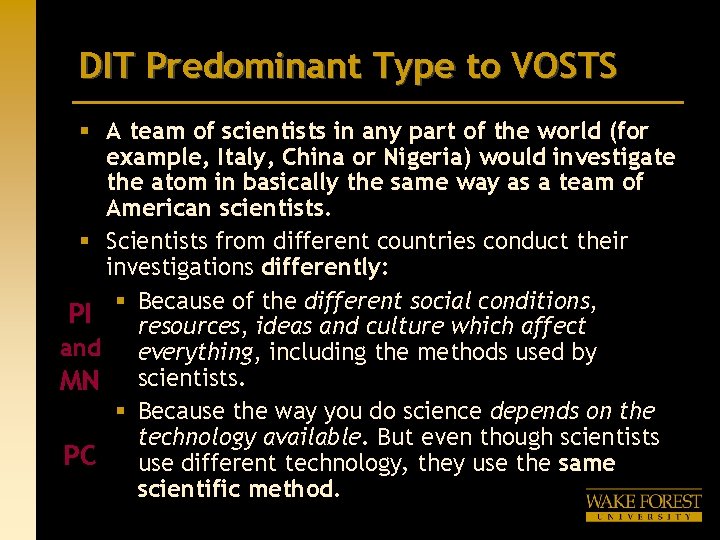
DIT Predominant Type to VOSTS § A team of scientists in any part of the world (for example, Italy, China or Nigeria) would investigate the atom in basically the same way as a team of American scientists. § Scientists from different countries conduct their investigations differently: § Because of the different social conditions, PI resources, ideas and culture which affect and everything, including the methods used by MN scientists. § Because the way you do science depends on the technology available. But even though scientists PC use different technology, they use the same scientific method.
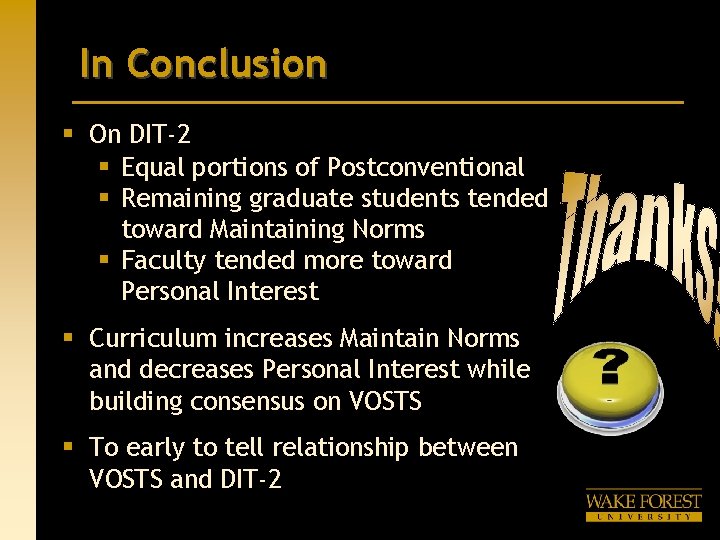
In Conclusion § On DIT-2 § Equal portions of Postconventional § Remaining graduate students tended toward Maintaining Norms § Faculty tended more toward Personal Interest § Curriculum increases Maintain Norms and decreases Personal Interest while building consensus on VOSTS § To early to tell relationship between VOSTS and DIT-2
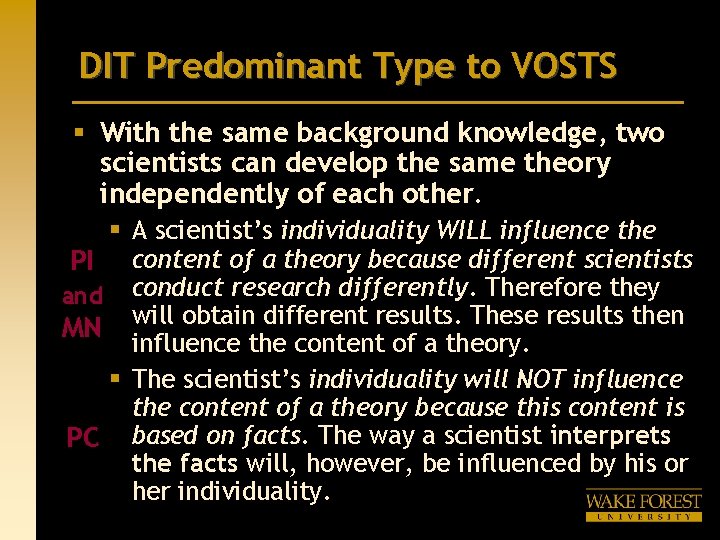
DIT Predominant Type to VOSTS § With the same background knowledge, two scientists can develop the same theory independently of each other. § A scientist’s individuality WILL influence the PI content of a theory because different scientists and conduct research differently. Therefore they will obtain different results. These results then MN influence the content of a theory. § The scientist’s individuality will NOT influence the content of a theory because this content is PC based on facts. The way a scientist interprets the facts will, however, be influenced by his or her individuality.