
Moral Reasoning Ethical Theories What is Ethics The
- Slides: 14
Moral Reasoning & Ethical Theories
What is Ethics? § The field of ethics, also called moral philosophy, involves systematizing, defending, and recommending concepts of right and wrong behavior.
Greek Virtue Ethics § Ethics comes from the Greek Ethos, meaning “character” and Ethike aretai, meaning “skills of character” § They asked “what is a Good Physician? ” § A Physician keeps people alive…ergo…The Hippocratic Oath which adopted a sanctity of life worldview
Morals, Ethics & Law “What’s the Difference? ” § Morals : Personal Sense of Right and Wrong § Ethics: Professional/Social Sense of Right and Wrong § Law: When wrong actions are punished by society
Christian Virtue Ethics § The virtue of Christian Compassion in Medicine emphasized “suffering with the patient” § At this point in time there were two schools of Medicine, naturalistic and religious
Natural Law Theory § “What is…ought to be. ” § Thomas Aquinas in the 11 th century said that a rational god made the world work rationally and gave humans the ability to discover his rationale
Doctrine of Double Effect § If an action has two effects, one good and the other evil, the action is morally permissible § If there was a good intention § If the good happened at exactly the same time as the evil § If only the Good was actually intended § If there was an important enough reason for performing the action and risking the evil outcome
Social Contract Theory § Assumes that people are fundamentally self-interested and that moral rules have evolved for humans to get along with one another.
Kantian Ethics § A right act always treats other humans as end-in-themselves, never as a mere means
Utilitarianism § Right acts produce the greatest amount of good for the greatest number of people § Four Tenets 1. 2. 3. 4. Consequentialism The Maximization Principle A Theory of Value A scope-of-morality premise
Case-Based Reasoning § Also known as Casuistry § Analyzes cases by comparing them to other cases rather than using philosophical principles § Also looks at each case as a unique situation and not a precedent
Pragmatism § Whatever methods has the best outcome is the best way to go
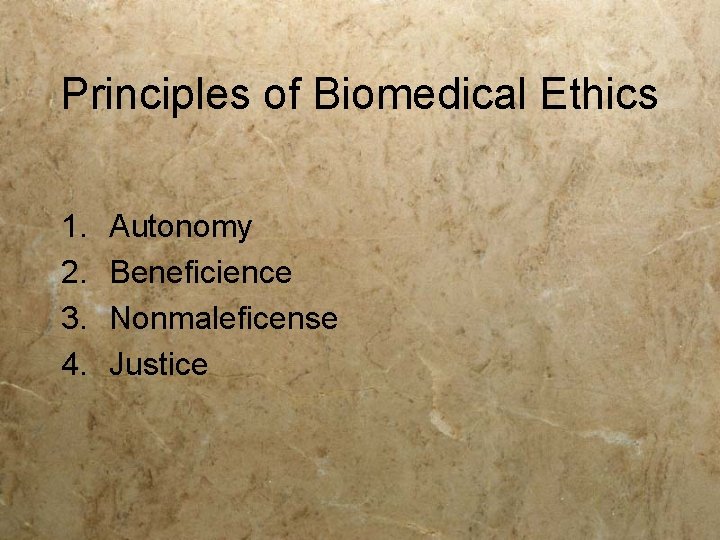
Principles of Biomedical Ethics 1. 2. 3. 4. Autonomy Beneficience Nonmaleficense Justice
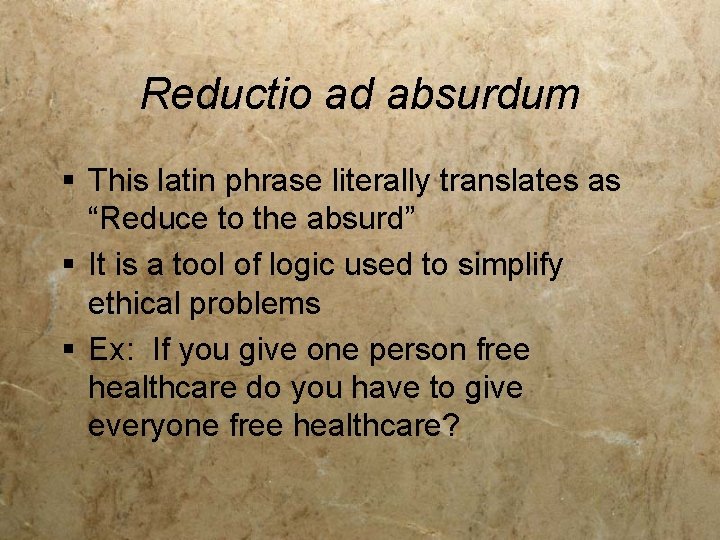
Reductio ad absurdum § This latin phrase literally translates as “Reduce to the absurd” § It is a tool of logic used to simplify ethical problems § Ex: If you give one person free healthcare do you have to give everyone free healthcare?