
Moral DevelopmentKohlberg Came up with a stage theory
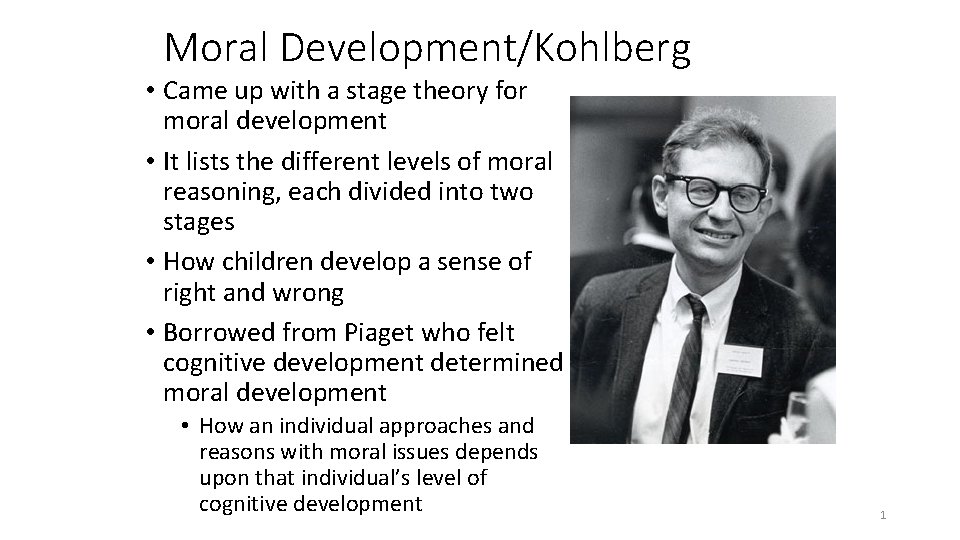
Moral Development/Kohlberg • Came up with a stage theory for moral development • It lists the different levels of moral reasoning, each divided into two stages • How children develop a sense of right and wrong • Borrowed from Piaget who felt cognitive development determined moral development • How an individual approaches and reasons with moral issues depends upon that individual’s level of cognitive development 1
Heinz’s Dilemma Kohlberg used “Heinz’s Dilemma” in his experiments. It goes something like this: “ In Europe, a woman was near death from cancer. One drug might save her, a form of radium that a druggist in the same town had recently discovered. The druggist was charging $2000, ten times what the drug cost him to make. The sick woman’s husband, Heinz, went to everyone he knew to borrow money, but could only get together about half of what the drug cost. He told the druggist that his wife was dying and asked him to sell it cheaper or let him pay later, but the druggist said, “No. ” Heinz then got desperate and broke into the man’s store to steal the drug for his wife. Should he have done that? Why or why not? 2
Stages 1– 2: Preconventional Level (Ages Birth-6) • Younger children are at what Kohlberg called the preconventional level • Children at this level think in terms of rewards and punishments • Stage 1: Punishment orientation • There is no difference between doing what’s right and avoiding punishment • An act is wrong if there is punishment • “It’s not wrong if I don’t get caught” • Stage 2: Negative reward orientation • Interest shifts to rewards rather than punishment • Effort is made to secure greatest benefit for oneself • Tit for tat mentality (“You can copy if I can see your test”) 3
Stages 3– 4: Conventional Level (Ages 7 -11) • Older children are at the conventional level • Stage 3: Good boy/good girl orientation • Begin to see rules as necessary for maintaining order • Rules are internalized in order to win approval from others • Concerned with maintaining interpersonal relations • Stage 4: Authority orientation • See rules as absolute • The purpose of morality is maintaining the social order • societies make rules and laws that prohibit “wrong” acts 4
Stages 5– 6: Post-conventional Level (12 and up) • Stage 5: Social contract orientation • During adolescence, teens begin the process of working out their own personal code of ethics • They no longer view rules as completely rigid • They start to understand that society’s rules governing right and wrong are fallible and not absolute • Stage 6: Individual principles and conscience orientation • Teens also learn that sometimes people don’t comply with society’s rules if these rules violate their own personal principles or go against their conscience • Adolescents begin to view right and wrong as determined not by society’s rules and laws, but by abstract principles that emphasize justice and equal treatment • Answer to an inner conscience 5
- Slides: 5