
Moral Development p Childrens moral developmentan understanding of
- Slides: 22
Moral Development p Children’s moral development—an understanding of right and wrong—and ultimately a child’s behavior-is influenced by: n n n Affective or emotional component: guilt, empathy, sense of conscience Cognitive component: how we think about right and wrong Behavioral component: how we actually behave we experience temptation to lie, cheat, or violate moral rules
Affective Component p Probably least understood n n n Freudian theory or guilt Temperament of child Parenting styles p E. g. , warmth-love, disciplinary approach
Behavioral Component Can be quite independent of both affect and understanding (e. g. , Clinton) p Again, is highly related to both personality and parenting p Again, the not well understood p E. g. , knowledge vs behavior– teen pregnancy p
Cognitive Component While moral behavior depends on socialization, it is also a process of cognitive development p One very influential theory was developed by Lawrence Kohlberg presented “moral dilemmas to children and studied how their answers changed with development p
Story of two brothers and dad p p Joe was working hard to earn money to attend a summer camp. He worked all year to make the necessary $500 Just before summer his Dad (a hard working, single father) decided he needed the money for a camping trip with friends He told Joe to give him the money. Should Joe refuse? Alex, Joe’s brother finds out that Joe really had earned $1, 000 not $500. Should Alex tell the father?
Conscientious Objector? p During a time of war, should people be allowed out of the military because they morally do not believe in killing?
Kohlberg Moral Dilemma p In Europe, a woman was near death from cancer. One drug might save her, a form of radium that a druggist in the same town had recently discovered. The druggist was charging $2, 000, ten times what the drug cost him to make. The sick woman’s husband, Heinz, went to everyone he knew to borrow the money, but he could get together only about half of what it cost. He told the druggist that his wife was dying and asked him to sell it cheaper or let him pay later. But the druggist said no. The husband got desperate and broke into the man’s store to steal the drug for his wife. Should the husband have done that? Why?
Heinz Morality Story
Kohlberg’s Theory of Moral Judgment p p p On basis of longitudinal research, Kohlberg proposed that children develop moral reasoning through a specific series of stages that are discontinuous and hierarchical. Each stage reflects a qualitatively different, more adequate way of thinking than the one before. Kohlberg presented children with hypothetical moral dilemmas and questioned them about the issues involved.
Kohlberg’s 6 Stages p Age-related p Sequential p Universal
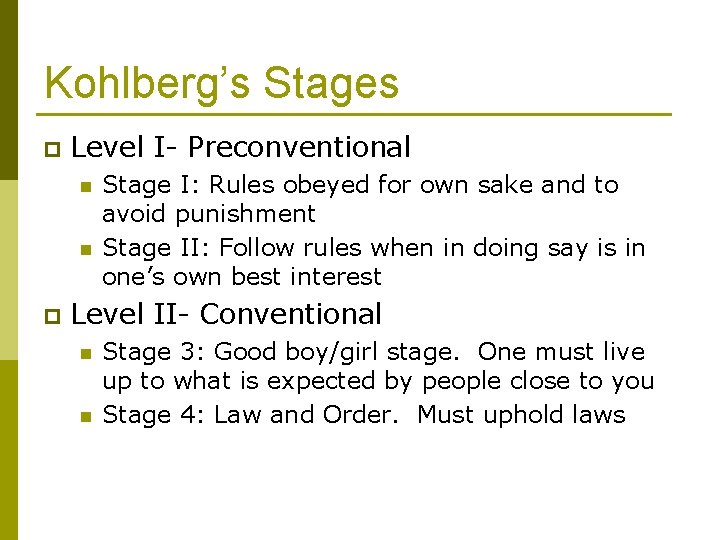
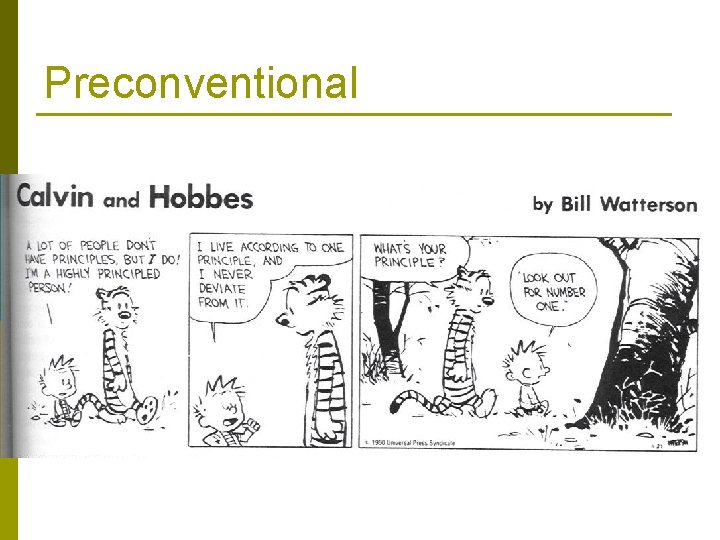
Kohlberg’s Stages p Level I- Preconventional n n p Stage I: Rules obeyed for own sake and to avoid punishment Stage II: Follow rules when in doing say is in one’s own best interest Level II- Conventional n n Stage 3: Good boy/girl stage. One must live up to what is expected by people close to you Stage 4: Law and Order. Must uphold laws
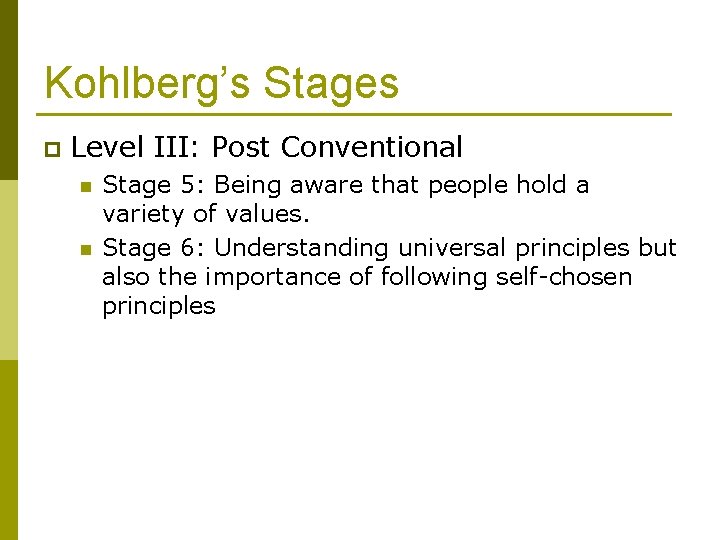
Kohlberg’s Stages p Level III: Post Conventional n n Stage 5: Being aware that people hold a variety of values. Stage 6: Understanding universal principles but also the importance of following self-chosen principles
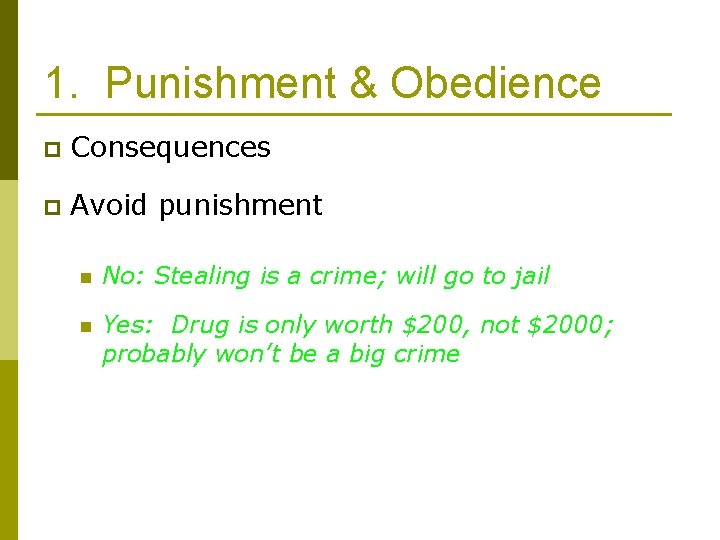
1. Punishment & Obedience p Consequences p Avoid punishment n No: Stealing is a crime; will go to jail n Yes: Drug is only worth $200, not $2000; probably won’t be a big crime
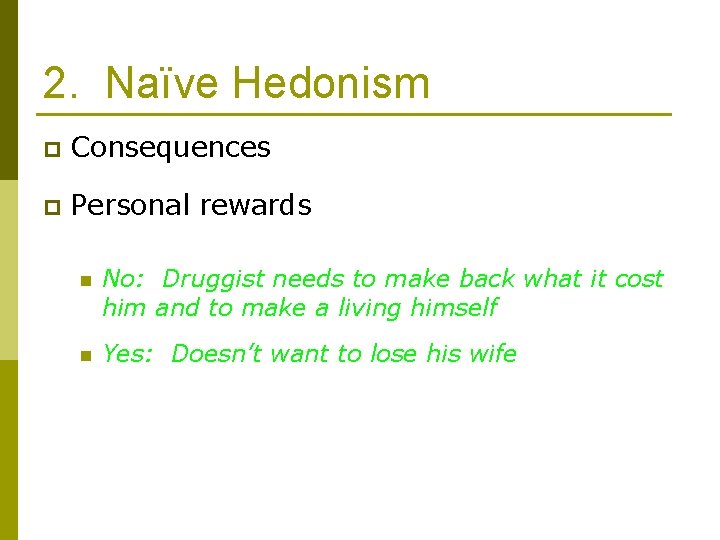
2. Naïve Hedonism p Consequences p Personal rewards n No: Druggist needs to make back what it cost him and to make a living himself n Yes: Doesn’t want to lose his wife
Preconventional
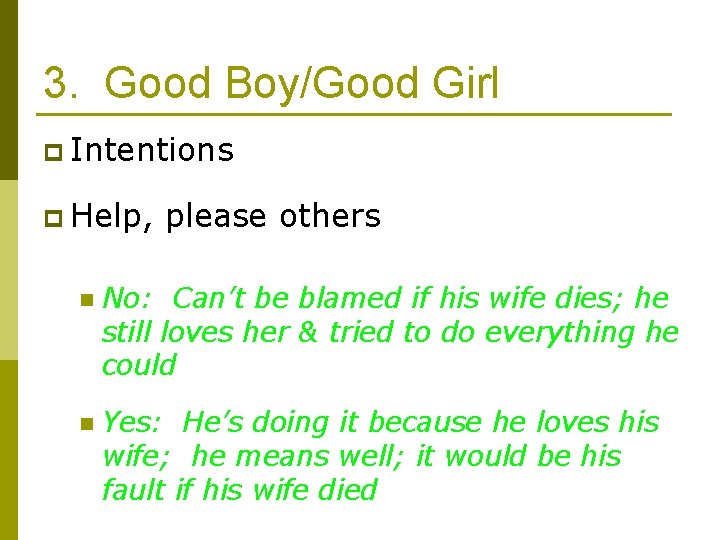
3. Good Boy/Good Girl p Intentions p Help, please others n No: Can’t be blamed if his wife dies; he still loves her & tried to do everything he could n Yes: He’s doing it because he loves his wife; he means well; it would be his fault if his wife died
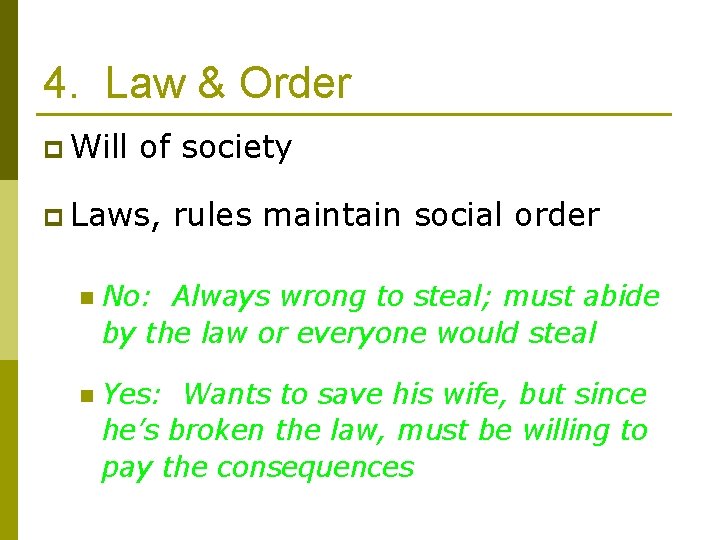
4. Law & Order p Will of society p Laws, rules maintain social order n No: Always wrong to steal; must abide by the law or everyone would steal n Yes: Wants to save his wife, but since he’s broken the law, must be willing to pay the consequences
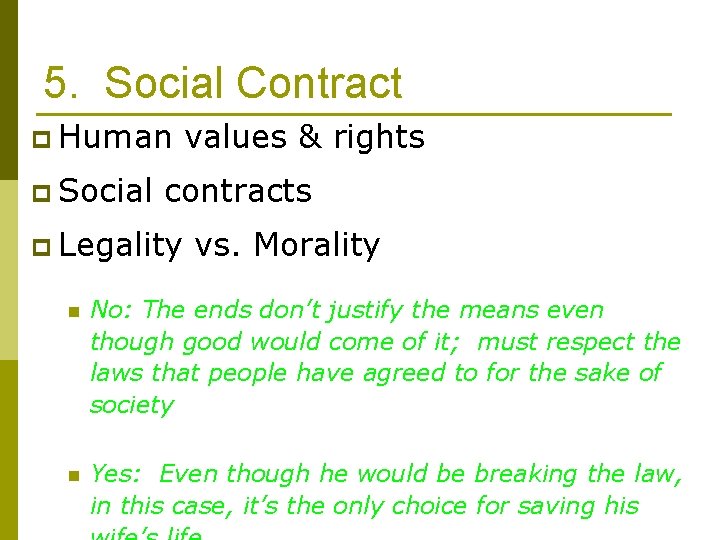
5. Social Contract p Human p Social values & rights contracts p Legality vs. Morality n No: The ends don’t justify the means even though good would come of it; must respect the laws that people have agreed to for the sake of society n Yes: Even though he would be breaking the law, in this case, it’s the only choice for saving his
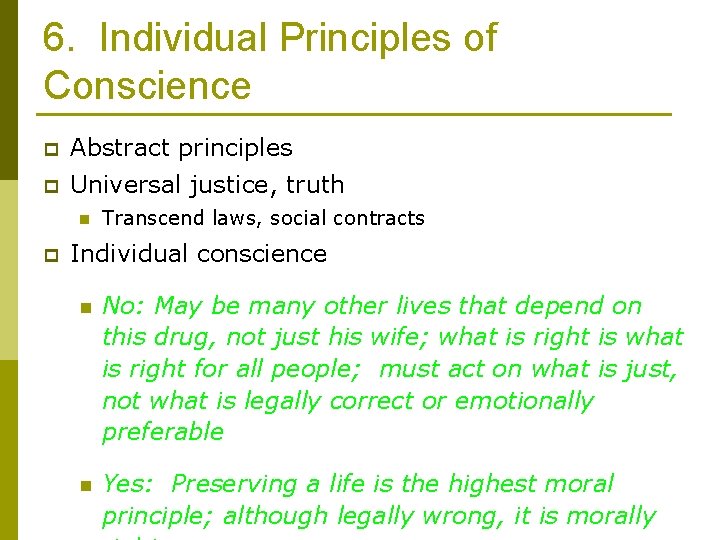
6. Individual Principles of Conscience p Abstract principles p Universal justice, truth n p Transcend laws, social contracts Individual conscience n No: May be many other lives that depend on this drug, not just his wife; what is right is what is right for all people; must act on what is just, not what is legally correct or emotionally preferable n Yes: Preserving a life is the highest moral principle; although legally wrong, it is morally
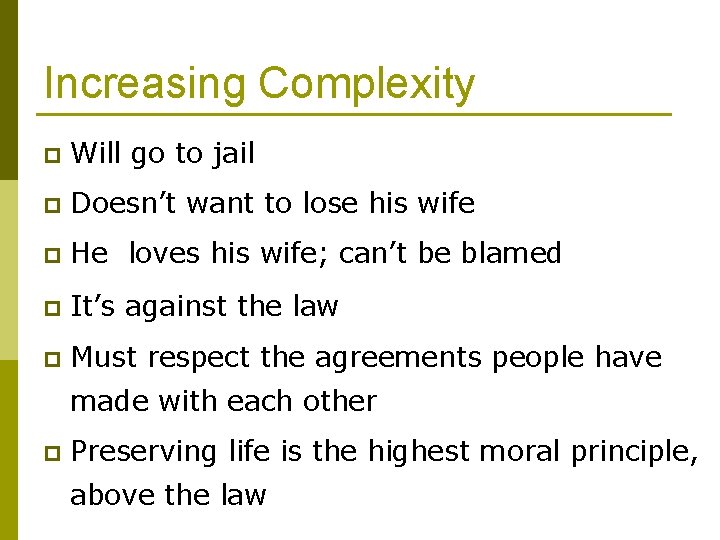
Increasing Complexity p Will go to jail p Doesn’t want to lose his wife p He loves his wife; can’t be blamed p It’s against the law p Must respect the agreements people have made with each other p Preserving life is the highest moral principle, above the law
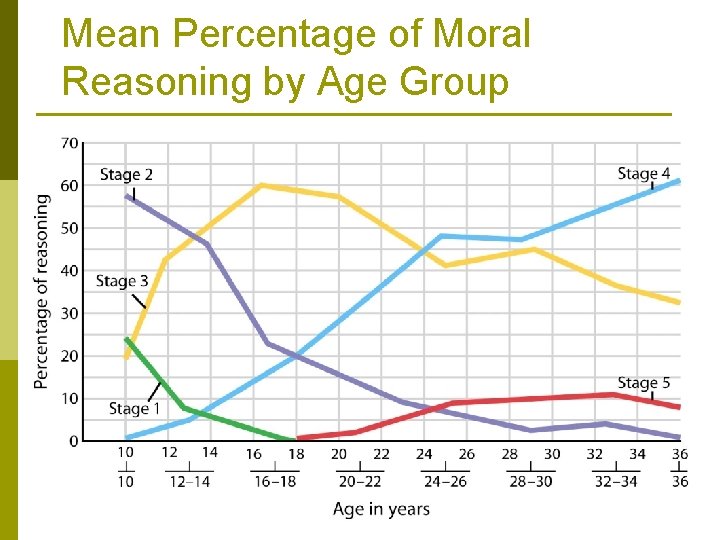
Mean Percentage of Moral Reasoning by Age Group
Role of Parents and Peers