
Moral Development Kohlberg Gilligan MORALITY ones ability to
Moral Development Kohlberg Gilligan
• MORALITY--> one's ability to distinguish between right and wrong, and to be able to act on this distinction. • MORAL DEVELOPMENT--> the process by which children acquire society's standards of what is right and wrong.
Is morality a topic of concern for children? Notions of fairness and justice in their environments: • recess (playing games)--> taking turns, following a set of rules. Upset this balance and the children get upset, it is “wrong to do this” • home--> Questions such as “why can't I stay up as late as you? ? You always get to watch what you want to watch. ” • chores--> participate and take part in doings tasks around the house, but are willing to lament about the fact that they “have to do everything”. • So in everyday situations, children abide by some rules, they have some sense of “right” and “wrong” and ask questions about how this came to be.
Heinz dilemma In Europe, a woman was near death from a special kind of cancer. There was one drug that doctors thought might save her. It was a form of radium that a druggist in the same town had recently discovered. The drug was expensive to make, but the druggist was charging $2000, or 10 times the cost of the drug, for a small (possibly life-saving dose). Heinz, the sick woman's husband, borrowed all the money he could, about $1000, or half of what he needed. He told the druggist that his wife was dying and asked him to sell the drug cheaper, or to let him pay later. The druggist replied “No, I discovered the drug, and I'm going to make money from it”. Heinz then became desperate and broke into the store to steal the drug from his wife. • Should Heinz have done that? • Kohlberg identified 3 stages of moral development – each with 2 sub-stages
KOHLBERG'S THEORY OF MORAL DEVELOPMENT • MORAL DILEMMAS. Each dilemma presented required the individual to choose between: (A) obeying a rule, law, or authority figure, or (B) taking some action which conflicts with these rules or commands while serving the welfare of others. • Kohlberg was less interested in what the subject's decision was (e. g. what Heinz should do), than in the underlying rationale. What is important is HOW they EXPLAINED their judgments. • 1) Like Piaget, Kohlberg developed stages of Moral development which follow some invariant sequence. • 2) Because each successive stage is built upon the foundation of an earlier one, each stage must be followed in a particular order. • 3) Again, according to Kohlberg, each stage represents a METHOD OF THINKING about a moral dilemma rather than a particular TYPE of moral decision.
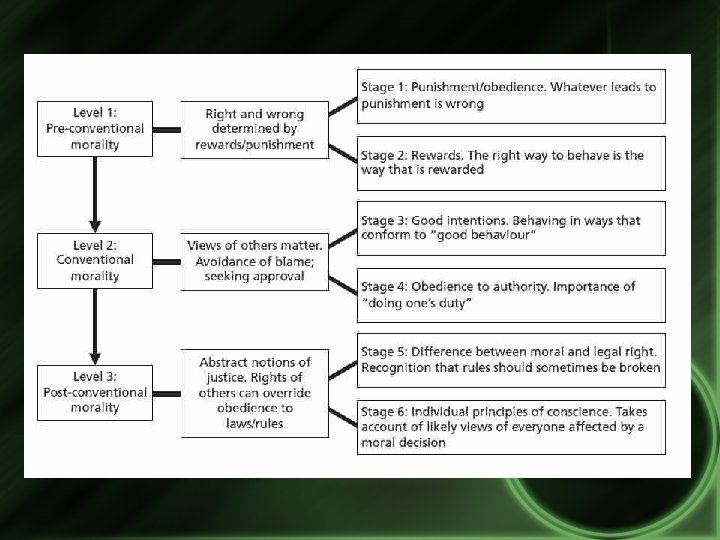
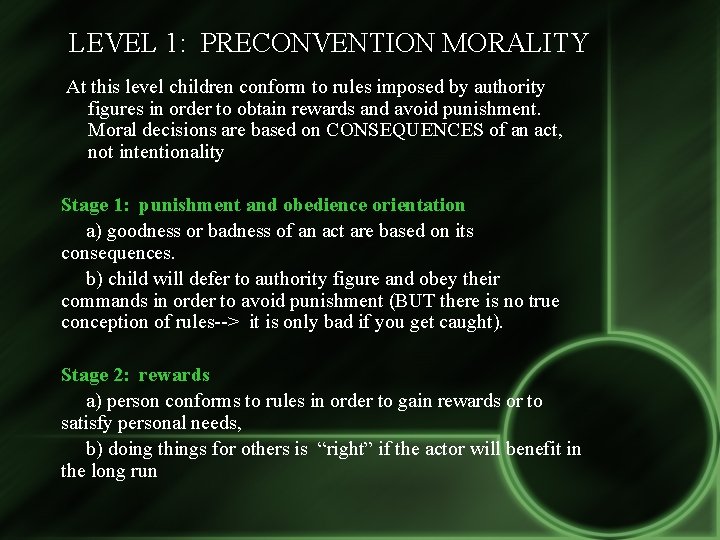
LEVEL 1: PRECONVENTION MORALITY At this level children conform to rules imposed by authority figures in order to obtain rewards and avoid punishment. Moral decisions are based on CONSEQUENCES of an act, not intentionality Stage 1: punishment and obedience orientation a) goodness or badness of an act are based on its consequences. b) child will defer to authority figure and obey their commands in order to avoid punishment (BUT there is no true conception of rules--> it is only bad if you get caught). Stage 2: rewards a) person conforms to rules in order to gain rewards or to satisfy personal needs, b) doing things for others is “right” if the actor will benefit in the long run
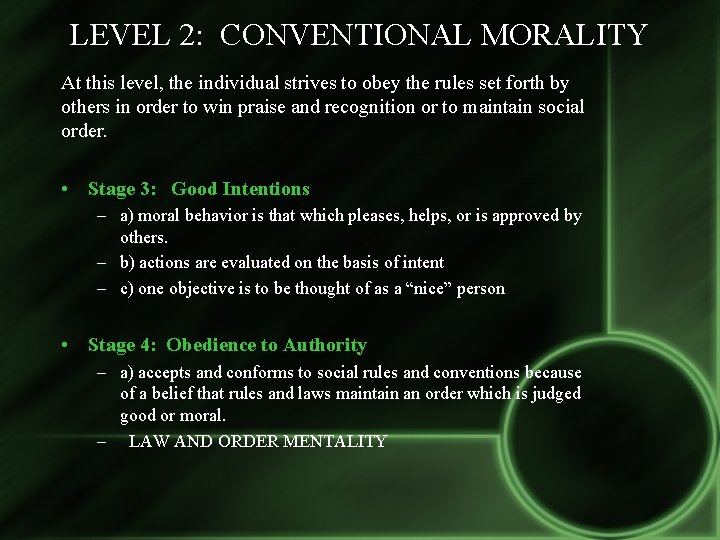
LEVEL 2: CONVENTIONAL MORALITY At this level, the individual strives to obey the rules set forth by others in order to win praise and recognition or to maintain social order. • Stage 3: Good Intentions – a) moral behavior is that which pleases, helps, or is approved by others. – b) actions are evaluated on the basis of intent – c) one objective is to be thought of as a “nice” person • Stage 4: Obedience to Authority – a) accepts and conforms to social rules and conventions because of a belief that rules and laws maintain an order which is judged good or moral. – LAW AND ORDER MENTALITY
LEVEL 3: POST-CONVENTIONAL MORALITY --moral standards are internalized and become the person's own. Stage 5: Social contract morality. – a) flexibility begins in moral reasoning – b) moral actions are those that express the will of the majority of individuals – c) a sense of having to live up to the law, but an understanding that laws can be wrong. Stage 6: Universal ethical principles – a) “highest” stage of moral reasoning – b) right and wrong defined on a personal belief or self-chosen ethics – c) belief in abstract principles which override all others (life, liberty, equality) – d) risk jail or social ostracism rather than violate personal ethics • This last stage is often considered to be a HYPOTHETICAL CONSTRUCT because very few people ever demonstrate this level of “saintliness”.
CRITICISMS: • rankings may reflect verbal abilities more so than moral level attained (young kids cannot express themselves) • Reflect a number of Biases: – political bias-- liberals tend to rank higher in this hierarchy (5 & 6) conservatives --> who believe in law and order are left in stage 4 – historical/generational bias • Validity questions: Questions which are asked are hypothetical and somewhat artificial. The dilemmas are not REAL to the subjects. • Moral talk vs. action • gender bias: – Kohlberg only tested males – Adult females are at stage 3, whereas adult males are at stage 4
Are women less moral? • YES -- Kohlberg (1971)-- suggests that women define the good as “what pleases or helps others” and is approved by them --Stage 3 • YES -- Freud (1925)-- Women show less sense of justice than men, that they are less ready to submit to the great urgency of life, that they are more often influenced in their judgments by feelings of affection or hostility. • YES -- Piaget (1965)-- the legal sense is far less developed in girls than in boys • Gwen Stefani (2000) - “I’m just a girl”
Carol Gilligan • Argues that the alleged inferiority of women has more to do with the standard by which moral development is measured rather than the quality of female's thinking. • In terms of development, girls are taught and trained to be more nurturing, empathetic, etc than males. • According to Kohlberg's model, the highest stages of moral development are defined in terms of traditional MASCULINE values: individuality, rationality, detachment, impersonality • The traditionally FEMININE values of caring, responsibility, welfare of others automatically force them to stay at level 3 and 4 because the dilemmas that are presented.
• Gilligan suggests that women are trained to be more interpersonalbound whereas men are raised to be more rule-bound. – MAN: world held together by a system of rules and consensus – WOMAN: world held together by human relationships and caring • In the Heinz dilemma Men would view it as a problem of competing rights. LIFE VS. PROPERTY HEINZ VS. DRUGGIST – can be resolved through LOGIC. • Women would view this dilemma as a fracture in human relationships that should be resolved through communication. – Rather than treat the problem in an abstract fashion, she focuses on the CONTEXT of the problem. – A woman would consider Heinz's relationship with his wife, her need for him, and the needs of the druggist. • Kohlberg’s scoring system does not take any of this into account.
• Gilligan concludes that women follow a different moral pathway than men. • Responsibility and concern for others precedes and overrides concern for individual rights. • WOMEN ARE NOT MORE OR LESS MORAL THAN MEN, THEY ARE MORAL IN A DIFFERENT WAY THAN MEN. • Gilligan’s research also provided “hypothetical but realistic” dilemmas to reason about (pregnant women-- keep baby or abortion).
- Slides: 14