
Moons of Jupiter The bodies in orbit around
Moons of Jupiter • The bodies in orbit around Jupiter make up a miniature version of the Solar System • _ • The four largest moons, the Galilean moons, are much larger than the others and are some of the most interesting bodies in the Solar System
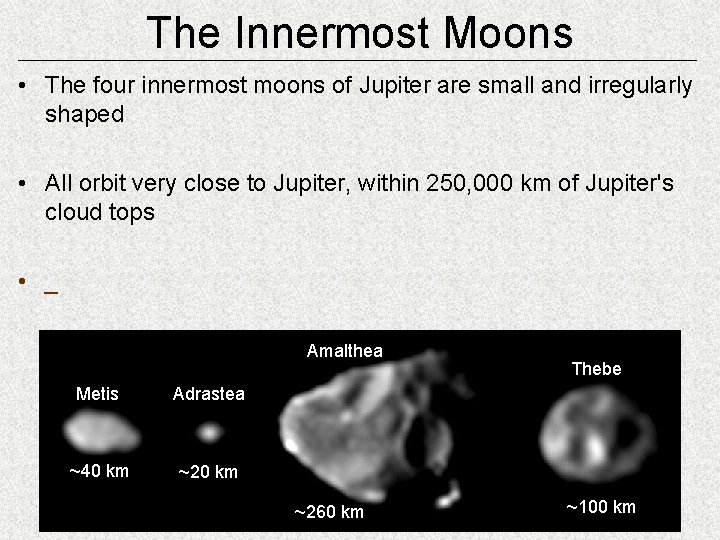
The Innermost Moons • The four innermost moons of Jupiter are small and irregularly shaped • All orbit very close to Jupiter, within 250, 000 km of Jupiter's cloud tops • _ Amalthea Metis Adrastea ~40 km ~260 km Thebe ~100 km
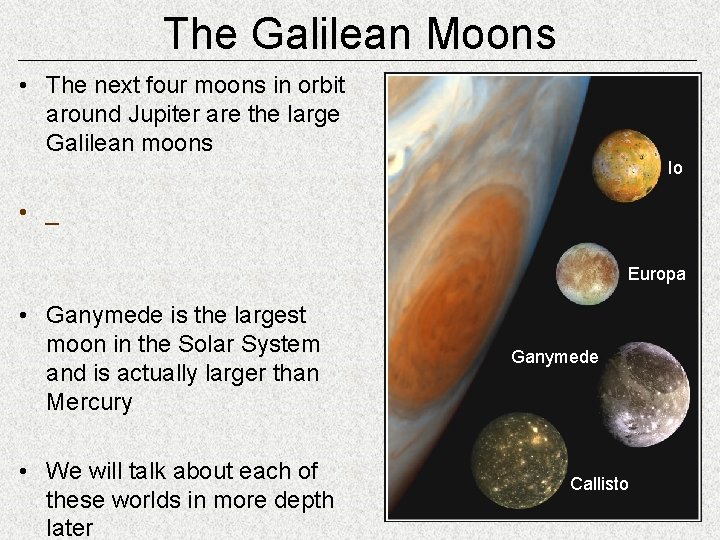
The Galilean Moons • The next four moons in orbit around Jupiter are the large Galilean moons Io • _ Europa • Ganymede is the largest moon in the Solar System and is actually larger than Mercury • We will talk about each of these worlds in more depth later Ganymede Callisto
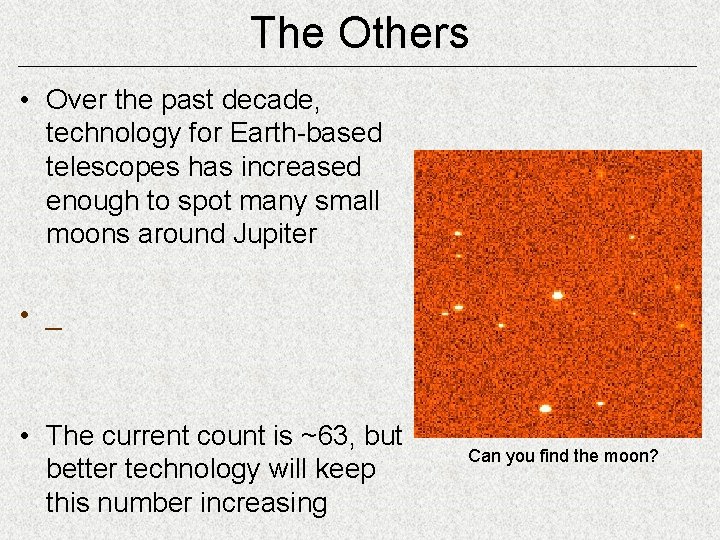
The Others • Over the past decade, technology for Earth-based telescopes has increased enough to spot many small moons around Jupiter • _ • The current count is ~63, but better technology will keep this number increasing Can you find the moon?
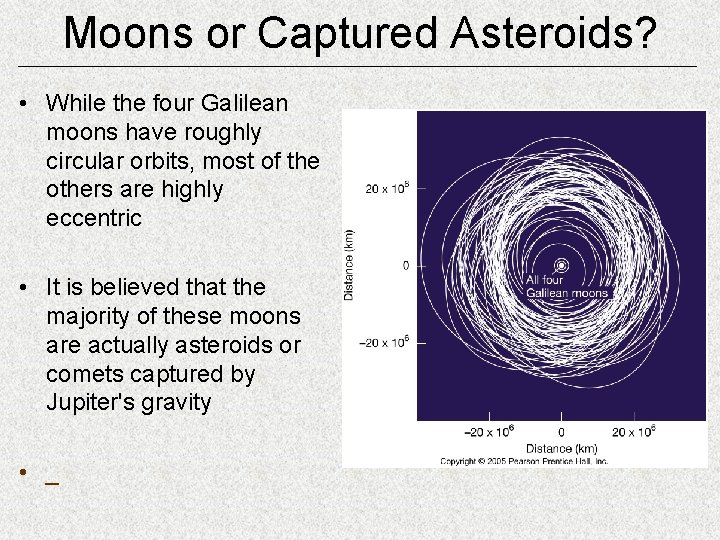
Moons or Captured Asteroids? • While the four Galilean moons have roughly circular orbits, most of the others are highly eccentric • It is believed that the majority of these moons are actually asteroids or comets captured by Jupiter's gravity • _
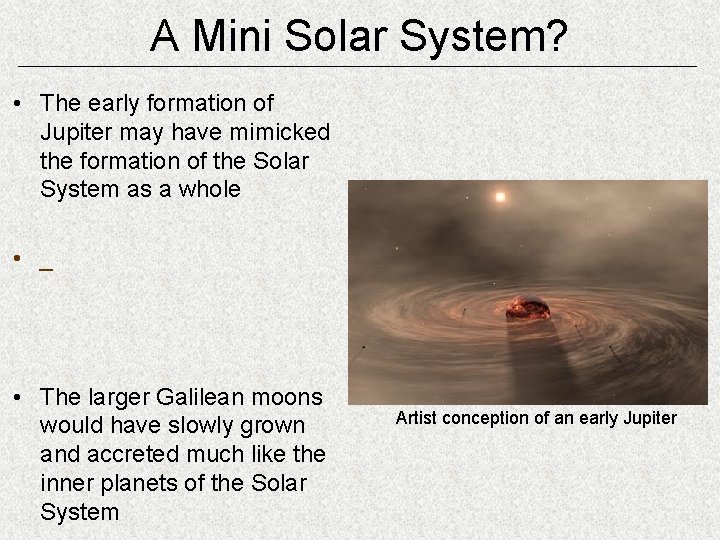
A Mini Solar System? • The early formation of Jupiter may have mimicked the formation of the Solar System as a whole • _ • The larger Galilean moons would have slowly grown and accreted much like the inner planets of the Solar System Artist conception of an early Jupiter
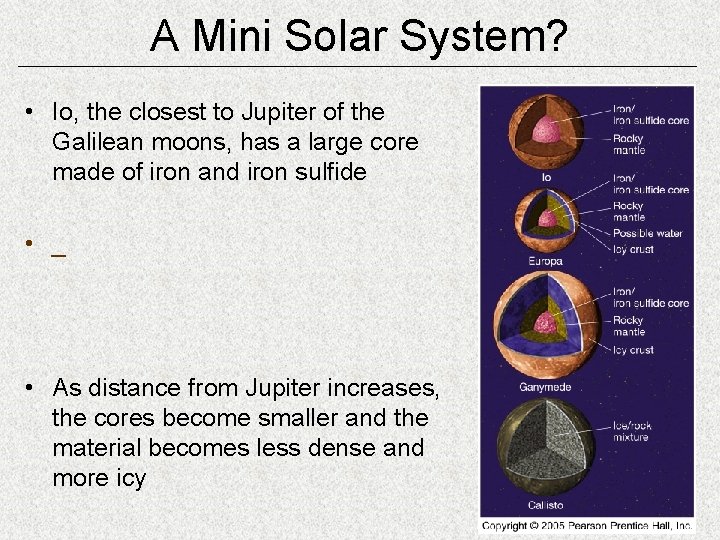
A Mini Solar System? • Io, the closest to Jupiter of the Galilean moons, has a large core made of iron and iron sulfide • _ • As distance from Jupiter increases, the cores become smaller and the material becomes less dense and more icy
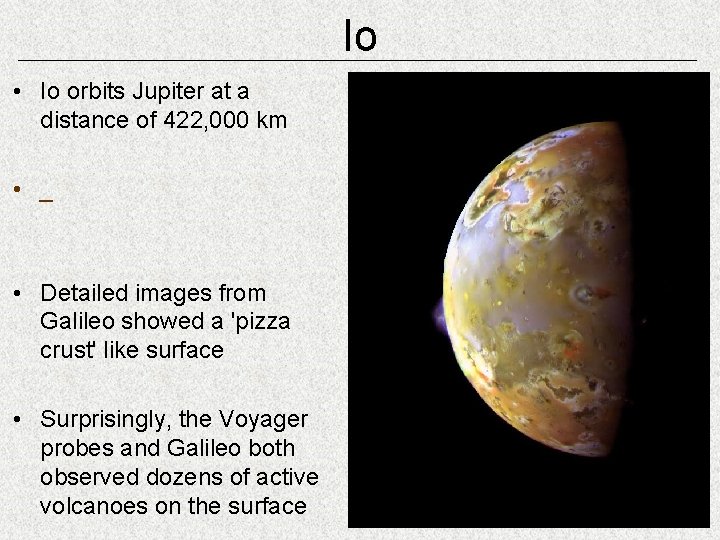
Io • Io orbits Jupiter at a distance of 422, 000 km • _ • Detailed images from Galileo showed a 'pizza crust' like surface • Surprisingly, the Voyager probes and Galileo both observed dozens of active volcanoes on the surface
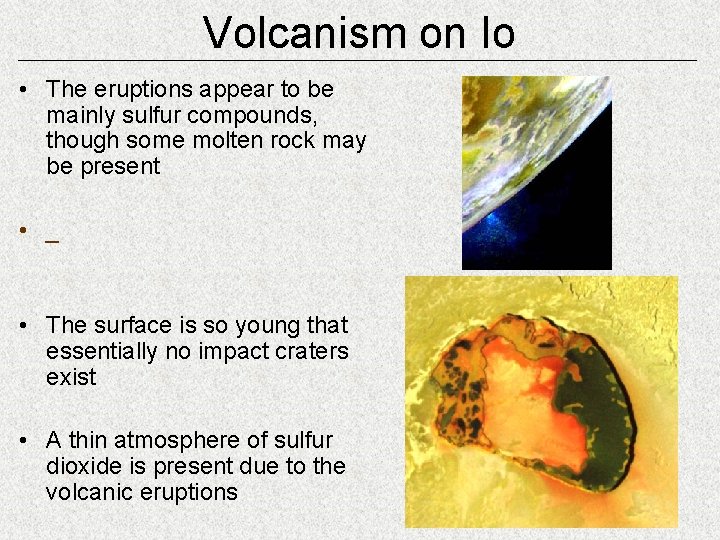
Volcanism on Io • The eruptions appear to be mainly sulfur compounds, though some molten rock may be present • _ • The surface is so young that essentially no impact craters exist • A thin atmosphere of sulfur dioxide is present due to the volcanic eruptions
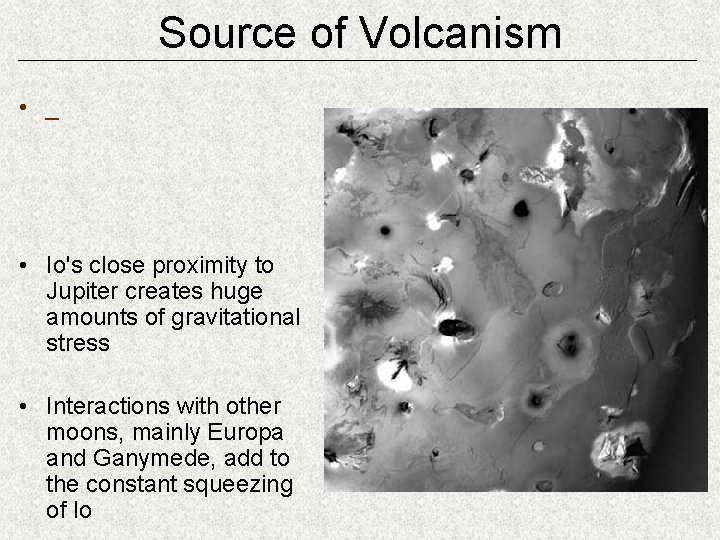
Source of Volcanism • _ • Io's close proximity to Jupiter creates huge amounts of gravitational stress • Interactions with other moons, mainly Europa and Ganymede, add to the constant squeezing of Io
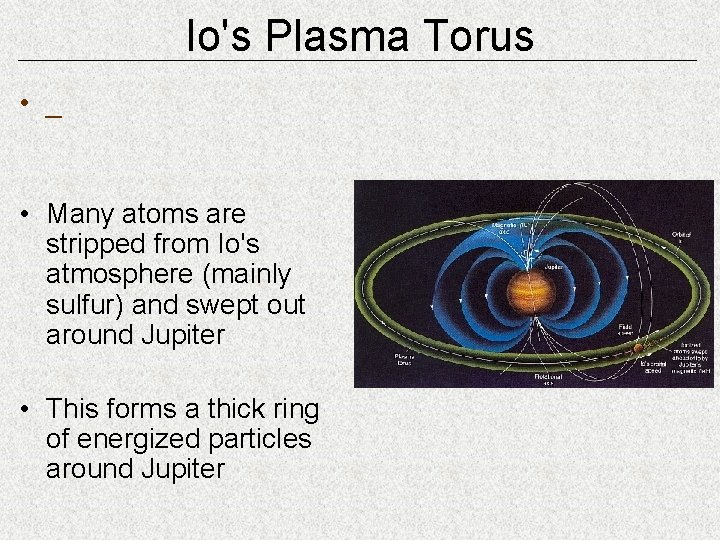
Io's Plasma Torus • _ • Many atoms are stripped from Io's atmosphere (mainly sulfur) and swept out around Jupiter • This forms a thick ring of energized particles around Jupiter
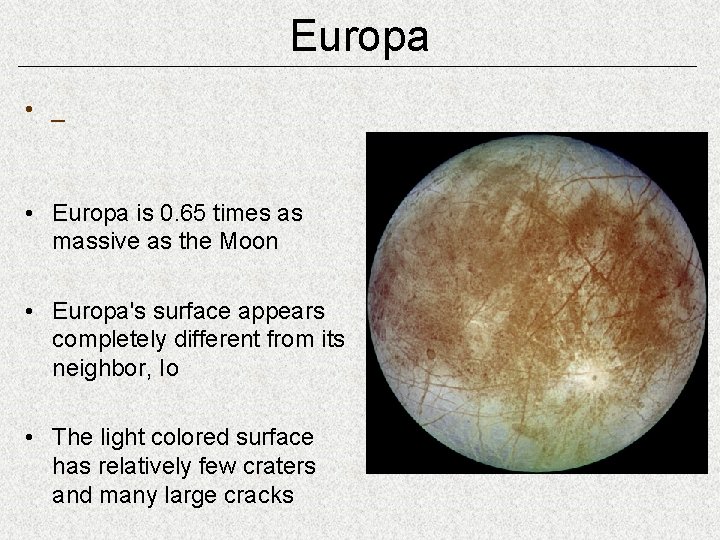
Europa • _ • Europa is 0. 65 times as massive as the Moon • Europa's surface appears completely different from its neighbor, Io • The light colored surface has relatively few craters and many large cracks
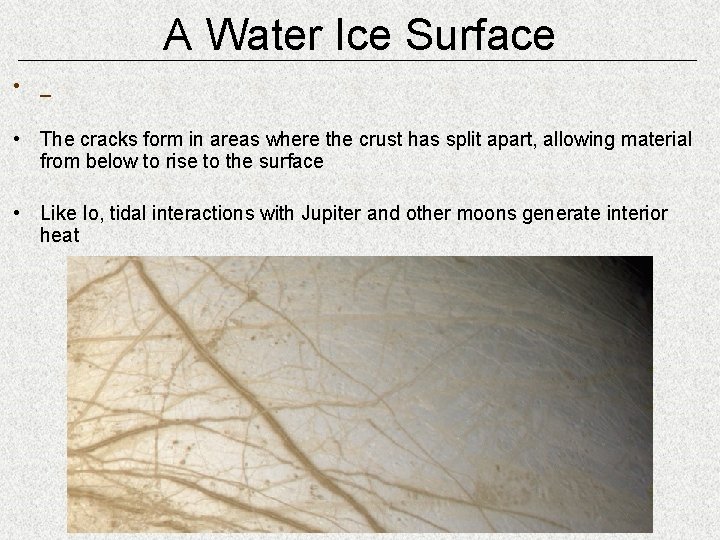
A Water Ice Surface • _ • The cracks form in areas where the crust has split apart, allowing material from below to rise to the surface • Like Io, tidal interactions with Jupiter and other moons generate interior heat
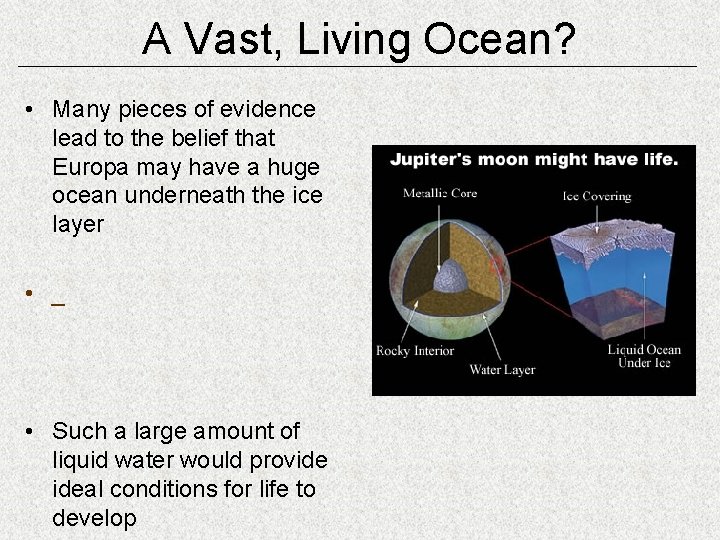
A Vast, Living Ocean? • Many pieces of evidence lead to the belief that Europa may have a huge ocean underneath the ice layer • _ • Such a large amount of liquid water would provide ideal conditions for life to develop
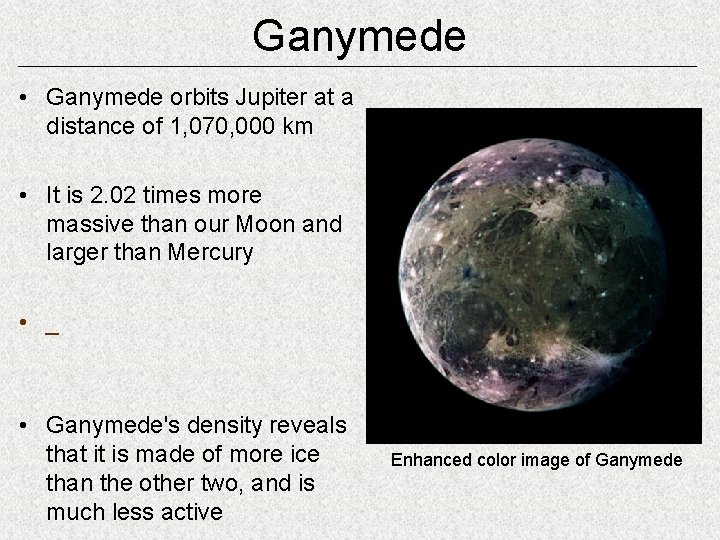
Ganymede • Ganymede orbits Jupiter at a distance of 1, 070, 000 km • It is 2. 02 times more massive than our Moon and larger than Mercury • _ • Ganymede's density reveals that it is made of more ice than the other two, and is much less active Enhanced color image of Ganymede
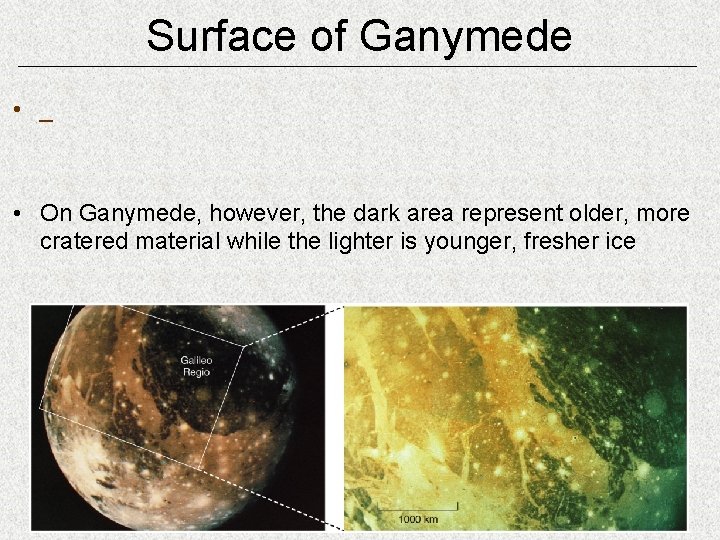
Surface of Ganymede • _ • On Ganymede, however, the dark area represent older, more cratered material while the lighter is younger, fresher ice
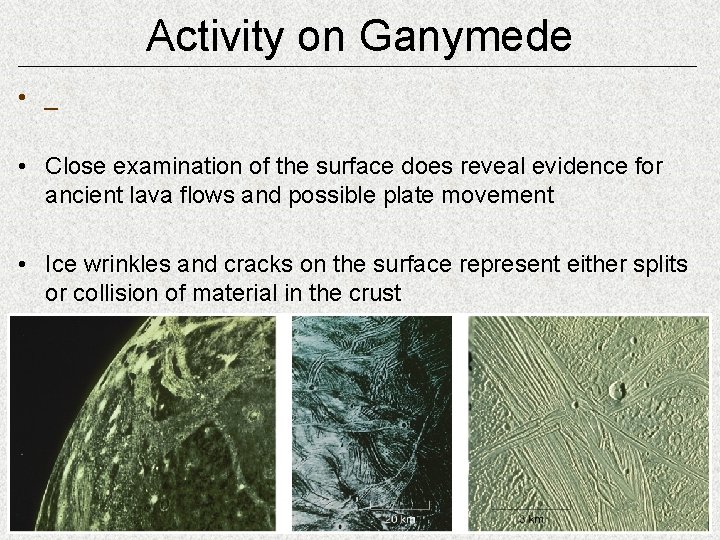
Activity on Ganymede • _ • Close examination of the surface does reveal evidence for ancient lava flows and possible plate movement • Ice wrinkles and cracks on the surface represent either splits or collision of material in the crust
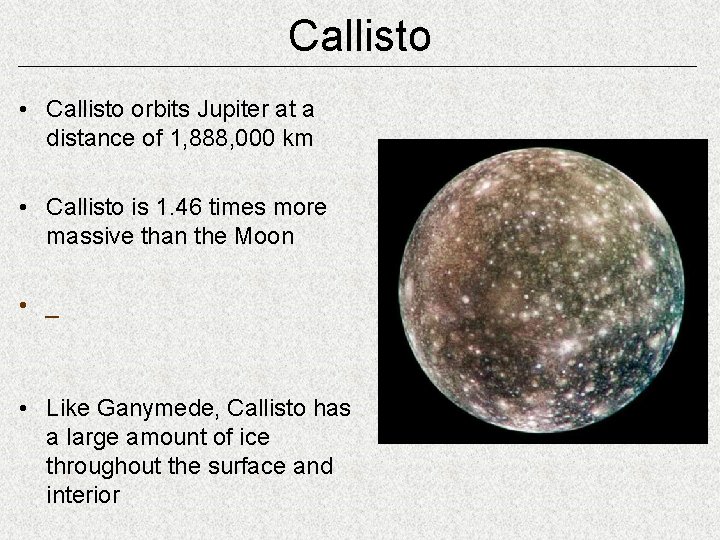
Callisto • Callisto orbits Jupiter at a distance of 1, 888, 000 km • Callisto is 1. 46 times more massive than the Moon • _ • Like Ganymede, Callisto has a large amount of ice throughout the surface and interior
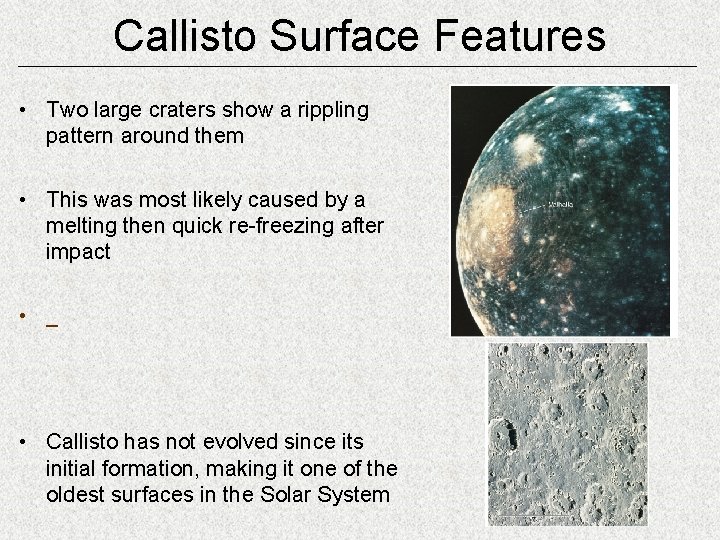
Callisto Surface Features • Two large craters show a rippling pattern around them • This was most likely caused by a melting then quick re-freezing after impact • _ • Callisto has not evolved since its initial formation, making it one of the oldest surfaces in the Solar System
Future Visits? • _ • The mission ended in 2003 when the spacecraft was intentionally crashed into Jupiter • There is a lot of talk about future missions to the Galilean moons, especially Europa • Funding is currently being concentrated toward manned spaceflight to the Moon and Mars
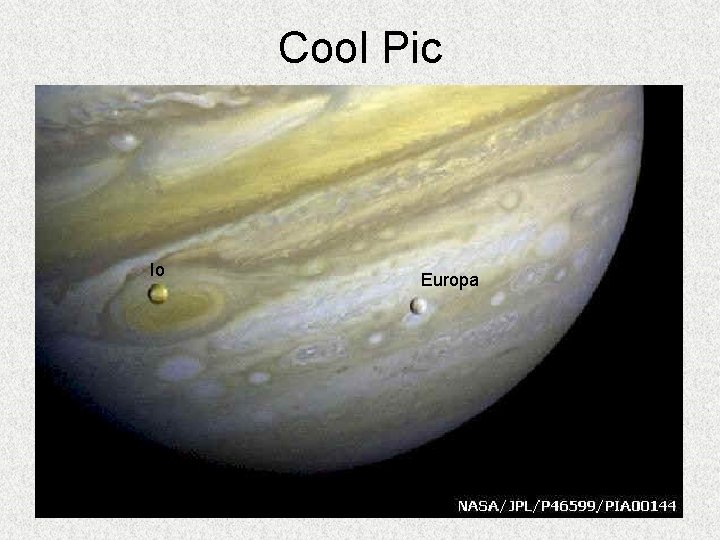
Cool Pic Io Europa
- Slides: 21