
MOON A Next Generation Double Beta Decay and
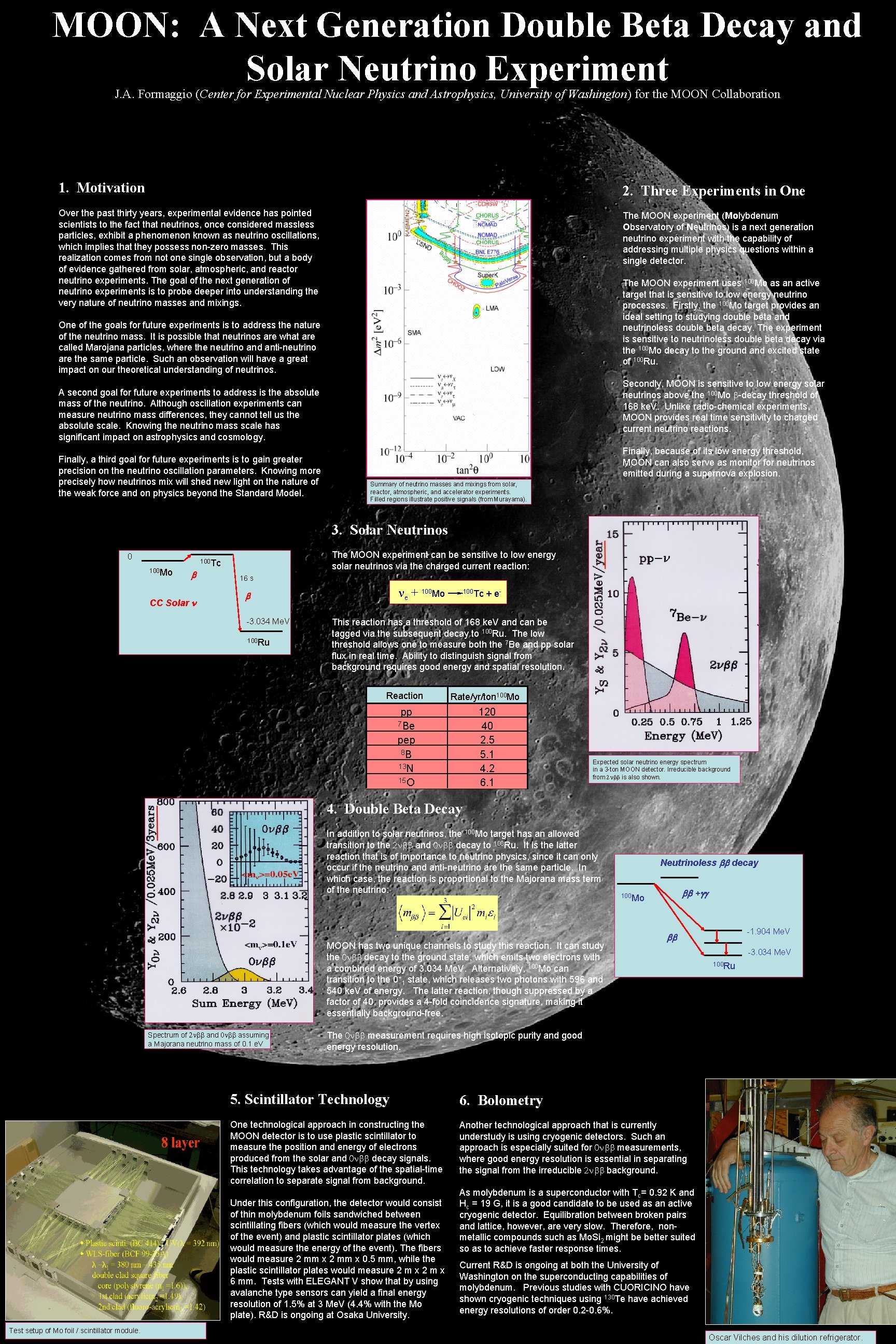
MOON: A Next Generation Double Beta Decay and Solar Neutrino Experiment J. A. Formaggio (Center for Experimental Nuclear Physics and Astrophysics, University of Washington) for the MOON Collaboration 1. Motivation 2. Three Experiments in One Over the past thirty years, experimental evidence has pointed scientists to the fact that neutrinos, once considered massless particles, exhibit a phenomenon known as neutrino oscillations, which implies that they possess non-zero masses. This realization comes from not one single observation, but a body of evidence gathered from solar, atmospheric, and reactor neutrino experiments. The goal of the next generation of neutrino experiments is to probe deeper into understanding the very nature of neutrino masses and mixings. The MOON experiment (Molybdenum Observatory of Neutrinos) is a next generation neutrino experiment with the capability of addressing multiple physics questions within a single detector. The MOON experiment uses 100 Mo as an active target that is sensitive to low energy neutrino processes. Firstly, the 100 Mo target provides an ideal setting to studying double beta and neutrinoless double beta decay. The experiment is sensitive to neutrinoless double beta decay via the 100 Mo decay to the ground and excited state of 100 Ru. One of the goals for future experiments is to address the nature of the neutrino mass. It is possible that neutrinos are what are called Marojana particles, where the neutrino and anti-neutrino are the same particle. Such an observation will have a great impact on our theoretical understanding of neutrinos. Secondly, MOON is sensitive to low energy solar neutrinos above the 100 Mo b-decay threshold of 168 ke. V. Unlike radio-chemical experiments, MOON provides real time sensitivity to charged current neutrino reactions. A second goal for future experiments to address is the absolute mass of the neutrino. Although oscillation experiments can measure neutrino mass differences, they cannot tell us the absolute scale. Knowing the neutrino mass scale has significant impact on astrophysics and cosmology. Finally, a third goal for future experiments is to gain greater precision on the neutrino oscillation parameters. Knowing more precisely how neutrinos mix will shed new light on the nature of the weak force and on physics beyond the Standard Model. Finally, because of its low energy threshold, MOON can also serve as monitor for neutrinos emitted during a supernova explosion. Summary of neutrino masses and mixings from solar, reactor, atmospheric, and accelerator experiments. Filled regions illustrate positive signals (from Murayama). 3. Solar Neutrinos 0 100 Mo CC Solar n The MOON experiment can be sensitive to low energy solar neutrinos via the charged current reaction: 100 Tc 16 s -3. 034 Me. V 100 Ru 0. 168 100 Mo ne + 100 Mo 100 Tc + e- This reaction has a threshold of 168 ke. V and can be tagged via the subsequent decay to 100 Ru. The low threshold allows one to measure both the 7 Be and pp solar flux in real time. Ability to distinguish signal from background requires good energy and spatial resolution. Reaction Rate/yr/ton 100 Mo pp 7 Be pep 8 B 13 N 15 O 120 40 2. 5 5. 1 4. 2 6. 1 Expected solar neutrino energy spectrum in a 3 -ton MOON detector. Irreducible background from 2 nbb is also shown. 4. Double Beta Decay In addition to solar neutrinos, the 100 Mo target has an allowed transition to the 2 nbb and 0 nbb decay to 100 Ru. It is the latter reaction that is of importance to neutrino physics, since it can only occur if the neutrino and anti-neutrino are the same particle. In which case, the reaction is proportional to the Majorana mass term of the neutrino: MOON has two unique channels to study this reaction. It can study the 0 nbb decay to the ground state, which emits two electrons with a combined energy of 3. 034 Me. V. Alternatively, 100 Mo can transition to the 0+1 state, which releases two photons with 596 and 540 ke. V of energy. The latter reaction, though suppressed by a factor of 40, provides a 4 -fold coincidence signature, making it essentially background-free. Spectrum of 2 nbb and 0 nbb assuming a Majorana neutrino mass of 0. 1 e. V +gg 100 Mo -1. 904 Me. V -3. 034 Me. V 100 Ru The 0 nbb measurement requires high isotopic purity and good energy resolution. 5. Scintillator Technology 6. Bolometry One technological approach in constructing the MOON detector is to use plastic scintillator to measure the position and energy of electrons produced from the solar and 0 nbb decay signals. This technology takes advantage of the spatial-time correlation to separate signal from background. Another technological approach that is currently understudy is using cryogenic detectors. Such an approach is especially suited for 0 nbb measurements, where good energy resolution is essential in separating the signal from the irreducible 2 nbb background. Under this configuration, the detector would consist of thin molybdenum foils sandwiched between scintillating fibers (which would measure the vertex of the event) and plastic scintillator plates (which would measure the energy of the event). The fibers would measure 2 mm x 0. 5 mm, while the plastic scintillator plates would measure 2 m x 6 mm. Tests with ELEGANT V show that by using avalanche type sensors can yield a final energy resolution of 1. 5% at 3 Me. V (4. 4% with the Mo plate). R&D is ongoing at Osaka University. Test setup of Mo foil / scintillator module. Neutrinoless decay As molybdenum is a superconductor with Tc= 0. 92 K and Hc = 19 G, it is a good candidate to be used as an active cryogenic detector. Equilibration between broken pairs and lattice, however, are very slow. Therefore, nonmetallic compounds such as Mo. Si 2 might be better suited so as to achieve faster response times. Current R&D is ongoing at both the University of Washington on the superconducting capabilities of molybdenum. Previous studies with CUORICINO have shown cryogenic techniques using 130 Te have achieved energy resolutions of order 0. 2 -0. 6%. Oscar Vilches and his dilution refrigerator.
- Slides: 1