
Moodys Local Government Overview Tennessee U S Public

Moody’s Local Government Overview - Tennessee U. S. Public Finance March 2018
Today’s Presenters Orlie Prince: Vice President, Senior Credit Officer/Manager, Local Governments Chris Coviello: Vice President, Senior Credit Analyst, Local Governments March 2018 2
Agenda 1. 2. 3. 4. 5. What Goes into a Moody’s Rating? General Obligation Methodology Moody’s TN Local Government Overview Moody’s US Local Government 2017 Overview Question and Answer March 2018 3
1 What Goes into a Moody’s Rating
Moody’s Public Finance Ratings » The mission of the US Public Finance Group is to provide reliable and independent opinions about the credit risk of states, cities, school districts, governmental authorities, and other US municipal borrowers. » We publish our opinions in the form of ratings, which rank debt issuers based on their relative credit quality. » We complement our ratings with written research that explains our analysis and makes our rating rationales transparent. » We constantly strive to strengthen the quality, transparency, and independence of our credit ratings March 2018 5

Moody’s Rating Scale Below investment grade (Ba or lower) does not necessarily indicate expected default March 2018 6
Moody’s Issuer Guide Six steps of the rating process: 1. Assignment of a lead analyst 2. Methodology 3. Analysis 4. Discussion with Moody’s 5. Committee review process 6. Publication of the final rating report March 2018 7
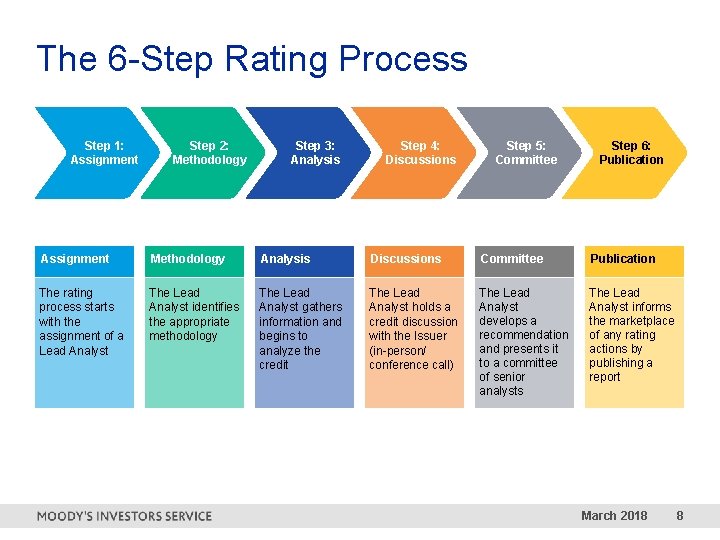
The 6 -Step Rating Process Step 1: Assignment Step 2: Methodology Step 3: Analysis Step 4: Discussions Step 5: Committee Step 6: Publication Assignment Methodology Analysis Discussions Committee Publication The rating process starts with the assignment of a Lead Analyst The Lead Analyst identifies the appropriate methodology The Lead Analyst gathers information and begins to analyze the credit The Lead Analyst holds a credit discussion with the Issuer (in-person/ conference call) The Lead Analyst develops a recommendation and presents it to a committee of senior analysts The Lead Analyst informs the marketplace of any rating actions by publishing a report March 2018 8
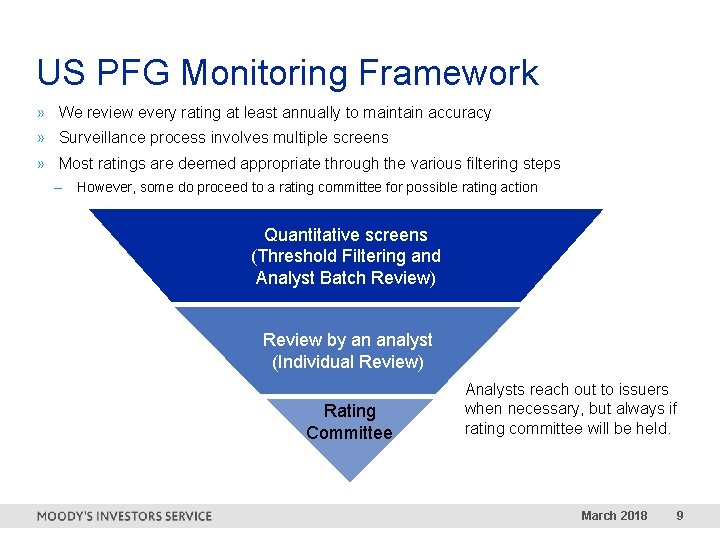
US PFG Monitoring Framework » We review every rating at least annually to maintain accuracy » Surveillance process involves multiple screens » Most ratings are deemed appropriate through the various filtering steps – However, some do proceed to a rating committee for possible rating action Quantitative screens (Threshold Filtering and Analyst Batch Review) Review by an analyst (Individual Review) Rating Committee Analysts reach out to issuers when necessary, but always if rating committee will be held. March 2018 9
US PFG Monitoring Framework » For credits that go to a committee, the rating process is the same for new sales and surveillance » We have one combined group responsible for new sales and surveillance » Analysts reach out to issuers for additional information when necessary and will always contact the issuer if a credit could go to a rating committee. » Financial advisors, auditors, bond counsels, etc. are welcome to participate in the surveillance process and the Lead Analyst will confirm if an issuer is working with an FA. March 2018 10

2 General Obligation Methodology
General Obligation (GO) Scorecard Purpose and Use of the Scorecard: » The scorecard acts as a starting point for a more thorough and individualistic analysis » Captures the key considerations that correspond to particular rating categories » Not an exhaustive list of factors that we consider in every local government rating » Each subfactor is a quantitative metric that are scored an initial grid March 2018 12
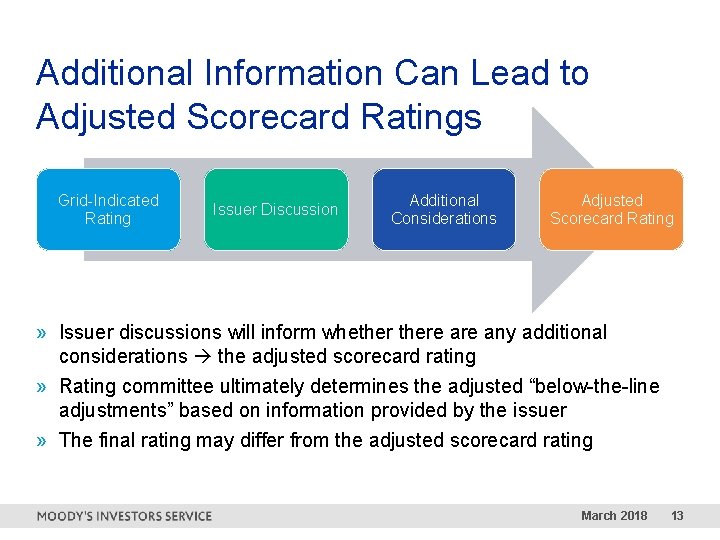
Additional Information Can Lead to Adjusted Scorecard Ratings Grid-Indicated Rating Issuer Discussion Additional Considerations Adjusted Scorecard Rating » Issuer discussions will inform whethere any additional considerations the adjusted scorecard rating » Rating committee ultimately determines the adjusted “below-the-line adjustments” based on information provided by the issuer » The final rating may differ from the adjusted scorecard rating March 2018 13
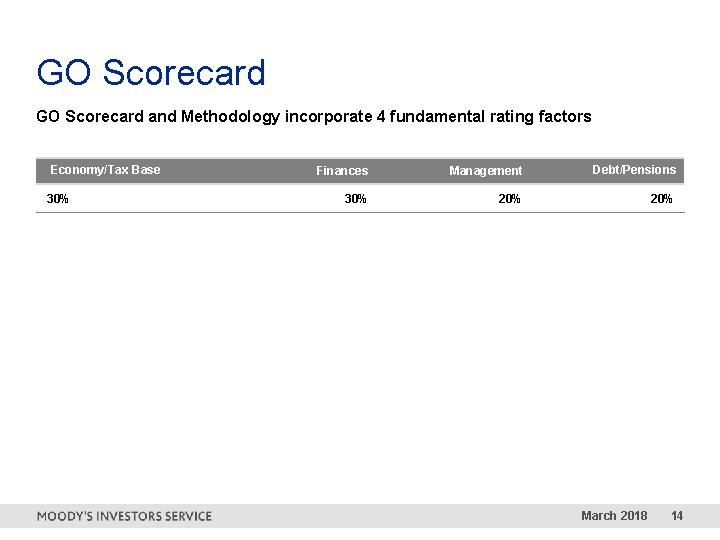
GO Scorecard and Methodology incorporate 4 fundamental rating factors Economy/Tax Base 30% Finances Management Debt/Pensions 30% 20% March 2018 14
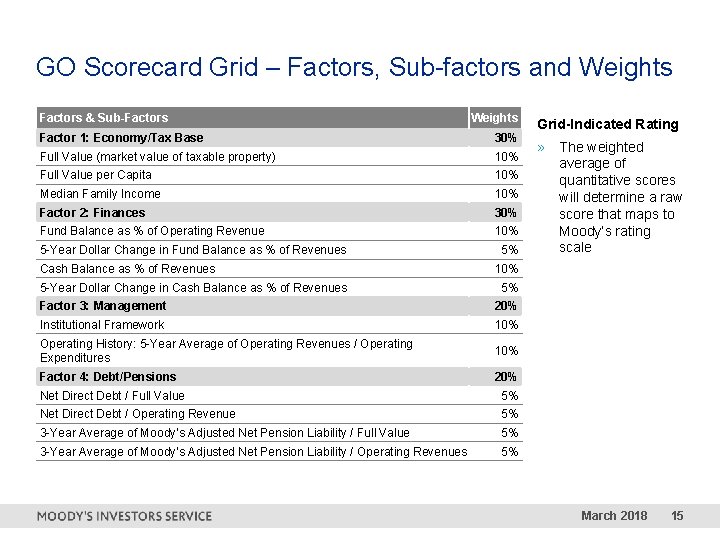
GO Scorecard Grid – Factors, Sub-factors and Weights Factors & Sub-Factors Weights Factor 1: Economy/Tax Base 30% Full Value (market value of taxable property) 10% Full Value per Capita 10% Median Family Income 10% Factor 2: Finances 30% Fund Balance as % of Operating Revenue 10% 5 -Year Dollar Change in Fund Balance as % of Revenues Cash Balance as % of Revenues 5 -Year Dollar Change in Cash Balance as % of Revenues 5% Grid-Indicated Rating » The weighted average of quantitative scores will determine a raw score that maps to Moody’s rating scale 10% 5% Factor 3: Management 20% Institutional Framework 10% Operating History: 5 -Year Average of Operating Revenues / Operating Expenditures 10% Factor 4: Debt/Pensions 20% Net Direct Debt / Full Value 5% Net Direct Debt / Operating Revenue 5% 3 -Year Average of Moody’s Adjusted Net Pension Liability / Full Value 5% 3 -Year Average of Moody’s Adjusted Net Pension Liability / Operating Revenues 5% March 2018 15
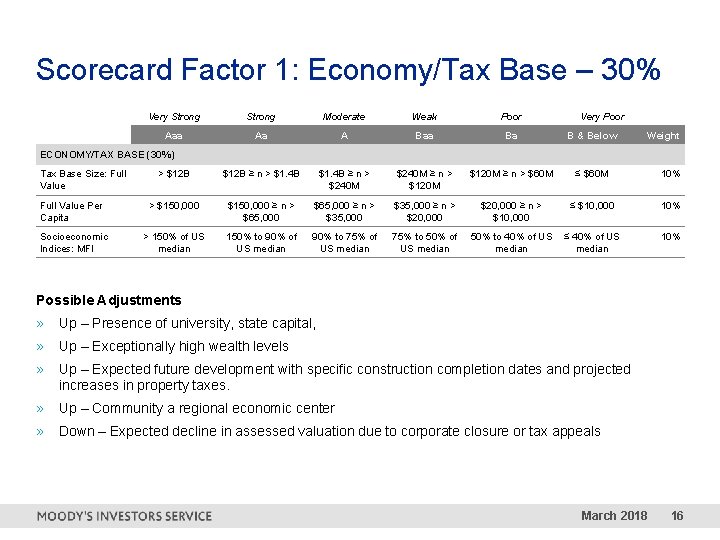
Scorecard Factor 1: Economy/Tax Base – 30% Very Strong Moderate Weak Poor Very Poor Aaa Aa A Baa Ba B & Below > $12 B ≥ n > $1. 4 B ≥ n > $240 M ≥ n > $120 M ≥ n > $60 M ≤ $60 M 10% Full Value Per Capita > $150, 000 ≥ n > $65, 000 ≥ n > $35, 000 ≥ n > $20, 000 ≥ n > $10, 000 ≤ $10, 000 10% Socioeconomic Indices: MFI > 150% of US median 150% to 90% of US median 90% to 75% of US median 75% to 50% of US median 50% to 40% of US median ≤ 40% of US median 10% Weight ECONOMY/TAX BASE (30%) Tax Base Size: Full Value Possible Adjustments » Up – Presence of university, state capital, » Up – Exceptionally high wealth levels » Up – Expected future development with specific construction completion dates and projected increases in property taxes. » Up – Community a regional economic center » Down – Expected decline in assessed valuation due to corporate closure or tax appeals March 2018 16
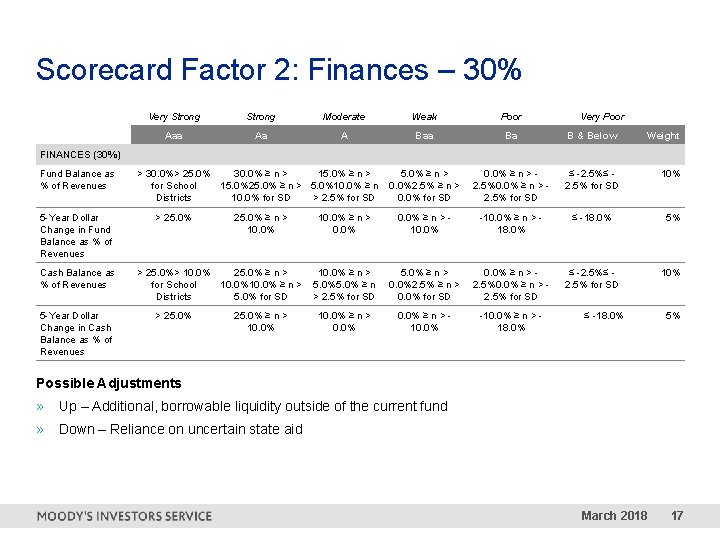
Scorecard Factor 2: Finances – 30% Very Strong Moderate Weak Poor Very Poor Aaa Aa A Baa Ba B & Below Weight 5. 0% ≥ n > 0. 0%2. 5% ≥ n > 0. 0% for SD 0. 0% ≥ n > 2. 5% for SD ≤ -2. 5%≤ 2. 5% for SD 10% 10. 0% ≥ n > 10. 0% -10. 0% ≥ n > 18. 0% ≤ -18. 0% 5% 10. 0% ≥ n > 5. 0% ≥ n > 2. 5% for SD 5. 0% ≥ n > 0. 0%2. 5% ≥ n > 0. 0% for SD 0. 0% ≥ n > 2. 5% for SD ≤ -2. 5%≤ 2. 5% for SD 10% 10. 0% ≥ n > 10. 0% -10. 0% ≥ n > 18. 0% FINANCES (30%) Fund Balance as % of Revenues 5 -Year Dollar Change in Fund Balance as % of Revenues Cash Balance as % of Revenues 5 -Year Dollar Change in Cash Balance as % of Revenues > 30. 0%> 25. 0% 30. 0% ≥ n > 15. 0% ≥ n > for School 15. 0%25. 0% ≥ n > 5. 0%10. 0% ≥ n Districts 10. 0% for SD > 2. 5% for SD > 25. 0% ≥ n > 10. 0% > 25. 0%> 10. 0% 25. 0% ≥ n > for School 10. 0% ≥ n > Districts 5. 0% for SD > 25. 0% ≥ n > 10. 0% ≤ -18. 0% 5% Possible Adjustments » Up – Additional, borrowable liquidity outside of the current fund » Down – Reliance on uncertain state aid March 2018 17
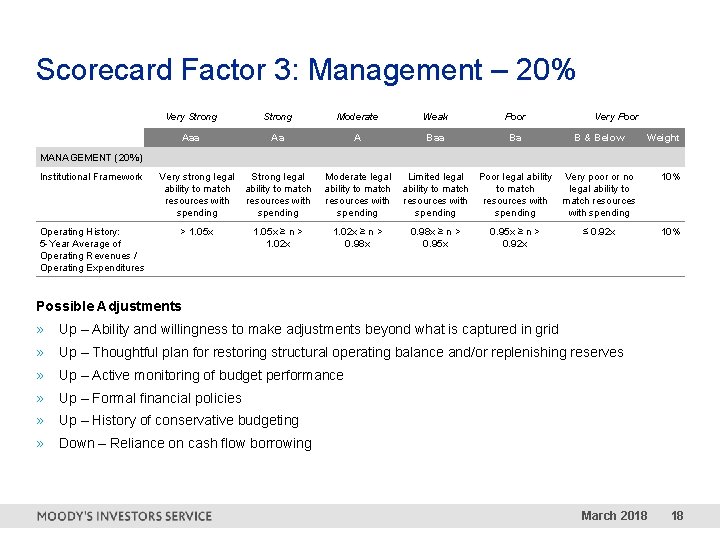
Scorecard Factor 3: Management – 20% Very Strong Moderate Weak Poor Aaa Aa A Baa Ba Very Poor B & Below Weight MANAGEMENT (20%) Institutional Framework Very strong legal ability to match resources with spending Strong legal ability to match resources with spending Moderate legal ability to match resources with spending Operating History: 5 -Year Average of Operating Revenues / Operating Expenditures > 1. 05 x ≥ n > 1. 02 x ≥ n > 0. 98 x Limited legal Poor legal ability to match resources with spending 0. 98 x ≥ n > 0. 95 x ≥ n > 0. 92 x Very poor or no legal ability to match resources with spending 10% ≤ 0. 92 x 10% Possible Adjustments » Up – Ability and willingness to make adjustments beyond what is captured in grid » Up – Thoughtful plan for restoring structural operating balance and/or replenishing reserves » Up – Active monitoring of budget performance » Up – Formal financial policies » Up – History of conservative budgeting » Down – Reliance on cash flow borrowing March 2018 18
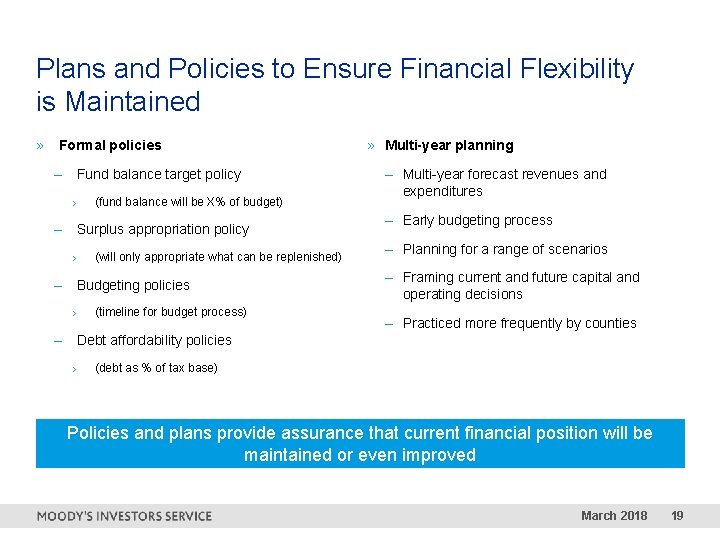
Plans and Policies to Ensure Financial Flexibility is Maintained » Formal policies – Fund balance target policy › (fund balance will be X% of budget) – Surplus appropriation policy › (will only appropriate what can be replenished) – Budgeting policies › (timeline for budget process) » Multi-year planning – Multi-year forecast revenues and expenditures – Early budgeting process – Planning for a range of scenarios – Framing current and future capital and operating decisions – Practiced more frequently by counties – Debt affordability policies › (debt as % of tax base) Policies and plans provide assurance that current financial position will be maintained or even improved March 2018 19
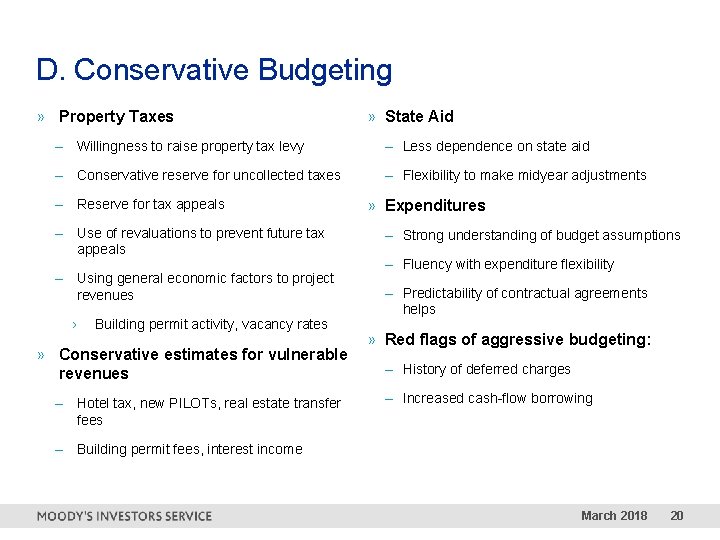
D. Conservative Budgeting » Property Taxes » State Aid – Willingness to raise property tax levy – Less dependence on state aid – Conservative reserve for uncollected taxes – Flexibility to make midyear adjustments – Reserve for tax appeals – Use of revaluations to prevent future tax appeals – Using general economic factors to project revenues › Building permit activity, vacancy rates » Conservative estimates for vulnerable revenues – Hotel tax, new PILOTs, real estate transfer fees » Expenditures – Strong understanding of budget assumptions – Fluency with expenditure flexibility – Predictability of contractual agreements helps » Red flags of aggressive budgeting: – History of deferred charges – Increased cash-flow borrowing – Building permit fees, interest income March 2018 20
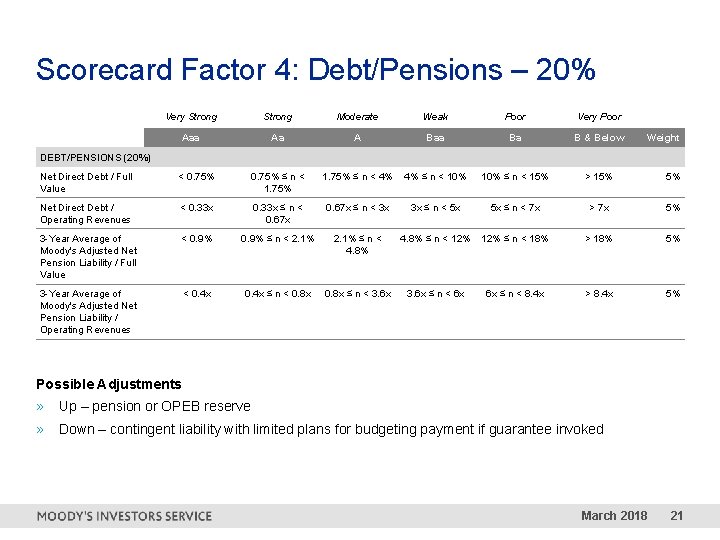
Scorecard Factor 4: Debt/Pensions – 20% Very Strong Moderate Weak Poor Very Poor Aaa Aa A Baa Ba B & Below Weight DEBT/PENSIONS (20%) Net Direct Debt / Full Value < 0. 75% ≤ n < 1. 75% ≤ n < 4% 4% ≤ n < 10% ≤ n < 15% > 15% 5% Net Direct Debt / Operating Revenues < 0. 33 x ≤ n < 0. 67 x ≤ n < 3 x 3 x ≤ n < 5 x 5 x ≤ n < 7 x > 7 x 5% 3 -Year Average of Moody's Adjusted Net Pension Liability / Full Value < 0. 9% ≤ n < 2. 1% ≤ n < 4. 8% ≤ n < 12% ≤ n < 18% > 18% 5% 3 -Year Average of Moody's Adjusted Net Pension Liability / Operating Revenues < 0. 4 x ≤ n < 0. 8 x ≤ n < 3. 6 x ≤ n < 6 x 6 x ≤ n < 8. 4 x > 8. 4 x 5% Possible Adjustments » Up – pension or OPEB reserve » Down – contingent liability with limited plans for budgeting payment if guarantee invoked March 2018 21
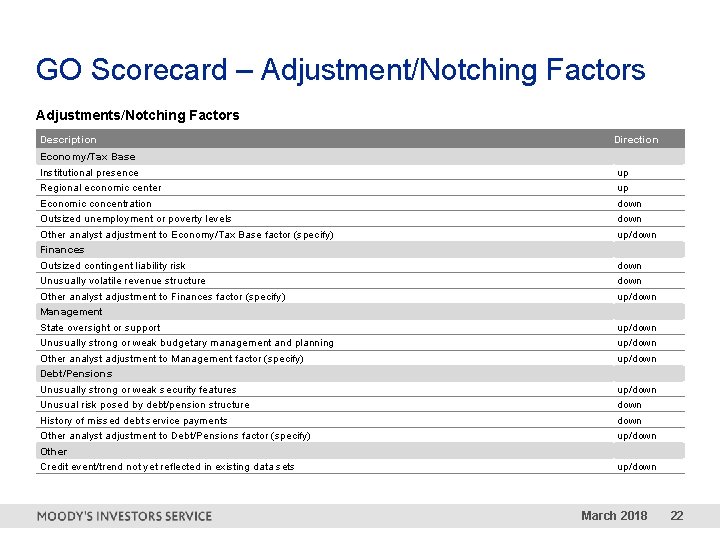
GO Scorecard – Adjustment/Notching Factors Adjustments/Notching Factors Description Economy/Tax Base Institutional presence Regional economic center Economic concentration Outsized unemployment or poverty levels Other analyst adjustment to Economy/Tax Base factor (specify) Finances Outsized contingent liability risk Unusually volatile revenue structure Other analyst adjustment to Finances factor (specify) Management State oversight or support Unusually strong or weak budgetary management and planning Other analyst adjustment to Management factor (specify) Debt/Pensions Unusually strong or weak security features Unusual risk posed by debt/pension structure History of missed debt service payments Other analyst adjustment to Debt/Pensions factor (specify) Other Credit event/trend not yet reflected in existing data sets Direction up up down up/down up/down up/down March 2018 22
3 Moody’s TN Local Government Overview
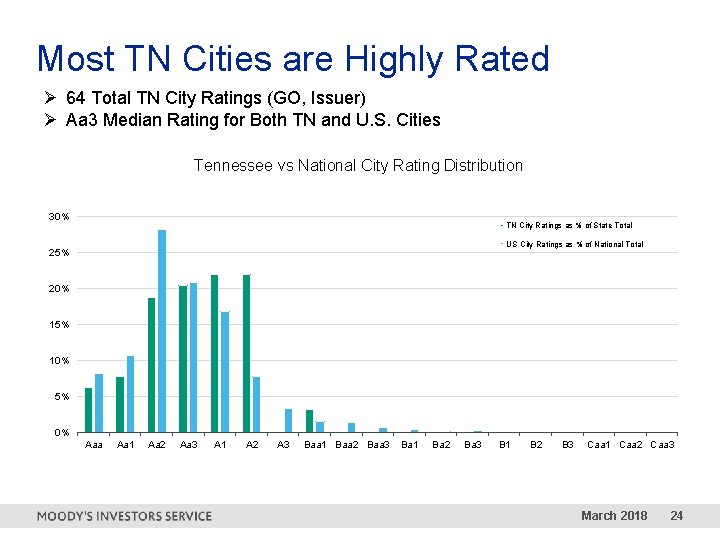
Most TN Cities are Highly Rated Ø 64 Total TN City Ratings (GO, Issuer) Ø Aa 3 Median Rating for Both TN and U. S. Cities Tennessee vs National City Rating Distribution 30% TN City Ratings as % of State Total US City Ratings as % of National Total 25% 20% 15% 10% 5% 0% Aaa Aa 1 Aa 2 Aa 3 A 1 A 2 A 3 Baa 1 Baa 2 Baa 3 Ba 1 Ba 2 Ba 3 B 1 B 2 B 3 Caa 1 Caa 2 Caa 3 March 2018 24
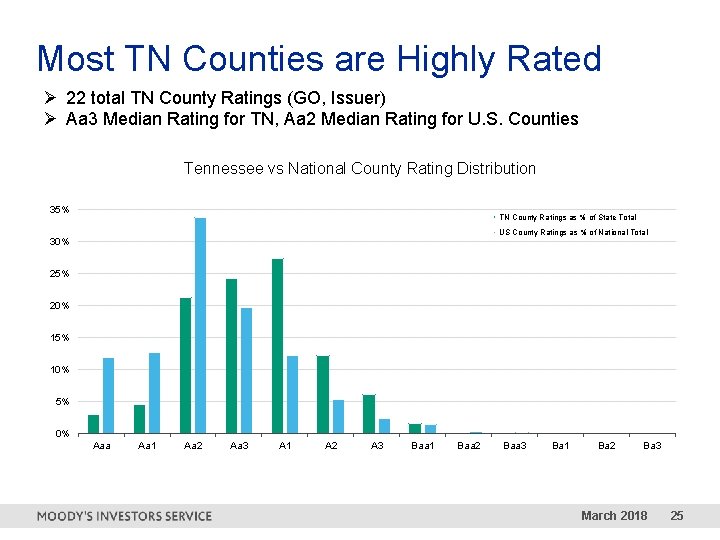
Most TN Counties are Highly Rated Ø 22 total TN County Ratings (GO, Issuer) Ø Aa 3 Median Rating for TN, Aa 2 Median Rating for U. S. Counties Tennessee vs National County Rating Distribution 35% TN County Ratings as % of State Total US County Ratings as % of National Total 30% 25% 20% 15% 10% 5% 0% Aaa Aa 1 Aa 2 Aa 3 A 1 A 2 A 3 Baa 1 Baa 2 Baa 3 Ba 1 Ba 2 Ba 3 March 2018 25
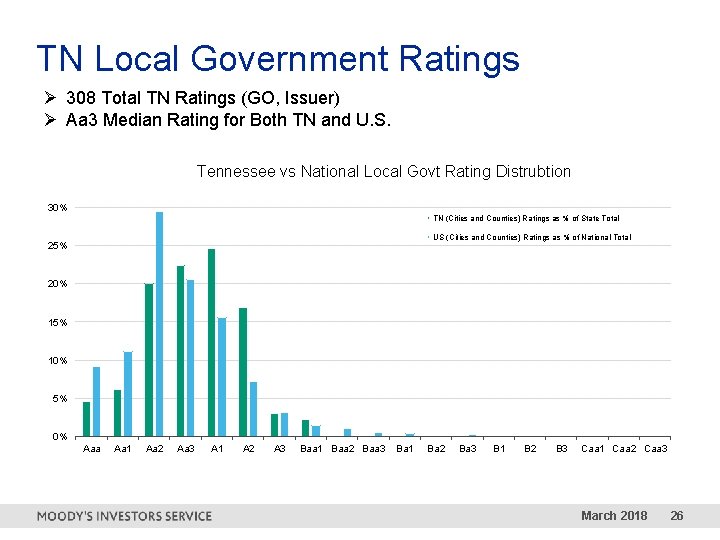
TN Local Government Ratings Ø 308 Total TN Ratings (GO, Issuer) Ø Aa 3 Median Rating for Both TN and U. S. Tennessee vs National Local Govt Rating Distrubtion 30% TN (Cities and Counties) Ratings as % of State Total US (Cities and Counties) Ratings as % of National Total 25% 20% 15% 10% 5% 0% Aaa Aa 1 Aa 2 Aa 3 A 1 A 2 A 3 Baa 1 Baa 2 Baa 3 Ba 1 Ba 2 Ba 3 B 1 B 2 B 3 Caa 1 Caa 2 Caa 3 March 2018 26
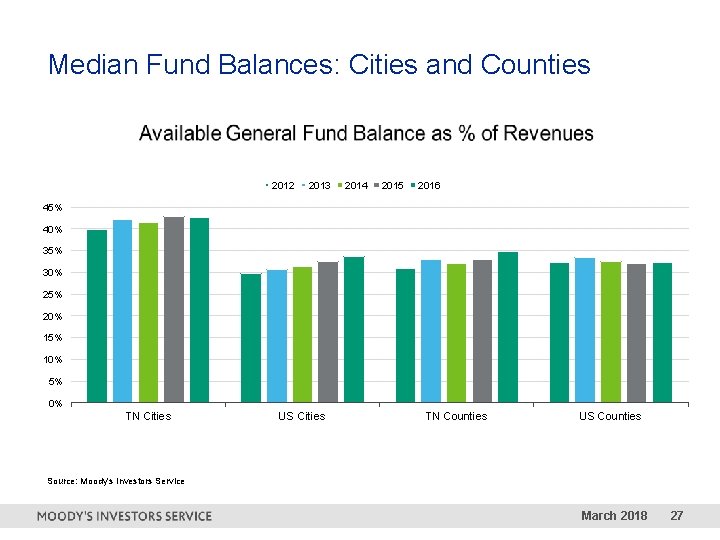
Median Fund Balances: Cities and Counties 2012 2013 2014 2015 2016 45% 40% 35% 30% 25% 20% 15% 10% 5% 0% TN Cities US Cities TN Counties US Counties Source: Moody’s Investors Service March 2018 27

4 US Local Governments 2017 Outlook

Local Governments NEGATIVE What could change outlook to negative » Property tax revenue growth of 1%-2% » Increase in long-term liabilities and fixed costs outpace revenue growth » A significant increase in the number of local governments with compounding challenges exacerbating credit deterioration STABLE » Property tax revenue growth of 3%-5% » Generally strong legal ability to maintain structurally balanced operations through raising revenues and cutting expenditures » Stable, healthy reserves highlight strong management and provide flexibility POSITIVE What could change outlook to positive » Continued strong property tax revenue growth of 4%-5% » Stabilization of fixed costs » Maintenance of healthy reserves » Alleviation of pension pressures Because our outlooks represent our forward-looking view on credit conditions that factor into our ratings, a negative (positive) outlook suggests that negative (positive) rating actions are more likely on average. However, the outlook does not represent a sum of upgrades, downgrades or ratings under review, or an average of the rating outlooks of issuers in the country or sector, but rather our assessment of the main direction of credit fundamentals within the country, region or sector. March 2018 29
Strong Tax Revenues and Healthy Reserves Drive Stability for Most Key credit themes » Property taxes, the bedrock of local governments, are healthy. A combination of property value growth and tax rate increases drove revenues 5. 1% higher in the first half of 2016. We expect these factors will continue to support revenue growth of 3%-5% in 2018. » Stable, healthy reserves highlight strong management and provide flexibility. An ongoing commitment to align revenues and expenditures supports stable financial performance and healthy reserve levels across the sector. » Growing balance sheet liabilities and fixed costs continue to pressure operations but remain manageable for most. Pensions are the sector's fastest growing longterm liability. Local governments will focus on balancing rising fixed costs with infrastructure demands and essential services. Stable to improving revenue trends will keep these costs manageable for most over the near term. » Despite overall stability across the sector, compounding pressures are deteriorating credit quality for a small group. Most local governments face one or two credit challenges. However, a modest but growing portion of the sector is experiencing a confluence of challenges, often including revenue stagnation combined with fixed cost growth, leading to a trend of credit deterioration. March 2018 30
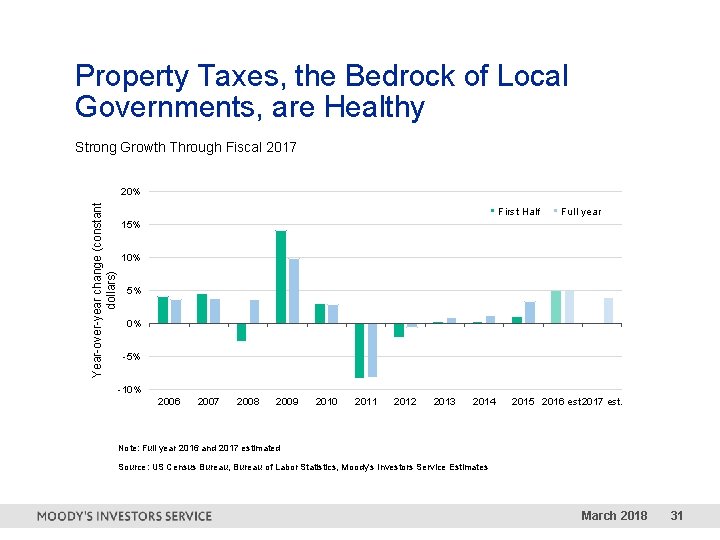
Property Taxes, the Bedrock of Local Governments, are Healthy Strong Growth Through Fiscal 2017 Year-over-year change (constant dollars) 20% First Half Full year 15% 10% 5% 0% -5% -10% 2006 2007 2008 2009 2010 2011 2012 2013 2014 2015 2016 est. 2017 est. Note: Full year 2016 and 2017 estimated Source: US Census Bureau, Bureau of Labor Statistics, Moody’s Investors Service Estimates March 2018 31
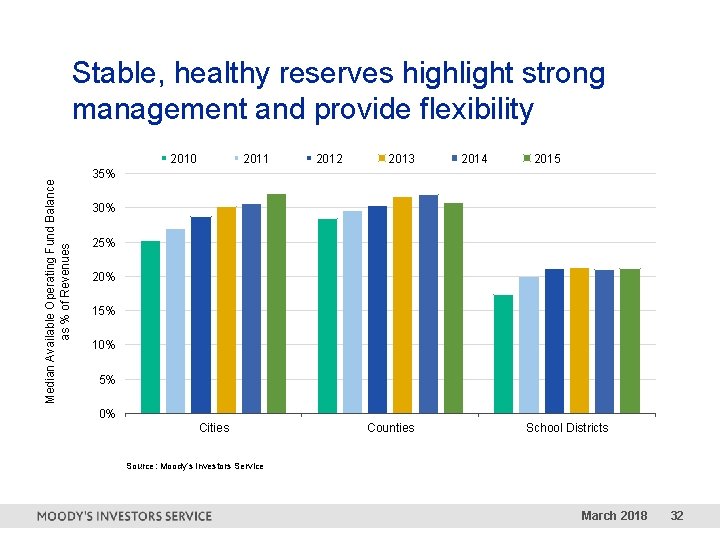
Stable, healthy reserves highlight strong management and provide flexibility Median Available Operating Fund Balance as % of Revenues 2010 2011 2012 2013 2014 2015 35% 30% 25% 20% 15% 10% 5% 0% Cities Counties School Districts Source: Moody’s Investors Service March 2018 32

Pensions Driving Growth in Long Term Liabilities Median direct debt and median three-year ANPL to operating revenues Cities School Districts Counties 3, 0 2, 0 1, 0 0, 0 2012 2013 2014 2015 0, 0 2012 2013 Net Debt / Op Rev 2014 2015 2012 2013 2014 2015 3 Yr ANPL / Op Rev Source: Moody’s Investors Service March 2018 33
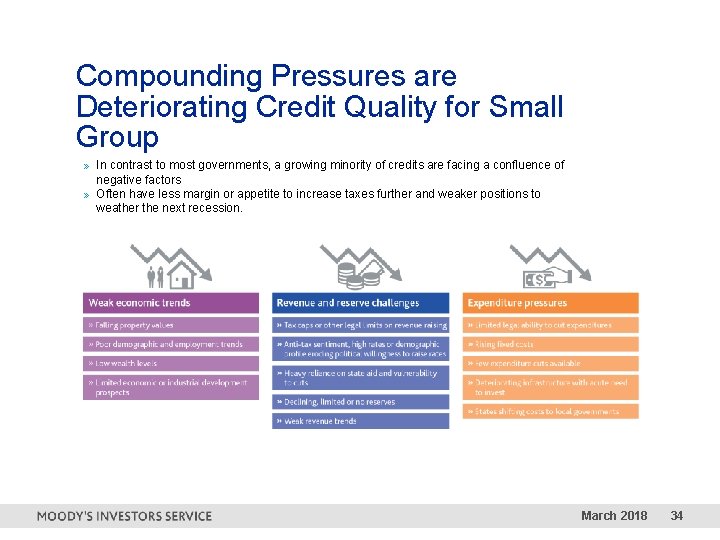
Compounding Pressures are Deteriorating Credit Quality for Small Group » In contrast to most governments, a growing minority of credits are facing a confluence of negative factors » Often have less margin or appetite to increase taxes further and weaker positions to weather the next recession. March 2018 34

5 Q&A

Leonard Jones Managing Director Leonard. Jones@moodys. com 212. 553. 3806 Orlie Prince Vice President, Senior Credit Officer/Manager Orlie. Prince@moodys. com 212. 553. 7738 Chris Coviello Vice President – Senior Analyst Christopher. Coviello@moodys. com 212. 553. 0575
This publication does not announce a credit rating action. For any credit ratings referenced in this publication, please see the ratings tab on the issuer/entity page on www. moodys. com for the most updated credit rating action information and rating history. © 2017 Moody’s Corporation, Moody’s Investors Service, Inc. , Moody’s Analytics, Inc. and/or their licensors and affiliates (collectively, “MOODY’S”). All rights reserved. CREDIT RATINGS ISSUED BY MOODY'S INVESTORS SERVICE, INC. AND ITS RATINGS AFFILIATES (“MIS”) ARE MOODY’S CURRENT OPINIONS OF THE RELATIVE FUTURE CREDIT RISK OF ENTITIES, CREDIT COMMITMENTS, OR DEBT-LIKE SECURITIES, AND MOODY’S PUBLICATIONS MAY INCLUDE MOODY’S CURRENT OPINIONS OF THE RELATIVE FUTURE CREDIT RISK OF ENTITIES, CREDIT COMMITMENTS, OR DEBT-LIKE SECURITIES. MOODY’S DEFINES CREDIT RISK AS THE RISK THAT AN ENTITY MAY NOT MEET ITS CONTRACTUAL, FINANCIAL OBLIGATIONS AS THEY COME DUE AND ANY ESTIMATED FINANCIAL LOSS IN THE EVENT OF DEFAULT. CREDIT RATINGS DO NOT ADDRESS ANY OTHER RISK, INCLUDING BUT NOT LIMITED TO: LIQUIDITY RISK, MARKET VALUE RISK, OR PRICE VOLATILITY. CREDIT RATINGS AND MOODY’S OPINIONS INCLUDED IN MOODY’S PUBLICATIONS ARE NOT STATEMENTS OF CURRENT OR HISTORICAL FACT. MOODY’S PUBLICATIONS MAY ALSO INCLUDE QUANTITATIVE MODEL-BASED ESTIMATES OF CREDIT RISK AND RELATED OPINIONS OR COMMENTARY PUBLISHED BY MOODY’S ANALYTICS, INC. CREDIT RATINGS AND MOODY’S PUBLICATIONS DO NOT CONSTITUTE OR PROVIDE INVESTMENT OR FINANCIAL ADVICE, AND CREDIT RATINGS AND MOODY’S PUBLICATIONS ARE NOT AND DO NOT PROVIDE RECOMMENDATIONS TO PURCHASE, SELL, OR HOLD PARTICULAR SECURITIES. NEITHER CREDIT RATINGS NOR MOODY’S PUBLICATIONS COMMENT ON THE SUITABILITY OF AN INVESTMENT FOR ANY PARTICULAR INVESTOR. MOODY’S ISSUES ITS CREDIT RATINGS AND PUBLISHES MOODY’S PUBLICATIONS WITH THE EXPECTATION AND UNDERSTANDING THAT EACH INVESTOR WILL, WITH DUE CARE, MAKE ITS OWN STUDY AND EVALUATION OF EACH SECURITY THAT IS UNDER CONSIDERATION FOR PURCHASE, HOLDING, OR SALE. MOODY’S CREDIT RATINGS AND MOODY’S PUBLICATIONS ARE NOT INTENDED FOR USE BY RETAIL INVESTORS AND IT WOULD BE RECKLESS AND INAPPROPRIATE FOR RETAIL INVESTORS TO USE MOODY’S CREDIT RATINGS OR MOODY’S PUBLICATIONS WHEN MAKING AN INVESTMENT DECISION. IF IN DOUBT YOU SHOULD CONTACT YOUR FINANCIAL OR OTHER PROFESSIONAL ADVISER. ALL INFORMATION CONTAINED HEREIN IS PROTECTED BY LAW, INCLUDING BUT NOT LIMITED TO, COPYRIGHT LAW, AND NONE OF SUCH INFORMATION MAY BE COPIED OR OTHERWISE REPRODUCED, REPACKAGED, FURTHER TRANSMITTED, TRANSFERRED, DISSEMINATED, REDISTRIBUTED OR RESOLD, OR STORED FOR SUBSEQUENT USE FOR ANY SUCH PURPOSE, IN WHOLE OR IN PART, IN ANY FORM OR MANNER OR BY ANY MEANS WHATSOEVER, BY ANY PERSON WITHOUT MOODY’S PRIOR WRITTEN CONSENT. All information contained herein is obtained by MOODY’S from sources believed by it to be accurate and reliable. Because of the possibility of human or mechanical error as well as other factors, however, all information contained herein is provided “AS IS” without warranty of any kind. MOODY'S adopts all necessary measures so that the information it uses in assigning a credit rating is of sufficient quality and from sources MOODY'S considers to be reliable including, when appropriate, independent third-party sources. However, MOODY’S is not an auditor and cannot in every instance independently verify or validate information received in the rating process or in preparing the Moody’s publications. To the extent permitted by law, MOODY’S and its directors, officers, employees, agents, representatives, licensors and suppliers disclaim liability to any person or entity for any indirect, special, consequential, or incidental losses or damages whatsoever arising from or in connection with the information contained herein or the use of or inability to use any such information, even if MOODY’S or any of its directors, officers, employees, agents, representatives, licensors or suppliers is advised in advance of the possibility of such losses or damages, including but not limited to: (a) any loss of present or prospective profits or (b) any loss or damage arising where the relevant financial instrument is not the subject of a particular credit rating assigned by MOODY’S. To the extent permitted by law, MOODY’S and its directors, officers, employees, agents, representatives, licensors and suppliers disclaim liability for any direct or compensatory losses or damages caused to any person or entity, including but not limited to by any negligence (but excluding fraud, willful misconduct or any other type of liability that, for the avoidance of doubt, by law cannot be excluded) on the part of, or any contingency within or beyond the control of, MOODY’S or any of its directors, officers, employees, agents, representatives, licensors or suppliers, arising from or in connection with the information contained herein or the use of or inability to use any such information. NO WARRANTY, EXPRESS OR IMPLIED, AS TO THE ACCURACY, TIMELINESS, COMPLETENESS, MERCHANTABILITY OR FITNESS FOR ANY PARTICULAR PURPOSE OF ANY SUCH RATING OR OTHER OPINION OR INFORMATION IS GIVEN OR MADE BY MOODY’S IN ANY FORM OR MANNER WHATSOEVER. Moody’s Investors Service, Inc. , a wholly-owned credit rating agency subsidiary of Moody’s Corporation (“MCO”), hereby discloses that most issuers of debt securities (including corporate and municipal bonds, debentures, notes and commercial paper) and preferred stock rated by Moody’s Investors Service, Inc. have, prior to assignment of any rating, agreed to pay to Moody’s Investors Service, Inc. for appraisal and rating services rendered by it fees ranging from $1, 500 to approximately $2, 500, 000. MCO and MIS also maintain policies and procedures to address the independence of MIS’s ratings and rating processes. Information regarding certain affiliations that may exist between directors of MCO and rated entities, and between entities who hold ratings from MIS and have also publicly reported to the SEC an ownership interest in MCO of more than 5%, is posted annually at www. moodys. com under the heading “Investor Relations — Corporate Governance — Director and Shareholder Affiliation Policy. ” Additional terms for Australia only: Any publication into Australia of this document is pursuant to the Australian Financial Services License of MOODY’S affiliate, Moody’s Investors Service Pty Limited ABN 61 003 399 657 AFSL 336969 and/or Moody’s Analytics Australia Pty Ltd ABN 94 105 136 972 AFSL 383569 (as applicable). This document is intended to be provided only to “wholesale clients” within the meaning of section 761 G of the Corporations Act 2001. By continuing to access this document from within Australia, you represent to MOODY’S that you are, or are accessing the document as a representative of, a “wholesale client” and that neither you nor the entity you represent will directly or indirectly disseminate this document or its contents to “retail clients” within the meaning of section 761 G of the Corporations Act 2001. MOODY’S credit rating is an opinion as to the creditworthiness of a debt obligation of the issuer, not on the equity securities of the issuer or any form of security that is available to retail investors. It would be reckless and inappropriate for retail investors to use MOODY’S credit ratings or publications when making an investment decision. If in doubt you should contact your financial or other professional adviser. Additional terms for Japan only: Moody's Japan K. K. (“MJKK”) is a wholly-owned credit rating agency subsidiary of Moody's Group Japan G. K. , which is wholly-owned by Moody’s Overseas Holdings Inc. , a wholly-owned subsidiary of MCO. Moody’s SF Japan K. K. (“MSFJ”) is a wholly-owned credit rating agency subsidiary of MJKK. MSFJ is not a Nationally Recognized Statistical Rating Organization (“NRSRO”). Therefore, credit ratings assigned by MSFJ are Non-NRSRO Credit Ratings are assigned by an entity that is not a NRSRO and, consequently, the rated obligation will not qualify for certain types of treatment under U. S. laws. MJKK and MSFJ are credit rating agencies registered with the Japan Financial Services Agency and their registration numbers are FSA Commissioner (Ratings) No. 2 and 3 respectively. MJKK or MSFJ (as applicable) hereby disclose that most issuers of debt securities (including corporate and municipal bonds, debentures, notes and commercial paper) and preferred stock rated by MJKK or MSFJ (as applicable) have, prior to assignment of any rating, agreed to pay to MJKK or MSFJ (as applicable) for appraisal and rating services rendered by it fees ranging from JPY 200, 000 to approximately JPY 350, 000. MJKK and MSFJ also maintain policies and procedures to address Japanese regulatory requirements. March 2018 37
- Slides: 37