
Mood disorders unipolar depression and bipolar affective disorder
Mood disorders (unipolar depression and bipolar affective disorder) Year 4 Psychiatry CBL 2 Authored by Dr Declan Hyland School of Medicine Specialty Lead for General Adult Psychiatry March 2020 School of Medicine @Uo. Lmedicine
Learning outcomes • To be aware of the epidemiology and aetiology of depression • To describe the clinical features of a depressive episode and know how to classify the severity of a depressive episode (mild, moderate and severe) • To be able to assess and manage the suicidal patient • To be aware of the epidemiology and aetiology of bipolar affective disorder • To describe the clinical features of a manic episode and know how a manic episode is treated • To have an understanding of the long-term treatment for depression and bipolar affective disorder School of Medicine @Uo. Lmedicine
UNIPOLAR DEPRESSION School of Medicine @Uo. Lmedicine
Epidemiology of depression • Very common! Affects 1 in 4 people at some point in their lives. • Affects 8 - 12% of U. K population per year. • Unipolar depressive disorder accounts for about 4% of global burden of disease (3 rd leading cause). • Across age groups, more common in women than in men. School of Medicine @Uo. Lmedicine
Aetiology of depression • Multifactorial! • Genetic • Biochemical (monoamine theory) • Social • Psychodynamic (personality traits can increase likelihood of depression) School of Medicine @Uo. Lmedicine
Clinical features of depression 3 CORE features: - Low mood - Anhedonia - Anergia Other features: - Sleep disturbance - Psychomotor agitation / retardation - Anorexia - Loss of libido - Emotional unreactivity - Diurnal variation in mood - Somatic symptoms - Thoughts of self-harm - Thoughts of suicide - Reduced concentration and attention - Memory problems - Feelings of guilt - Loss of self-confidence - Feelings of hopelessness, worthlessness, helplessness School of Medicine @Uo. Lmedicine
• Psychotic symptoms: - Delusions (commonly delusions of guilt, nihilistic delusions, delusions of poverty, persecutory delusions, self-referential or hypochondrical delusions) - Hallucinations (typically second person, derogatory in content) - Depressive stupor - Occur in severe depressive episodes only! School of Medicine @Uo. Lmedicine
Making the diagnosis of depression Comprehensive history. Exclude an organic cause: - FBC - U and Es - Vitamin B 12 - bone profile - TFTs - LFTs - folate level - diabetes screen Exclude illicit substance use or medication-related. ? Bipolar depression rather than unipolar depression. Symptoms present for at least two weeks. School of Medicine @Uo. Lmedicine
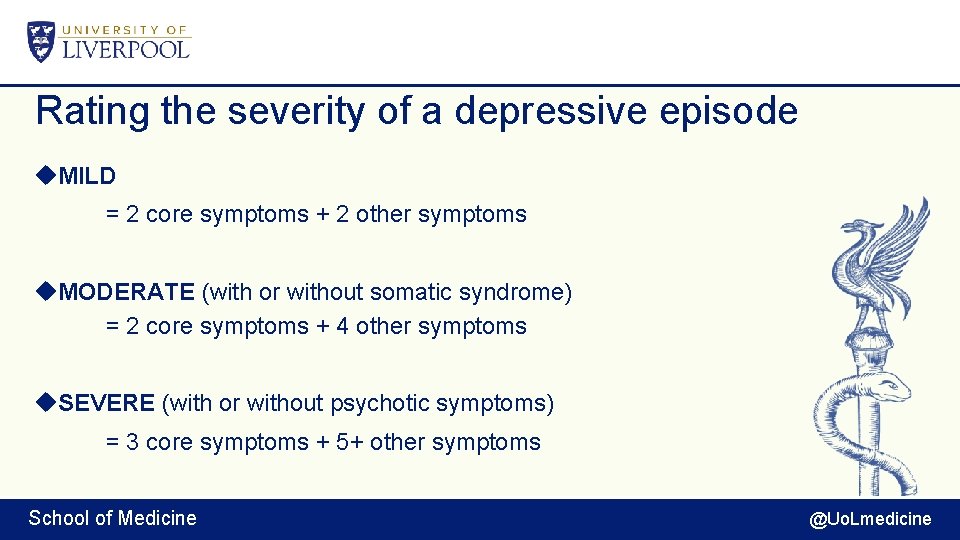
Rating the severity of a depressive episode MILD = 2 core symptoms + 2 other symptoms MODERATE (with or without somatic syndrome) = 2 core symptoms + 4 other symptoms SEVERE (with or without psychotic symptoms) = 3 core symptoms + 5+ other symptoms School of Medicine @Uo. Lmedicine
Treatment of depression • Biological (medical) • Psychological • Social School of Medicine @Uo. Lmedicine
Biological treatment • Start with SSRI antidepressant (typically Sertraline, Fluoxetine or Citalopram). • Assess within two weeks of initiation. • Increase the dose if no response after three - four weeks (check concordance!). • Warn about risk of suicidal thoughts in patients < 30. • If no response, try an alternative SSRI. School of Medicine @Uo. Lmedicine
If no response with a second SSRI, try an SNRI (Venlafaxine). If no response, refer to secondary care for specialist opinion. Could try Mirtazapine (helps with sleep disturbance and appetite disturbance). Then, combination of antidepressants - either Venlafaxine + Mirtazapine or SSRI + Mirtazapine. Lithium Carbonate can be added in (can help to reduce suicidality). School of Medicine @Uo. Lmedicine
• Augment the antidepressant with an antipsychotic (Quetiapine, Risperidone or Aripiprazole). • Avoid MAO inhibitors (tyramine-containing foods can provoke hypertensive crisis). • Avoid tricyclic antidepressants (cardiotoxic in overdose and poorly tolerated). • Newest antidepressant - Vortioxetine (SSRI-related). There is data to show it improves cognitive function in depression. School of Medicine @Uo. Lmedicine
Electroconvulsive therapy (ECT) - Been around since 1938. - Used in difficult to treat depression. - First line treatment in psychotic depression. - Very effective (90%+ response rate). - Poor understanding of how it works. - Can either give unilateral or bilateral. Unilateral less likely to cause cognitive impairment, but bilateral is more effective. - Usual course is 8 - 12 sessions, delivered twice weekly. Either as inpatient or outpatient. - Can give maintenance ECT as well as treatment course. School of Medicine @Uo. Lmedicine
Psychological treatment • Low-intensity psychological interventions - for mild depression: • Individual guided self-help, based on principles of CBT. Usually consists of 6 - 8 sessions. • Computerised CBT. Usually takes place over 9 - 12 weeks. • Structured group-based physical activity programme. Usually consists of 2 - 3 sessions per week of moderate duration (45 mins to 1 hour), over 3 -month period. • Group-based peer support. Usually consists of one session per week over 8 - 12 weeks. • High-intensity psychological interventions - for moderate or severe depression: • Group based CBT, Usually consists of 12 x 2 -hour sessions over 8 - 12 weeks. • Individual CBT. Usually given over 16 - 20 sessions over 3 - 4 months. For severe depression, 2 sessions per week might be provided for the first 2 or 3 weeks. • Interpersonal therapy. Duration and no. of sessions similar to CBT. • Behavioural School of Medicine activation. Duration and no. of sessions similar to CBT. @Uo. Lmedicine
Social interventions • Regular exercise • Sleep hygiene • Healthy diet • Reduce alcohol intake • Address any financial worries • Address any housing issues School of Medicine @Uo. Lmedicine
• Review period should be determined by risk of suicide and need to assess tolerability and effectiveness of any antidepressant started or changed. • In general, for people not considered to be at increased risk of suicide: • Arrange initial review: • Within one week for people less than 30 who have been started on an antidepressant. • Within two weeks for anyone > 30 years old. • Arrange subsequent reviews every two - four weeks for first three months and, if response to treatment is good, longer review intervals can be considered. School of Medicine @Uo. Lmedicine
Duration of antidepressant treatment • Antidepressants are not addictive! • NICE guidelines recommend continuing antidepressant for six - nine months following resolution of single depressive episode. • For recurrent depressive disorder, continue antidepressant for two years. • Risk of recurrence of depression is high (85%); increases with each episode. • Any antidepressant should not be discontinued abruptly! School of Medicine @Uo. Lmedicine
Assessment of the suicidal patient • Description of the current suicide attempt: • What precipitated the attempt? • Planned or impulsive? • Intention to die or cry for help? • What method did they use? • Any final acts (e. g. suicide note)? • Was the patient intoxicated with drugs and / or alcohol at the time? • Were steps taken to avoid discovery? • Was the patient alone at the time? • What was the patient’s perceived lethality of his / her suicide attempt? • Did the patient seek help after the suicide attempt or was he / she found by someone? • Does the patient regret the suicide attempt? School of Medicine @Uo. Lmedicine
• Assess for risk factors for suicide: • Male • Age > 45 years • Unemployed • Divorced, widowed or single • Physical illness • Mental disorder present • Substance misuse • Previous suicide attempt • Family history of mental disorder • Family history of suicide attempt School of Medicine @Uo. Lmedicine
• Will the patient be returning to the same situation? • How does the person see the future? • Any ongoing suicidal thoughts? • Obtain a collateral history if possible / appropriate. • Protective factors: - Positive social support - Spirituality / religion - Sense of responsibility to family - Children in the home or pregnant spouse - Life satisfaction School of Medicine - Reality testing ability - Positive problem solving skills - Positive coping skills - Positive therapeutic relationship @Uo. Lmedicine
Management of the suicidal patient • Take a thorough history of the suicide attempt. • Screen for any evidence of any illicit substance use or alcohol abuse. • Do a mental state examination and formulate a risk assessment. • If the suicide attempt is an OD of a psychotropic medication(s), consult Toxbase on how best to manage the patient medically. • Ensure the patient is medically fit to undergo a mental health assessment! School of Medicine @Uo. Lmedicine
• Following psychiatric assessment, there are four management options: 1) The patient is discharged with advice to be reviewed by the G. P within the next couple of weeks. 2) The patient is discharged with a referral made to the local CMHT to monitor the patient’s mental health. 3) The patient is discharged with follow-up from the Crisis Team (can visit daily if required). They may then refer to the CMHT for ongoing follow-up. 4) The patient is admitted to a psychiatric inpatient unit - either voluntarily or detained under the Mental Health Act 1983 (usually section 2). School of Medicine @Uo. Lmedicine
BIPOLAR AFFECTIVE DISORDER School of Medicine @Uo. Lmedicine
What is bipolar affective disorder? • a. k. a “manic-depression. ” • Can be difficult to diagnose. • Classically, periods of prolonged and profound depression alternate with periods of excessively elevated and / or irritable mood - mania. • A milder form of main, called hypomania, may also occur. • There is a subclinical presentation, called cyclothymia. School of Medicine @Uo. Lmedicine
Classification of bipolar affective disorder • ICD-10: - At least two episodes, one of which must be hypomanic, manic or mixed, with recovery usually complete between episodes. Criteria for depressive episodes are the same as for unipolar depression. Separate category (“manic episode”) for hypomania or mania (with or without psychotic symptoms) without history of depressive episodes. • Mixed episodes: • Occurrence of both manic / hypomanic and depressive symptoms in a single episode, present for every day for at least two weeks (ICD-10). • Typical presentations include: • • Depression + overactivity / pressure of speech Mania + agitation and reduced energy / libido Dysphoria + manic symptoms (with exception of elevated mood) Rapid cycling (fluctuating between mania and depression - four or more episodes / year) School of Medicine @Uo. Lmedicine
Epidemiology of bipolar affective disorder • Lifetime risk is ~ 1%. • Average of onset is around 20. • Male to female ratio is 1: 1. • > 90% of patients who have a single manic episode have further episodes. • Completed suicide occurs in 10 - 15% of bipolar patients. School of Medicine @Uo. Lmedicine
Aetiology of bipolar affective disorder • Interaction between genes and environment (similar to unipolar depression). • Heritability estimate is 65 - 80%. First degree relatives of people with bipolar affective disorder have ~ seven-fold increased risk of having the diagnosis. • Most important environmental risk factor is childbirth (risk of mania post partum). • Structural and functional abnormalities to brain regions linked to emotion (esp. hippocampus, amygdala, anterior cingulate and corpus callosum) have been identified. • Association between increased levels of monoamines and mania. School of Medicine @Uo. Lmedicine
Mania / manic episode • = distinct period of abnormally and persistently elevated, expansive or irritable mood, with three or more characteristic symptoms of mania. • Episode should last at least one week, or less if hospital admission is necessary. • Disturbance is sufficiently severe to impair occupational and social functioning. • Psychotic features may or may not be present. School of Medicine @Uo. Lmedicine
• Clinical features in mania: • Elevated mood (usually out of keeping with circumstances) • Increased energy, which may manifest as: • Overactivity • Pressured speech (“flight of ideas”) • Racing thoughts • Reduced need for sleep • Increased self-esteem, evident as: • Overoptimistic ideation • Grandiosity • Reduced social inhibitions • Overfamiliarity (which may be overly amorous) • Facetiousness School of Medicine @Uo. Lmedicine
• Reduced attention / increased distractibility • Tendency to engage in behaviour that could have serious consequences: • Preoccupation with extravagant, impracticable schemes • Spending recklessly • Inappropriate sexual encounters • Other behavioural manifestations: • Excitement • Irritability • Aggressiveness • Suspiciousness • Marked disruption of work, usual social activities and family life School of Medicine @Uo. Lmedicine
Hypomania / hypomanic episode • = three or more characteristic symptoms lasting at least four days. • Clearly different from individual’s “normal” mood. • Not severe enough to interfere with social or occupational functioning, require hospital admission or include psychotic features. • Shares symptoms with mania, but evident to a lesser degree and do not significantly disrupt work or lead to social rejection. School of Medicine @Uo. Lmedicine
Treatment of mania / hypomania • Discontinue any antidepressant the patient is prescribed. • Commence an antipsychotic (Quetiapine, Risperidone or Olanzapine). If the patient won’t accept an oral antipsychotic, use a depot (injectable). • Patient may require a short course of regular benzodiazepines (e. g. Diazepam 5 mg TDS) if there is significant behavioural disturbance. • Consider short-term use of an hypnotic (Zopiclone or Zolpidem) to ensure good quality sleep. School of Medicine @Uo. Lmedicine
Bipolar depressive episodes • Clinical features are similar to unipolar depression. • Bipolar depressive episodes tend to be more rapid in onset, more frequent, more severe, shorter, more likely to involve delusional thinking, hyperphagia and hypersomnia than unipolar episodes. • Treatment of bipolar depression is controversial - poorly studied and because of the need to consider long-term outcome not just discrete episode response. • Most effective treatment available is Olanzapine + Fluoxetine. School of Medicine @Uo. Lmedicine
• Other SSRIs may be effective, but should be avoided unless clear individual benefit is obvious. • Alternative first-line treatment choices are: Quetiapine, Olanzapine, Lurasidone, Lamotrigine and Sodium Valproate (not in women of childbearing potential!) • Lithium Carbonate is also effective in treating bipolar depression. • Antidepressant medication can precipitate manic / hypomanic episodes! School of Medicine @Uo. Lmedicine
Prophylaxis in bipolar affective disorder • Consider initiation of a mood stabiliser after remission of a manic episode. • First-line treatment for mood stabilisation is Lithium Carbonate or Depakote (Depakote must not be used in women of childbearing potential because of its teratogenicity - significantly increased risk of neural tube defects). • Second-line - Carbamazepine (= CYP 450 inducer and so can lower serum level of some medications and make them less effective). • Lamotrigine should be considered if the patient is more prone to bipolar depressive episodes rather than manic / hypomanic episodes. School of Medicine @Uo. Lmedicine
Psychotherapeutic interventions • Include: - Psychoeducation (including completion of a “staying well” plan) - Cognitive behavioural therapy (CBT) - Interpersonal therapy (IPT) - Family therapy - Support groups (both local and national), e. g. Mind, Bipolar U. K, SANE School of Medicine @Uo. Lmedicine
Thank you Contact your Year Lead if you find any digital content difficult or impossible to use. School of Medicine @Uo. Lmedicine
- Slides: 38