
Mood and Modality Rajat Kumar Mohanty rkmATcseDOTiitbDOTacDOTin Centre
Mood and Modality Rajat Kumar Mohanty rkm[AT]cse[DOT]iitb[DOT]ac[DOT]in Centre for Indian Language Technology Department of Computer Science and Engineering Indian Institute of Technology Bombay Mumbai, India Monday, May 09, 2005 CFILT
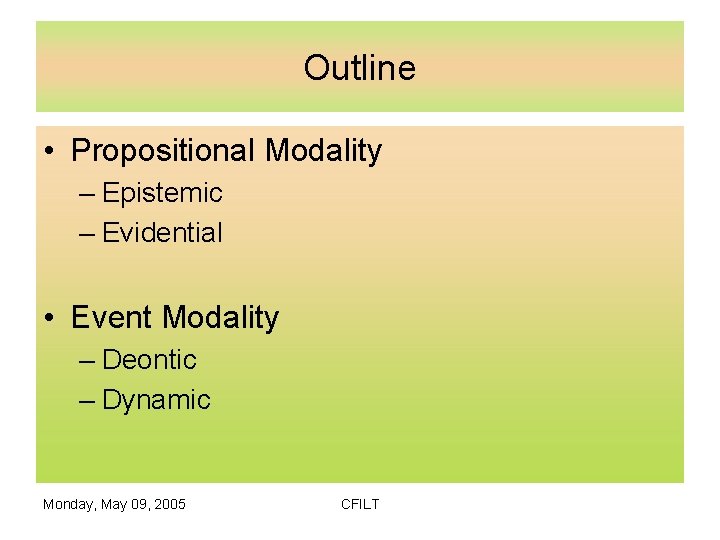
Outline • Propositional Modality – Epistemic – Evidential • Event Modality – Deontic – Dynamic Monday, May 09, 2005 CFILT

Modality • Modality differs from tense and aspect in that it does not refer directly to any characteristic of the events, but simply to the status of the proposition. • Example: – John is at home. – John may/must be at home now. – John may/must come in now. – John can solve this problem. • English uses a modal verbs to distinguish a judgement about a proposition from a categorical statement. Monday, May 09, 2005 CFILT
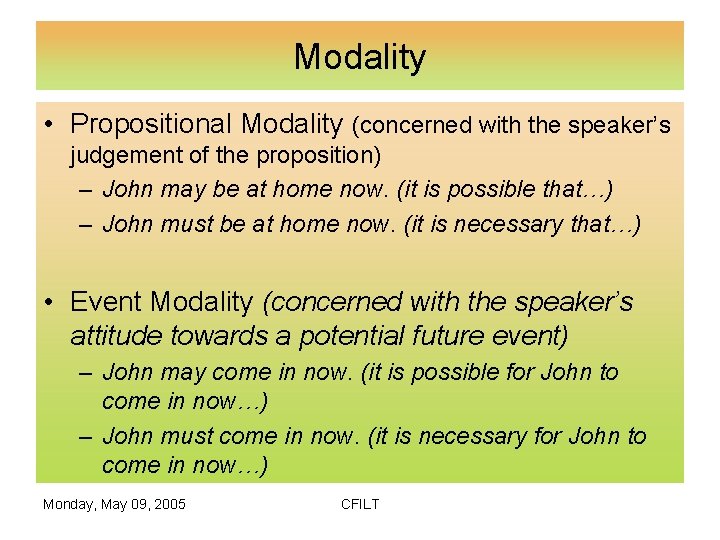
Modality • Propositional Modality (concerned with the speaker’s judgement of the proposition) – John may be at home now. (it is possible that…) – John must be at home now. (it is necessary that…) • Event Modality (concerned with the speaker’s attitude towards a potential future event) – John may come in now. (it is possible for John to come in now…) – John must come in now. (it is necessary for John to come in now…) Monday, May 09, 2005 CFILT
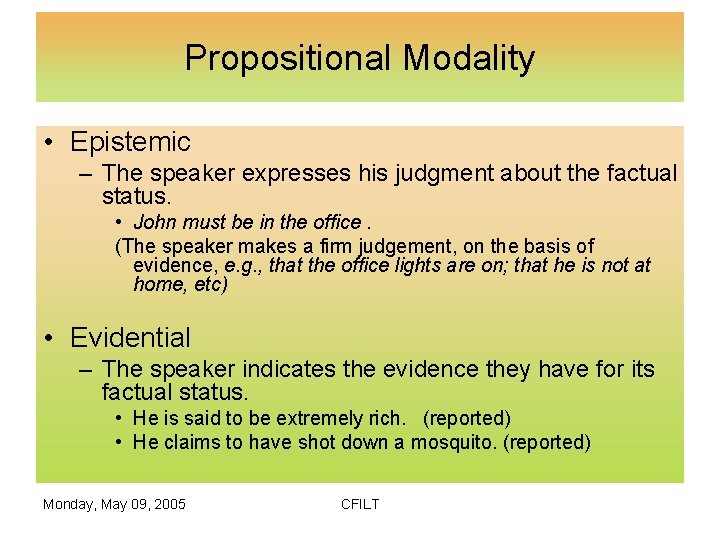
Propositional Modality • Epistemic – The speaker expresses his judgment about the factual status. • John must be in the office. (The speaker makes a firm judgement, on the basis of evidence, e. g. , that the office lights are on; that he is not at home, etc) • Evidential – The speaker indicates the evidence they have for its factual status. • He is said to be extremely rich. (reported) • He claims to have shot down a mosquito. (reported) Monday, May 09, 2005 CFILT
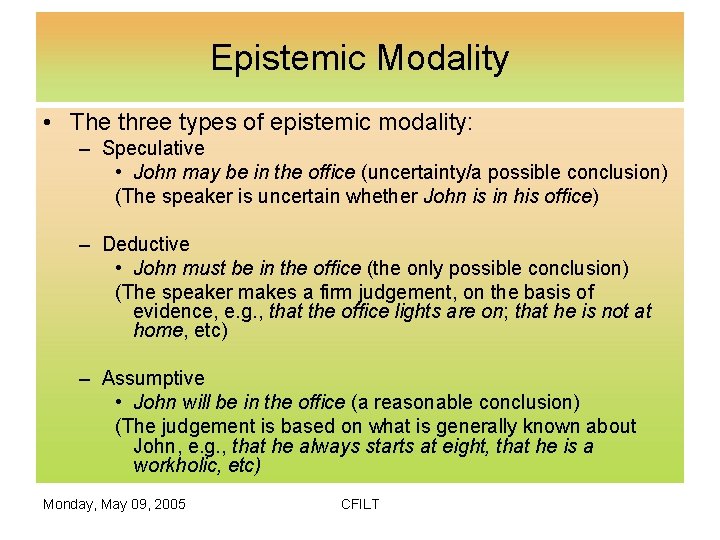
Epistemic Modality • The three types of epistemic modality: – Speculative • John may be in the office (uncertainty/a possible conclusion) (The speaker is uncertain whether John is in his office) – Deductive • John must be in the office (the only possible conclusion) (The speaker makes a firm judgement, on the basis of evidence, e. g. , that the office lights are on; that he is not at home, etc) – Assumptive • John will be in the office (a reasonable conclusion) (The judgement is based on what is generally known about John, e. g. , that he always starts at eight, that he is a workholic, etc) Monday, May 09, 2005 CFILT
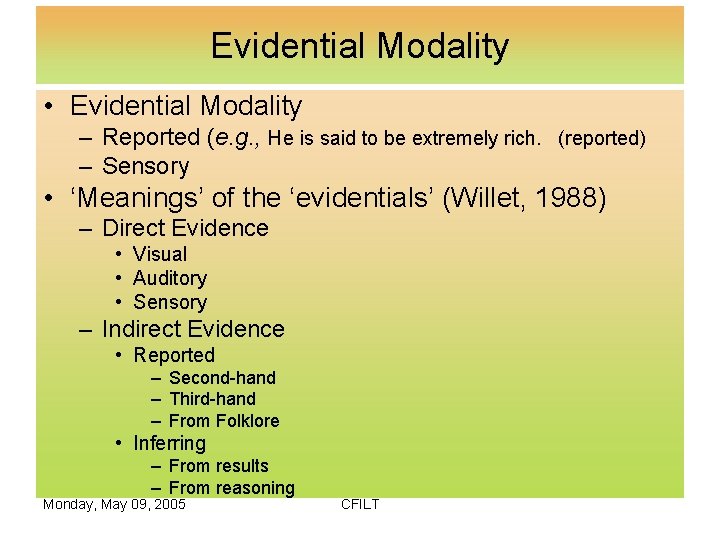
Evidential Modality • Evidential Modality – Reported (e. g. , He is said to be extremely rich. (reported) – Sensory • ‘Meanings’ of the ‘evidentials’ (Willet, 1988) – Direct Evidence • Visual • Auditory • Sensory – Indirect Evidence • Reported – Second-hand – Third-hand – From Folklore • Inferring – From results – From reasoning Monday, May 09, 2005 CFILT
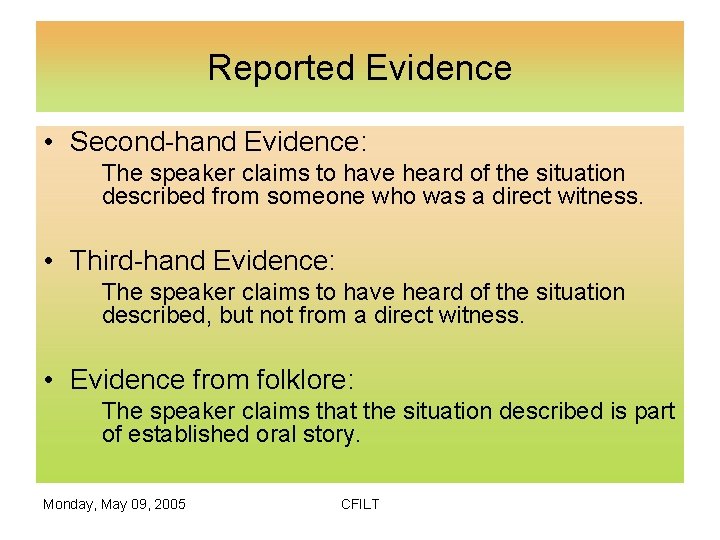
Reported Evidence • Second-hand Evidence: The speaker claims to have heard of the situation described from someone who was a direct witness. • Third-hand Evidence: The speaker claims to have heard of the situation described, but not from a direct witness. • Evidence from folklore: The speaker claims that the situation described is part of established oral story. Monday, May 09, 2005 CFILT
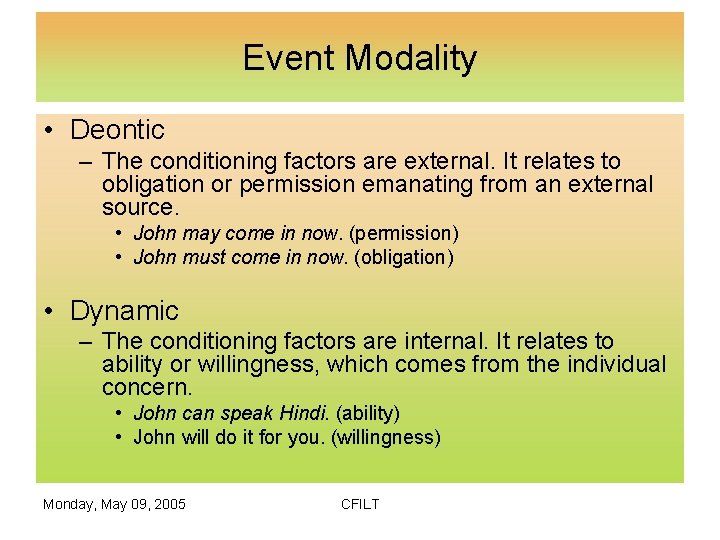
Event Modality • Deontic – The conditioning factors are external. It relates to obligation or permission emanating from an external source. • John may come in now. (permission) • John must come in now. (obligation) • Dynamic – The conditioning factors are internal. It relates to ability or willingness, which comes from the individual concern. • John can speak Hindi. (ability) • John will do it for you. (willingness) Monday, May 09, 2005 CFILT
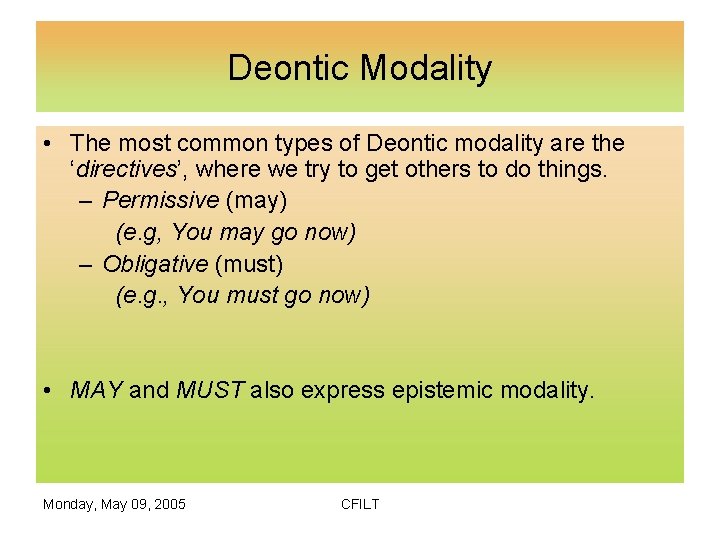
Deontic Modality • The most common types of Deontic modality are the ‘directives’, where we try to get others to do things. – Permissive (may) (e. g, You may go now) – Obligative (must) (e. g. , You must go now) • MAY and MUST also express epistemic modality. Monday, May 09, 2005 CFILT
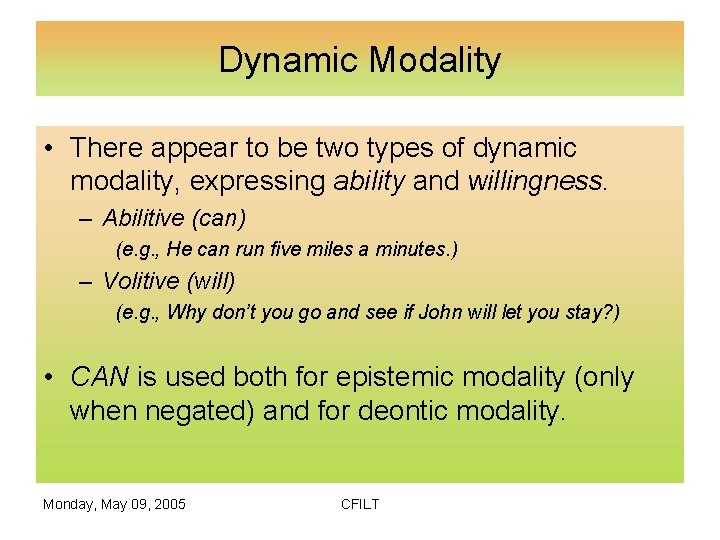
Dynamic Modality • There appear to be two types of dynamic modality, expressing ability and willingness. – Abilitive (can) (e. g. , He can run five miles a minutes. ) – Volitive (will) (e. g. , Why don’t you go and see if John will let you stay? ) • CAN is used both for epistemic modality (only when negated) and for deontic modality. Monday, May 09, 2005 CFILT
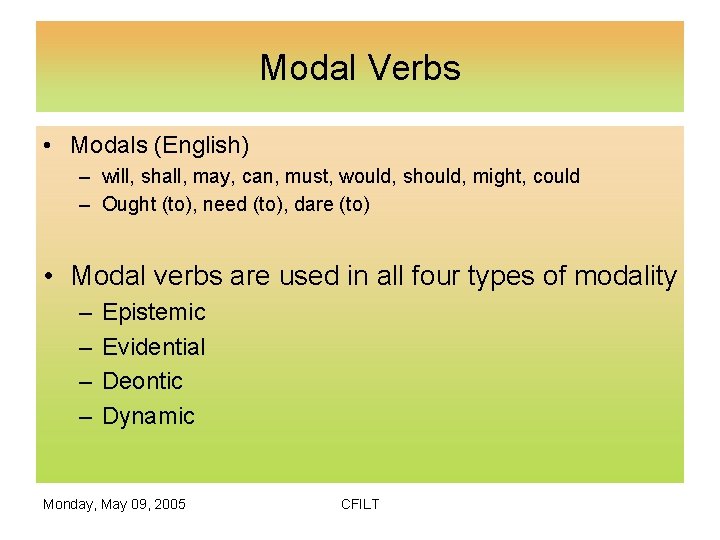
Modal Verbs • Modals (English) – will, shall, may, can, must, would, should, might, could – Ought (to), need (to), dare (to) • Modal verbs are used in all four types of modality – – Epistemic Evidential Deontic Dynamic Monday, May 09, 2005 CFILT
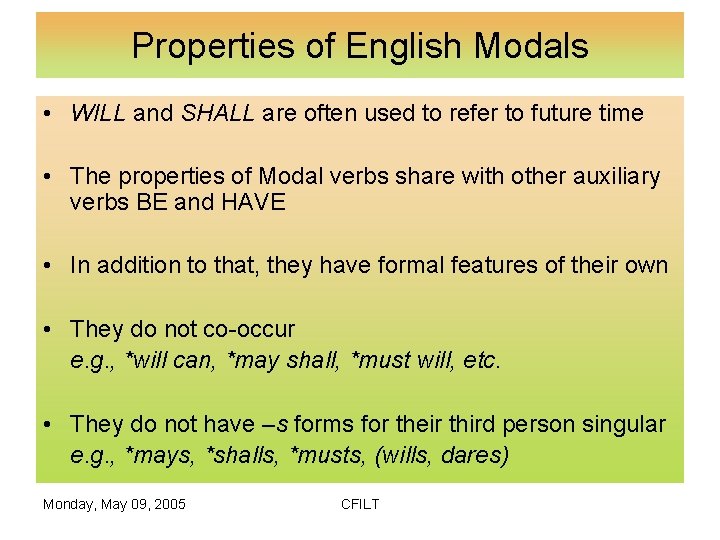
Properties of English Modals • WILL and SHALL are often used to refer to future time • The properties of Modal verbs share with other auxiliary verbs BE and HAVE • In addition to that, they have formal features of their own • They do not co-occur e. g. , *will can, *may shall, *must will, etc. • They do not have –s forms for their third person singular e. g. , *mays, *shalls, *musts, (wills, dares) Monday, May 09, 2005 CFILT
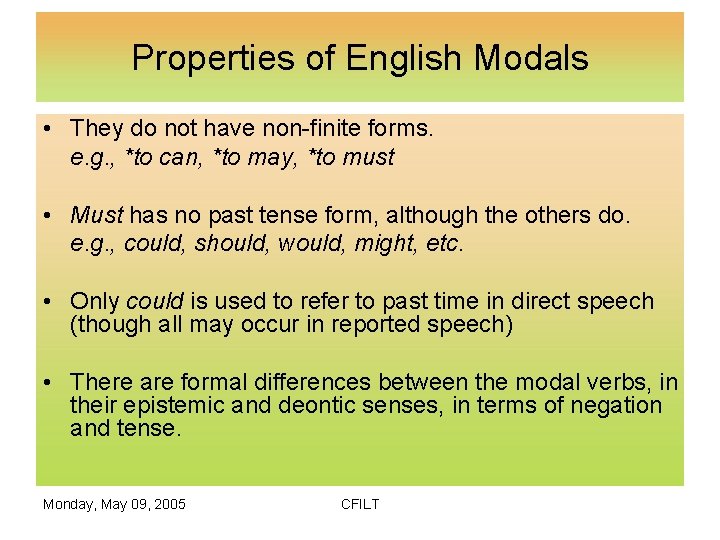
Properties of English Modals • They do not have non-finite forms. e. g. , *to can, *to may, *to must • Must has no past tense form, although the others do. e. g. , could, should, would, might, etc. • Only could is used to refer to past time in direct speech (though all may occur in reported speech) • There are formal differences between the modal verbs, in their epistemic and deontic senses, in terms of negation and tense. Monday, May 09, 2005 CFILT

Formal Differences • The same modal verb may be used in English for both epistemic and deontic modality. • Deontic MUST has negative mustn’t and needn’t, but epistemic MUST has no morphologically related negative. – John must / mustn’t come for the meeting. (deontic) – John must /*mustn’t be in his office. (epistemic) • MAY and MUST followed by HAVE always epistemic. – John may/must have been in his office. Monday, May 09, 2005 CFILT
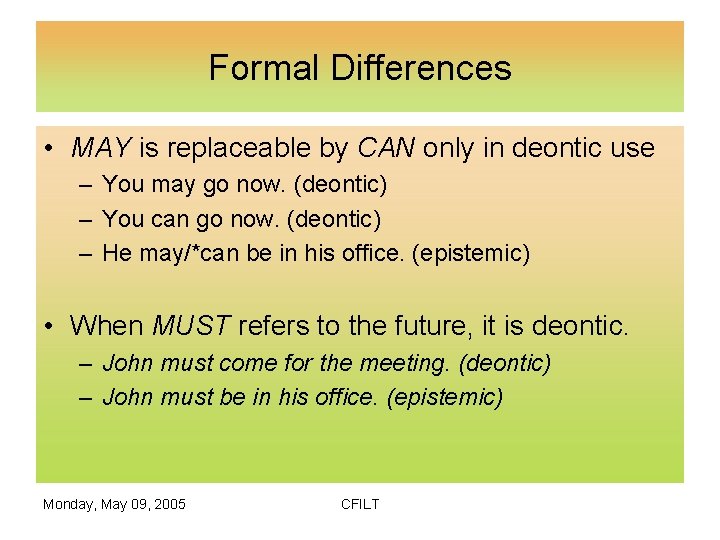
Formal Differences • MAY is replaceable by CAN only in deontic use – You may go now. (deontic) – You can go now. (deontic) – He may/*can be in his office. (epistemic) • When MUST refers to the future, it is deontic. – John must come for the meeting. (deontic) – John must be in his office. (epistemic) Monday, May 09, 2005 CFILT
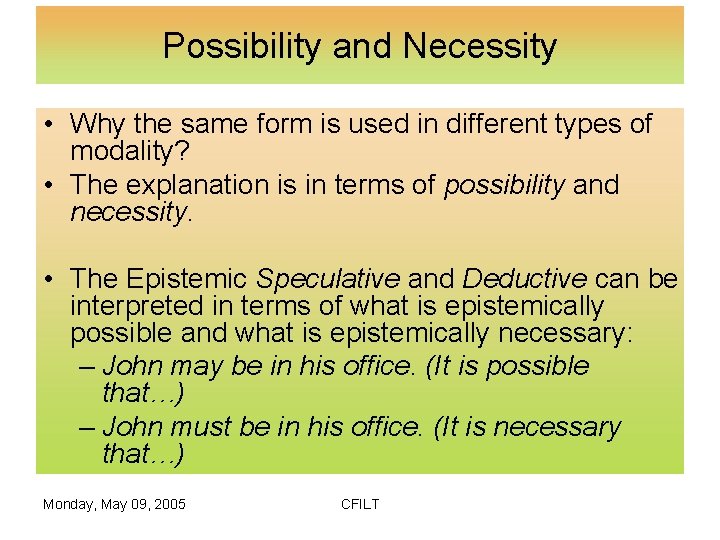
Possibility and Necessity • Why the same form is used in different types of modality? • The explanation is in terms of possibility and necessity. • The Epistemic Speculative and Deductive can be interpreted in terms of what is epistemically possible and what is epistemically necessary: – John may be in his office. (It is possible that…) – John must be in his office. (It is necessary that…) Monday, May 09, 2005 CFILT
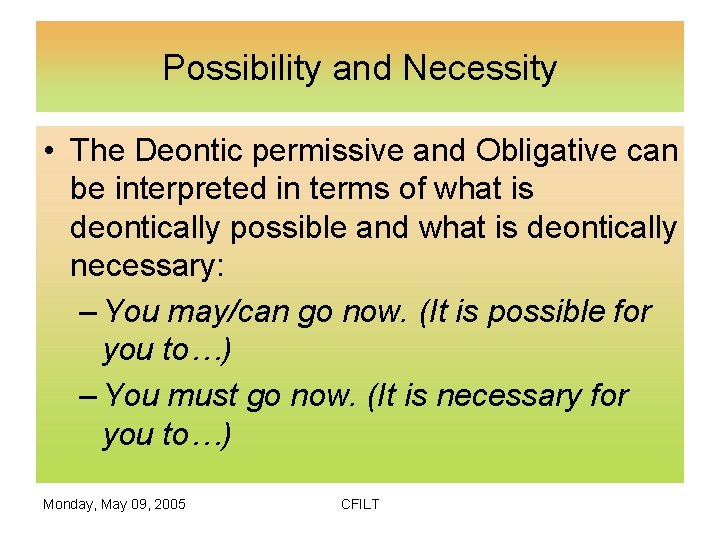
Possibility and Necessity • The Deontic permissive and Obligative can be interpreted in terms of what is deontically possible and what is deontically necessary: – You may/can go now. (It is possible for you to…) – You must go now. (It is necessary for you to…) Monday, May 09, 2005 CFILT
Sources and Suggested Reading • Bhat, D. N. S. 1999. The prominence of tense, aspect and mood. (Studies in language companion series). Benjamins, Philadelphia. • Palmer, F. R. 1990. Modality and English Modals. Longman, NY. • Palmer, F. R. 2001. Mood and Modality. CUP • Plank, F. 1984. The modals story retold. Studies in Language 8: 305 -64 • Willet, T. 1988. A cross-linguistic survey of the grammaticalization of evidentiality. Studies in Language 12: 51 -97 Monday, May 09, 2005 CFILT
Thank You Monday, May 09, 2005 CFILT
- Slides: 20