
MONTH JULY TOPIC ELECTRICAL SAFETY DEVICES CLASS VIII


- Slides: 23
MONTH – JULY TOPIC - ELECTRICAL SAFETY DEVICES CLASS - VIII Prepared by M. S Anwar TGT WET
CONTENTS 1. Pre-requisites/Recap 2. Introduction 3. Overloading and short-circuiting 4. Types of Electrical safety devices 5. Structure, function and types of electrical fuse 6. Fuse wire and it’s characteristics 7. Structure, types and role of Circuit Breaker 8. Conclusion
Pre-requisites/Recap Why electrical safety is required. . . What are the electrical safety measures… Do you know about overloading and short circuiting… How electrical fuse works… How electrical safety devices protects user, equipments and wiring from electrical fire…
Introduction Electricity is very useful form of energy in our daily life. Without proper safety precautions electricity can be harmful for the property and precious human life. To avoid any an accident in electrical wiring or appliances caused due to overloading or shortcircuit, different types of electrical safety devices are placed at various key locations in the electrical wiring system. These topic is focused on two important electrical safety devices: i) Electrical Fuse ii)
Overloading and short-circuiting q What is an electric overload? An electric overload occurs when excessive current passes through electric wires. What happens if a circuit get overloaded? Electrical circuits are designed to handle a limited amount of electricity/current. An overload occurs when you draw more electric current than a circuit can safely handle. If there were no breaker in the circuit, an overload would cause the circuit wiring to
Overloading and short-circuiting What is electric short circuit? A short circuit is simply a low resistance connection between the two conductor supplying electrical power to any circuit. This results in excessive current flow in the power source through the 'short' and may even cause the power source to be destroyed. q Normally short-circuit happens when Live and Neutral wires comes in direct contact with each other. In this condition massive current flows through the wires resulting in to overheating and
Types of Electrical safety devices Electric circuits, equipments/appliances and user can be effectively protect against overloading and short-circuit by using appropriate electrical safety devices such as Fuse and Circuit breaker. Fuses and Circuit Breakers both serve the same purpose, to protect electrical circuits by preventing overloads that can cause fire. They both interrupt the excessive flow of electricity, but in very different ways from each other.
Fuse & Circuit Breaker An electric fuse is a safety device which is used to limit the current in an electric circuit. The fuse safeguards the circuit and the electrical appliances from the damaged caused due to overloading and short-circuit. A circuit breaker is an automatically operated electrical switch designed to protect an electrical circuit from damage caused by excess current from an overload or short circuit. It’s basic function is to interrupt current flow after a fault is detected.
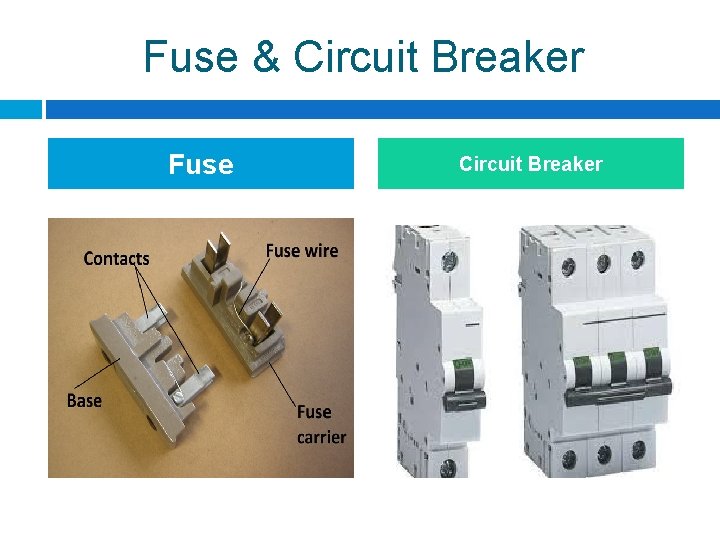
Fuse & Circuit Breaker Fuse Circuit Breaker
Structure, function and types of electrical fuse A fuse is a small, thin conductor designed to melt and separate into two pieces for the purpose of breaking a circuit in the event of excessive current. The fuses are mainly classified into two types, depends on the input supply voltages they are the AC fuses and the DC fuses. The working principle of a fuse is based on the “Heating effect of Current". Whenever excess current flows through the circuit the fuse wire inside the fuse melt and break the circuit from power supply thus safeguard equipments/appliances from
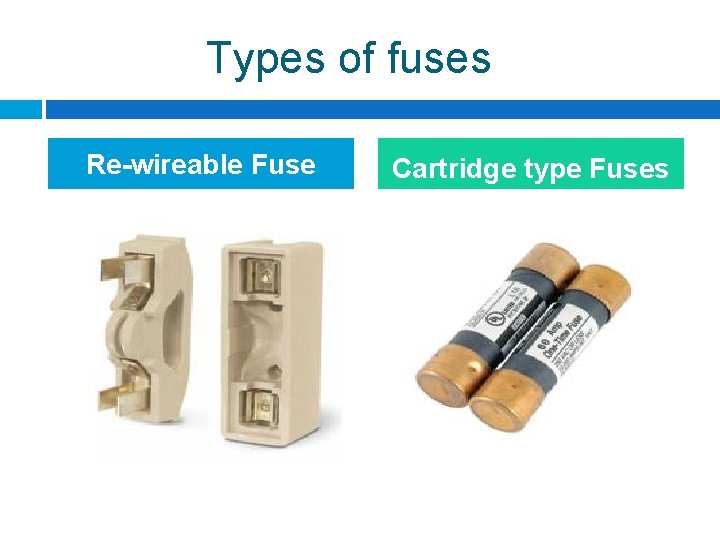
Types of fuses : Re-wireable Fuses The most famous kit-kat fuse (also know as rewireable fuse) mostly used in home electrical wiring for small current applications in Low Voltage (LV) circuits. Re-wireable fuse contains two basic parts. Fuse base and fuse carrier. Both are made up of insulating material ‘Porcelain’. Fuse base consist of IN and OUT terminals. Incoming and outgoing live wires are connected across it. Fuse carrier is a removable part consist of small piece of fuse wire made up of Lead, Tin,
Cartridge type Fuse The cartridge type fuse has entirely closed container and metal contacts. The type of fuse is suitable for low voltage (LV), high voltage (HV) circuits. They are classified into two types: D-type and Link-type. D-type Cartridge Fuse This type of fuse is composed with the cartridge, adapter ring and cap. The base of the fuse includes fuse cap, which is packed with the fuse ingredient by cartridge using an adapter ring.
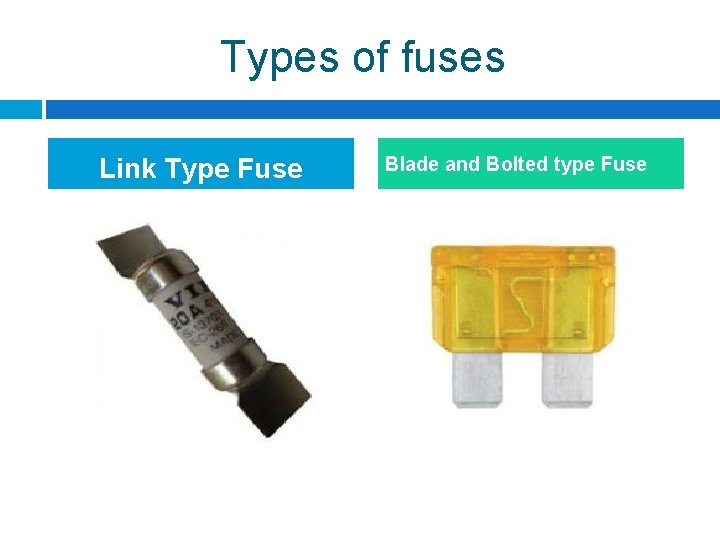
Link, Blade & Bolted type fuses Link Type Fuse The link type fuse is also known as high rupturing capacity (HRC) fuse. It is suitable for HV(High Voltage) industrial applications. Blade and Bolted type Fuses These are knife type or plug-in type fuses designed with moulded plastic case. They are suitable for variable electric loads and easily replaceable in any circuits.
Types of fuses Re-wireable Fuse Cartridge type Fuses
Types of fuses Link Type Fuse Blade and Bolted type Fuse
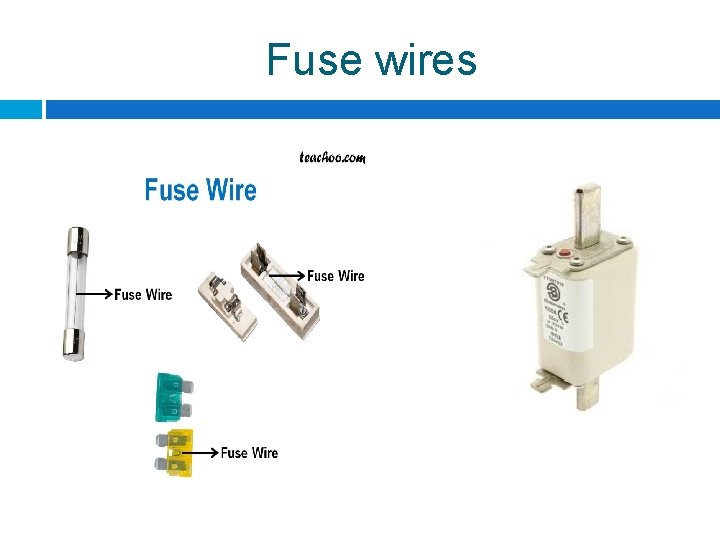
Fuse wire and its characteristics Fuse is a piece of wire made up of a material with a very low melting point. When a high current flows through the circuit due to Overloading or a Short circuit , the fuse wires gets heated and melts. Which ultimately in turn break the circuit. The material used for making fuse elements must be of low melting point, high conductivity (or low resistivity) and low cost. Lead, Tin, Copper or it’s alloys are widely used to prepare fuse wires.
Fuse wire and its characteristics The fuse is connected to the live wire so that the appliance will not become charged (with a potential difference of 230 V) after the fuse has melt down due to over current. Fuses must be fixed in the live wire so that when it blows, it will disconnect (isolate) the appliance from the high voltage live wire. Main power supply should be switch-off before replacing blown out fuse wire.
Fuse wires
Circuit Breaker A circuit breaker is an automatically-operated electrical switch designed to protect an electrical circuit from damage caused by overload of electricity or short circuit. A circuit breakers function is to detect a fault condition and immediately discontinue electrical current flow. q The advantage of a circuit breaker over a fuse is that it can be reset and used over and over. when a fuse blows you have to replace it with a new fuse. q
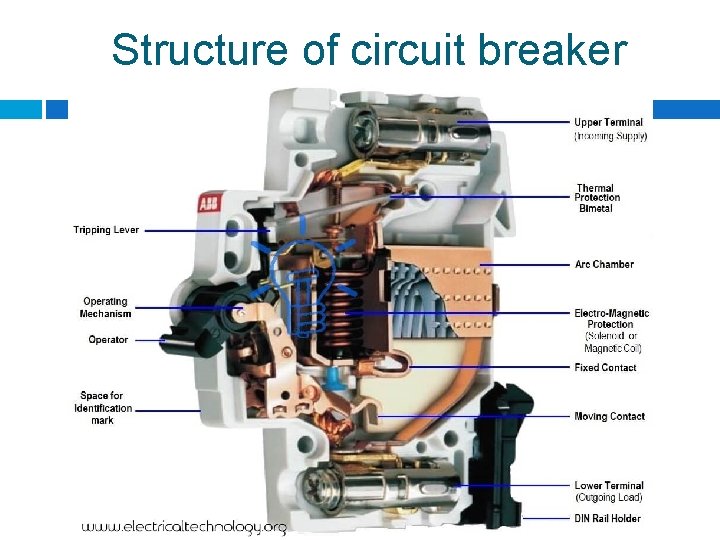
Structure of circuit breaker
Types of domestic circuit breakers The most widely used electrical circuit breakers for domestic electrical circuits are Miniature circuit breakers (MCBs) , Residual current circuit breaker (RCCB) and Mounded Case Circuit Breaker (MCCB) Miniature Circuit Breakers (MCB) Miniature circuit breakers (MCBs) are used in place of fuse in distribution boards. Different electrical circuits are protected through individual MBC’s. During overloading and short -circuit they trip and cut-off the power supply.
Types of domestic circuit breakers q Residual Current Circuit Breaker (RCCB) Residual current circuit breaker is designed to protect user from electric shock. It operates by sensing balance of current between Live and Neutral wires. It is also known as RCD (Residual current device). Mounded Case Circuit Breaker (MCCB) A Mounded Case Circuit Breaker (MCCB) breaker will automatically trip and cut-off the power supply, when the current through it exceeds a predetermined value. It can be used as a main switch
Conclusion Fuse and Circuit breakers are electrical safety devices used to protect electrical appliances, equipments and wiring from overloading and short-circuiting. Some special types of circuit breakers are used to protect user from electric shock. By using appropriate safety devices we can safeguard our important resources and precious human life.