
Month Day Year Analysis of Turbine Cooling Technologies

Month Day, Year Analysis of Turbine Cooling Technologies to Increase NGCC Efficiency Selcuk Can Uysal, Ph. D
Agenda • Objective • Introduction • Baseline Performance Metrics • Sensitivity Analysis • Techno-economic Analysis • Conclusion 2

Objective • This study aims to evaluate impacts on NGCC efficiency from general turbine cooling parameters such as: ◦ ◦ ◦ Various cooling configurations External blade cooling effectiveness Internal blade cooling effectiveness Material properties Thermal barrier coatings(TBCs) • The ultimate goal is to identify and evaluate cooling technologies that will lead to combined cycle efficiency of 65% and more • The model will also be able to analyze the effects of pressure gain combustion, and cooling of the coolant flow on NGCC performance 3

NGCC Simulation Development Analysis Tool • An ASPEN Plus model (NGCC-Sim) has been developed in NETL for NGCC analyses 1 • Cooled Gas Turbine Model (CGTM) is developed in MATLAB/Simulink and validated with H-Class GT data 2 • The NGCC Simulation with Cooled Turbine Analysis is developed by integrating CGTM into NGCC-Sim 3 • Steam cycle has been modified to give H-Class GT integrated NGCC performance (2 x 1 Configuration)3 1) National Energy Technology Laboratory (NETL), "Cost and Performance Baseline for Fossil Energy Plants Volume 1: Bituminous Coal and Natural Gas to Electricity, " DOE/NETL 2019/1885, September 25, 2019, Pittsburgh, PA 2) Uysal, S. C. , (2017), "Analytical Modelling of the Effects of Different Gas Turbine Cooling Techniques on Engine Performance, West Virginia University, Ann Arbor, MI 3) Uysal, S. C. , (2019), “Sensitivity and Techno-Economic Analysis for Turbine Cooling Technologies for Higher Combined Cycle Efficiency “, NETL-PUB-22369 4
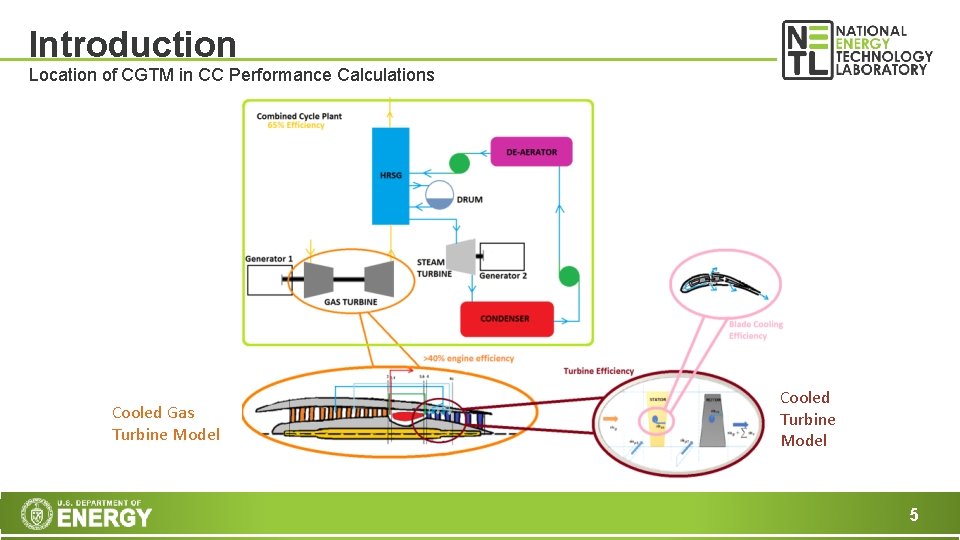
Introduction Location of CGTM in CC Performance Calculations Cooled Gas Turbine Model Cooled Turbine Model 5
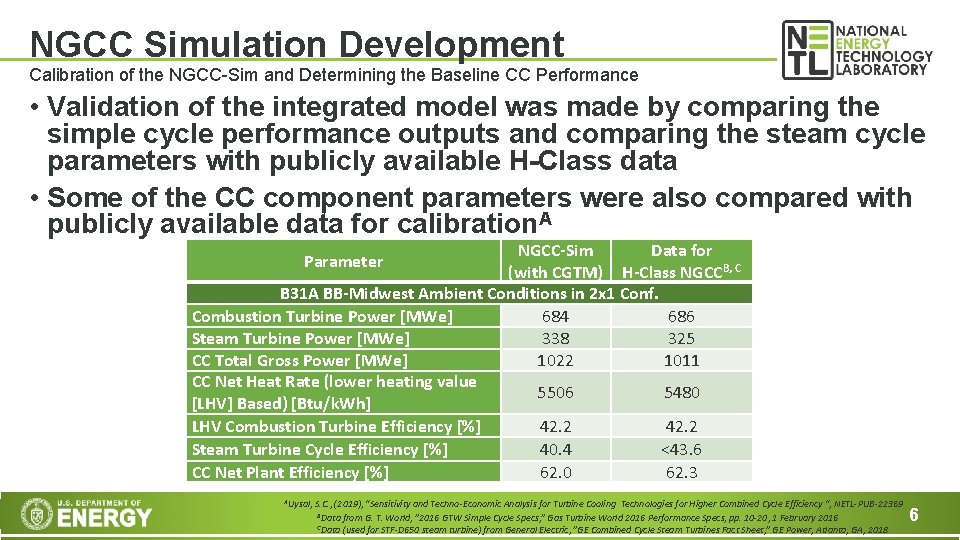
NGCC Simulation Development Calibration of the NGCC-Sim and Determining the Baseline CC Performance • Validation of the integrated model was made by comparing the simple cycle performance outputs and comparing the steam cycle parameters with publicly available H-Class data • Some of the CC component parameters were also compared with publicly available data for calibration. A NGCC-Sim Data for (with CGTM) H-Class NGCCB, C B 31 A BB-Midwest Ambient Conditions in 2 x 1 Conf. Combustion Turbine Power [MWe] 684 686 Steam Turbine Power [MWe] 338 325 CC Total Gross Power [MWe] 1022 1011 CC Net Heat Rate (lower heating value 5506 5480 [LHV] Based) [Btu/k. Wh] LHV Combustion Turbine Efficiency [%] 42. 2 Steam Turbine Cycle Efficiency [%] 40. 4 <43. 6 CC Net Plant Efficiency [%] 62. 0 62. 3 Parameter AUysal, S. C. , (2019), “Sensitivity and Techno-Economic Analysis for Turbine Cooling Technologies for Higher Combined Cycle Efficiency “, NETL-PUB-22369 BData from G. T. World, "2016 GTW Simple Cycle Specs, " Gas Turbine World 2016 Performance Specs, pp. 10 -20, 1 February 2016 CData (used for STF-D 650 steam turbine) from General Electric, "GE Combined Cycle Steam Turbines Fact Sheet, " GE Power, Atlanta, GA, 2018 6
Baseline Performance Metrics • Baseline performance metrics were determined for the H-Class engine scenario used in the calibration study • Auxiliary load calculations follow the methodology used in NETL Bituminous Baseline Reports for NGCC* • Calculations were based on 85% plant capacity factor • Calculated baseline plant net CC efficiency(LHV based) is 62. 0% for 2 x 1 H-Class GT NGCC Plant *National Energy Technology Laboratory (NETL), "Cost and Performance Baseline for Fossil Energy Plants Volume 1: Bituminous Coal and Natural Gas to Electricity, " DOE/NETL-2019/1885, September 25, 2019, Pittsburgh, PA 7

Baseline Performance Metrics Performance Summary Parameter Combustion Turbine Power, MWe Steam Turbine Power, MWe Total Gross Power, MWe CO₂ Capture/Removal Auxiliaries, k. We CO₂ Compression, k. We Balance of Plant, k. We Total Auxiliaries, MWe Net Power, MWe LHV Net Plant Efficiency, % LHV Net Plant Heat Rate, k. J/k. Wh (Btu/k. Wh) LHV Combustion Turbine Efficiency, % Steam Turbine Cycle Efficiency, % Steam Turbine Heat Rate, k. J/k. Wh (Btu/k. Wh) Condenser Duty, GJ/hr (MMBtu/hr) Acid Gas Removal (AGR) Cooling Duty, GJ/hr (MMBtu/hr) Natural Gas Feed Flow, kg/hr (lb/hr) HHV Thermal Input, k. Wt LHV Thermal Input, k. Wt Raw Water Withdrawal, (m 3/min)/MWnet (gpm/MWnet) Raw Water Consumption, (m 3/min)/MWnet (gpm/MWnet) 8 Value 684 338 1, 022 0 0 17, 712 18 1, 004 62. 0% 5, 809 (5, 506) 42. 2% 40. 4% 8, 908 (8, 443) 1, 717 (1, 628) – (–) 123, 578 (272, 442) 1, 795, 147 1, 620, 297 0. 013 (3. 5) 0. 010 (2. 7)
Sensitivity Analysis • The sensitivity analysis was made for the impact of several turbine cooling parameters on the gas turbine, steam cycle, and combined cycle performance parameters • Analysis inputs were the following turbine cooling parameters ◦ Blade metal material properties (through Biot number and max. allowable metal temperature) ◦ TBC material properties (through TBC Biot number) ◦ Internal cooling effectiveness ◦ Film cooling effectiveness ◦ Purge cooling flow fractions and distribution 9
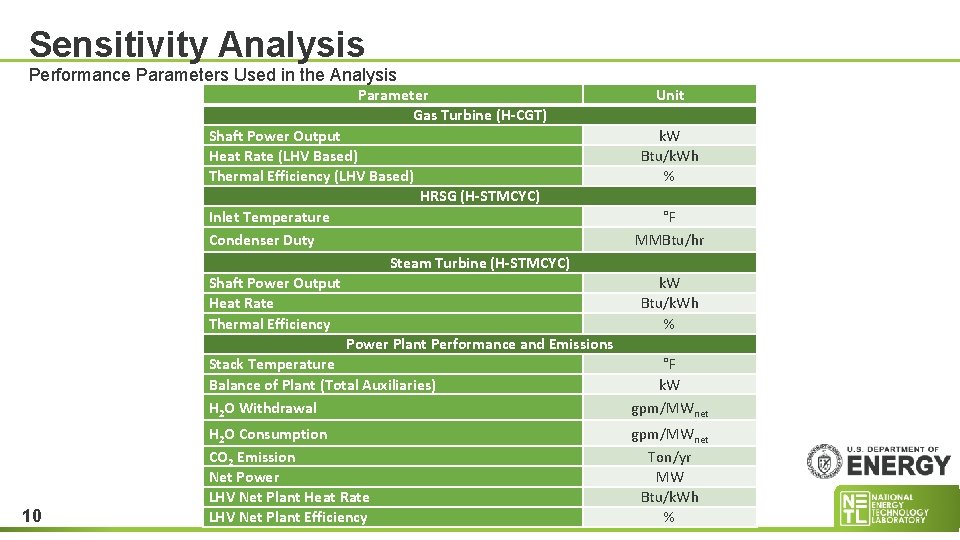
Sensitivity Analysis Performance Parameters Used in the Analysis Parameter Gas Turbine (H-CGT) Shaft Power Output Heat Rate (LHV Based) Thermal Efficiency (LHV Based) Unit k. W Btu/k. Wh % HRSG (H-STMCYC) Inlet Temperature Condenser Duty °F MMBtu/hr Steam Turbine (H-STMCYC) Shaft Power Output Heat Rate Thermal Efficiency k. W Btu/k. Wh % Power Plant Performance and Emissions 10 Stack Temperature Balance of Plant (Total Auxiliaries) H 2 O Withdrawal °F k. W gpm/MWnet H 2 O Consumption CO 2 Emission Net Power LHV Net Plant Heat Rate LHV Net Plant Efficiency gpm/MWnet Ton/yr MW Btu/k. Wh %
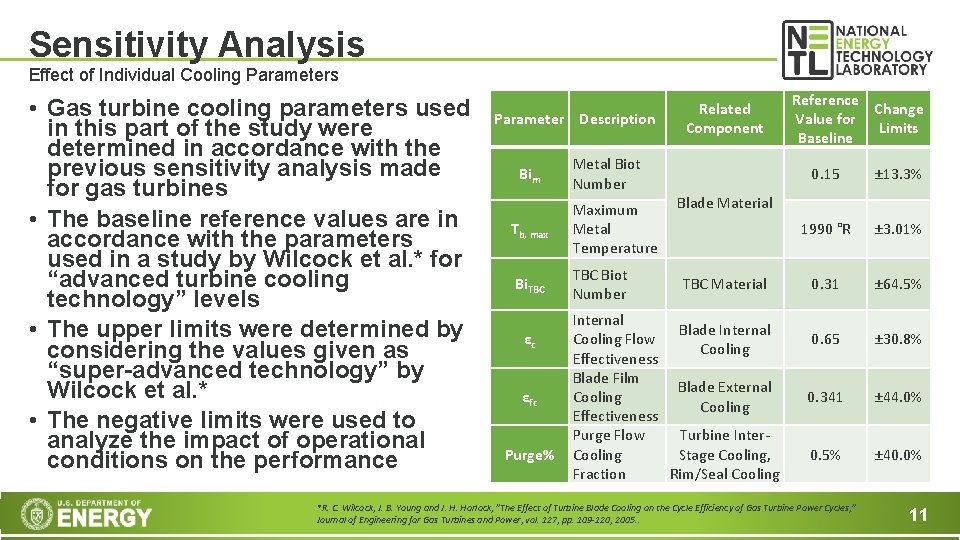
Sensitivity Analysis Effect of Individual Cooling Parameters • Gas turbine cooling parameters used in this part of the study were determined in accordance with the previous sensitivity analysis made for gas turbines • The baseline reference values are in accordance with the parameters used in a study by Wilcock et al. * for “advanced turbine cooling technology” levels • The upper limits were determined by considering the values given as “super-advanced technology” by Wilcock et al. * • The negative limits were used to analyze the impact of operational conditions on the performance Parameter Description Bim Metal Biot Number Tb, max Maximum Metal Temperature Bi. TBC Biot Number εc εfc Purge% Related Component Reference Change Value for Limits Baseline 0. 15 ± 13. 3% 1990 °R ± 3. 01% 0. 31 ± 64. 5% 0. 65 ± 30. 8% 0. 341 ± 44. 0% 0. 5% ± 40. 0% Blade Material TBC Material Internal Blade Internal Cooling Flow Cooling Effectiveness Blade Film Blade External Cooling Effectiveness Purge Flow Turbine Inter. Cooling Stage Cooling, Fraction Rim/Seal Cooling *R. C. Wilcock, J. B. Young and J. H. Horlock, "The Effect of Turbine Blade Cooling on the Cycle Efficiency of Gas Turbine Power Cycles, " Journal of Engineering for Gas Turbines and Power, vol. 127, pp. 109 -120, 2005. . 11
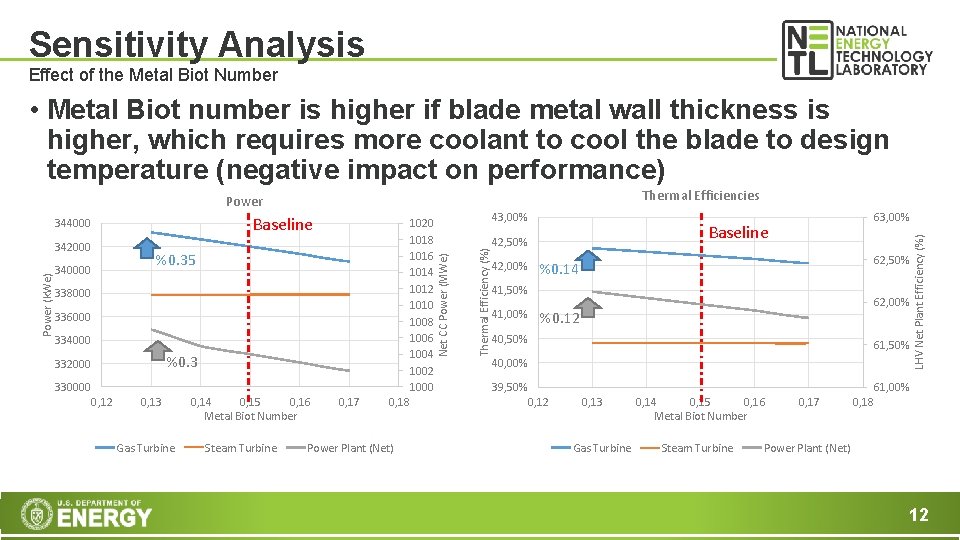
Sensitivity Analysis Effect of the Metal Biot Number • Metal Biot number is higher if blade metal wall thickness is higher, which requires more coolant to cool the blade to design temperature (negative impact on performance) Thermal Efficiencies %0. 35 340000 338000 336000 334000 %0. 3 332000 330000 0, 12 0, 13 Gas Turbine 0, 14 0, 15 0, 16 Metal Biot Number Steam Turbine 0, 17 0, 18 Power Plant (Net) 43, 00% Thermal Efficiency (%) Power (k. We) 342000 1020 1018 1016 1014 1012 1010 1008 1006 1004 1002 1000 Net CC Power (MWe) Baseline 344000 Baseline 42, 50% 42, 00% 63, 00% 62, 50% %0. 14 41, 50% 41, 00% 62, 00% %0. 12 40, 50% 61, 50% 40, 00% 39, 50% LHV Net Plant Efficiency (%) Power 61, 00% 0, 12 0, 13 Gas Turbine 0, 14 0, 15 0, 16 Metal Biot Number Steam Turbine 0, 17 0, 18 Power Plant (Net) 12
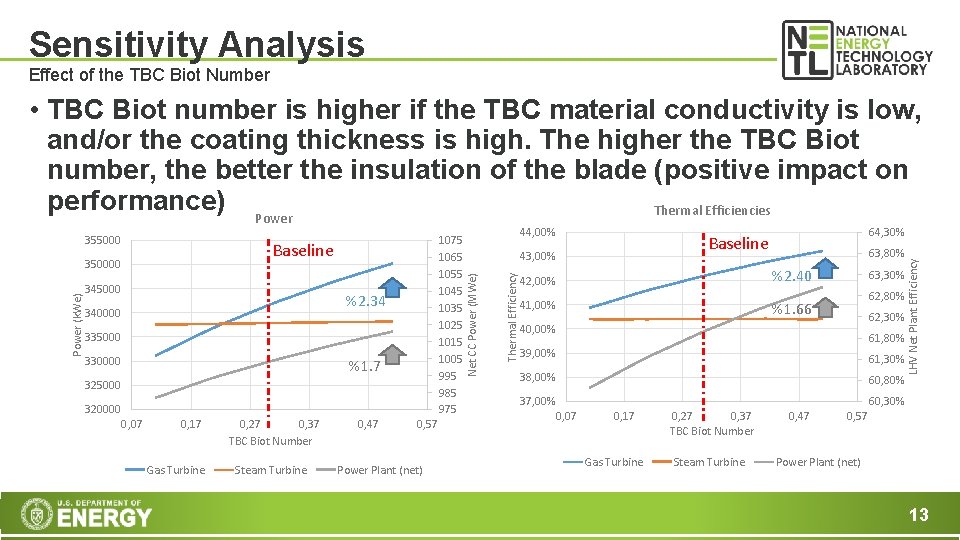
Sensitivity Analysis Effect of the TBC Biot Number • TBC Biot number is higher if the TBC material conductivity is low, and/or the coating thickness is high. The higher the TBC Biot number, the better the insulation of the blade (positive impact on performance) Power Thermal Efficiencies %2. 34 340000 335000 330000 %1. 7 325000 320000 0, 07 0, 17 Gas Turbine 0, 27 0, 37 TBC Biot Number Steam Turbine 0, 47 0, 57 Power Plant (net) 64, 30% Baseline 43, 00% 63, 80% %2. 40 42, 00% 41, 00% 63, 30% 62, 80% %1. 66 62, 30% 40, 00% 61, 80% 39, 00% 61, 30% 38, 00% 60, 80% 37, 00% 60, 30% 0, 07 0, 17 Gas Turbine 0, 27 0, 37 TBC Biot Number Steam Turbine 0, 47 LHV Net Plant Efficiency 345000 44, 00% Thermal Efficiency Baseline 350000 Power (k. We) 1075 1065 1055 1045 1035 1025 1015 1005 995 985 975 Net CC Power (MWe) 355000 0, 57 Power Plant (net) 13
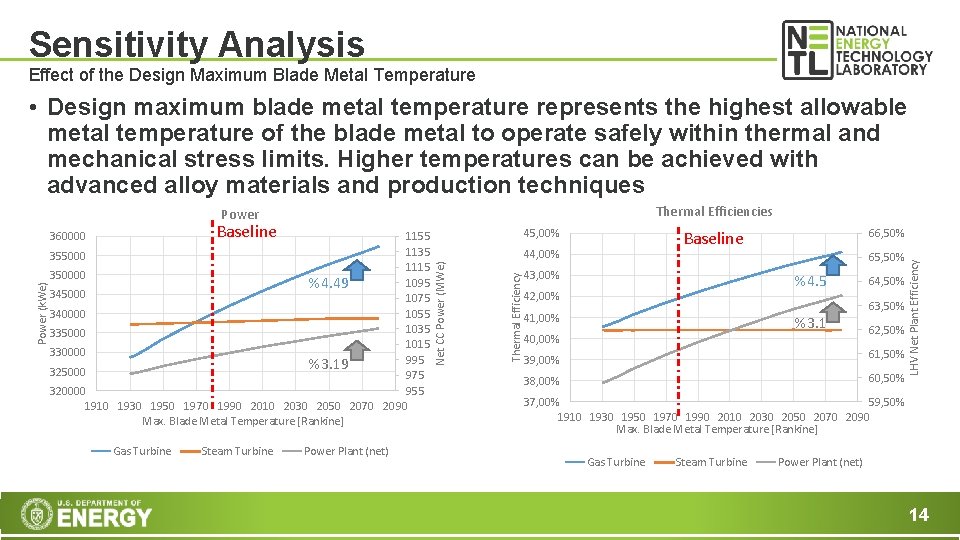
Sensitivity Analysis Effect of the Design Maximum Blade Metal Temperature • Design maximum blade metal temperature represents the highest allowable metal temperature of the blade metal to operate safely within thermal and mechanical stress limits. Higher temperatures can be achieved with advanced alloy materials and production techniques Thermal Efficiencies Baseline Gas Turbine Steam Turbine Power Plant (net) 45, 00% 66, 50% Baseline 44, 00% Thermal Efficiency 1155 1135 355000 1115 350000 1095 %4. 49 345000 1075 340000 1055 1035 335000 1015 330000 995 %3. 19 325000 975 320000 955 1910 1930 1950 1970 1990 2010 2030 2050 2070 2090 Max. Blade Metal Temperature [Rankine] Net CC Power (MWe) Power (k. We) 360000 65, 50% 43, 00% %4. 5 42, 00% 41, 00% %3. 1 40, 00% 64, 50% 63, 50% 62, 50% 61, 50% 39, 00% 60, 50% 38, 00% LHV Net Plant Efficiency Power 37, 00% 59, 50% 1910 1930 1950 1970 1990 2010 2030 2050 2070 2090 Max. Blade Metal Temperature [Rankine] Gas Turbine Steam Turbine Power Plant (net) 14
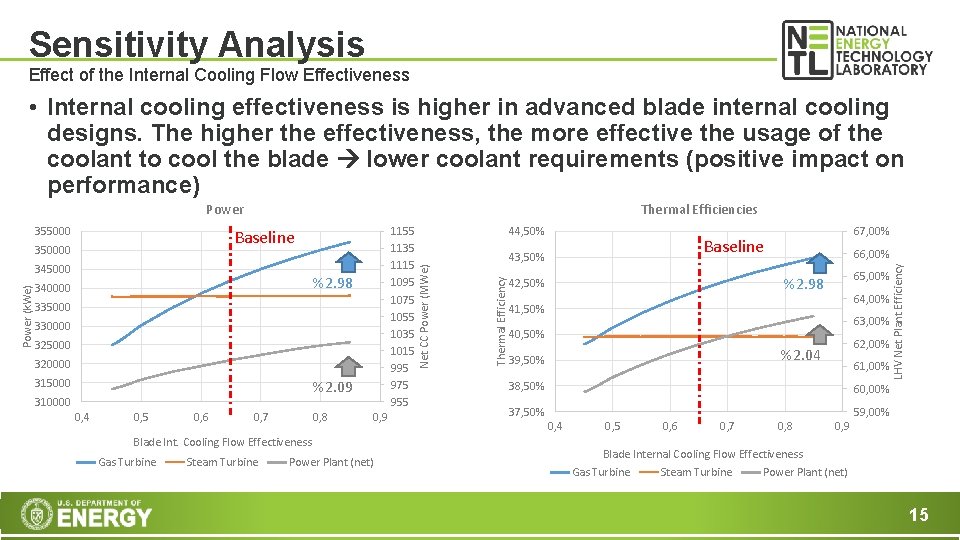
Sensitivity Analysis Effect of the Internal Cooling Flow Effectiveness • Internal cooling effectiveness is higher in advanced blade internal cooling designs. The higher the effectiveness, the more effective the usage of the coolant to cool the blade lower coolant requirements (positive impact on performance) 345000 %2. 98 340000 335000 330000 325000 320000 315000 %2. 09 310000 0, 4 0, 5 0, 6 0, 7 0, 8 0, 9 Blade Int. Cooling Flow Effectiveness Gas Turbine Steam Turbine Power Plant (net) 44, 50% 67, 00% Baseline 43, 50% Thermal Efficiency 350000 Power (k. We) 1155 1135 1115 1095 1075 1055 1035 1015 995 975 955 Baseline Net CC Power (MWe) 355000 Thermal Efficiencies 66, 00% 65, 00% %2. 98 42, 50% 64, 00% 41, 50% 63, 00% 40, 50% 62, 00% %2. 04 39, 50% 61, 00% 38, 50% 60, 00% 37, 50% 59, 00% 0, 4 0, 5 0, 6 0, 7 0, 8 LHV Net Plant Efficiency Power 0, 9 Blade Internal Cooling Flow Effectiveness Gas Turbine Steam Turbine Power Plant (net) 15
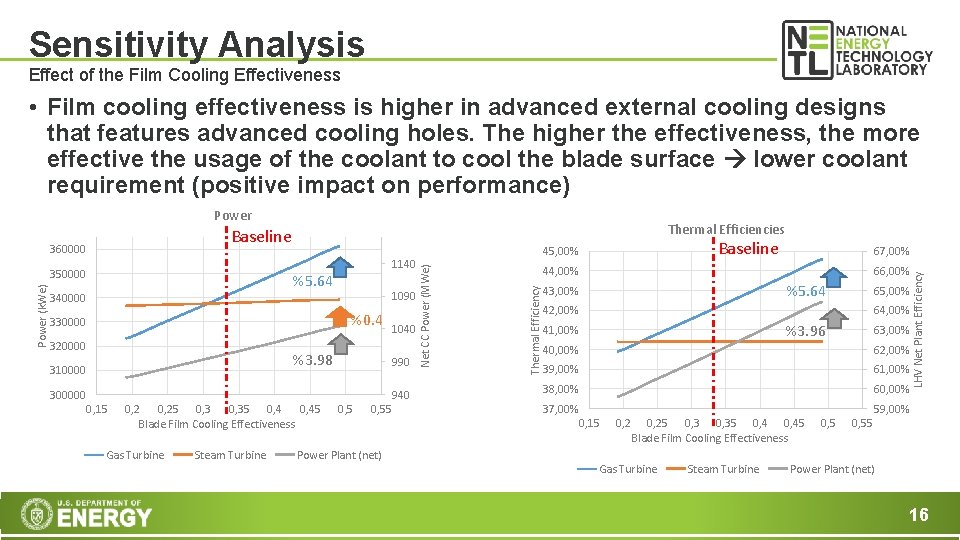
Sensitivity Analysis Effect of the Film Cooling Effectiveness • Film cooling effectiveness is higher in advanced external cooling designs that features advanced cooling holes. The higher the effectiveness, the more effective the usage of the coolant to cool the blade surface lower coolant requirement (positive impact on performance) Power 1090 340000 %0. 4 330000 320000 %3. 98 310000 1040 990 300000 940 0, 15 0, 25 0, 35 0, 45 Blade Film Cooling Effectiveness Gas Turbine Steam Turbine 0, 55 Power Plant (net) 67, 00% 44, 00% 66, 00% %5. 64 43, 00% 65, 00% 42, 00% 64, 00% %3. 96 41, 00% 63, 00% 40, 00% 62, 00% 39, 00% 61, 00% 38, 00% 60, 00% 37, 00% LHV Net Plant Efficiency %5. 64 Baseline 45, 00% Thermal Efficiency 350000 1140 Net CC Power (MWe) 360000 Power (k. We) Thermal Efficiencies Baseline 59, 00% 0, 15 0, 25 0, 35 0, 45 Blade Film Cooling Effectiveness Gas Turbine Steam Turbine 0, 55 Power Plant (net) 16
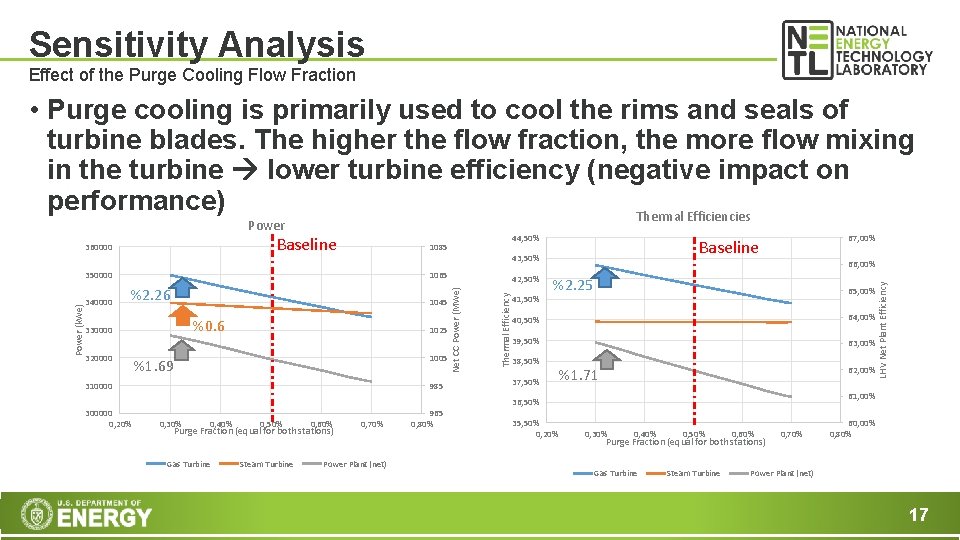
Sensitivity Analysis Effect of the Purge Cooling Flow Fraction • Purge cooling is primarily used to cool the rims and seals of turbine blades. The higher the flow fraction, the more flow mixing in the turbine lower turbine efficiency (negative impact on performance) Thermal Efficiencies Baseline 360000 1045 %0. 6 330000 320000 1025 1005 %1. 69 310000 985 Thermal Efficiency %2. 26 42, 50% Net CC Power (MWe) Power (k. We) 1065 41, 50% 67, 00% Baseline 43, 50% 350000 340000 44, 50% 1085 66, 00% %2. 25 65, 00% 40, 50% 64, 00% 39, 50% 63, 00% 38, 50% 37, 50% 62, 00% %1. 71 61, 00% 36, 50% 300000 0, 20% 0, 30% 0, 40% 0, 50% 0, 60% Purge Fraction (equal for both stations) Gas Turbine Steam Turbine 0, 70% Power Plant (net) 965 0, 80% 35, 50% 0, 20% LHV Net Plant Efficiency Power 0, 30% 0, 40% 0, 50% 0, 60% Purge Fraction (equal for both stations) Gas Turbine Steam Turbine 0, 70% 60, 00% 0, 80% Power Plant (net) 17
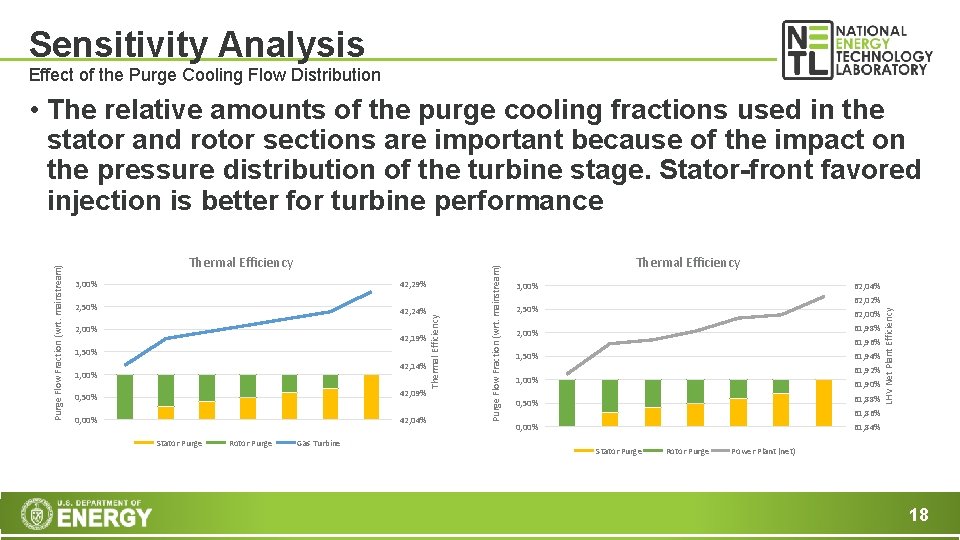
Sensitivity Analysis Effect of the Purge Cooling Flow Distribution 42, 29% 2, 50% 42, 24% 2, 00% 42, 19% 1, 50% 42, 14% 1, 00% 42, 09% 0, 50% 0, 00% 42, 04% Stator Purge Rotor Purge Gas Turbine Thermal Efficiency 3, 00% 62, 04% 62, 02% 2, 50% 62, 00% 61, 98% 2, 00% 61, 96% 1, 50% 61, 94% 61, 92% 1, 00% 61, 90% 61, 88% 0, 50% LHV Net Plant Efficiency 3, 00% Purge Flow Fraction (wrt. mainstream) Thermal Efficiency Purge Flow Fraction (wrt. mainstream) • The relative amounts of the purge cooling fractions used in the stator and rotor sections are important because of the impact on the pressure distribution of the turbine stage. Stator-front favored injection is better for turbine performance 61, 86% 0, 00% 61, 84% Stator Purge Rotor Purge Power Plant (net) 18
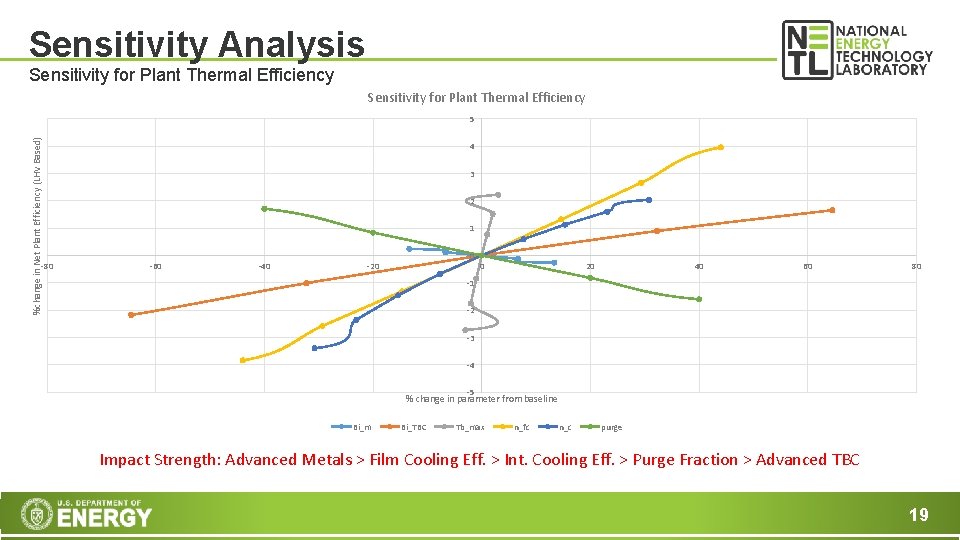
Sensitivity Analysis Sensitivity for Plant Thermal Efficiency %change in Net Plant Efficiency (LHV Based) 5 -80 4 3 2 1 -60 -40 0 -20 0 20 40 60 80 -1 -2 -3 -4 -5 % change in parameter from baseline Bi_m Bi_TBC Tb_max n_fc n_c purge Impact Strength: Advanced Metals > Film Cooling Eff. > Int. Cooling Eff. > Purge Fraction > Advanced TBC 19
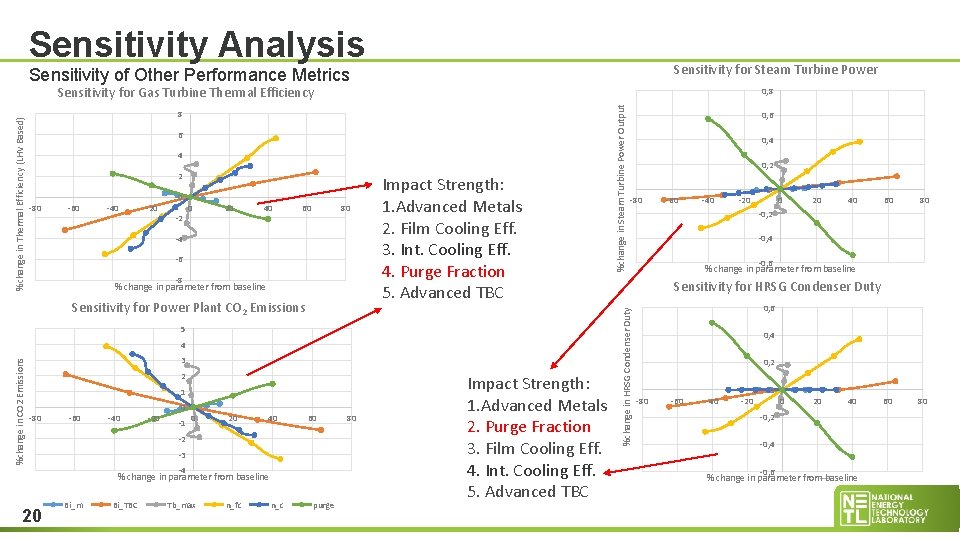
Sensitivity Analysis Sensitivity for Steam Turbine Power Sensitivity of Other Performance Metrics 8 6 4 2 -80 -60 -40 -20 0 -2 0 20 40 60 80 -4 -6 -8 % change in parameter from baseline Sensitivity for Power Plant CO 2 Emissions Impact Strength: 1. Advanced Metals 2. Film Cooling Eff. 3. Int. Cooling Eff. 4. Purge Fraction 5. Advanced TBC 5 %change in CO 2 Emissions 4 3 2 1 -80 -60 -40 -20 0 -1 0 20 40 60 -2 -3 -4 % change in parameter from baseline 20 Bi_m Bi_TBC Tb_max n_fc n_c purge 80 Impact Strength: 1. Advanced Metals 2. Purge Fraction 3. Film Cooling Eff. 4. Int. Cooling Eff. 5. Advanced TBC %change in Steam Turbine Power Output 0, 8 0, 6 0, 4 0, 2 -80 -60 -40 -20 0 0 20 40 60 80 -0, 2 -0, 4 -0, 6 % change in parameter from baseline Sensitivity for HRSG Condenser Duty %change in Thermal Efficiency (LHV Based) Sensitivity for Gas Turbine Thermal Efficiency 0, 6 0, 4 0, 2 -80 -60 -40 -20 0 0 20 40 -0, 2 -0, 4 -0, 6 % change in parameter from baseline
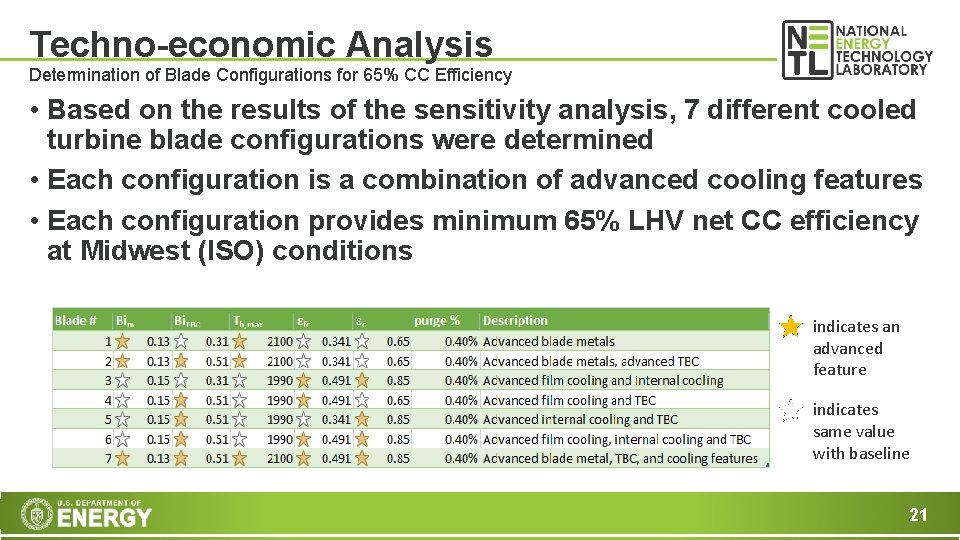
Techno-economic Analysis Determination of Blade Configurations for 65% CC Efficiency • Based on the results of the sensitivity analysis, 7 different cooled turbine blade configurations were determined • Each configuration is a combination of advanced cooling features • Each configuration provides minimum 65% LHV net CC efficiency at Midwest (ISO) conditions indicates an advanced feature indicates same value with baseline 21
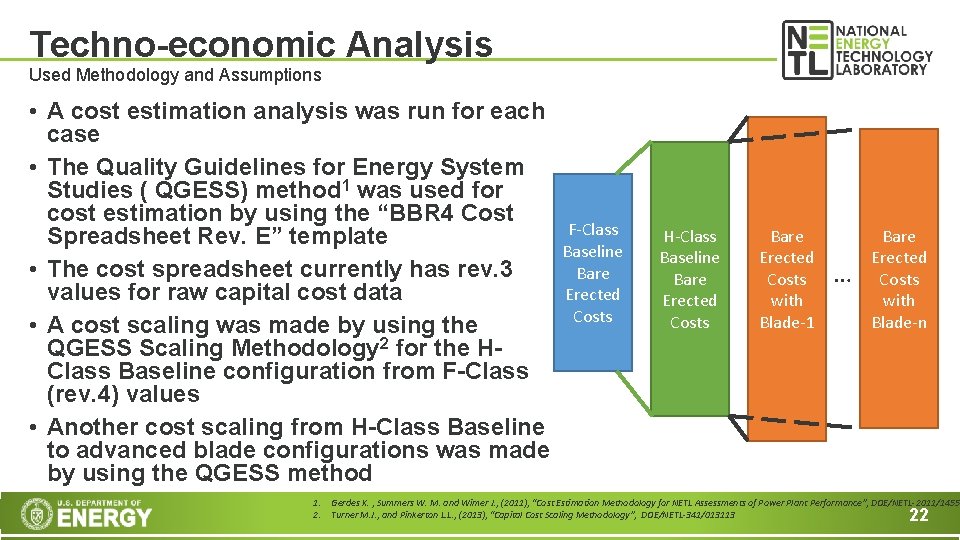
Techno-economic Analysis Used Methodology and Assumptions • A cost estimation analysis was run for each case • The Quality Guidelines for Energy System Studies ( QGESS) method 1 was used for cost estimation by using the “BBR 4 Cost Spreadsheet Rev. E” template • The cost spreadsheet currently has rev. 3 values for raw capital cost data • A cost scaling was made by using the QGESS Scaling Methodology 2 for the HClass Baseline configuration from F-Class (rev. 4) values • Another cost scaling from H-Class Baseline to advanced blade configurations was made by using the QGESS method F-Class Baseline Bare Erected Costs H-Class Baseline Bare Erected Costs with Blade-1 … Bare Erected Costs with Blade-n 1. Gerdes K. , Summers W. M. and Wimer J. , (2011), “Cost Estimation Methodology for NETL Assessments of Power Plant Performance”, DOE/NETL-2011/1455 2. Turner M. J. , and Pinkerton L. L. , (2013), “Capital Cost Scaling Methodology”, DOE/NETL-341/013113 22
Techno-economic Analysis Used Methodology and Assumptions (cont’d) • The engineering, development, and material costs of the advanced blades were assumed to be included in the scaled “Combustion Turbine Equipment Cost” from the baseline performance • The following outputs were calculated and compared for each blade configuration ◦ ◦ ◦ Cost of Electricity (COE) Total Overnight Costs (TOC) Total As-Spent Costs (TASC) Owner’s Costs and Cost Breakdown Operating Costs and Cost Breakdown • The following sensitivities were investigated for each configuration ◦ Natural Gas Fuel Price ◦ Power Plant Capacity Factor 23
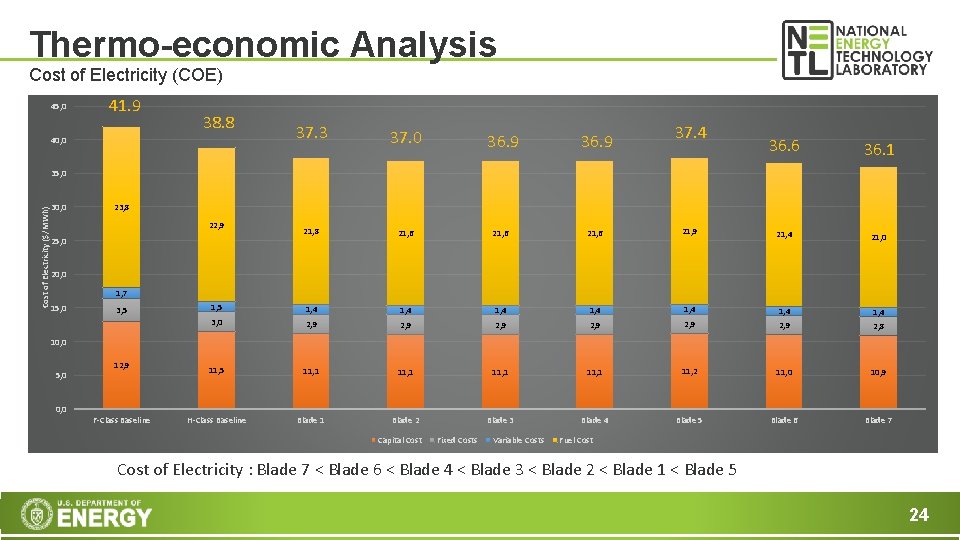
Thermo-economic Analysis Cost of Electricity (COE) 45, 0 41. 9 38. 8 40, 0 37. 3 37. 0 36. 9 37. 4 36. 6 36. 1 Cost of Electricity ($/MWh) 35, 0 30, 0 23, 8 22, 9 21, 8 21, 6 21, 9 21, 4 21, 0 1, 5 1, 4 1, 4 3, 0 1, 4 2, 9 2, 9 2, 8 11, 5 11, 1 11, 2 11, 0 10, 9 H-Class Baseline Blade 1 Blade 2 Blade 3 Blade 4 Blade 5 Blade 6 Blade 7 25, 0 20, 0 1, 7 15, 0 3, 5 10, 0 5, 0 0, 0 12, 9 F-Class Baseline Capital Cost Fixed Costs Variable Costs Fuel Cost of Electricity : Blade 7 < Blade 6 < Blade 4 < Blade 3 < Blade 2 < Blade 1 < Blade 5 24
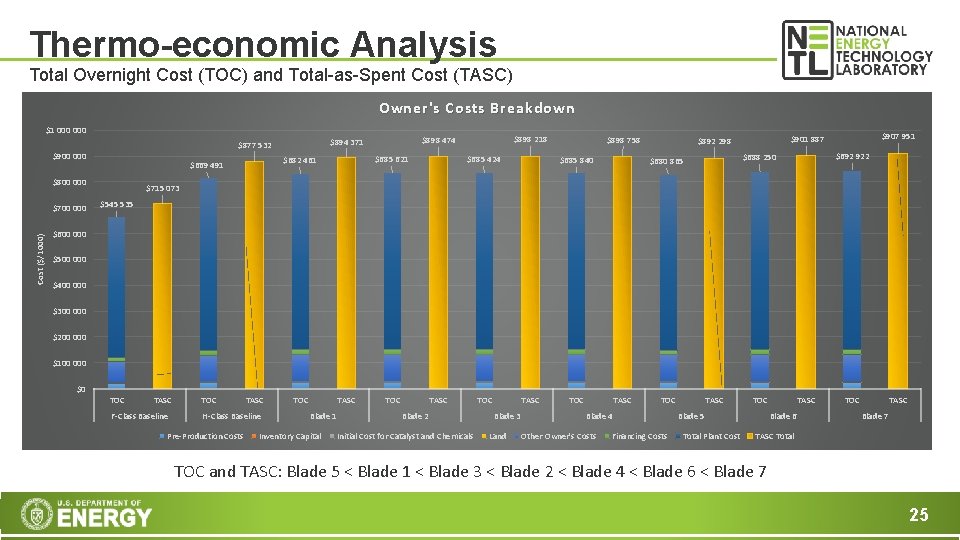
Thermo-economic Analysis Total Overnight Cost (TOC) and Total-as-Spent Cost (TASC) Owner's Costs Breakdown $1 000 $900 000 $800 000 Cost ($/1000) $700 000 $685 621 $682 461 $669 491 $898 218 $898 474 $894 371 $877 532 $685 424 $898 758 $685 840 $692 922 $688 250 $680 865 $907 951 $901 887 $892 298 $715 073 $545 535 $600 000 $500 000 $400 000 $300 000 $200 000 $100 000 $0 TOC TASC F-Class Baseline TOC TASC H-Class Baseline Pre-Production Costs TOC TASC Blade 1 Inventory Capital TOC TASC Blade 2 Initial Cost for Catalyst and Chemicals TOC TASC Blade 3 Land TOC TASC TOC Blade 4 Other Owner's Costs Financing Costs TASC TOC Blade 5 Total Plant Cost TASC Blade 6 TOC TASC Blade 7 TASC Total TOC and TASC: Blade 5 < Blade 1 < Blade 3 < Blade 2 < Blade 4 < Blade 6 < Blade 7 25
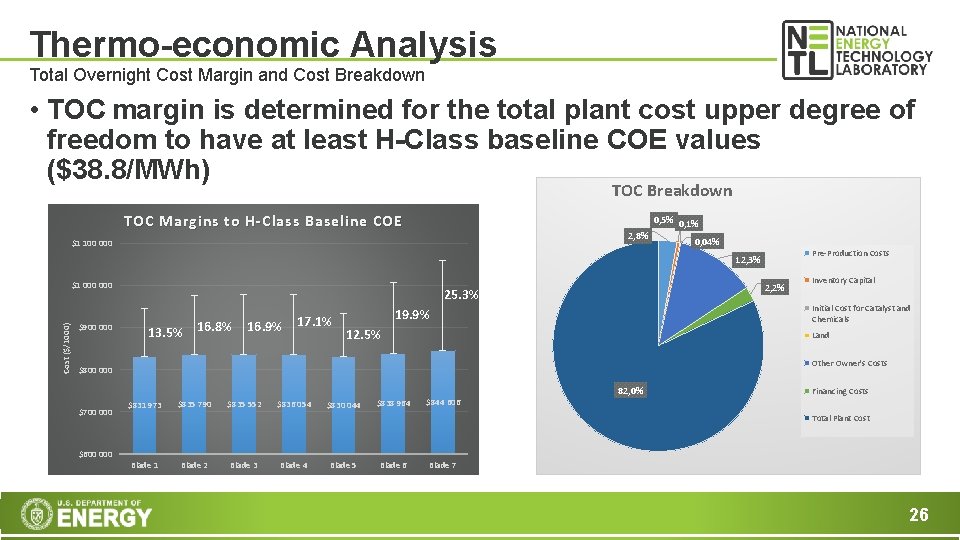
Thermo-economic Analysis Total Overnight Cost Margin and Cost Breakdown • TOC margin is determined for the total plant cost upper degree of freedom to have at least H-Class baseline COE values ($38. 8/MWh) TOC Breakdown TOC Margins to H-Class Baseline COE 0, 5% 0, 1% 2, 8% $1 100 0, 04% Pre-Production Costs 12, 3% Cost ($/1000) $1 000 $900 000 2, 2% 25. 3% 13. 5% 16. 8% 16. 9% 17. 1% Initial Cost for Catalyst and Chemicals 19. 9% 12. 5% Land Other Owner's Costs $800 000 82, 0% $700 000 $600 000 Inventory Capital $831 973 $835 790 $835 552 $836 054 $830 044 $838 964 Financing Costs $844 606 Total Plant Cost Blade 1 Blade 2 Blade 3 Blade 4 Blade 5 Blade 6 Blade 7 26
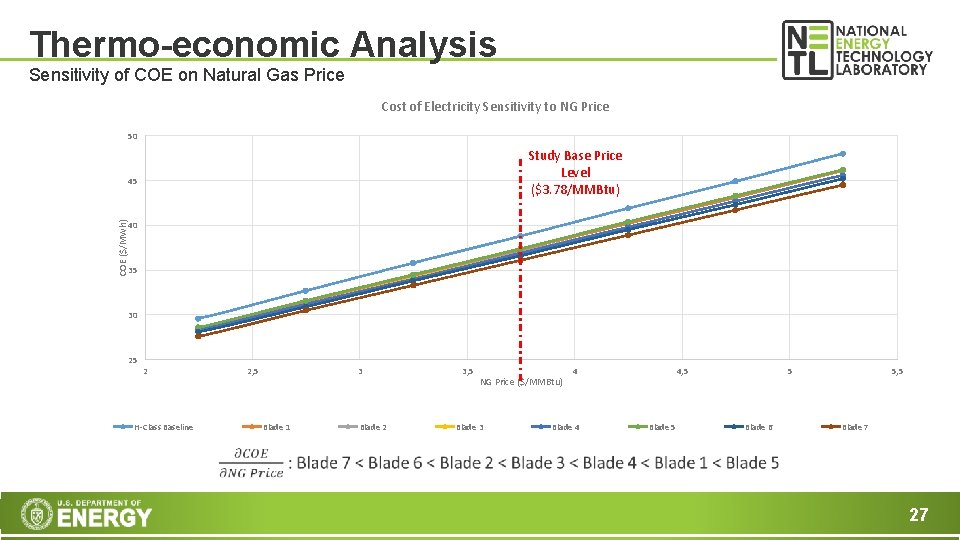
Thermo-economic Analysis Sensitivity of COE on Natural Gas Price Cost of Electricity Sensitivity to NG Price 50 Study Base Price Level ($3. 78/MMBtu) COE ($/MWh) 45 40 35 30 25 2 H-Class Baseline 2, 5 3 Blade 1 Blade 2 3, 5 NG Price ($/MMBtu) Blade 3 4 Blade 4 4, 5 Blade 5 5 Blade 6 5, 5 Blade 7 27
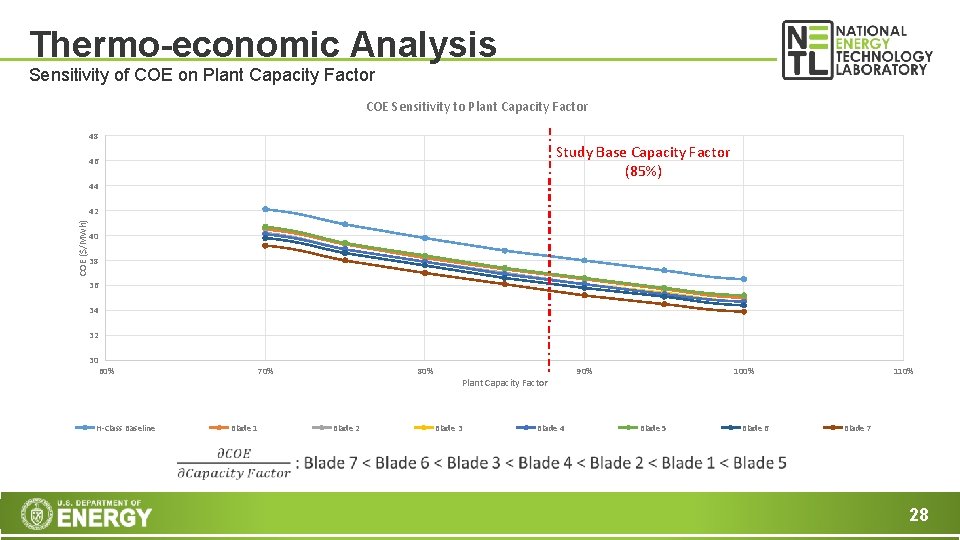
Thermo-economic Analysis Sensitivity of COE on Plant Capacity Factor COE Sensitivity to Plant Capacity Factor 48 Study Base Capacity Factor (85%) 46 44 COE ($/MWh) 42 40 38 36 34 32 30 60% H-Class Baseline 70% Blade 1 80% Blade 2 Plant Capacity Factor Blade 3 Blade 4 90% 100% Blade 5 Blade 6 110% Blade 7 28
Conclusion • Sensitivity analysis was made for CC performance parameters and the ranking of the impacts of turbine cooling parameters followed the same trend with the GT sensitivity: Advanced Metals > Film Cooling Eff. > Int. Cooling Eff. > Purge Fraction > Advanced TBC • 7 different advanced blade configurations were determined for 65%+ CC efficiency • Techno-economic analysis was made for 7 blade configurations to find the best possible configuration 29
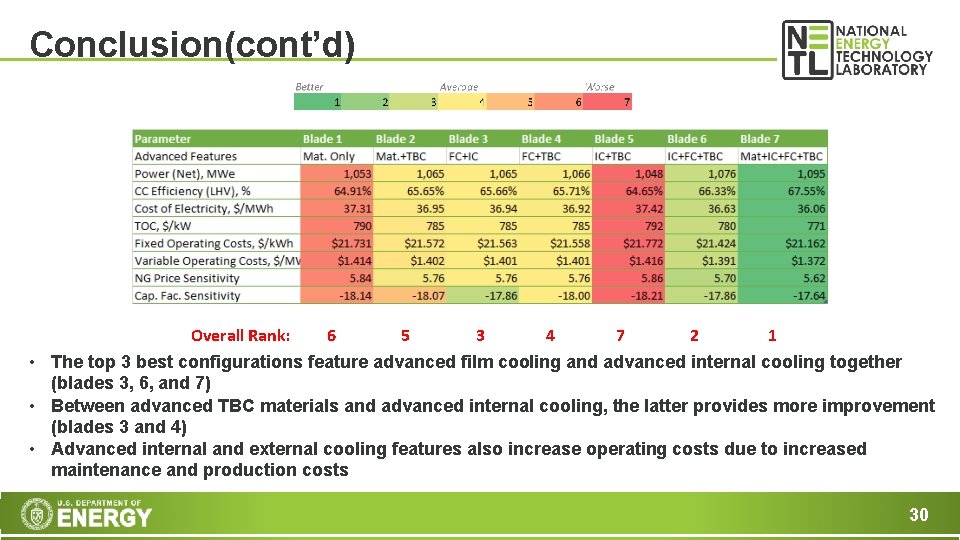
Conclusion(cont’d) Overall Rank: 6 5 3 4 7 2 1 • The top 3 best configurations feature advanced film cooling and advanced internal cooling together (blades 3, 6, and 7) • Between advanced TBC materials and advanced internal cooling, the latter provides more improvement (blades 3 and 4) • Advanced internal and external cooling features also increase operating costs due to increased maintenance and production costs 30

Month Day, Year Questions/Comments 31
- Slides: 31