
MONTESSORI LIBRARY Supporting Student Learning Over 60 studies
MONTESSORI LIBRARY
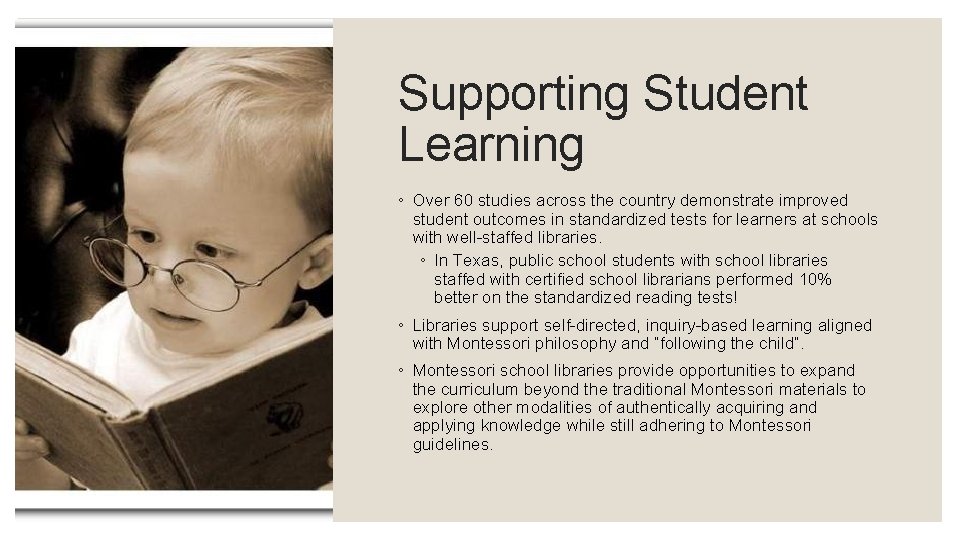
Supporting Student Learning ◦ Over 60 studies across the country demonstrate improved student outcomes in standardized tests for learners at schools with well-staffed libraries. ◦ In Texas, public school students with school libraries staffed with certified school librarians performed 10% better on the standardized reading tests! ◦ Libraries support self-directed, inquiry-based learning aligned with Montessori philosophy and “following the child”. ◦ Montessori school libraries provide opportunities to expand the curriculum beyond the traditional Montessori materials to explore other modalities of authentically acquiring and applying knowledge while still adhering to Montessori guidelines.
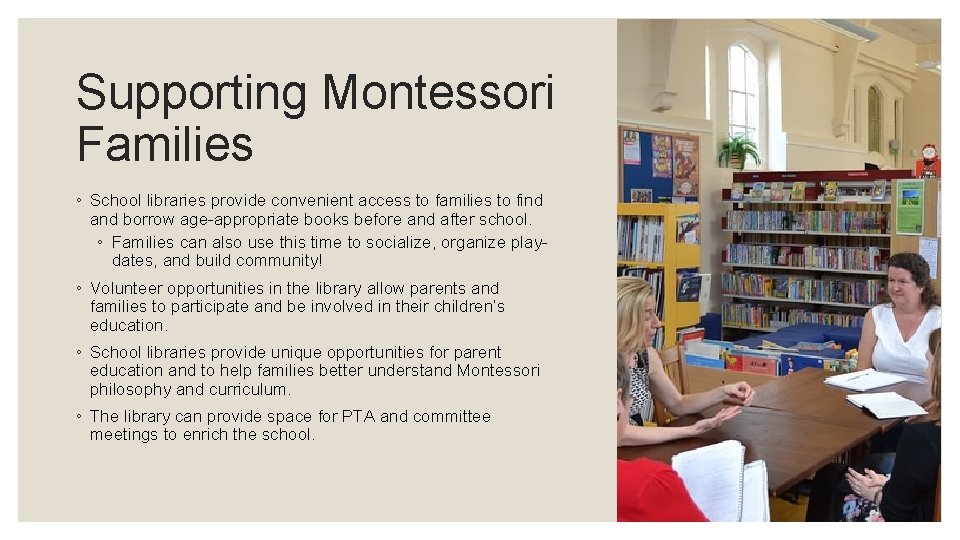
Supporting Montessori Families ◦ School libraries provide convenient access to families to find and borrow age-appropriate books before and after school. ◦ Families can also use this time to socialize, organize playdates, and build community! ◦ Volunteer opportunities in the library allow parents and families to participate and be involved in their children’s education. ◦ School libraries provide unique opportunities for parent education and to help families better understand Montessori philosophy and curriculum. ◦ The library can provide space for PTA and committee meetings to enrich the school.
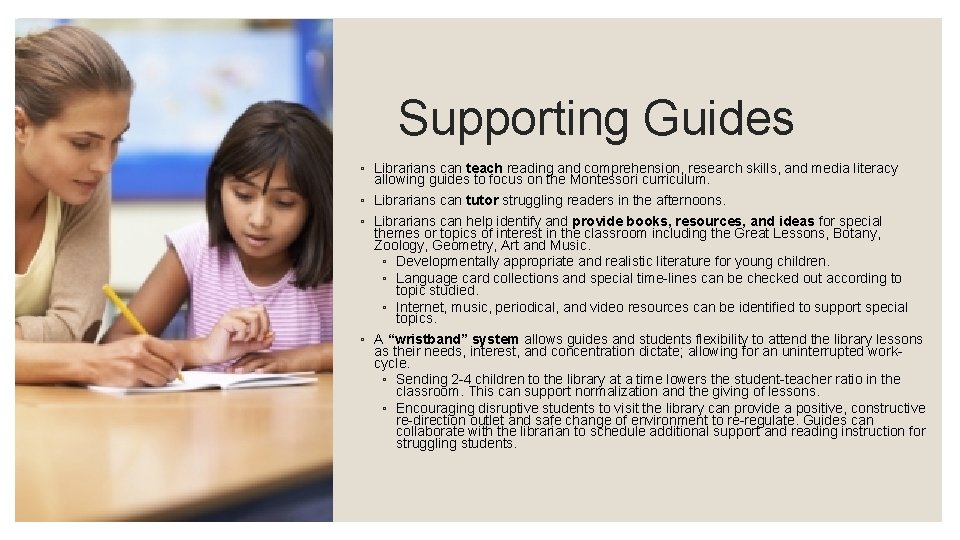
Supporting Guides ◦ Librarians can teach reading and comprehension, research skills, and media literacy allowing guides to focus on the Montessori curriculum. ◦ Librarians can tutor struggling readers in the afternoons. ◦ Librarians can help identify and provide books, resources, and ideas for special themes or topics of interest in the classroom including the Great Lessons, Botany, Zoology, Geometry, Art and Music. ◦ Developmentally appropriate and realistic literature for young children. ◦ Language card collections and special time-lines can be checked out according to topic studied. ◦ Internet, music, periodical, and video resources can be identified to support special topics. ◦ A “wristband” system allows guides and students flexibility to attend the library lessons as their needs, interest, and concentration dictate; allowing for an uninterrupted workcycle. ◦ Sending 2 -4 children to the library at a time lowers the student-teacher ratio in the classroom. This can support normalization and the giving of lessons. ◦ Encouraging disruptive students to visit the library can provide a positive, constructive re-direction outlet and safe change of environment to re-regulate. Guides can collaborate with the librarian to schedule additional support and reading instruction for struggling students.
Library Programs ◦ Regularly scheduled morning story-times ensure Primary students are regularly read-aloud to and exposed to reading comprehension strategies as well as helping children identify “good-fit” books for independent reading. ◦ Regularly scheduled early elementary lessons provide opportunities to directly support research projects, research skills instruction, ethical information usage, and report writing strategies. ◦ Regularly scheduled upper elementary lessons teach media literacy skills including internet research guidelines, access to databases, appropriate internet safety and netiquette, and evaluating information for bias and credibility. ◦ Open afternoon scheduling allows for independent research, recreational reading, literacy tutoring, book-study groups, and special project and activities scheduling. ◦ Volunteer reading tutors are trained and provided time, space, and resources to tutor struggling readers. ◦ Community Coffee and Open Library before and after school allow families to connect and check-out books. ◦ Monthly Parent Education nights help families and community to better understand integrate Montessori philosophy and resources.
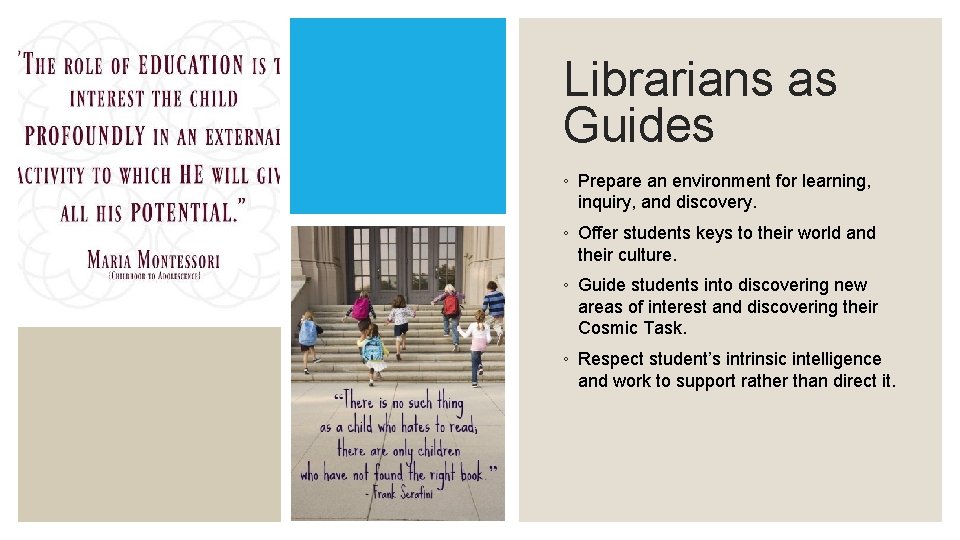
Librarians as Guides ◦ Prepare an environment for learning, inquiry, and discovery. ◦ Offer students keys to their world and their culture. ◦ Guide students into discovering new areas of interest and discovering their Cosmic Task. ◦ Respect student’s intrinsic intelligence and work to support rather than direct it.
References ◦ Scholastic Library Publishing. (2016). School libraries work!. Danbury, CT: Scholastic Library Pub. ◦ Montessori, Maria, 1870 -1952. From Childhood to Adolescence; Including Erdkinder and The Function of the University. New York : Schocken Books, 1973.
- Slides: 7