
MONTEREY COUNTY OP AREA EMERGENCY OPERATIONS PLAN ANNEX


- Slides: 32
MONTEREY COUNTY OP AREA EMERGENCY OPERATIONS PLAN ANNEX A: ANIMAL RESPONSE ANNEX B: CARE AND SHELTER ANNEX I: DISASTER COST RECOVERY
AGENDA • • • Overview ANNEX A: Animal Response ANNEX B: Care and Shelter ANNEX I: Disaster Cost Recovery Questions and Comments
Overview • OP AREA EMERGENCY OPERATIONS PLAN • ALIGNMENT • ORGANIZATION
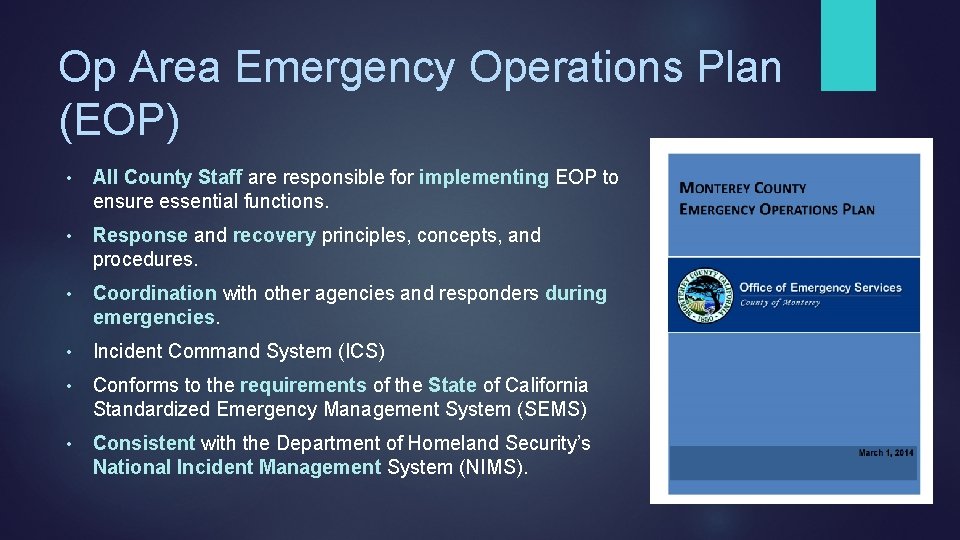
Op Area Emergency Operations Plan (EOP) • All County Staff are responsible for implementing EOP to ensure essential functions. • Response and recovery principles, concepts, and procedures. • Coordination with other agencies and responders during emergencies. • Incident Command System (ICS) • Conforms to the requirements of the State of California Standardized Emergency Management System (SEMS) • Consistent with the Department of Homeland Security’s National Incident Management System (NIMS).
Alignment The EOP consists of a basic plan and functional and hazard, threat, or incident specific annexes Annexes are considered part of the EOP. 1 EOP 22 Annexes 3 New Annexes
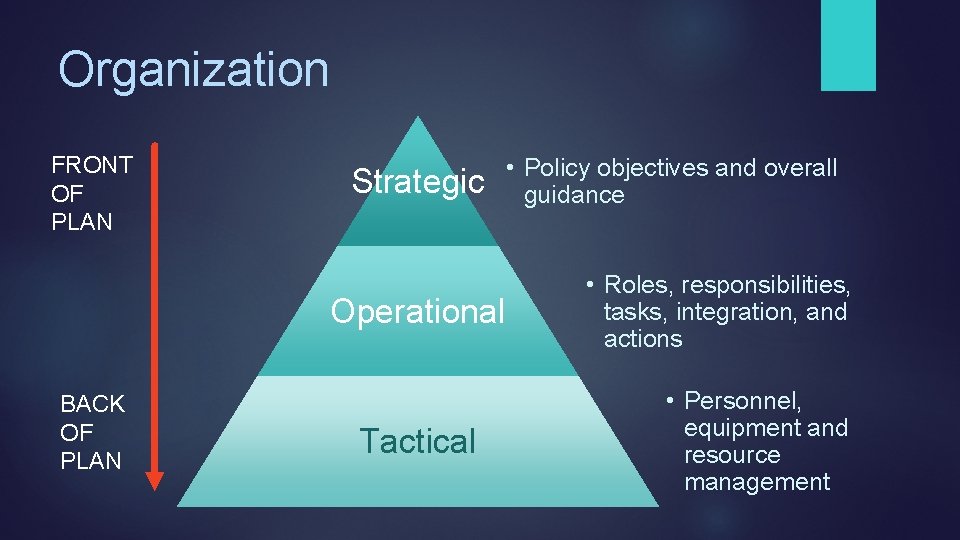
Organization FRONT OF PLAN Strategic • Policy objectives and overall guidance Operational BACK OF PLAN Tactical • Roles, responsibilities, tasks, integration, and actions • Personnel, equipment and resource management
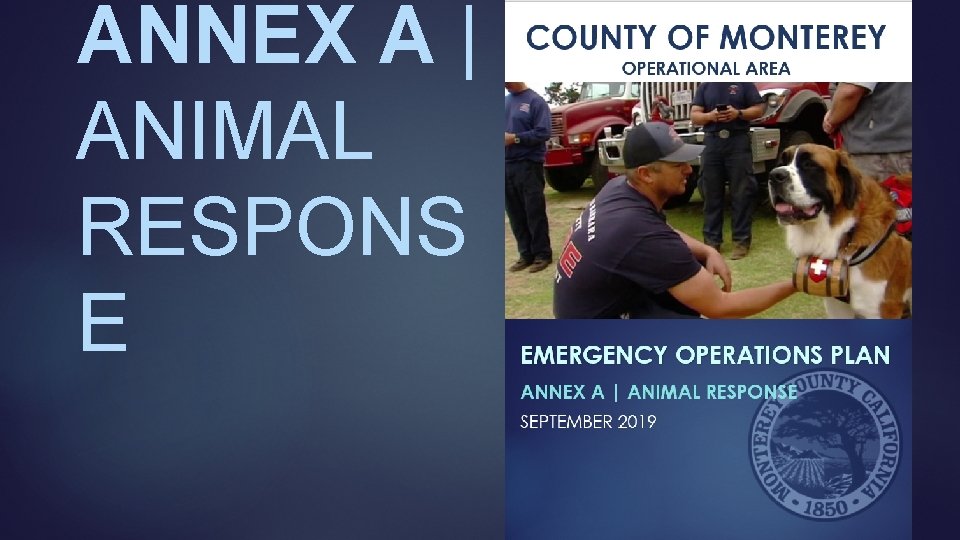
ANNEX A | ANIMAL RESPONS E
In Partnership with SPCA for Monterey County.
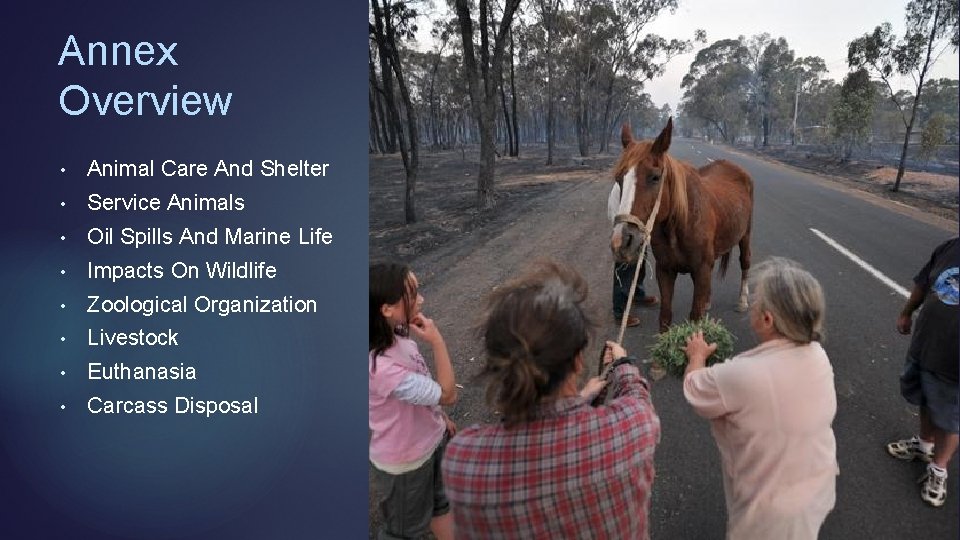
Annex Overview • Animal Care And Shelter • Service Animals • Oil Spills And Marine Life • Impacts On Wildlife • Zoological Organization • Livestock • Euthanasia • Carcass Disposal
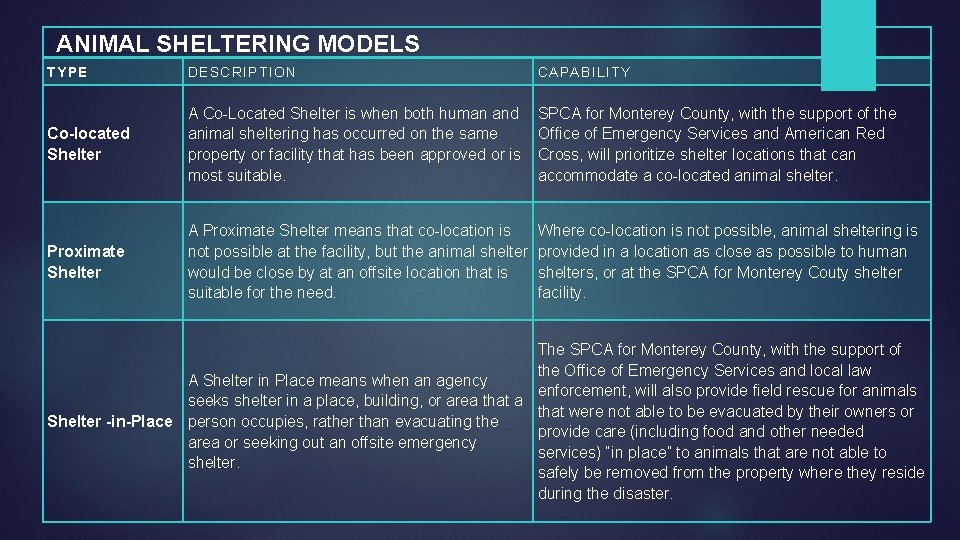
ANIMAL SHELTERING MODELS TYPE DESCRIPTION CAPABILITY Co-located Shelter A Co-Located Shelter is when both human and animal sheltering has occurred on the same property or facility that has been approved or is most suitable. SPCA for Monterey County, with the support of the Office of Emergency Services and American Red Cross, will prioritize shelter locations that can accommodate a co-located animal shelter. Proximate Shelter A Proximate Shelter means that co-location is not possible at the facility, but the animal shelter would be close by at an offsite location that is suitable for the need. Where co-location is not possible, animal sheltering is provided in a location as close as possible to human shelters, or at the SPCA for Monterey Couty shelter facility. The SPCA for Monterey County, with the support of the Office of Emergency Services and local law A Shelter in Place means when an agency enforcement, will also provide field rescue for animals seeks shelter in a place, building, or area that were not able to be evacuated by their owners or Shelter -in-Place person occupies, rather than evacuating the provide care (including food and other needed area or seeking out an offsite emergency services) “in place” to animals that are not able to shelter. safely be removed from the property where they reside during the disaster.
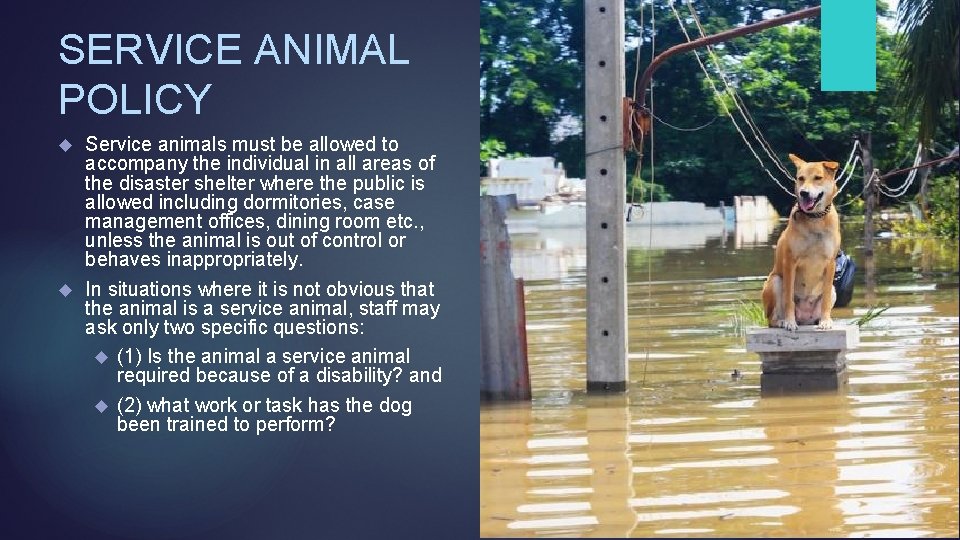
SERVICE ANIMAL POLICY Service animals must be allowed to accompany the individual in all areas of the disaster shelter where the public is allowed including dormitories, case management offices, dining room etc. , unless the animal is out of control or behaves inappropriately. In situations where it is not obvious that the animal is a service animal, staff may ask only two specific questions: (1) Is the animal a service animal required because of a disability? and (2) what work or task has the dog been trained to perform?
ANNEX B | CARE AND SHELTER
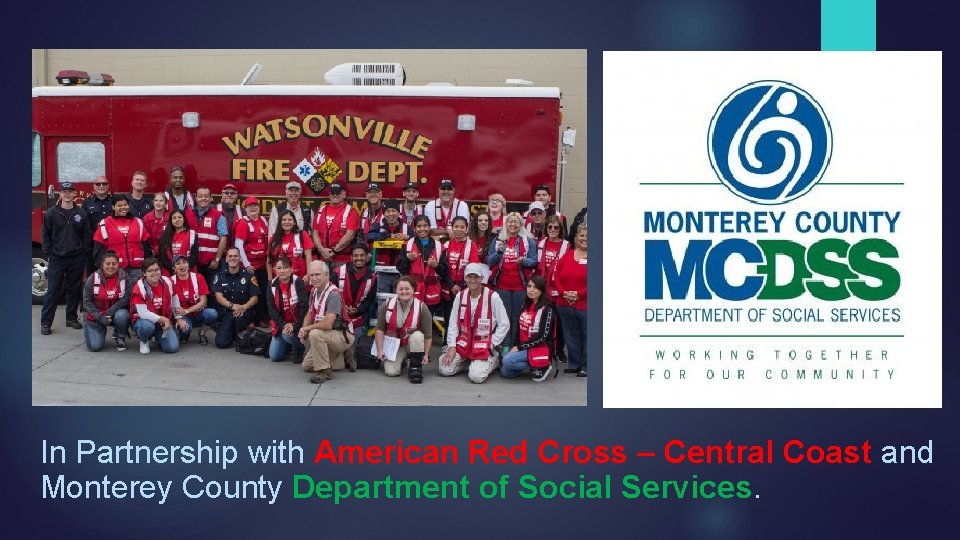
In Partnership with American Red Cross – Central Coast and Monterey County Department of Social Services.
MILESTONES ü Plan Development (March 2017 – March 2019) ü Care and Shelter Working Group Review and Approval (January 2019) ü AFN Working Group Review and Approval (March 2019) ü Disaster Council Review and Approval (April 2019) ü Presentation to the Commission on Disabilities (July 29, 2019) ü Presentation and Resolution from the BOS (September 17, 2019)
“ Provide a safe, sanitary, and secure environment and life-sustaining services to disaster survivors displaced from their primary residences due to natural or manmade disasters. ”
OVERVIEW PURPOSE SCOPE PROGRAM Provide relief to people temporarily displaced by emergencies or disasters. MASS CARE • MOU with ARC Provision of shelter, feeding, and bulk distribution of needed items. • EOC Shelter Branch • Shelter Management and Coordination Outlines the Monterey County Operational Area’s (OA) planned response for mass care and shelter associated with large-scale disasters. HUMAN SERVICES • Tracking Provision of very basic supplemental services to support individuals affected by disaster. • Operations • Staff and Training • Resources and Equipment
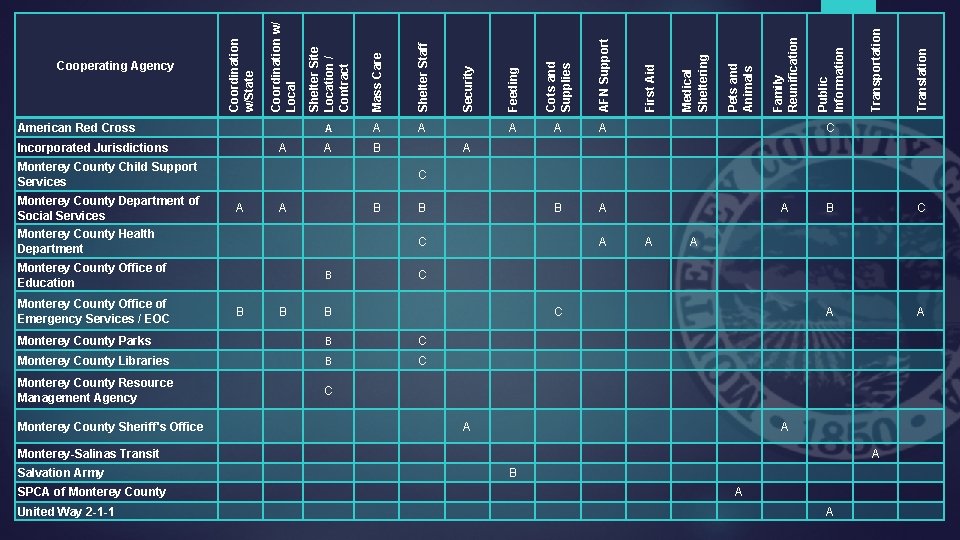
Monterey County Child Support Services Monterey County Department of Social Services A A B B B A A A B C A A A C B C Monterey County Libraries B C Monterey County Resource Management Agency C A A Monterey-Salinas Transit SPCA of Monterey County United Way 2 -1 -1 Translation B C Monterey County Parks Salvation Army Transportation Public Information Family Reunification A Pets and Animals B C A C Monterey County Office of Education Monterey County Sheriff's Office A C Monterey County Health Department Monterey County Office of Emergency Services / EOC A Medical Sheltering B A First Aid A AFN Support A Cots and Supplies A Security A Feeding A Shelter Staff Incorporated Jurisdictions Mass Care American Red Cross Shelter Site Location / Contract Coordination w/ Local Coordination w/State Cooperating Agency A B A A
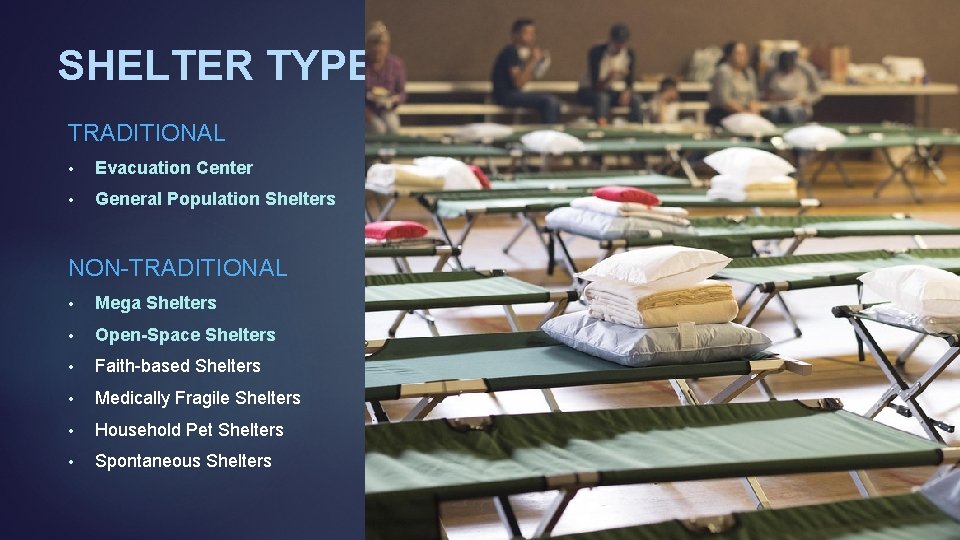
SHELTER TYPES TRADITIONAL • Evacuation Center • General Population Shelters NON-TRADITIONAL • Mega Shelters • Open-Space Shelters • Faith-based Shelters • Medically Fragile Shelters • Household Pet Shelters • Spontaneous Shelters
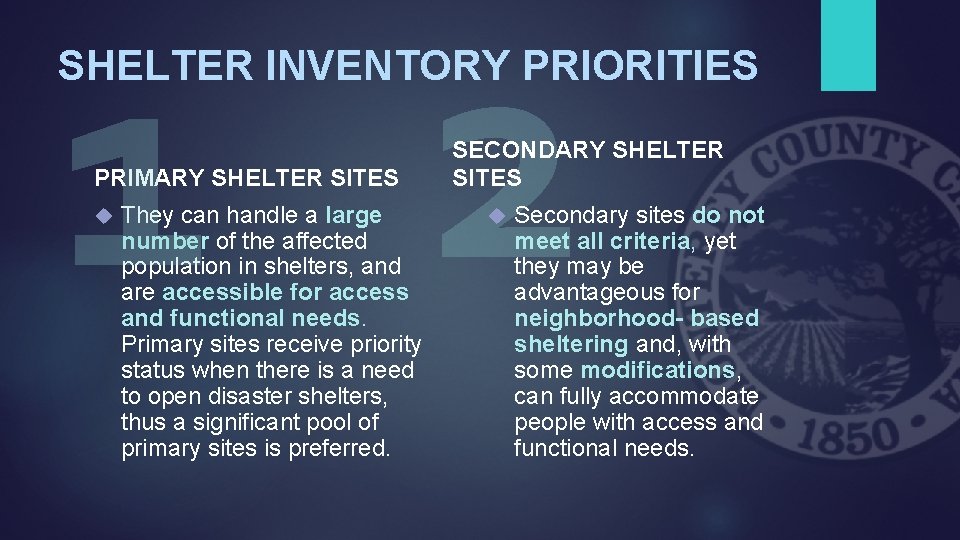
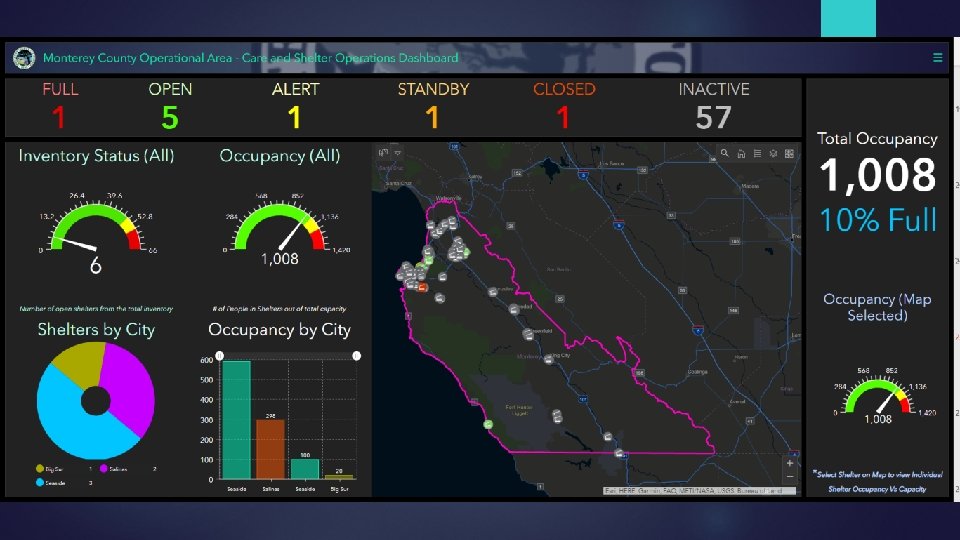
1 2 SHELTER INVENTORY PRIORITIES PRIMARY SHELTER SITES They can handle a large number of the affected population in shelters, and are accessible for access and functional needs. Primary sites receive priority status when there is a need to open disaster shelters, thus a significant pool of primary sites is preferred. SECONDARY SHELTER SITES Secondary sites do not meet all criteria, yet they may be advantageous for neighborhood- based sheltering and, with some modifications, can fully accommodate people with access and functional needs.
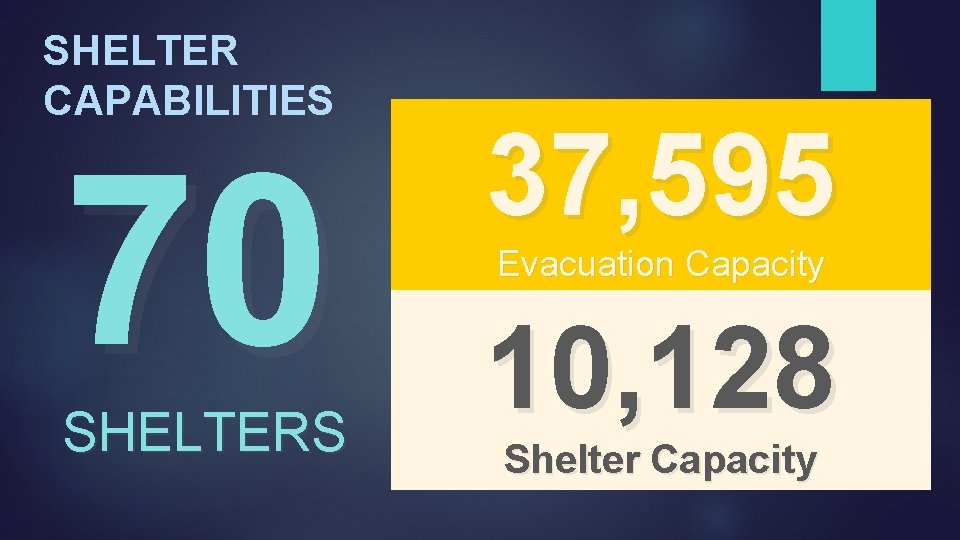
SHELTER CAPABILITIES 70 SHELTERS 37, 595 Evacuation Capacity 10, 128 Shelter Capacity
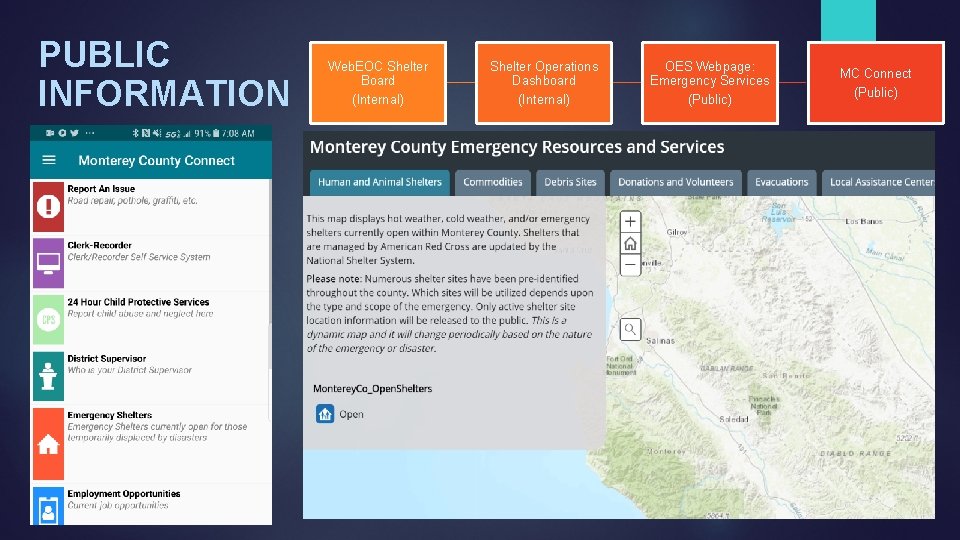
PUBLIC INFORMATION Web. EOC Shelter Board (Internal) Shelter Operations Dashboard (Internal) OES Webpage: Emergency Services (Public) MC Connect (Public)
ANNEX I | DISASTER COST RECOVERY
MILESTONES ü Plan Development (March 2017 – March 2019) ü Disaster Cost Recovery Working Group Review and Approval (January 2019) ü Disaster Council Review and Approval (April 2019) ü Presentation and Resolution from the BOS (September 17, 2019)
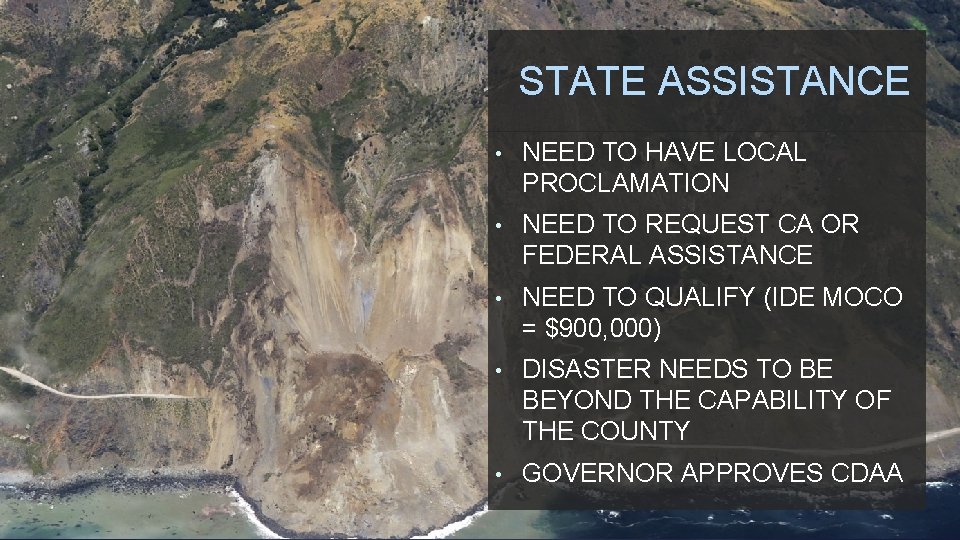
STATE ASSISTANCE • NEED TO HAVE LOCAL PROCLAMATION • NEED TO REQUEST CA OR FEDERAL ASSISTANCE • NEED TO QUALIFY (IDE MOCO = $900, 000) • DISASTER NEEDS TO BE BEYOND THE CAPABILITY OF THE COUNTY • GOVERNOR APPROVES CDAA
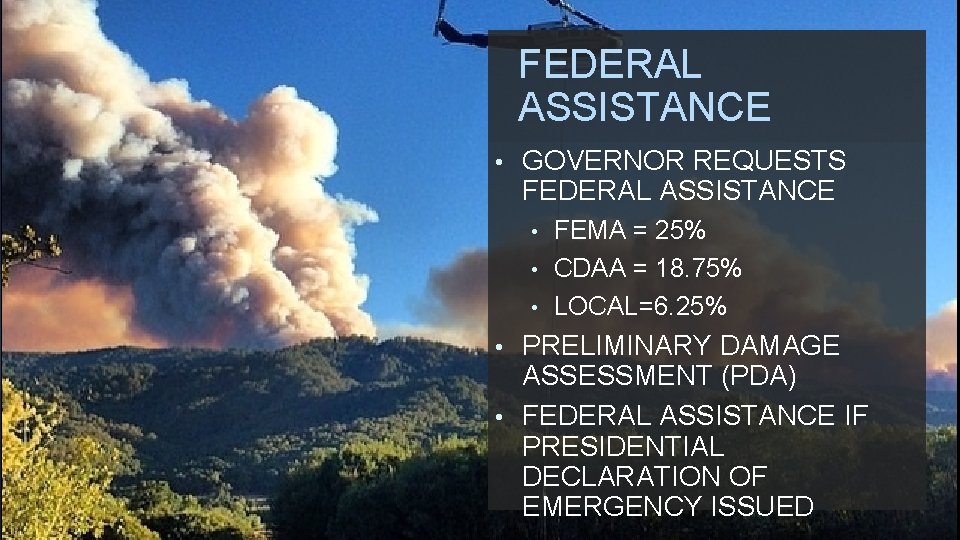
FEDERAL ASSISTANCE • GOVERNOR REQUESTS FEDERAL ASSISTANCE FEMA = 25% • CDAA = 18. 75% • LOCAL=6. 25% • PRELIMINARY DAMAGE ASSESSMENT (PDA) • FEDERAL ASSISTANCE IF PRESIDENTIAL DECLARATION OF EMERGENCY ISSUED •
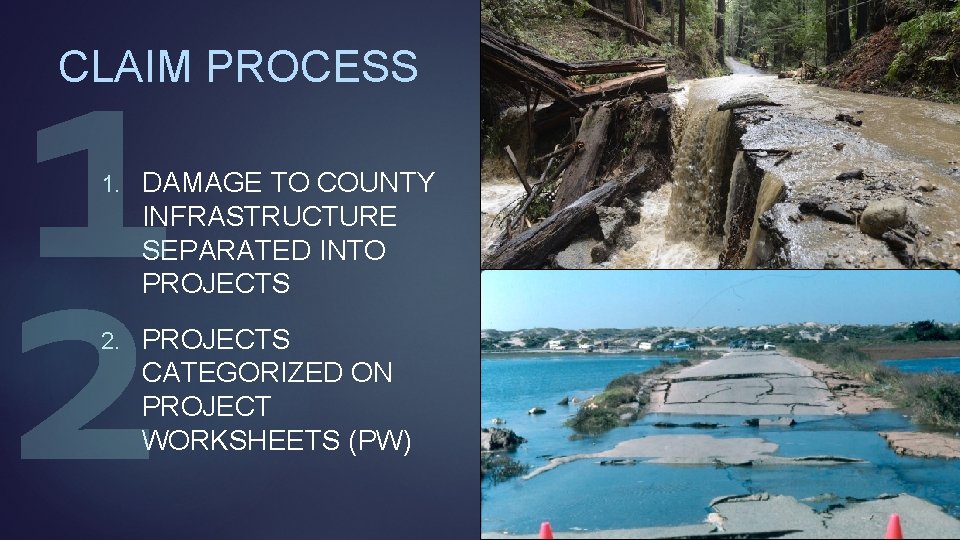
1 2 CLAIM PROCESS 1. DAMAGE TO COUNTY INFRASTRUCTURE SEPARATED INTO PROJECTS 2. PROJECTS CATEGORIZED ON PROJECT WORKSHEETS (PW)
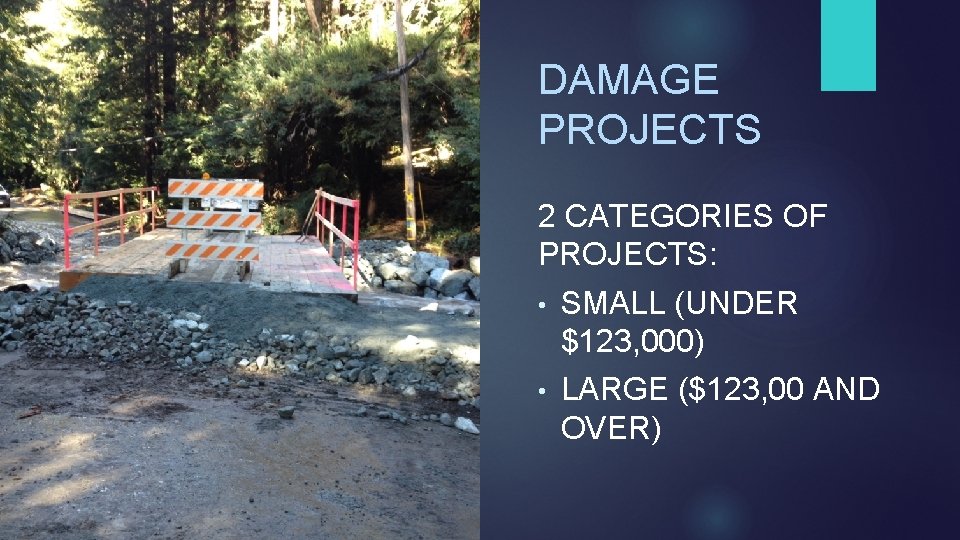
DAMAGE PROJECTS 2 CATEGORIES OF PROJECTS: • SMALL (UNDER $123, 000) • LARGE ($123, 00 AND OVER)
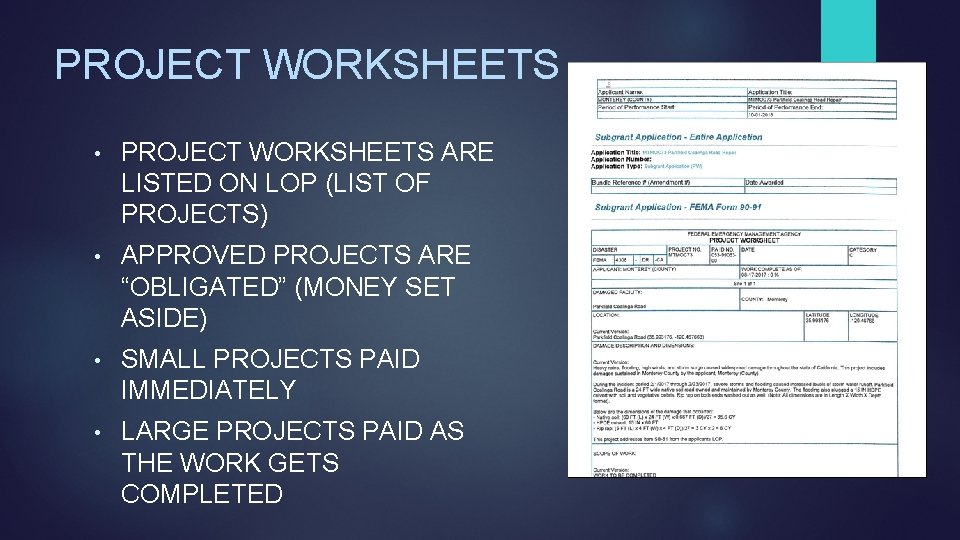
PROJECT WORKSHEETS • PROJECT WORKSHEETS ARE LISTED ON LOP (LIST OF PROJECTS) • APPROVED PROJECTS ARE “OBLIGATED” (MONEY SET ASIDE) • SMALL PROJECTS PAID IMMEDIATELY • LARGE PROJECTS PAID AS THE WORK GETS COMPLETED
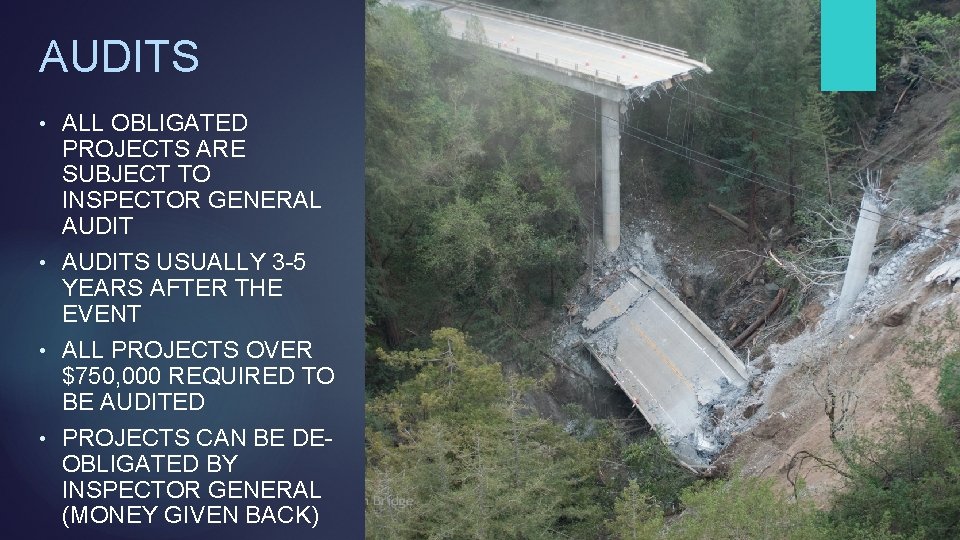
AUDITS ALL OBLIGATED PROJECTS ARE SUBJECT TO INSPECTOR GENERAL AUDIT • AUDITS USUALLY 3 -5 YEARS AFTER THE EVENT • ALL PROJECTS OVER $750, 000 REQUIRED TO BE AUDITED • PROJECTS CAN BE DEOBLIGATED BY INSPECTOR GENERAL (MONEY GIVEN BACK) •
QUESTIONS? COMMENTS?