
MONTE CARLO SIMULATIONS IN MATLAB Jake Blanchard University

MONTE CARLO SIMULATIONS IN MATLAB Jake Blanchard University of Wisconsin Spring 2006

Introduction �Monte Carlo approaches use random sampling to simulate physical phenomena �They have been used to simulate particle transport, risk analysis, reliability of components, molecular modeling, and many other areas

An Example – Beam Bending � Consider a cantilever beam with a load (F) applied at the end � Assume that the diameter (d) of the beam cross section, the load (F), and the elastic modulus (E) of the beam material vary from beam to beam (L is constant – 10 centimeters) � We need to know the character of the variations in the displacement ( ) of the end of the beam
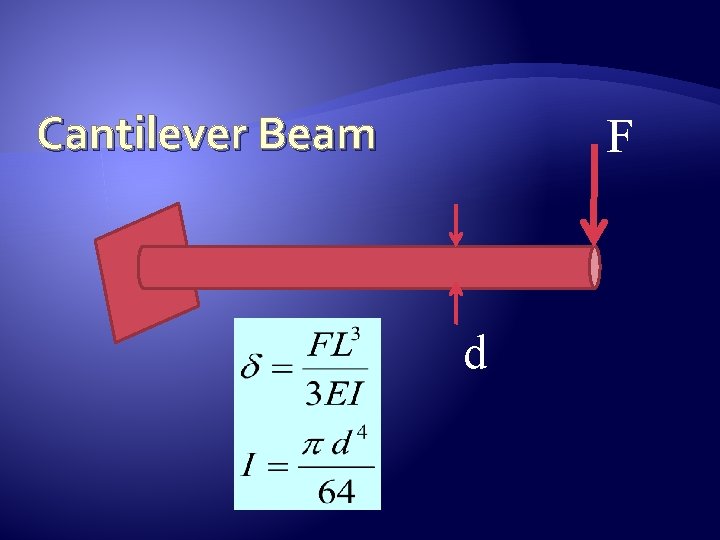
Cantilever Beam F d
Analysis �If F is the only random variable and F has, for example, a lognormal distribution, then the deflection will also have a lognormal distribution �But if several variables are random, then the analysis is much more complication

Approach �Assume/determine a distribution function to represent all input variables �Sample each (independently) �Calculate the deflection from the formula �Repeat many times to obtain output distribution
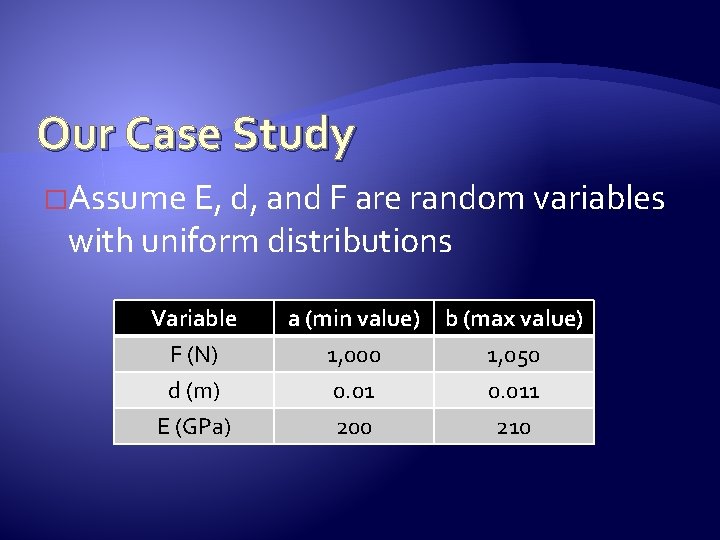
Our Case Study �Assume E, d, and F are random variables with uniform distributions Variable F (N) d (m) E (GPa) a (min value) 1, 000 0. 01 200 b (max value) 1, 050 0. 011 210
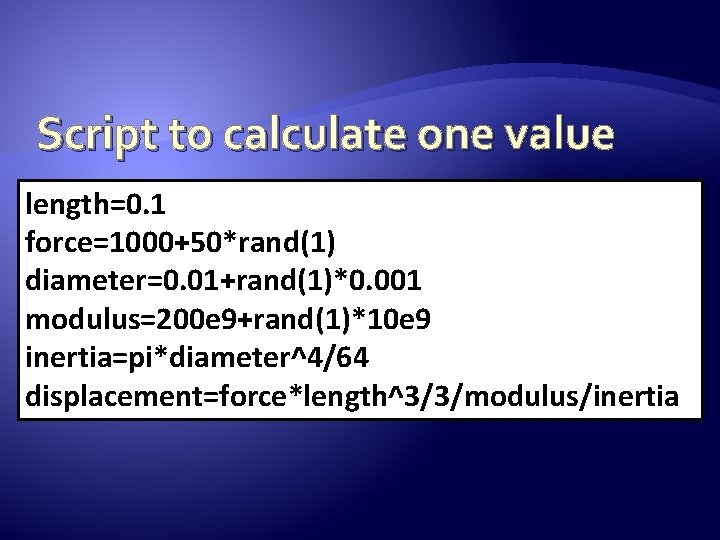
Script to calculate one value length=0. 1 force=1000+50*rand(1) diameter=0. 01+rand(1)*0. 001 modulus=200 e 9+rand(1)*10 e 9 inertia=pi*diameter^4/64 displacement=force*length^3/3/modulus/inertia
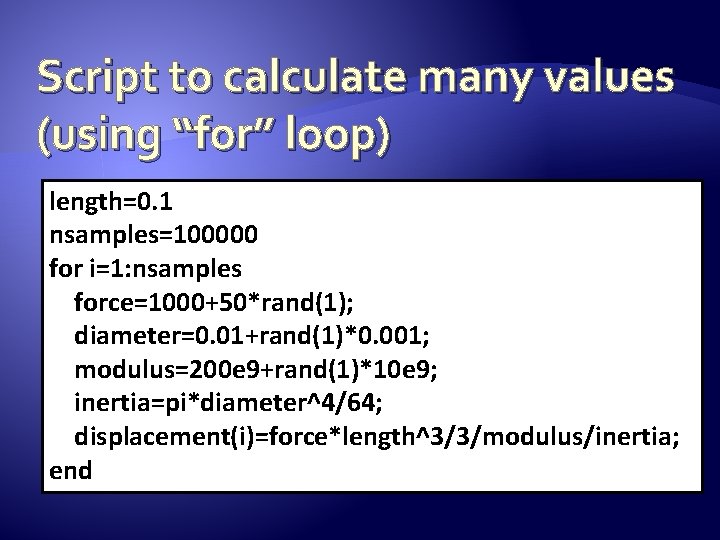
Script to calculate many values (using “for” loop) length=0. 1 nsamples=100000 for i=1: nsamples force=1000+50*rand(1); diameter=0. 01+rand(1)*0. 001; modulus=200 e 9+rand(1)*10 e 9; inertia=pi*diameter^4/64; displacement(i)=force*length^3/3/modulus/inertia; end
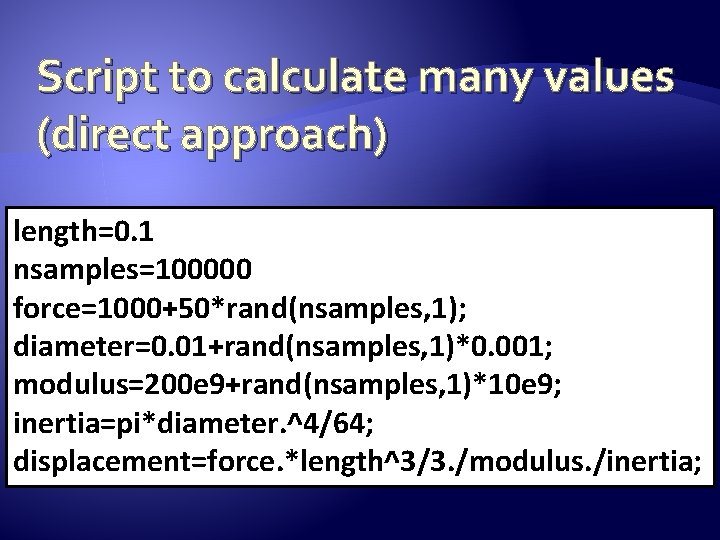
Script to calculate many values (direct approach) length=0. 1 nsamples=100000 force=1000+50*rand(nsamples, 1); diameter=0. 01+rand(nsamples, 1)*0. 001; modulus=200 e 9+rand(nsamples, 1)*10 e 9; inertia=pi*diameter. ^4/64; displacement=force. *length^3/3. /modulus. /inertia;
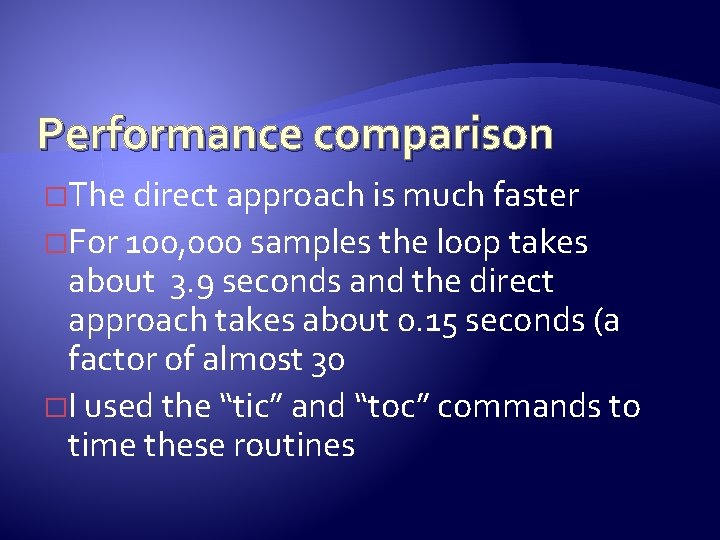
Performance comparison �The direct approach is much faster �For 100, 000 samples the loop takes about 3. 9 seconds and the direct approach takes about 0. 15 seconds (a factor of almost 30 �I used the “tic” and “toc” commands to time these routines
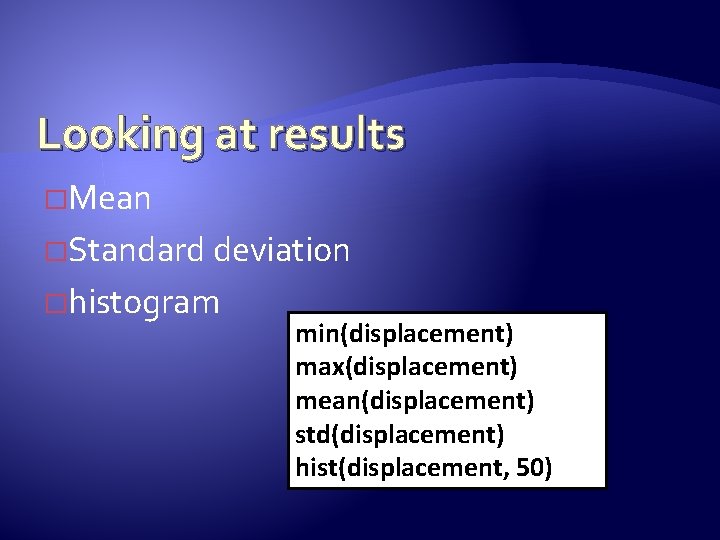
Looking at results �Mean �Standard deviation �histogram min(displacement) max(displacement) mean(displacement) std(displacement) hist(displacement, 50)
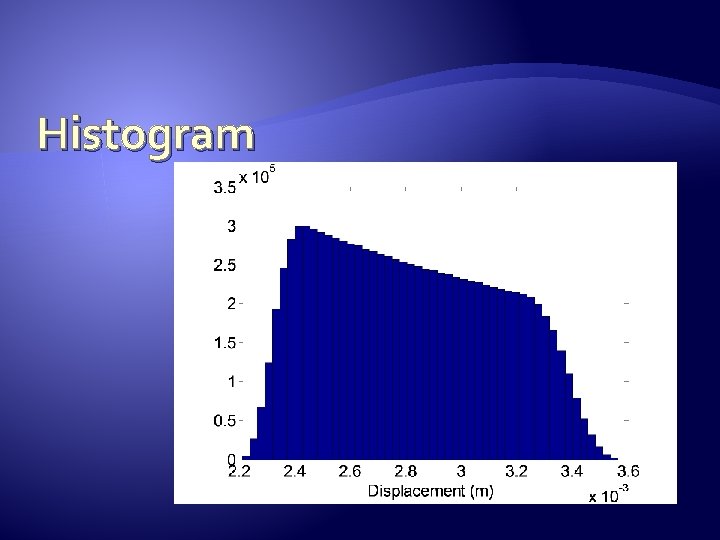
Histogram
- Slides: 13