
Monte Carlo simulation of thermal neutron scattering processes
- Slides: 20
Monte Carlo simulation of thermal neutron scattering processes in condensed matter Complete detector and experiment simulation Xiao Cai, DTU & ESS (xcai@dtu. dk) Thomas Kittelmann, ESS (thomas. kittelmann@esss. dk) grant agreement 676548
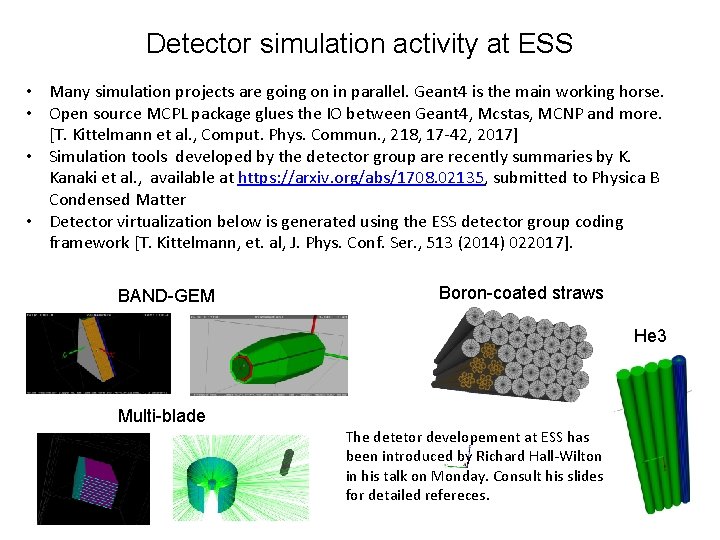
Detector simulation activity at ESS • Many simulation projects are going on in parallel. Geant 4 is the main working horse. • Open source MCPL package glues the IO between Geant 4, Mcstas, MCNP and more. [T. Kittelmann et al. , Comput. Phys. Commun. , 218, 17 -42, 2017] • Simulation tools developed by the detector group are recently summaries by K. Kanaki et al. , available at https: //arxiv. org/abs/1708. 02135, submitted to Physica B Condensed Matter • Detector virtualization below is generated using the ESS detector group coding framework [T. Kittelmann, et. al, J. Phys. Conf. Ser. , 513 (2014) 022017]. BAND-GEM Boron-coated straws He 3 Multi-blade The detetor developement at ESS has been introduced by Richard Hall-Wilton in his talk on Monday. Consult his slides for detailed refereces.
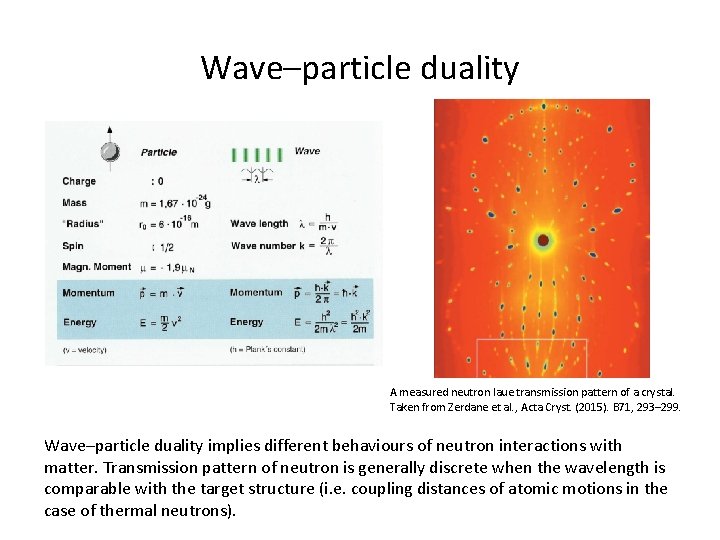
Wave–particle duality A measured neutron laue transmission pattern of a crystal. Taken from Zerdane et al. , Acta Cryst. (2015). B 71, 293– 299. Wave–particle duality implies different behaviours of neutron interactions with matter. Transmission pattern of neutron is generally discrete when the wavelength is comparable with the target structure (i. e. coupling distances of atomic motions in the case of thermal neutrons).
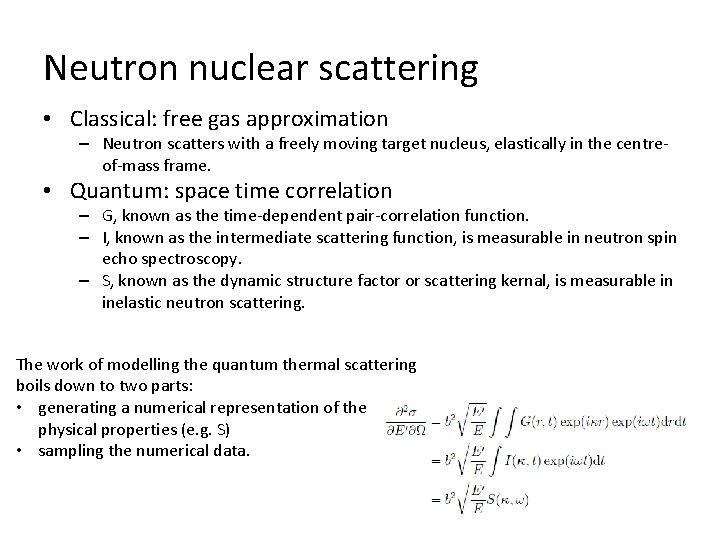
Neutron nuclear scattering • Classical: free gas approximation – Neutron scatters with a freely moving target nucleus, elastically in the centreof-mass frame. • Quantum: space time correlation – G, known as the time-dependent pair-correlation function. – I, known as the intermediate scattering function, is measurable in neutron spin echo spectroscopy. – S, known as the dynamic structure factor or scattering kernal, is measurable in inelastic neutron scattering. The work of modelling the quantum thermal scattering boils down to two parts: • generating a numerical representation of the physical properties (e. g. S) • sampling the numerical data.
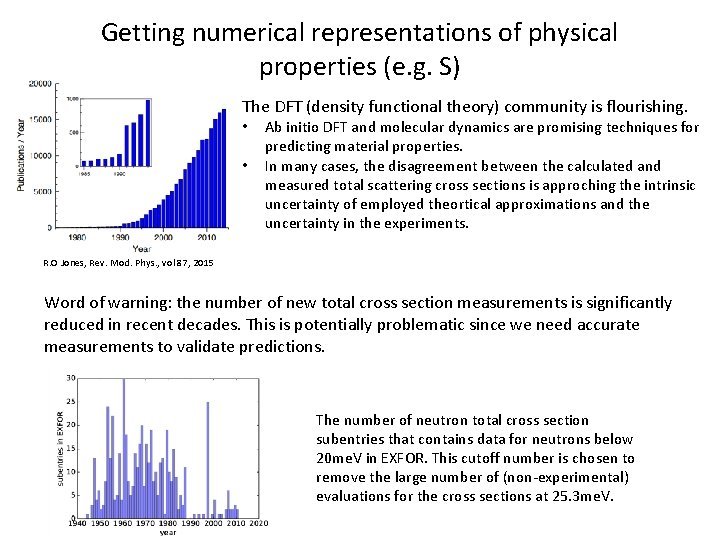
Getting numerical representations of physical properties (e. g. S) The DFT (density functional theory) community is flourishing. • • Ab initio DFT and molecular dynamics are promising techniques for predicting material properties. In many cases, the disagreement between the calculated and measured total scattering cross sections is approching the intrinsic uncertainty of employed theortical approximations and the uncertainty in the experiments. R. O Jones, Rev. Mod. Phys. , vol 87, 2015 Word of warning: the number of new total cross section measurements is significantly reduced in recent decades. This is potentially problematic since we need accurate measurements to validate predictions. The number of neutron total cross section subentries that contains data for neutrons below 20 me. V in EXFOR. This cutoff number is chosen to remove the large number of (non-experimental) evaluations for the cross sections at 25. 3 me. V.
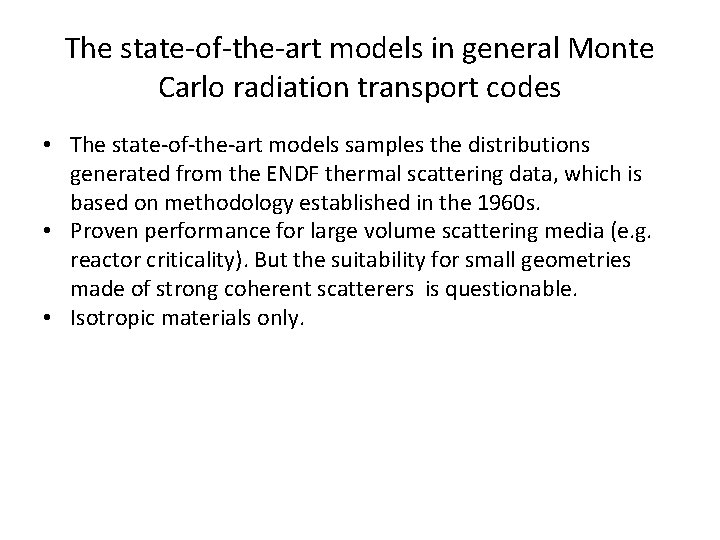
The state-of-the-art models in general Monte Carlo radiation transport codes • The state-of-the-art models samples the distributions generated from the ENDF thermal scattering data, which is based on methodology established in the 1960 s. • Proven performance for large volume scattering media (e. g. reactor criticality). But the suitability for small geometries made of strong coherent scatterers is questionable. • Isotropic materials only.
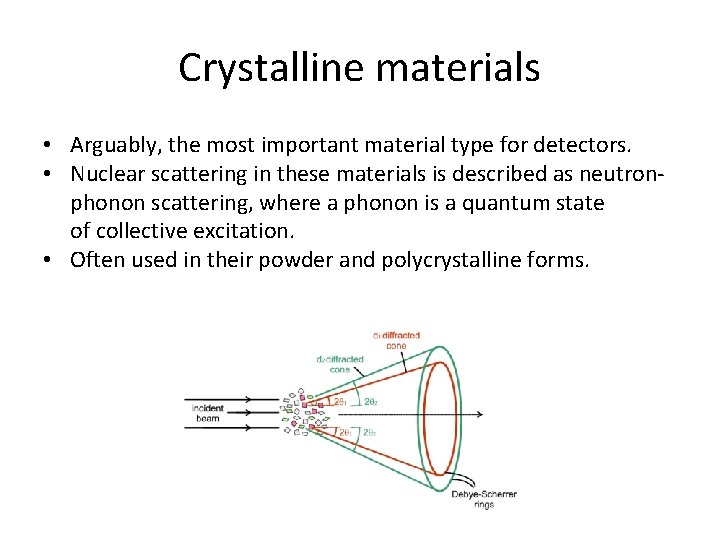
Crystalline materials • Arguably, the most important material type for detectors. • Nuclear scattering in these materials is described as neutronphonon scattering, where a phonon is a quantum state of collective excitation. • Often used in their powder and polycrystalline forms.
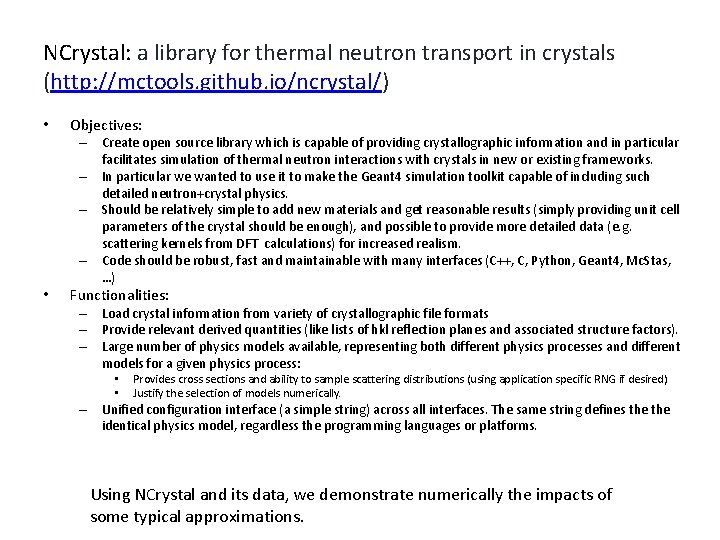
NCrystal: a library for thermal neutron transport in crystals (http: //mctools. github. io/ncrystal/) • • Objectives: – Create open source library which is capable of providing crystallographic information and in particular facilitates simulation of thermal neutron interactions with crystals in new or existing frameworks. – In particular we wanted to use it to make the Geant 4 simulation toolkit capable of including such detailed neutron+crystal physics. – Should be relatively simple to add new materials and get reasonable results (simply providing unit cell parameters of the crystal should be enough), and possible to provide more detailed data (e. g. scattering kernels from DFT calculations) for increased realism. – Code should be robust, fast and maintainable with many interfaces (C++, C, Python, Geant 4, Mc. Stas, …) Functionalities: – Load crystal information from variety of crystallographic file formats – Provide relevant derived quantities (like lists of hkl reflection planes and associated structure factors). – Large number of physics models available, representing both different physics processes and different models for a given physics process: • • Provides cross sections and ability to sample scattering distributions (using application specific RNG if desired) Justify the selection of models numerically. – Unified configuration interface (a simple string) across all interfaces. The same string defines the identical physics model, regardless the programming languages or platforms. Using NCrystal and its data, we demonstrate numerically the impacts of some typical approximations.
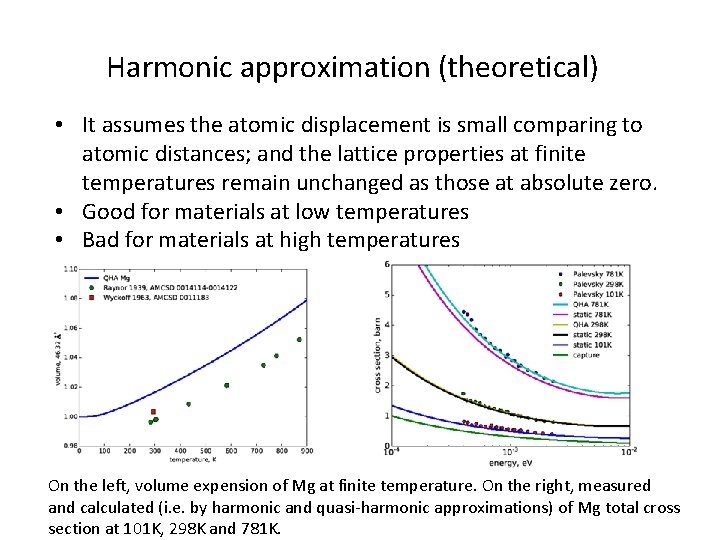
Harmonic approximation (theoretical) • It assumes the atomic displacement is small comparing to atomic distances; and the lattice properties at finite temperatures remain unchanged as those at absolute zero. • Good for materials at low temperatures • Bad for materials at high temperatures On the left, volume expension of Mg at finite temperature. On the right, measured and calculated (i. e. by harmonic and quasi-harmonic approximations) of Mg total cross section at 101 K, 298 K and 781 K.
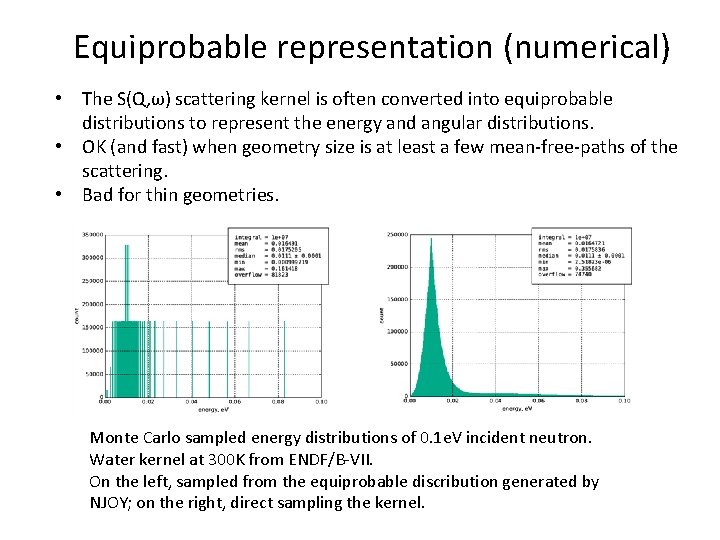
Equiprobable representation (numerical) • The S(Q, ω) scattering kernel is often converted into equiprobable distributions to represent the energy and angular distributions. • OK (and fast) when geometry size is at least a few mean-free-paths of the scattering. • Bad for thin geometries. Monte Carlo sampled energy distributions of 0. 1 e. V incident neutron. Water kernel at 300 K from ENDF/B-VII. On the left, sampled from the equiprobable discribution generated by NJOY; on the right, direct sampling the kernel.
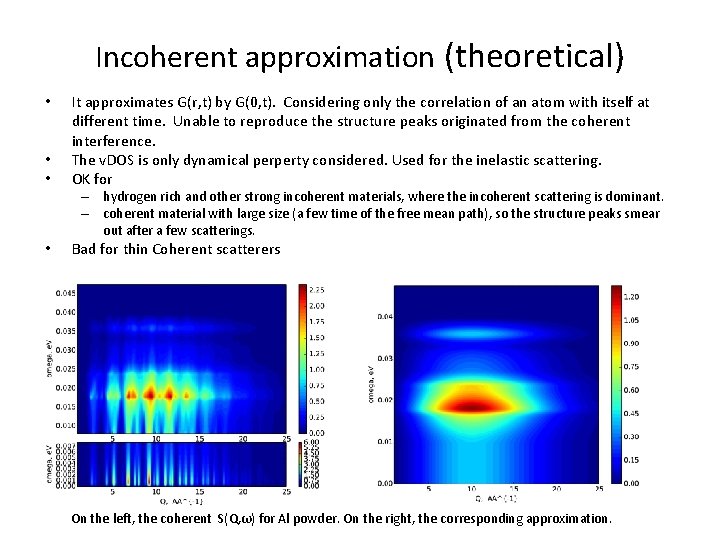
Incoherent approximation (theoretical) • • It approximates G(r, t) by G(0, t). Considering only the correlation of an atom with itself at different time. Unable to reproduce the structure peaks originated from the coherent interference. The v. DOS is only dynamical perperty considered. Used for the inelastic scattering. OK for – hydrogen rich and other strong incoherent materials, where the incoherent scattering is dominant. – coherent material with large size (a few time of the free mean path), so the structure peaks smear out after a few scatterings. Bad for thin Coherent scatterers On the left, the coherent S(Q, ω) for Al powder. On the right, the corresponding approximation.
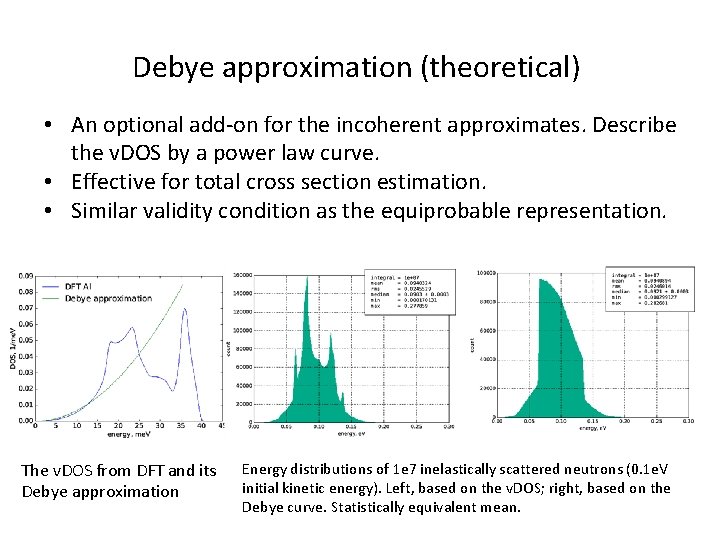
Debye approximation (theoretical) • An optional add-on for the incoherent approximates. Describe the v. DOS by a power law curve. • Effective for total cross section estimation. • Similar validity condition as the equiprobable representation. The v. DOS from DFT and its Debye approximation Energy distributions of 1 e 7 inelastically scattered neutrons (0. 1 e. V initial kinetic energy). Left, based on the v. DOS; right, based on the Debye curve. Statistically equivalent mean.
Status of NCrystal • Initial release(v 0. 9. 1 released Aug 2017) – Detailed treatment for the coherent elastic scattering (i. e. Bragg diffraction) in single- and poly-crystals. – Reliable for estimating the total inelastic scattering cross section (based on the Debye approximation with high order phonon expansion). – X. X. Cai and T. Kittelmann, NCrystal, https: //doi. org/10. 5281/zenodo. 853186, available at http: //mctools. github. io/ncrystal/. • Next major release spring 2018 (in preparation) – Detailed treatment for the inelastic scatterings
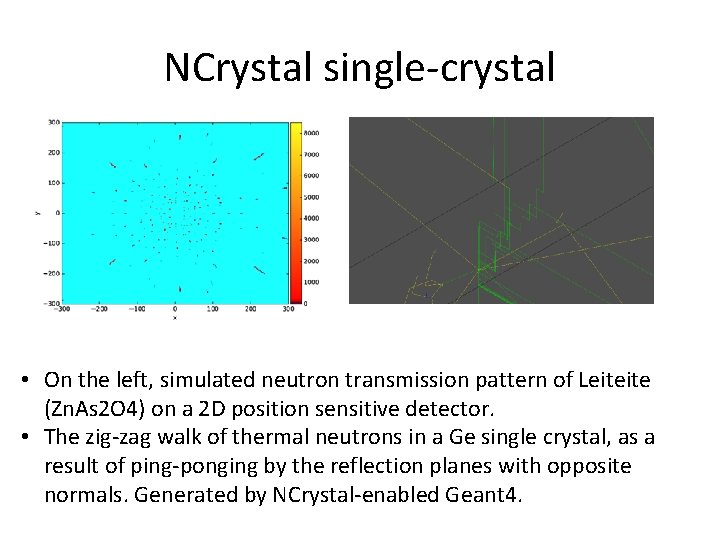
NCrystal single-crystal • On the left, simulated neutron transmission pattern of Leiteite (Zn. As 2 O 4) on a 2 D position sensitive detector. • The zig-zag walk of thermal neutrons in a Ge single crystal, as a result of ping-ponging by the reflection planes with opposite normals. Generated by NCrystal-enabled Geant 4.
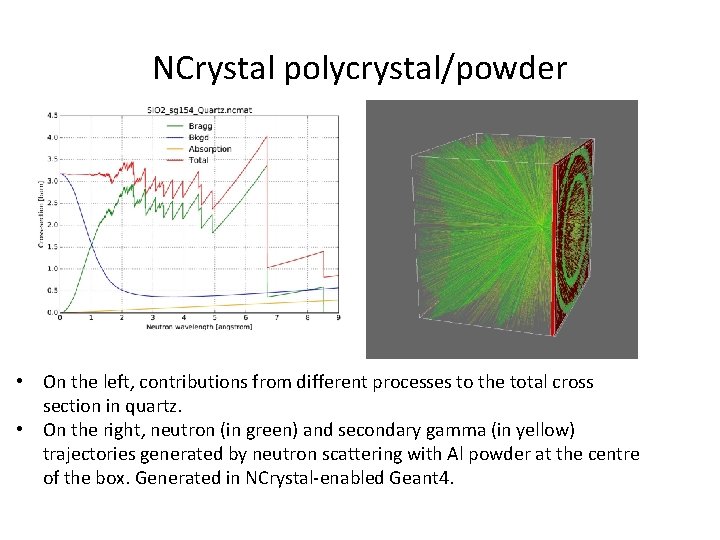
NCrystal polycrystal/powder • On the left, contributions from different processes to the total cross section in quartz. • On the right, neutron (in green) and secondary gamma (in yellow) trajectories generated by neutron scattering with Al powder at the centre of the box. Generated in NCrystal-enabled Geant 4.
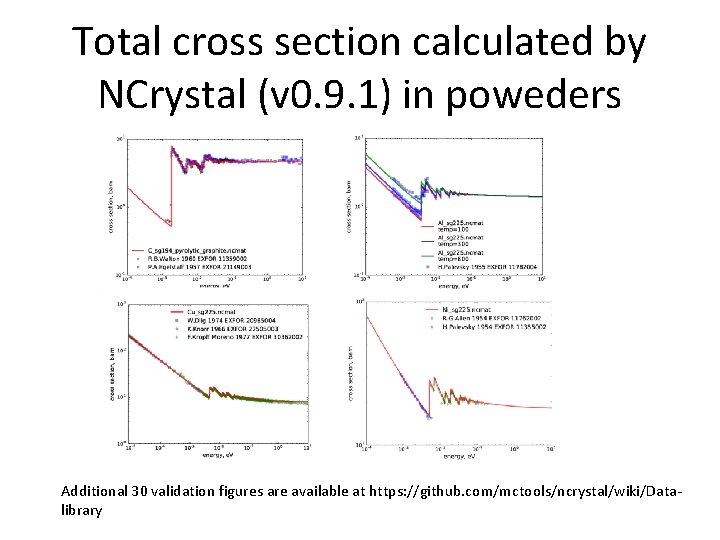
Total cross section calculated by NCrystal (v 0. 9. 1) in poweders Additional 30 validation figures are available at https: //github. com/mctools/ncrystal/wiki/Datalibrary
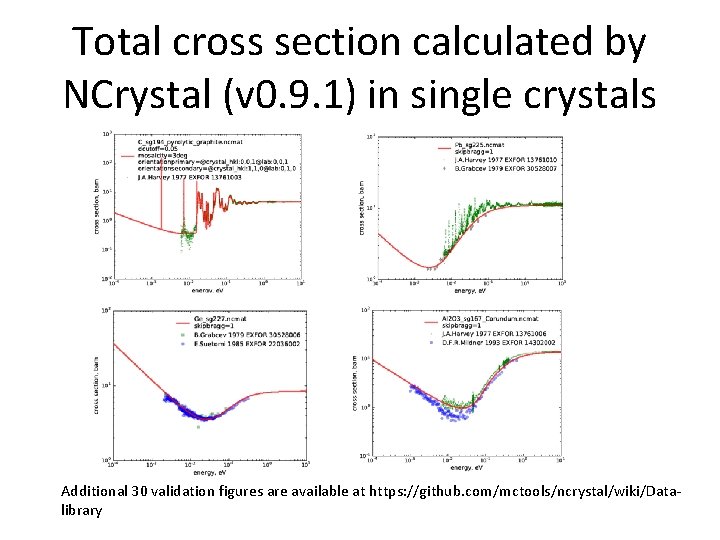
Total cross section calculated by NCrystal (v 0. 9. 1) in single crystals Additional 30 validation figures are available at https: //github. com/mctools/ncrystal/wiki/Datalibrary
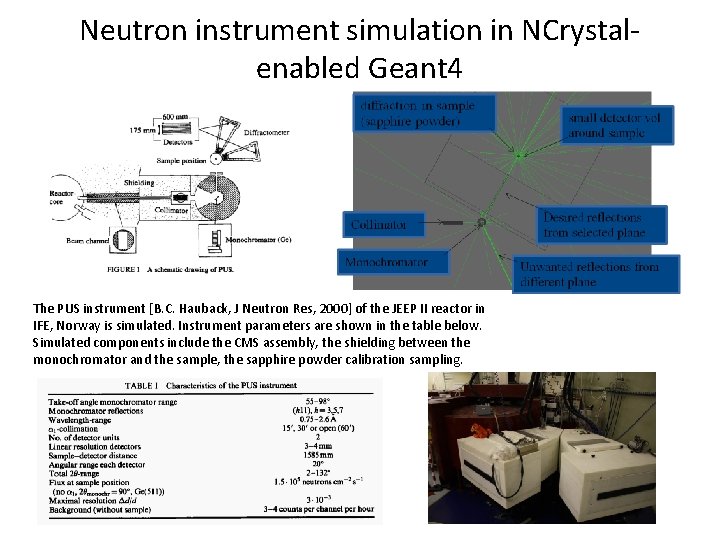
Neutron instrument simulation in NCrystalenabled Geant 4 The PUS instrument [B. C. Hauback, J Neutron Res, 2000] of the JEEP II reactor in IFE, Norway is simulated. Instrument parameters are shown in the table below. Simulated components include the CMS assembly, the shielding between the monochromator and the sample, the sapphire powder calibration sampling.
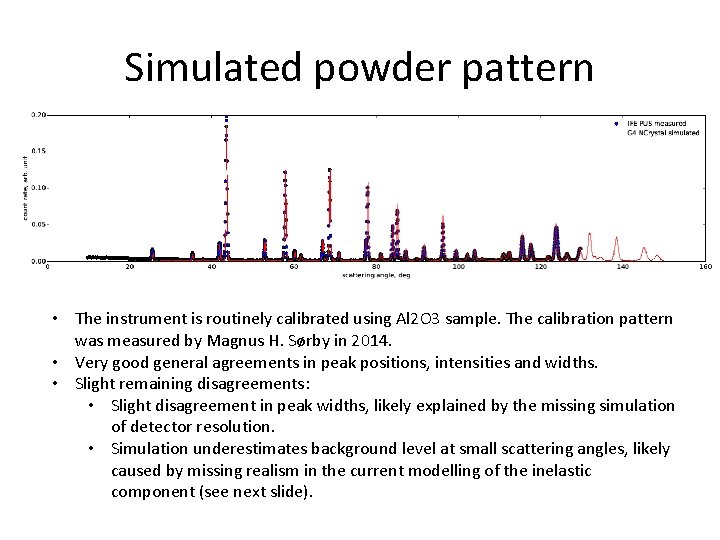
Simulated powder pattern • The instrument is routinely calibrated using Al 2 O 3 sample. The calibration pattern was measured by Magnus H. Sørby in 2014. • Very good general agreements in peak positions, intensities and widths. • Slight remaining disagreements: • Slight disagreement in peak widths, likely explained by the missing simulation of detector resolution. • Simulation underestimates background level at small scattering angles, likely caused by missing realism in the current modelling of the inelastic component (see next slide).
Summary • Facilitated by modern theories and numerical techniques, it is feasible to develop more detailed models for neutron nuclear scattering in Monte Carlo radiation transport codes. • Depending on user configuration and (simple) data files, NCrystal will reproduce detailed single- or poly-crystal neutron physics with focus on both numerical errors and efficiency. • With the planned developments, NCrystal can optionally use detailed data (e. g. scattering kernels) to increase realism when simulating a material. – However, the cost of obtaining the corresponding physical input is not trivial by either experiments or computations. Considering the demands of a large variety of materials from different applications, the production of the input data should be in the form of a community based collaboration. • Geant 4 can simulate a large variaty of particles in a wide energy range. Along with NCrystal, it is feasible to simulate neutron instruments in full scale to understand the intrinsic radiation background. • NCrystal is available at http: //mctools. github. io/ncrystal/.