
Monte Carlo Simulation of Liquid Water Daniel Shoemaker
- Slides: 11
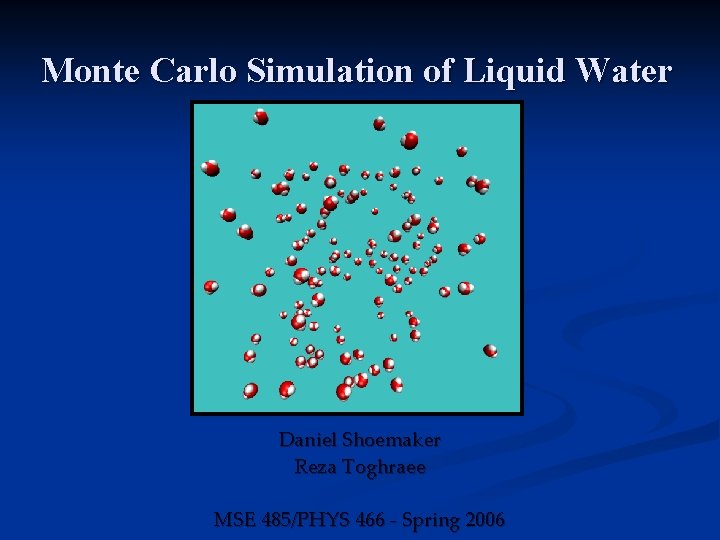
Monte Carlo Simulation of Liquid Water Daniel Shoemaker Reza Toghraee MSE 485/PHYS 466 - Spring 2006
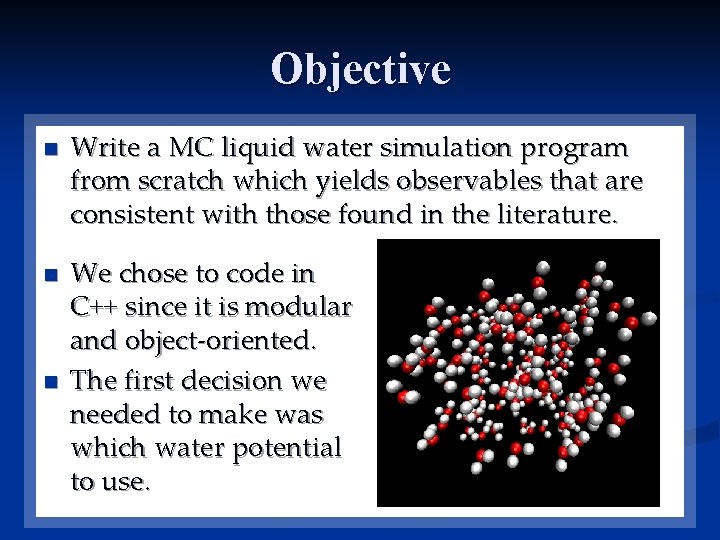
Objective n n n Write a MC liquid water simulation program from scratch which yields observables that are consistent with those found in the literature. We chose to code in C++ since it is modular and object-oriented. The first decision we needed to make was which water potential to use.
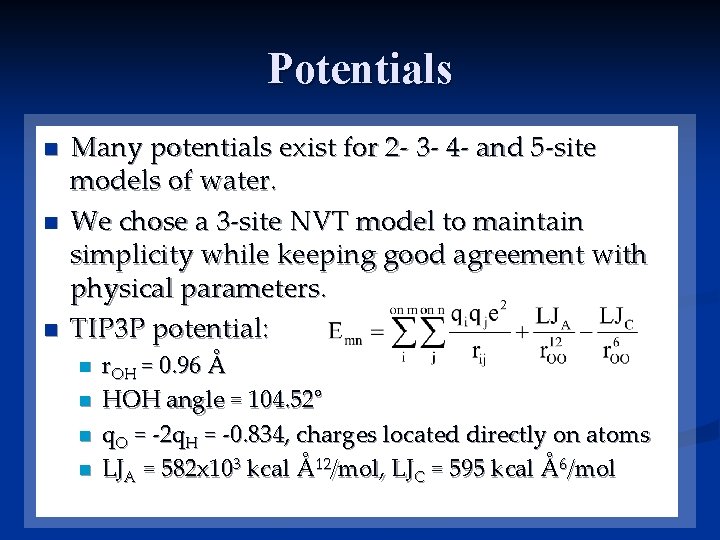
Potentials n n n Many potentials exist for 2 - 3 - 4 - and 5 -site models of water. We chose a 3 -site NVT model to maintain simplicity while keeping good agreement with physical parameters. TIP 3 P potential: n n r. OH = 0. 96 Å HOH angle = 104. 52° q. O = -2 q. H = -0. 834, charges located directly on atoms LJA = 582 x 103 kcal Å12/mol, LJC = 595 kcal Å6/mol
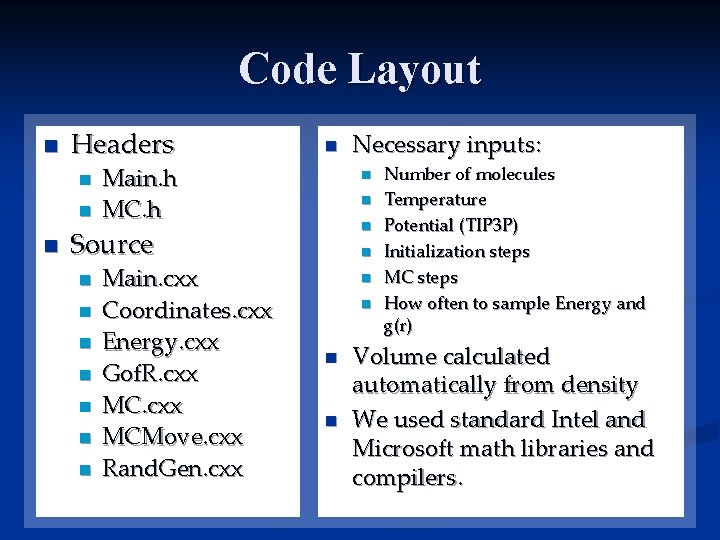
Code Layout n Headers n n Main. h MC. h n n n Source n n n n Main. cxx Coordinates. cxx Energy. cxx Gof. R. cxx MCMove. cxx Rand. Gen. cxx Necessary inputs: n n n Number of molecules Temperature Potential (TIP 3 P) Initialization steps MC steps How often to sample Energy and g(r) Volume calculated automatically from density We used standard Intel and Microsoft math libraries and compilers.
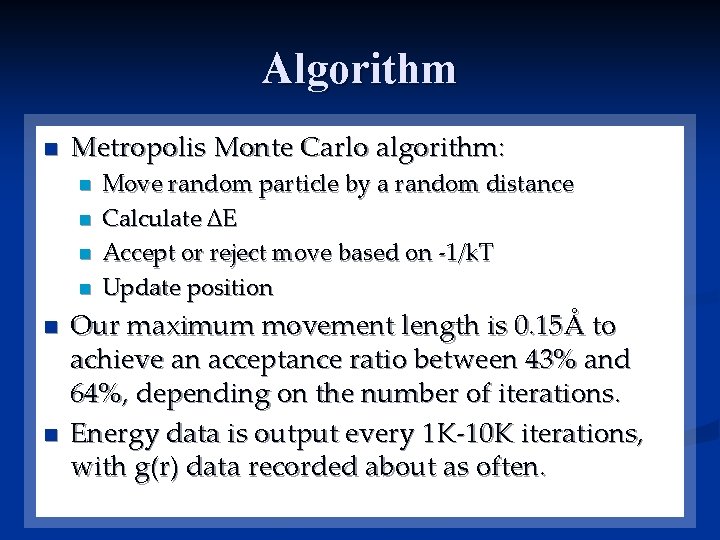
Algorithm n Metropolis Monte Carlo algorithm: n n n Move random particle by a random distance Calculate ∆E Accept or reject move based on -1/k. T Update position Our maximum movement length is 0. 15Å to achieve an acceptance ratio between 43% and 64%, depending on the number of iterations. Energy data is output every 1 K-10 K iterations, with g(r) data recorded about as often.
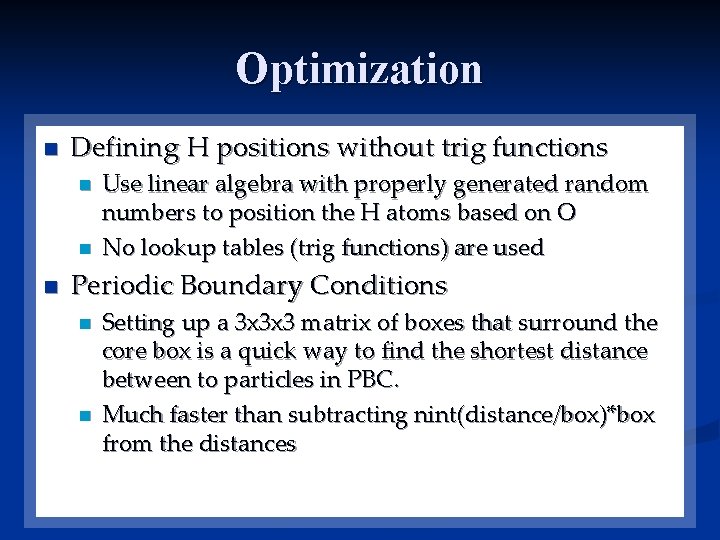
Optimization n Defining H positions without trig functions n n n Use linear algebra with properly generated random numbers to position the H atoms based on O No lookup tables (trig functions) are used Periodic Boundary Conditions n n Setting up a 3 x 3 x 3 matrix of boxes that surround the core box is a quick way to find the shortest distance between to particles in PBC. Much faster than subtracting nint(distance/box)*box from the distances
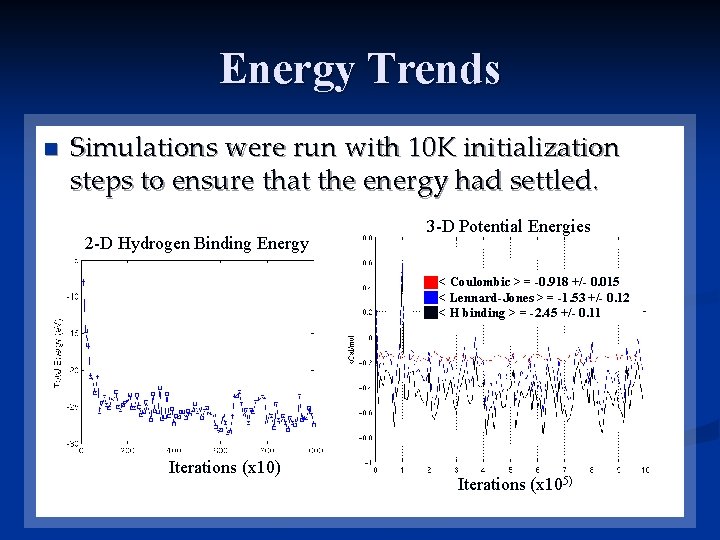
Energy Trends n Simulations were run with 10 K initialization steps to ensure that the energy had settled. 2 -D Hydrogen Binding Energy 3 -D Potential Energies < Coulombic > = -0. 918 +/- 0. 015 < Lennard-Jones > = -1. 53 +/- 0. 12 < H binding > = -2. 45 +/- 0. 11 Iterations (x 10) Iterations (x 105)
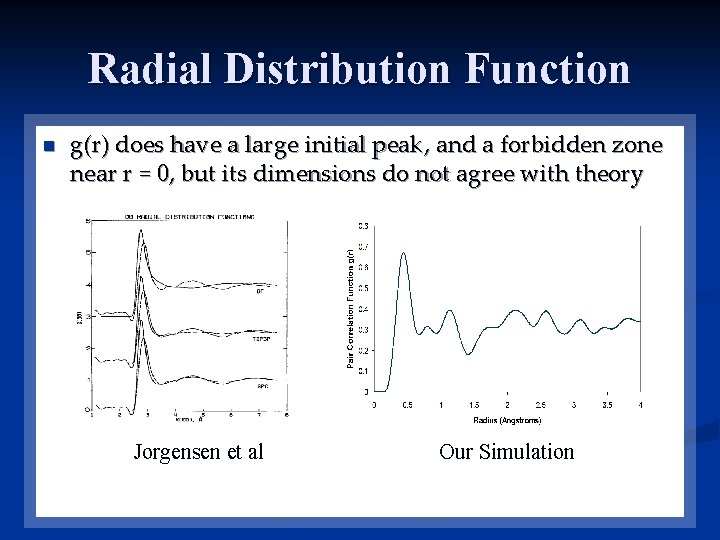
Radial Distribution Function n g(r) does have a large initial peak, and a forbidden zone near r = 0, but its dimensions do not agree with theory Jorgensen et al Our Simulation
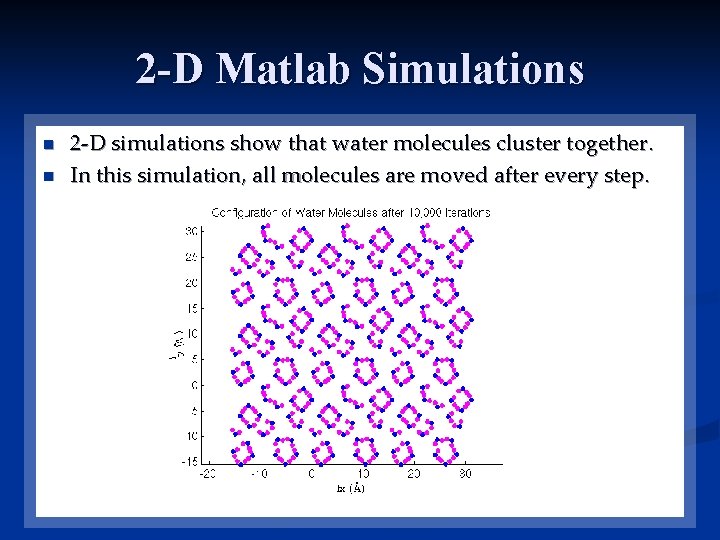
2 -D Matlab Simulations n n 2 -D simulations show that water molecules cluster together. In this simulation, all molecules are moved after every step.
Conclusions n n Our program is a fast and intuitive way to simulate water using Monte Carlo. This code can easily handle a 3 -site potential, and minor modifications would allow 4 -sites. Our Lennard-Jones interactions are a little too strong, but the potentials behave as expected. The g(r) normalization should be examined to correct its scale.
References n n n 2 -D Simulations by Jihan Kim Berendsen, H. J. C. et al, Intermolecular Forces, (D. Reidel Co. , Holland 1983), 331. Frenkel, D. and B. Smit, Understanding Molecular Simulation, (2 nd Ed. , Academic Press 2002). Jorgensen, W. L. , J. Am. Chem. Soc. 103, 1981, 335. Jorgensen, W. L. et al, J. Chem. Phys. 79 (2), 12 July 1983, 926. Mc. Donald, I. R. , Mol. Phys. 23, 1972, 41.