
Monte Carlo modeling of reflectance of human skin
- Slides: 18
Monte Carlo modeling of reflectance of human skin with embedded Ti. O 2 nanoparticles Roman Karandashov, Alexey N. Bashkatov, Elina A. Genina, Valery V. Tuchin Department of Optics and Biophotonics of Saratov State University, Saratov, Russia Interdisciplinary Laboratory of Biophotonics, Tomsk State University, Tomsk, Russia e-mail: karandashovrg@gmail. com
Contents 1. Introduction 2. Model of human skin 3. Optical properties of human skin 4. Optical properties of Ti. O 2 5. Model of human skin with embedded nanoparticles Ti. O 2 6. Monte Carlo algorithm 7. Results 8. Conclusion
1. Introduction The goal of this work is to research the influence of Ti. O 2 on reflectance of human skin by Monte Carlo modeling Nowadays different properties of Ti. O 2 and its influence on biotissue is widely researched. This is due to the fact that Ti. O 2 is activity used in many fields of science. So, in dentistry its used for teeth whitening. Cosmetologists add it to sunscreen products for ultraviolet protection. Ti. O 2 usage is also observed in OCT for image contrast. Hiding of tattoos with Ti. O 2 is a quite perspective branch of medicine.
Monte-Carlo modeling of reflectance of human skin was chosen as a very precise method, which results correspond to experimental data. Real experiments are increasingly replaced by computer modeling, as this method has some advantages. Firstly, as it has been already mentioned, it gives accurate results. Secondly, it replaces expensive equipment.
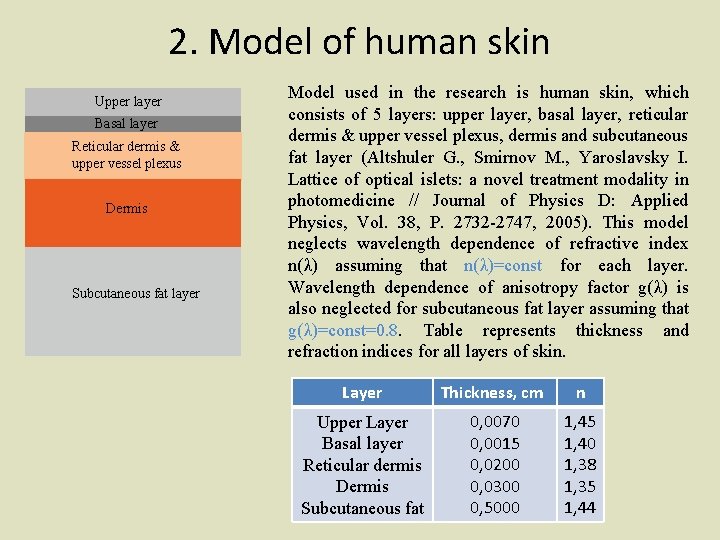
2. Model of human skin Upper layer Basal layer Reticular dermis & upper vessel plexus Dermis Subcutaneous fat layer Model used in the research is human skin, which consists of 5 layers: upper layer, basal layer, reticular dermis & upper vessel plexus, dermis and subcutaneous fat layer (Altshuler G. , Smirnov M. , Yaroslavsky I. Lattice of optical islets: a novel treatment modality in photomedicine // Journal of Physics D: Applied Physics, Vol. 38, P. 2732 -2747, 2005). This model neglects wavelength dependence of refractive index n(λ) assuming that n(λ)=const for each layer. Wavelength dependence of anisotropy factor g(λ) is also neglected for subcutaneous fat layer assuming that g(λ)=const=0. 8. Table represents thickness and refraction indices for all layers of skin. Layer Thickness, cm n Upper Layer Basal layer Reticular dermis Dermis Subcutaneous fat 0, 0070 0, 0015 0, 0200 0, 0300 0, 5000 1, 45 1, 40 1, 38 1, 35 1, 44
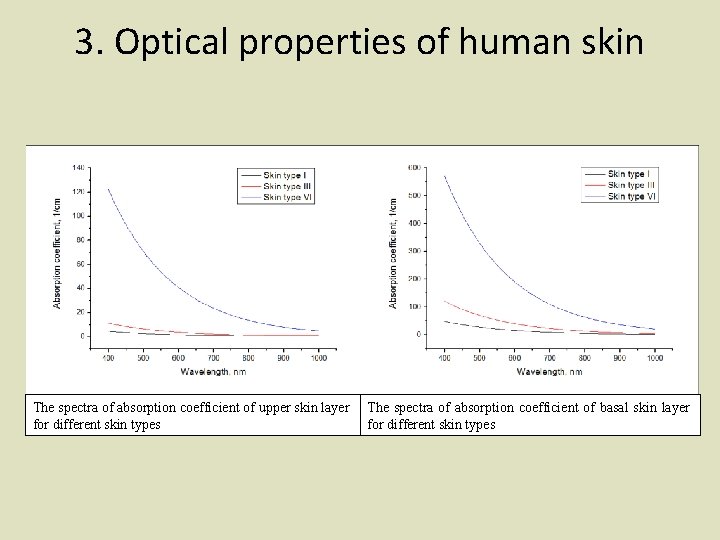
3. Optical properties of human skin The spectra of absorption coefficient of upper skin layer for different skin types The spectra of absorption coefficient of basal skin layer for different skin types
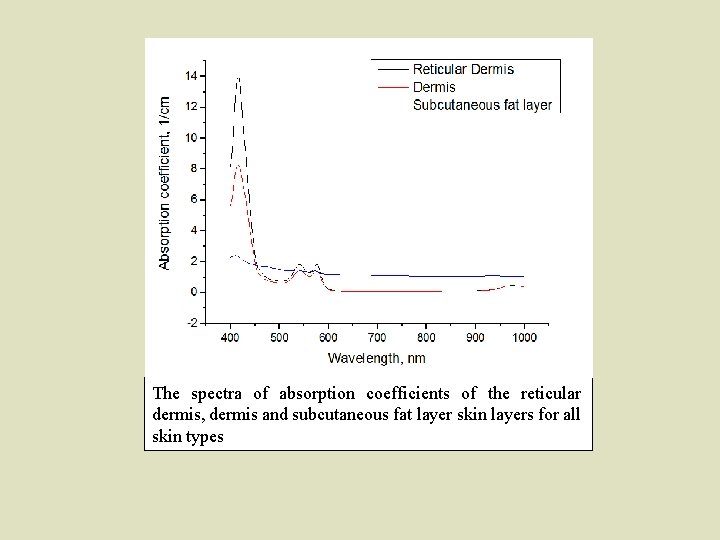
The spectra of absorption coefficients of the reticular dermis, dermis and subcutaneous fat layer skin layers for all skin types
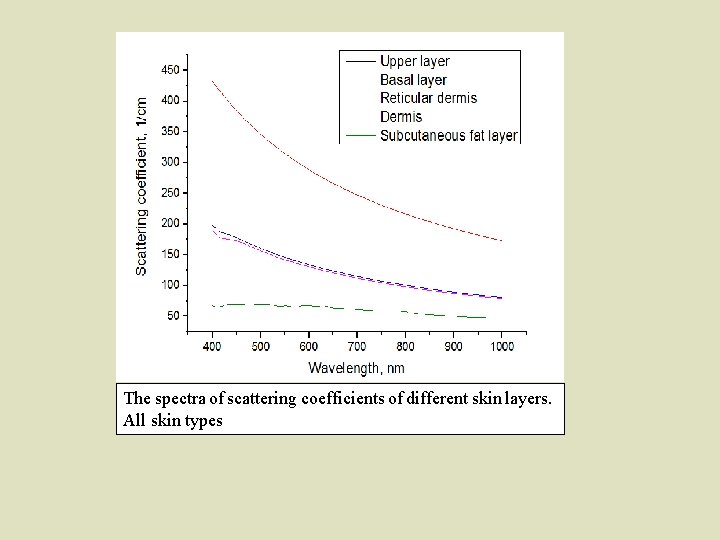
The spectra of scattering coefficients of different skin layers. All skin types
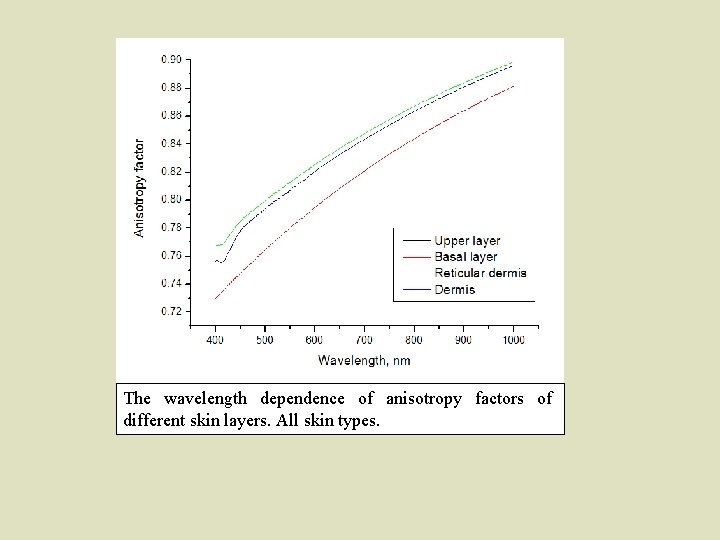
The wavelength dependence of anisotropy factors of different skin layers. All skin types.
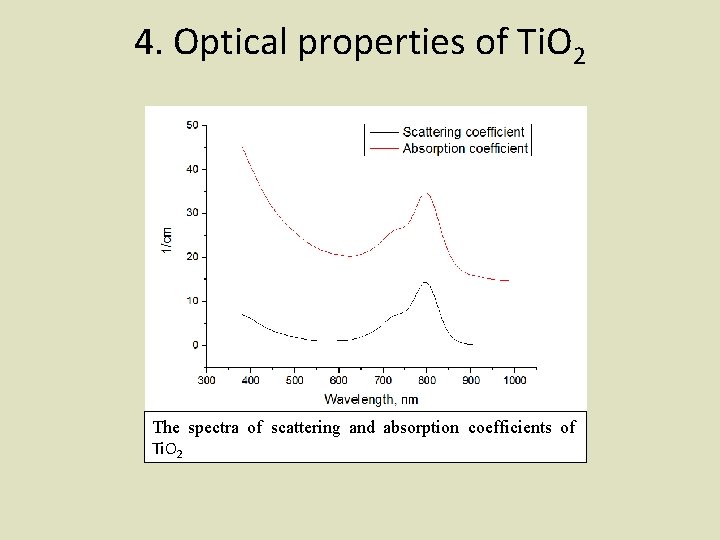
4. Optical properties of Ti. O 2 The spectra of scattering and absorption coefficients of Ti. O 2
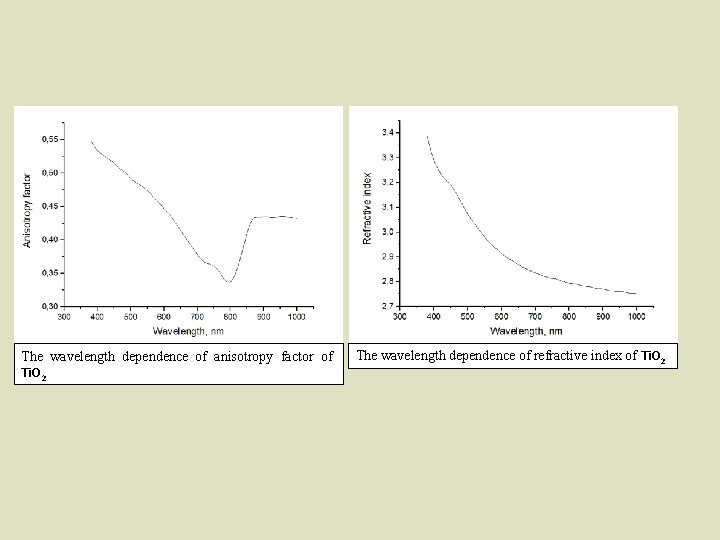
The wavelength dependence of anisotropy factor of Ti. O 2 The wavelength dependence of refractive index of Ti. O 2
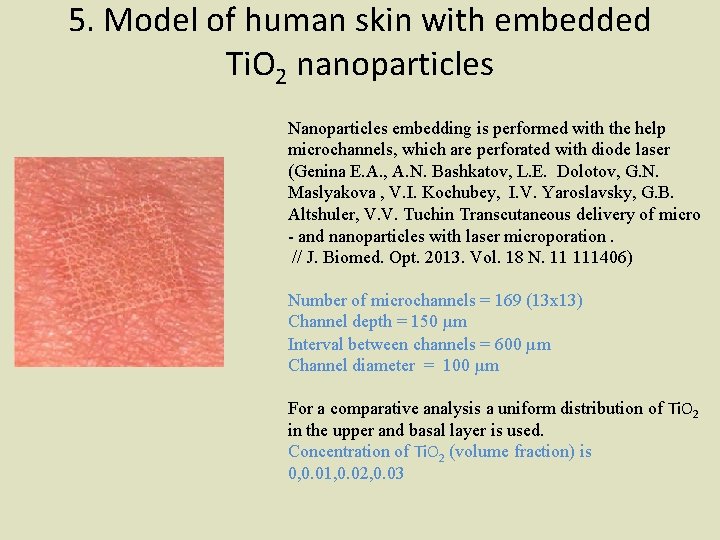
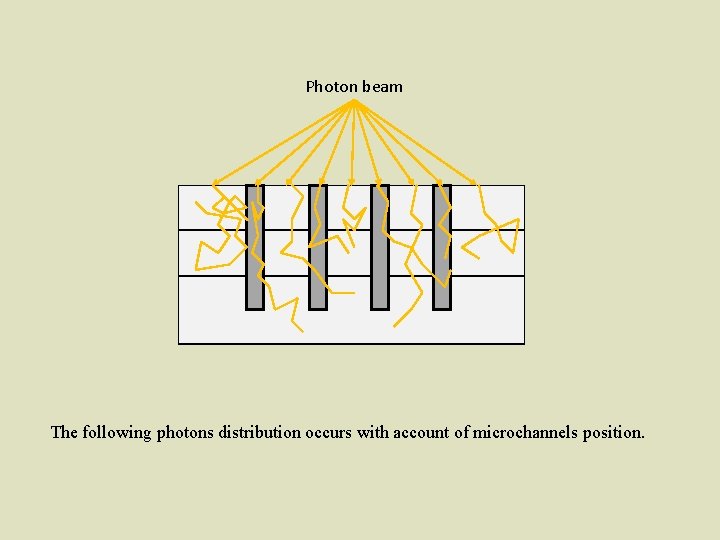
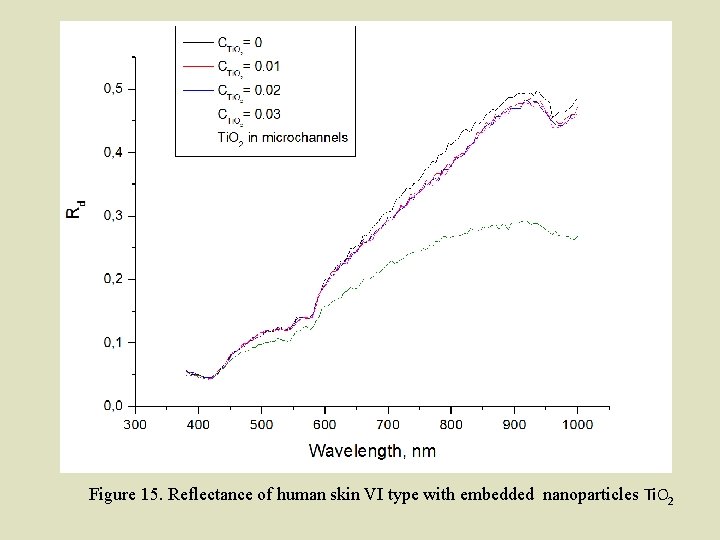
5. Model of human skin with embedded Ti. O 2 nanoparticles Nanoparticles embedding is performed with the help microchannels, which are perforated with diode laser (Genina E. A. , A. N. Bashkatov, L. E. Dolotov, G. N. Maslyakova , V. I. Kochubey, I. V. Yaroslavsky, G. B. Altshuler, V. V. Tuchin Transcutaneous delivery of micro - and nanoparticles with laser microporation. // J. Biomed. Opt. 2013. Vol. 18 N. 11 111406) Number of microchannels = 169 (13 x 13) Channel depth = 150 µm Interval between channels = 600 µm Channel diameter = 100 µm For a comparative analysis a uniform distribution of Ti. O 2 in the upper and basal layer is used. Concentration of Ti. O 2 (volume fraction) is 0, 0. 01, 0. 02, 0. 03
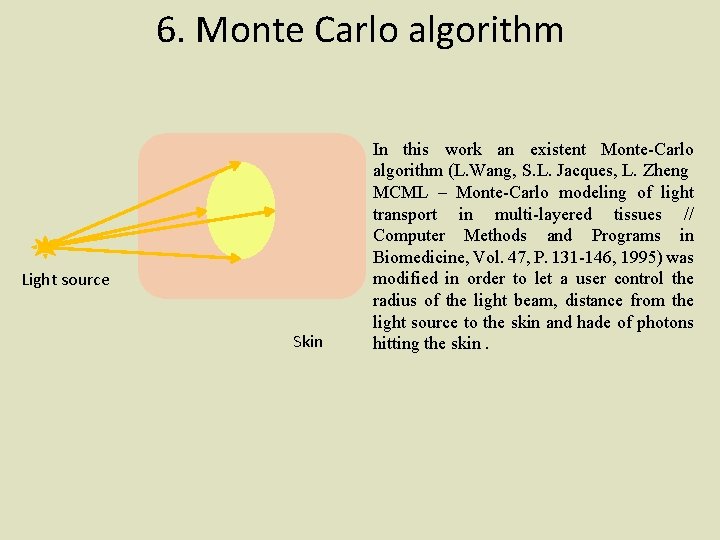
6. Monte Carlo algorithm Light source Skin In this work an existent Monte-Carlo algorithm (L. Wang, S. L. Jacques, L. Zheng MCML – Monte-Carlo modeling of light transport in multi-layered tissues // Computer Methods and Programs in Biomedicine, Vol. 47, P. 131 -146, 1995) was modified in order to let a user control the radius of the light beam, distance from the light source to the skin and hade of photons hitting the skin.
Photon beam The following photons distribution occurs with account of microchannels position.
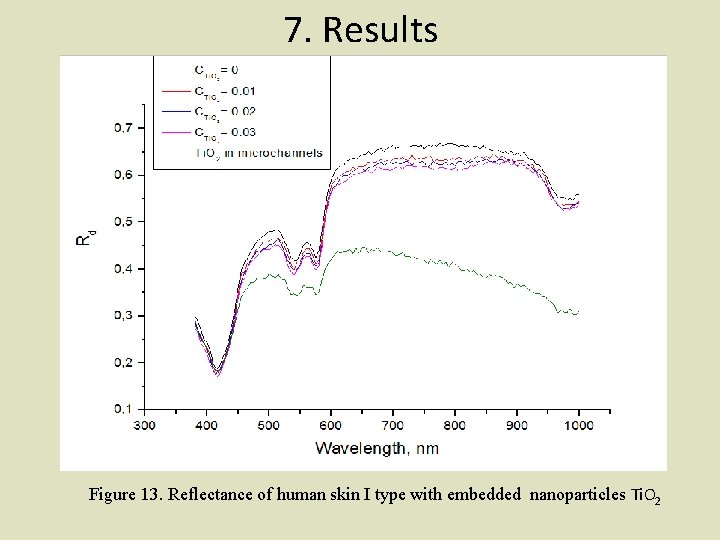
7. Results Figure 13. Reflectance of human skin I type with embedded nanoparticles Ti. O 2
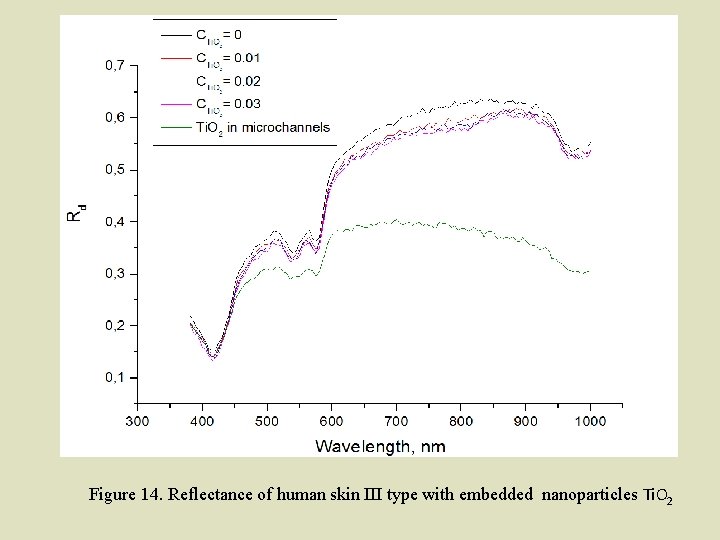
Figure 14. Reflectance of human skin III type with embedded nanoparticles Ti. O 2
Figure 15. Reflectance of human skin VI type with embedded nanoparticles Ti. O 2
8. Conclusion As a result, spectra show that uniform distribution of nanoparticles Ti. O 2 leads to decreasing of reflectance. Besides, the more the concentration is, the less is reflectance. So, Ti. O 2 embedding causes a considerable decrease of reflectance and it also changes the form of reflectance spectrum