
Monte Carlo Methods Some example applications in C

![Example Populate a square with n randomly-place points [the blue and red points] Count](https://slidetodoc.com/presentation_image_h2/6d0b9a72198cf0f0e1f4f338078ebcc3/image-8.jpg "Example Populate a square with n randomly-place points [the blue and red points] Count")

- Slides: 17
Monte Carlo Methods Some example applications in C++
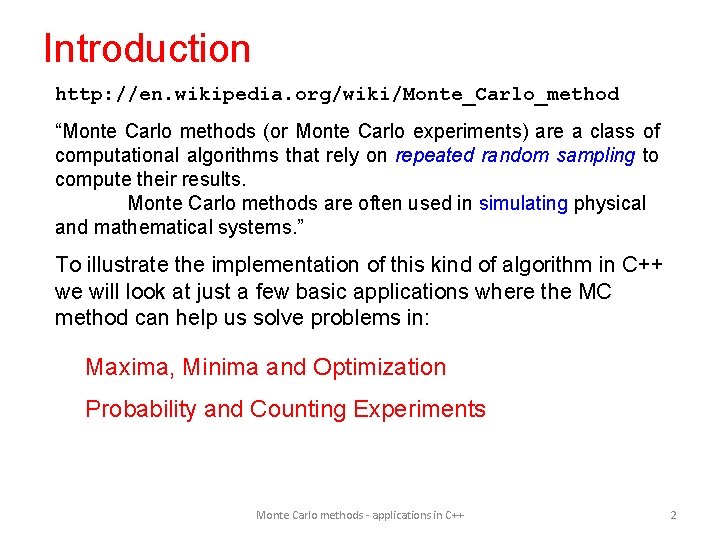
Introduction http: //en. wikipedia. org/wiki/Monte_Carlo_method “Monte Carlo methods (or Monte Carlo experiments) are a class of computational algorithms that rely on repeated random sampling to compute their results. Monte Carlo methods are often used in simulating physical and mathematical systems. ” To illustrate the implementation of this kind of algorithm in C++ we will look at just a few basic applications where the MC method can help us solve problems in: Maxima, Minima and Optimization Probability and Counting Experiments Monte Carlo methods - applications in C++ 2
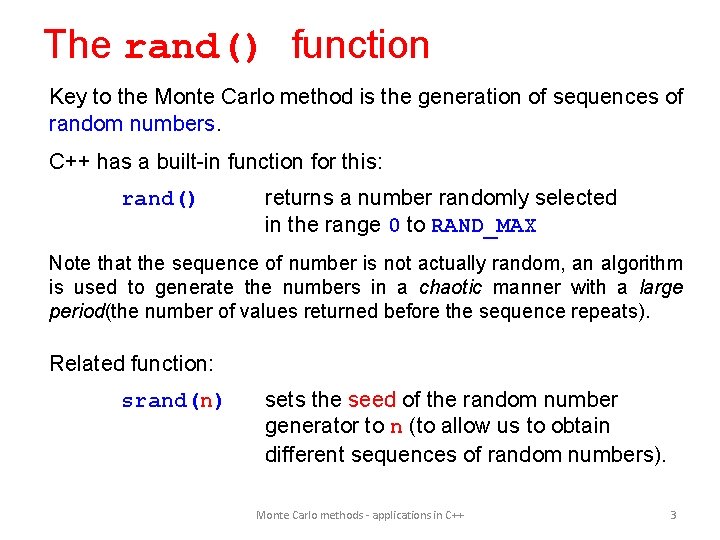
The rand() function Key to the Monte Carlo method is the generation of sequences of random numbers. C++ has a built-in function for this: rand() returns a number randomly selected in the range 0 to RAND_MAX Note that the sequence of number is not actually random, an algorithm is used to generate the numbers in a chaotic manner with a large period(the number of values returned before the sequence repeats). Related function: srand(n) sets the seed of the random number generator to n (to allow us to obtain different sequences of random numbers). Monte Carlo methods - applications in C++ 3
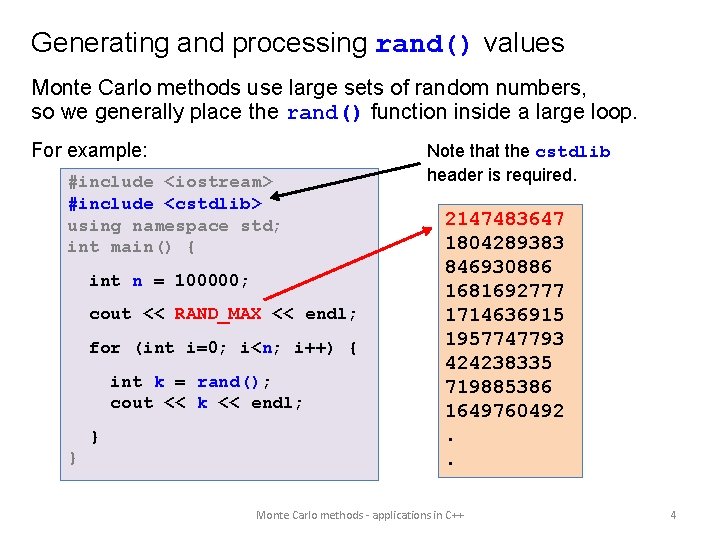
Generating and processing rand() values Monte Carlo methods use large sets of random numbers, so we generally place the rand() function inside a large loop. For example: #include <iostream> #include <cstdlib> using namespace std; int main() { int n = 100000; cout << RAND_MAX << endl; for (int i=0; i<n; i++) { int k = rand(); cout << k << endl; } } Note that the cstdlib header is required. 2147483647 1804289383 846930886 1681692777 1714636915 1957747793 424238335 719885386 1649760492. . Monte Carlo methods - applications in C++ 4
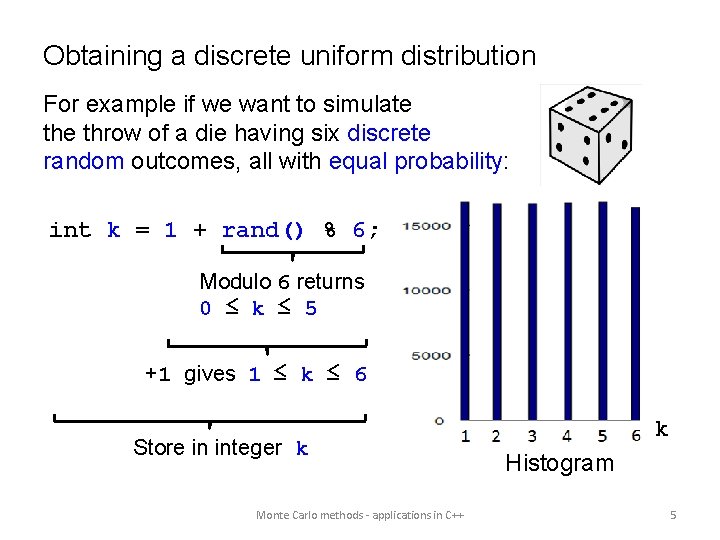
Obtaining a discrete uniform distribution For example if we want to simulate throw of a die having six discrete random outcomes, all with equal probability: int k = 1 + rand() % 6; Modulo 6 returns 0 ≤ k ≤ 5 +1 gives 1 ≤ k ≤ 6 Store in integer k Monte Carlo methods - applications in C++ k Histogram 5
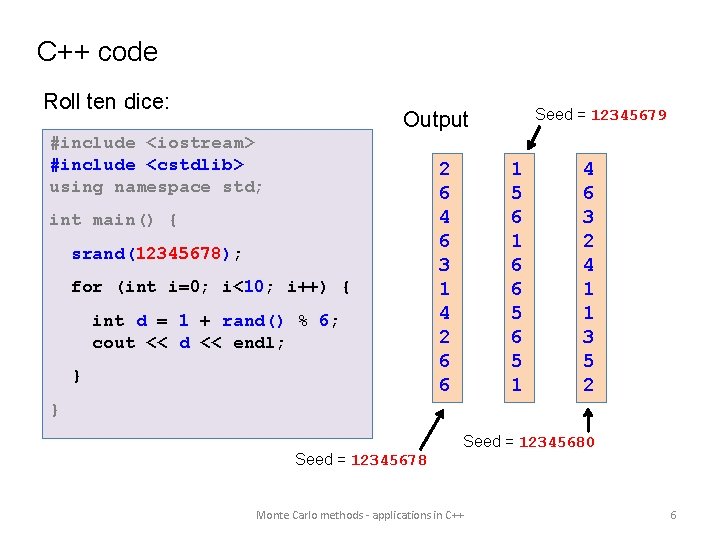
C++ code Roll ten dice: Seed = 12345679 Output #include <iostream> #include <cstdlib> using namespace std; int main() { srand(12345678); for (int i=0; i<10; i++) { int d = 1 + rand() % 6; cout << d << endl; } 2 6 4 6 3 1 4 2 6 6 1 5 6 1 6 6 5 1 4 6 3 2 4 1 1 3 5 2 } Seed = 12345678 Seed = 12345680 Monte Carlo methods - applications in C++ 6
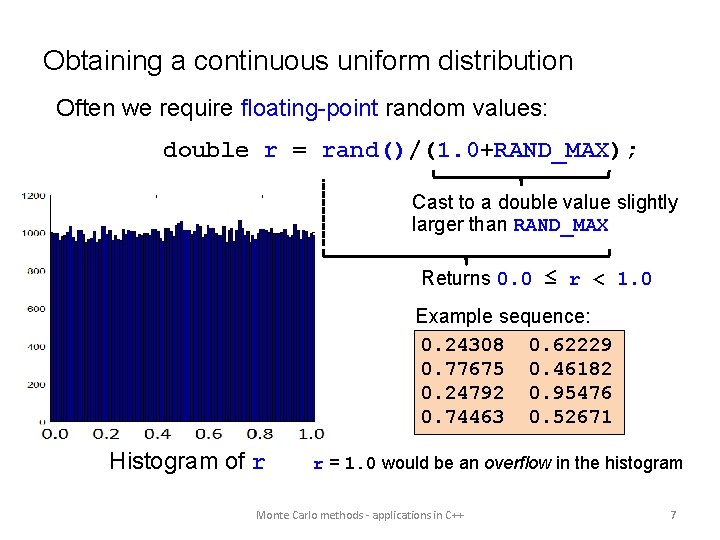
Obtaining a continuous uniform distribution Often we require floating-point random values: double r = rand()/(1. 0+RAND_MAX); Cast to a double value slightly larger than RAND_MAX Returns 0. 0 ≤ r < 1. 0 Example sequence: 0. 24308 0. 62229 0. 77675 0. 46182 0. 24792 0. 95476 0. 74463 0. 52671 Histogram of r r = 1. 0 would be an overflow in the histogram Monte Carlo methods - applications in C++ 7
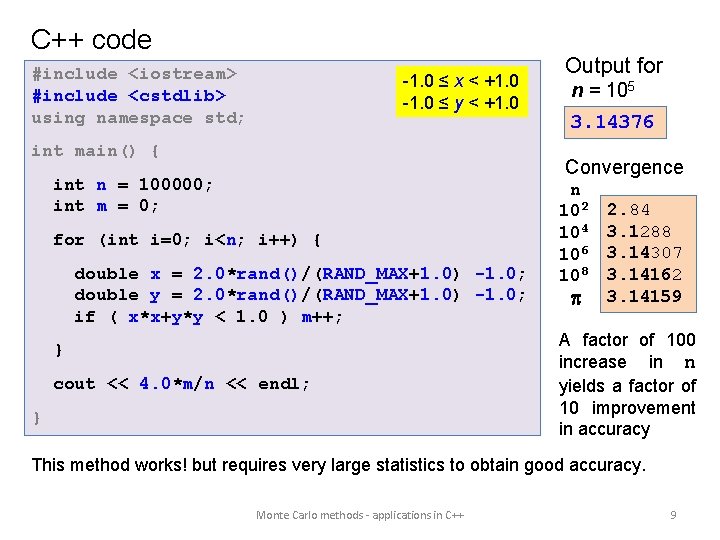
Example Populate a square with n randomly-place points [the blue and red points] Count the number of points m that lie inside the circle [the blue points] The ratio 4 m/n is then an approximation to the area of the circle (the area of the square being 4 units 2) and therefore an approximation to . -1. 0 ≤ x < +1. 0 -1. 0 ≤ y < +1. 0 Monte Carlo methods - applications in C++ 8
C++ code #include <iostream> #include <cstdlib> using namespace std; -1. 0 ≤ x < +1. 0 -1. 0 ≤ y < +1. 0 int main() { Output for n = 105 3. 14376 Convergence int n = 100000; int m = 0; for (int i=0; i<n; i++) { double x = 2. 0*rand()/(RAND_MAX+1. 0) -1. 0; double y = 2. 0*rand()/(RAND_MAX+1. 0) -1. 0; if ( x*x+y*y < 1. 0 ) m++; } cout << 4. 0*m/n << endl; } n 102 104 106 108 2. 84 3. 1288 3. 14307 3. 14162 3. 14159 A factor of 100 increase in n yields a factor of 10 improvement in accuracy This method works! but requires very large statistics to obtain good accuracy. Monte Carlo methods - applications in C++ 9
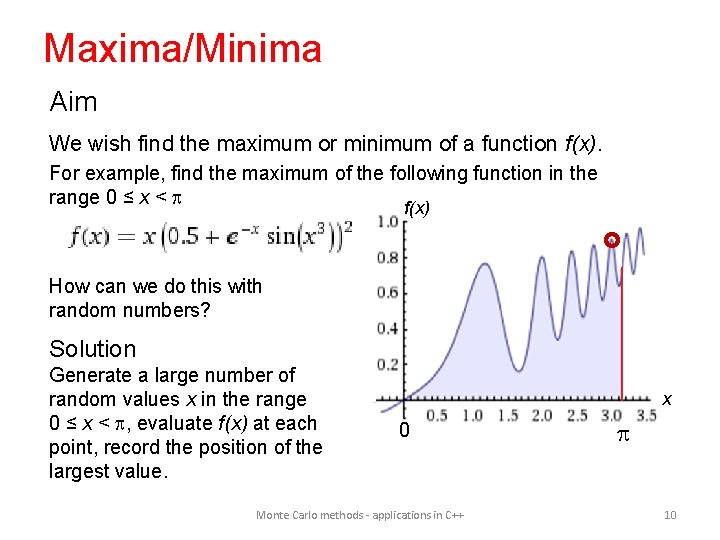
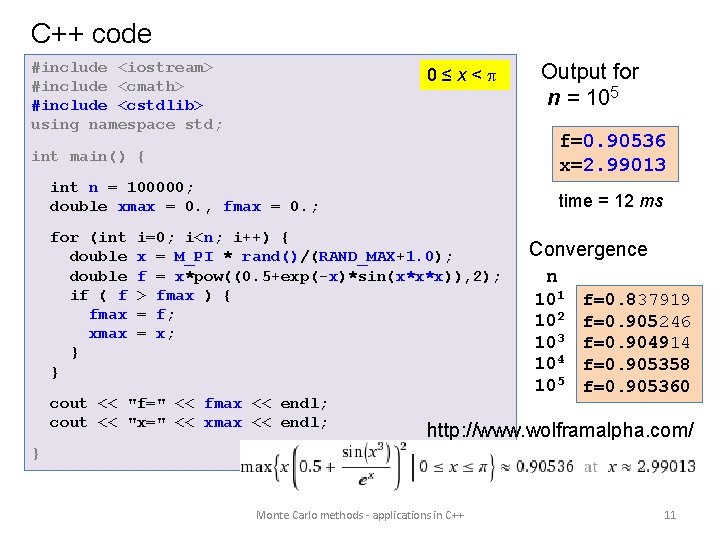
Maxima/Minima Aim We wish find the maximum or minimum of a function f(x). For example, find the maximum of the following function in the range 0 ≤ x < f(x) How can we do this with random numbers? Solution Generate a large number of random values x in the range 0 ≤ x < , evaluate f(x) at each point, record the position of the largest value. x 0 Monte Carlo methods - applications in C++ 10
C++ code #include <iostream> #include <cmath> #include <cstdlib> using namespace std; 0≤x< f=0. 90536 x=2. 99013 int main() { int n = 100000; double xmax = 0. , fmax = 0. ; for (int double if ( f fmax xmax } } Output for n = 105 time = 12 ms i=0; i<n; i++) { x = M_PI * rand()/(RAND_MAX+1. 0); f = x*pow((0. 5+exp(-x)*sin(x*x*x)), 2); > fmax ) { = f; = x; cout << "f=" << fmax << endl; cout << "x=" << xmax << endl; Convergence n 101 102 103 104 105 f=0. 837919 f=0. 905246 f=0. 904914 f=0. 905358 f=0. 905360 http: //www. wolframalpha. com/ } Monte Carlo methods - applications in C++ 11
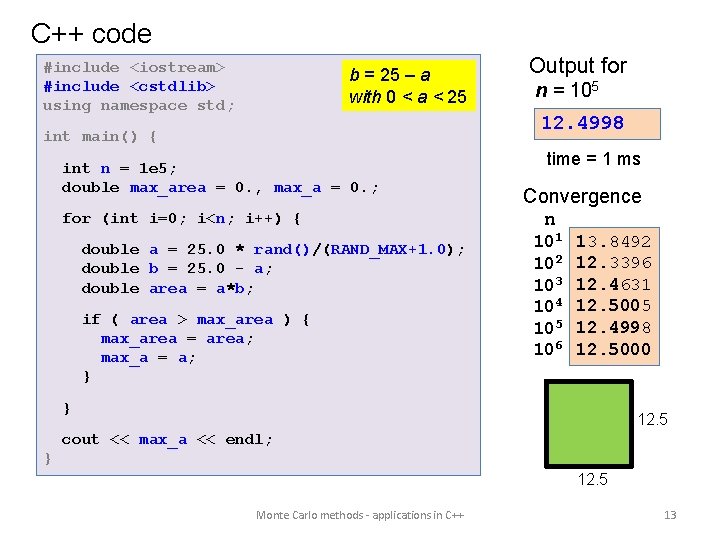
Optimization Aim Similar to the idea of obtaining the maximum or minimum of a function, we sometimes wish to optimize a system; i. e. maximise or minimize a target quantity. b Example We have 50 meters of fencing and wish to construct a fenced rectangular area, sides a and b with the target of maximizing the area A = a b enclosed by the fence. 2 a + 2 b = 50 b = 25 – a a A=ab a b with 0 < a < 25 Monte Carlo methods - applications in C++ 12
C++ code #include <iostream> #include <cstdlib> using namespace std; b = 25 – a with 0 < a < 25 Output for n = 105 12. 4998 int main() { int n = 1 e 5; double max_area = 0. , max_a = 0. ; for (int i=0; i<n; i++) { double a = 25. 0 * rand()/(RAND_MAX+1. 0); double b = 25. 0 - a; double area = a*b; if ( area > max_area ) { max_area = area; max_a = a; } time = 1 ms Convergence n 101 102 103 104 105 106 13. 8492 12. 3396 12. 4631 12. 5005 12. 4998 12. 5000 } 12. 5 cout << max_a << endl; } 12. 5 Monte Carlo methods - applications in C++ 13
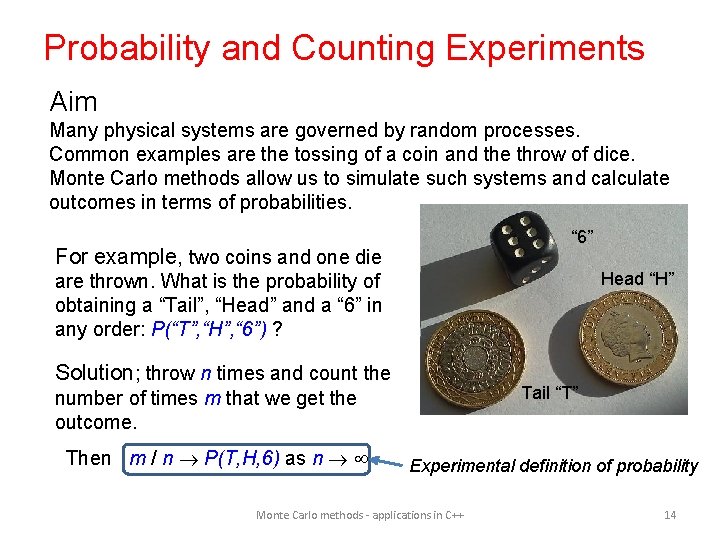
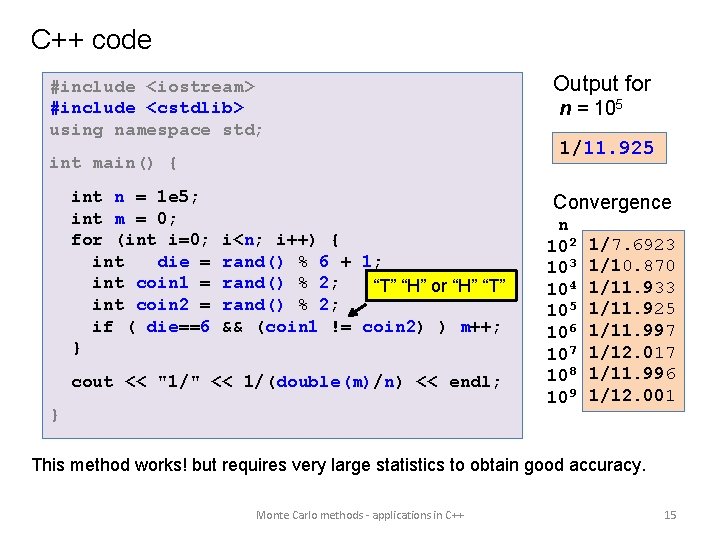
Probability and Counting Experiments Aim Many physical systems are governed by random processes. Common examples are the tossing of a coin and the throw of dice. Monte Carlo methods allow us to simulate such systems and calculate outcomes in terms of probabilities. “ 6” For example, two coins and one die Head “H” are thrown. What is the probability of obtaining a “Tail”, “Head” and a “ 6” in any order: P(“T”, “H”, “ 6”) ? Solution; throw n times and count the Tail “T” number of times m that we get the outcome. Then m / n P(T, H, 6) as n Experimental definition of probability Monte Carlo methods - applications in C++ 14
C++ code #include <iostream> #include <cstdlib> using namespace std; int main() { int n = 1 e 5; int m = 0; for (int i=0; int die = int coin 1 = int coin 2 = if ( die==6 } Output for n = 105 1/11. 925 Convergence i<n; i++) { rand() % 6 + 1; rand() % 2; “T” “H” or “H” “T” rand() % 2; && (coin 1 != coin 2) ) m++; cout << "1/" << 1/(double(m)/n) << endl; } n 102 103 104 105 106 107 108 109 1/7. 6923 1/10. 870 1/11. 933 1/11. 925 1/11. 997 1/12. 017 1/11. 996 1/12. 001 This method works! but requires very large statistics to obtain good accuracy. Monte Carlo methods - applications in C++ 15
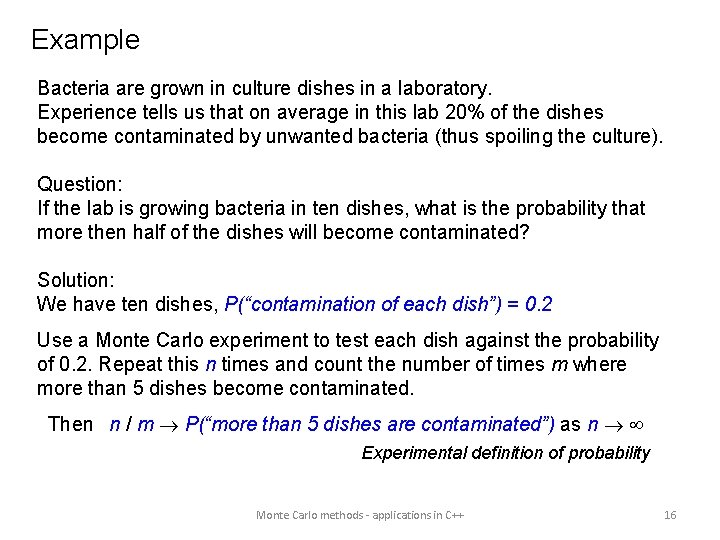
Example Bacteria are grown in culture dishes in a laboratory. Experience tells us that on average in this lab 20% of the dishes become contaminated by unwanted bacteria (thus spoiling the culture). Question: If the lab is growing bacteria in ten dishes, what is the probability that more then half of the dishes will become contaminated? Solution: We have ten dishes, P(“contamination of each dish”) = 0. 2 Use a Monte Carlo experiment to test each dish against the probability of 0. 2. Repeat this n times and count the number of times m where more than 5 dishes become contaminated. Then n / m P(“more than 5 dishes are contaminated”) as n Experimental definition of probability Monte Carlo methods - applications in C++ 16
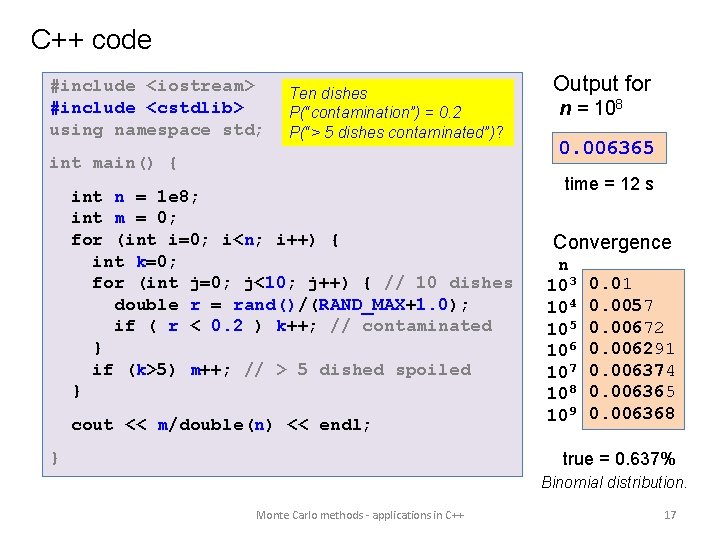
C++ code #include <iostream> #include <cstdlib> using namespace std; Ten dishes P(“contamination”) = 0. 2 P(“> 5 dishes contaminated”)? int main() { int n = 1 e 8; int m = 0; for (int i=0; i<n; i++) { int k=0; for (int j=0; j<10; j++) { // 10 dishes double r = rand()/(RAND_MAX+1. 0); if ( r < 0. 2 ) k++; // contaminated } if (k>5) m++; // > 5 dished spoiled } cout << m/double(n) << endl; } Output for n = 108 0. 006365 time = 12 s Convergence n 103 104 105 106 107 108 109 0. 01 0. 0057 0. 00672 0. 006291 0. 006374 0. 006365 0. 006368 true = 0. 637% Binomial distribution. Monte Carlo methods - applications in C++ 17