
Monte Carlo Generators in CMS 1 Overlook requirements
![Double Parton Scattering and PYTHIA 8/Herwig++ validation DP Component [F. Bechtel] Currently extending these](https://slidetodoc.com/presentation_image/ac13ce7c04df845a31cf2b832d765a31/image-15.jpg "Double Parton Scattering and PYTHIA 8/Herwig++ validation DP Component [F. Bechtel] Currently extending these")
- Slides: 31
Monte Carlo Generators in CMS 1. Overlook & requirements 2. Tuning & physics validation 3. Strategies in production Paolo Bartalini National Taiwan University on behalf of the CMS collaboration ACAT 08 - November 4 th 2008
The Monte Carlo generators in CMS Overlook & requirements • The LHC physics needs • Main MC choices by CMS • General input settings • Software integration strategy • Organization Paolo. Bartalini@cern. ch Nov 4 th ‘ 08 2
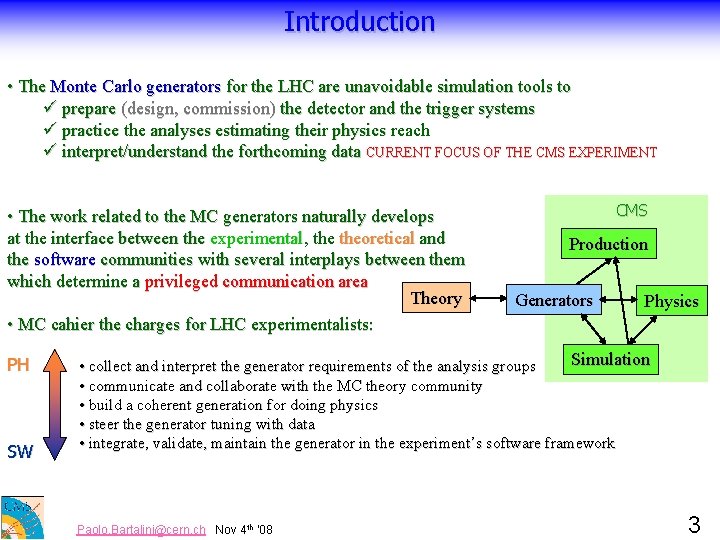
Introduction • The Monte Carlo generators for the LHC are unavoidable simulation tools to prepare (design, commission) the detector and the trigger systems practice the analyses estimating their physics reach interpret/understand the forthcoming data CURRENT FOCUS OF THE CMS EXPERIMENT • The work related to the MC generators naturally develops at the interface between the experimental, theoretical and the software communities with several interplays between them which determine a privileged communication area Theory • MC cahier the charges for LHC experimentalists: PH SW CMS Production Generators Physics Simulation • collect and interpret the generator requirements of the analysis groups • communicate and collaborate with the MC theory community • build a coherent generation for doing physics • steer the generator tuning with data • integrate, validate, maintain the generator in the experiment’s software framework Paolo. Bartalini@cern. ch Nov 4 th ‘ 08 3
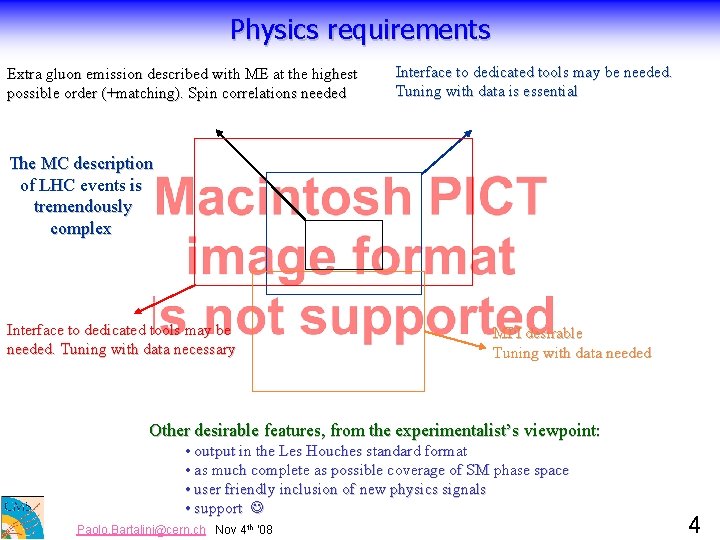
Physics requirements Extra gluon emission described with ME at the highest possible order (+matching). Spin correlations needed Interface to dedicated tools may be needed. Tuning with data is essential The MC description of LHC events is tremendously complex Interface to dedicated tools may be needed. Tuning with data necessary MPI desirable Tuning with data needed Other desirable features, from the experimentalist’s viewpoint: • output in the Les Houches standard format • as much complete as possible coverage of SM phase space • user friendly inclusion of new physics signals • support Paolo. Bartalini@cern. ch Nov 4 th ‘ 08 4
General purpose generators & decay tools in CMS • Latest FORTRAN event generator version, moving to the newest C++ versions PYTHIA 6, HERWIG extensively used as baseline event generators (SM, BSM) and for PS/fragmentation from external MEs PYTHIA 8, HERWIG++ being used in parallel. First central productions recently performed in CMS! SHERPA interfaced. Currently being validated. Not used in production yet • Several decay tools are used (work with all the supported general purpose MCs) TAUOLA ( decays) used where the description of decays is relevant PHOTOS (QED corrections) used where real QED description in simple process important Evt. Gen (for B hadron decays) used only in signal description Paolo. Bartalini@cern. ch Nov 4 th ‘ 08 5
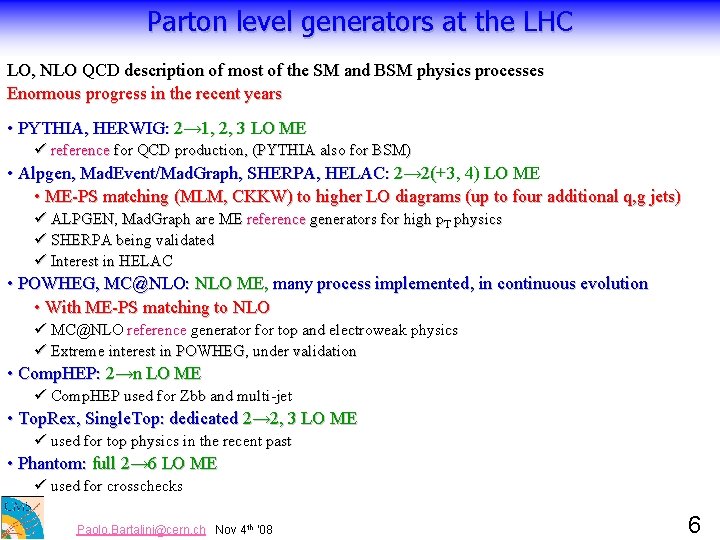
Parton level generators at the LHC LO, NLO QCD description of most of the SM and BSM physics processes Enormous progress in the recent years • PYTHIA, HERWIG: 2→ 1, 2, 3 LO ME reference for QCD production, (PYTHIA also for BSM) • Alpgen, Mad. Event/Mad. Graph, SHERPA, HELAC: 2→ 2(+3, 4) LO ME • ME-PS matching (MLM, CKKW) to higher LO diagrams (up to four additional q, g jets) ALPGEN, Mad. Graph are ME reference generators for high p. T physics SHERPA being validated Interest in HELAC • POWHEG, MC@NLO: NLO ME, many process implemented, in continuous evolution • With ME-PS matching to NLO MC@NLO reference generator for top and electroweak physics Extreme interest in POWHEG, under validation • Comp. HEP: 2→n LO ME Comp. HEP used for Zbb and multi-jet • Top. Rex, Single. Top: dedicated 2→ 2, 3 LO ME used for top physics in the recent past • Phantom: full 2→ 6 LO ME used for crosschecks Paolo. Bartalini@cern. ch Nov 4 th ‘ 08 6
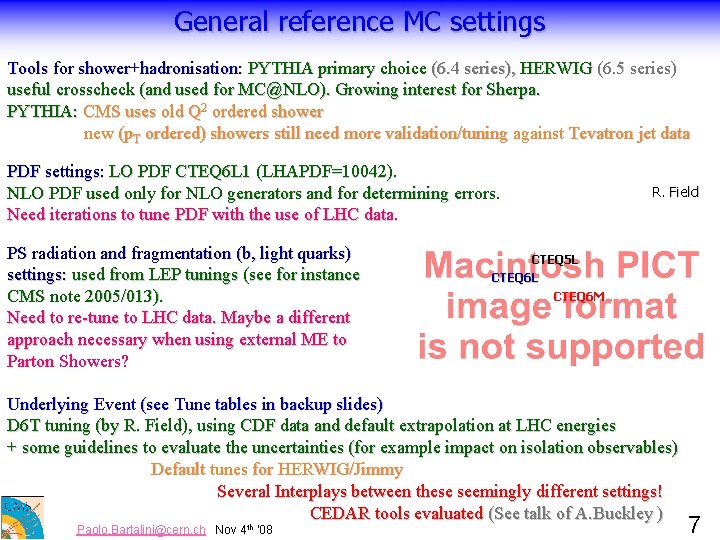
General reference MC settings Tools for shower+hadronisation: PYTHIA primary choice (6. 4 series), HERWIG (6. 5 series) useful crosscheck (and used for MC@NLO). Growing interest for Sherpa. PYTHIA: CMS uses old Q 2 ordered shower new (p. T ordered) showers still need more validation/tuning against Tevatron jet data PDF settings: LO PDF CTEQ 6 L 1 (LHAPDF=10042). NLO PDF used only for NLO generators and for determining errors. Need iterations to tune PDF with the use of LHC data. PS radiation and fragmentation (b, light quarks) settings: used from LEP tunings (see for instance CMS note 2005/013). Need to re-tune to LHC data. Maybe a different approach necessary when using external ME to Parton Showers? R. Field CTEQ 5 L CTEQ 6 M Underlying Event (see Tune tables in backup slides) D 6 T tuning (by R. Field), using CDF data and default extrapolation at LHC energies + some guidelines to evaluate the uncertainties (for example impact on isolation observables) Default tunes for HERWIG/Jimmy Several Interplays between these seemingly different settings! CEDAR tools evaluated (See talk of A. Buckley ) Paolo. Bartalini@cern. ch Nov 4 th ‘ 08 7
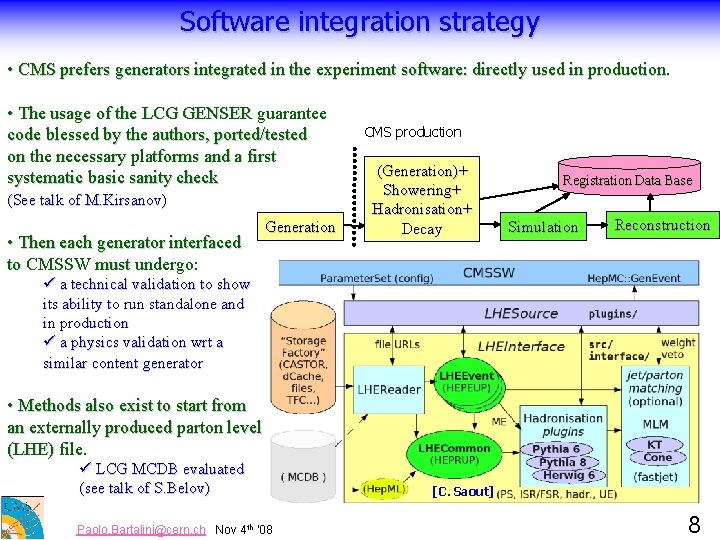
Software integration strategy • CMS prefers generators integrated in the experiment software: directly used in production. • The usage of the LCG GENSER guarantee code blessed by the authors, ported/tested on the necessary platforms and a first systematic basic sanity check (See talk of M. Kirsanov) • Then each generator interfaced to CMSSW must undergo: Generation CMS production (Generation)+ Showering+ Hadronisation+ Decay Registration Data Base Simulation Reconstruction a technical validation to show its ability to run standalone and in production a physics validation wrt a similar content generator • Methods also exist to start from an externally produced parton level (LHE) file. LCG MCDB evaluated (see talk of S. Belov) Paolo. Bartalini@cern. ch Nov 4 th ‘ 08 [C. Saout] 8
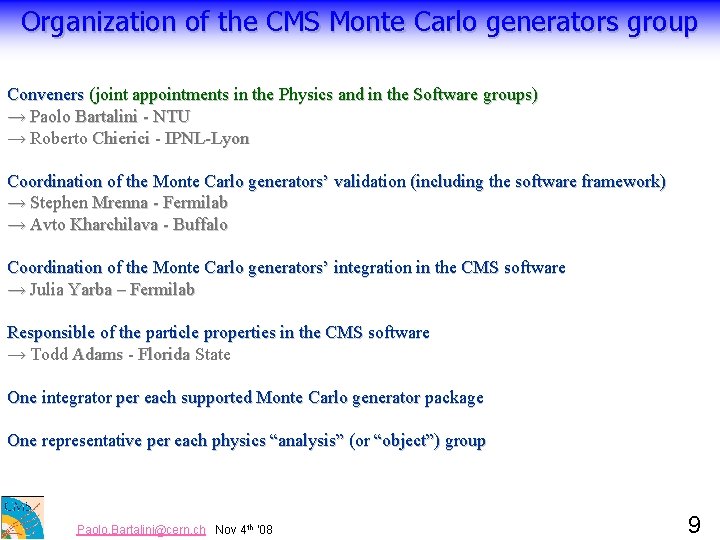
Organization of the CMS Monte Carlo generators group Conveners (joint appointments in the Physics and in the Software groups) → Paolo Bartalini - NTU → Roberto Chierici - IPNL-Lyon Coordination of the Monte Carlo generators’ validation (including the software framework) → Stephen Mrenna - Fermilab → Avto Kharchilava - Buffalo Coordination of the Monte Carlo generators’ integration in the CMS software → Julia Yarba – Fermilab Responsible of the particle properties in the CMS software → Todd Adams - Florida State One integrator per each supported Monte Carlo generator package One representative per each physics “analysis” (or “object”) group Paolo. Bartalini@cern. ch Nov 4 th ‘ 08 9
Monte Carlo Generators in CMS Tuning & physics validation (few use cases) • Multiple Parton Interactions and Underlying Event tunes • Double Parton Scattering as a benchmark for Pythia 8/Herwig++ validation • Matrix Element-Parton Shower vs Next to Leading Order in the top sector Paolo. Bartalini@cern. ch Nov 4 th ‘ 08 10
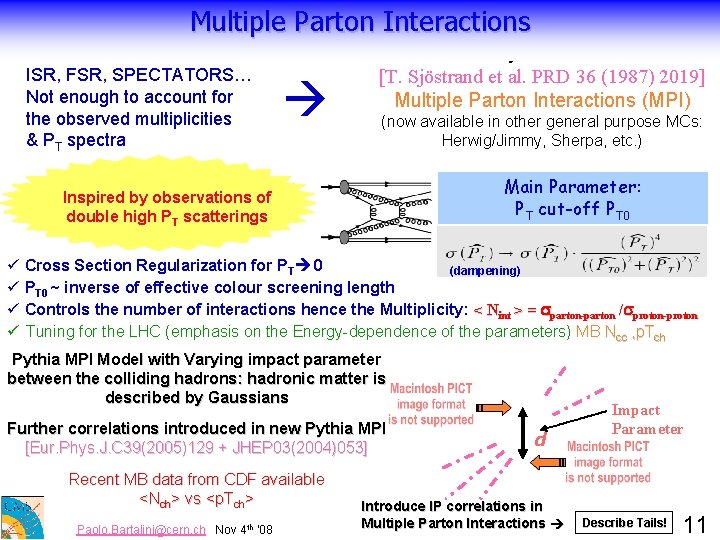
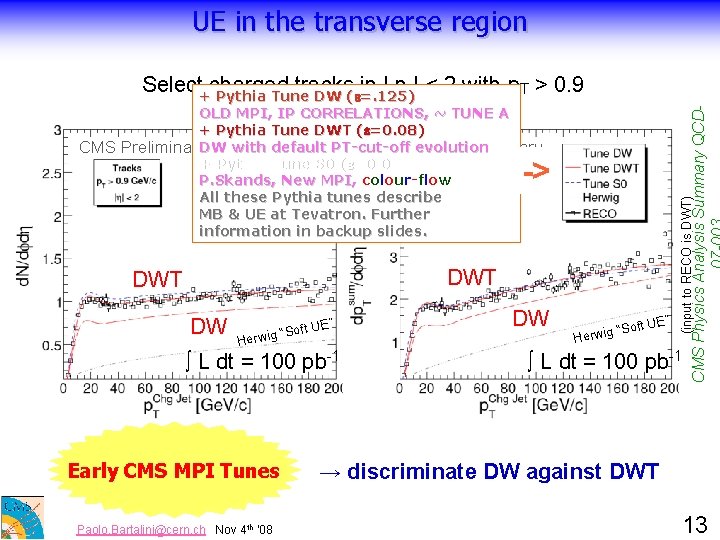
Parton Interactions p. QCDMultiple Models ISR, FSR, SPECTATORS… Not enough to account for the observed multiplicities & PT spectra The Pythia solution: [T. Sjöstrand et al. PRD 36 (1987) 2019] Multiple Parton Interactions (MPI) (now available in other general purpose MCs: Herwig/Jimmy, Sherpa, etc. ) Main Parameter: PT cut-off PT 0 Inspired by observations of double high PT scatterings Cross Section Regularization for PT 0 (dampening) PT 0 ~ inverse of effective colour screening length Controls the number of interactions hence the Multiplicity: < Nint > = sparton-parton /sproton-proton Tuning for the LHC (emphasis on the Energy-dependence of the parameters) MB Ncc , p. Tch Pythia MPI Model with Varying impact parameter between the colliding hadrons: hadronic matter is described by Gaussians Further correlations introduced in new Pythia MPI [Eur. Phys. J. C 39(2005)129 + JHEP 03(2004)053] Recent MB data from CDF available <Nch> vs <p. Tch> Paolo. Bartalini@cern. ch Nov 4 th ‘ 08 d Introduce IP correlations in Multiple Parton Interactions Impact Parameter Describe Tails! 11
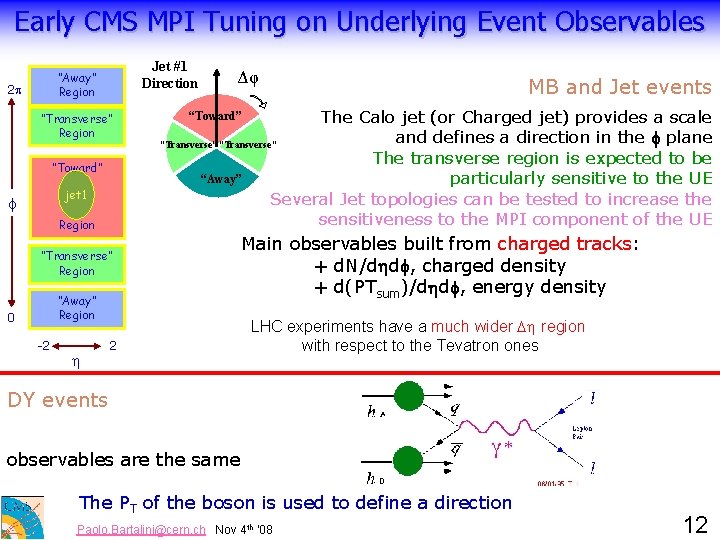
Early CMS MPI Tuning on Underlying Event Observables Jet #1 Direction “Away” Region 2 “Transverse” Region “Toward” jet 1 Region Δφ The Calo jet (or Charged jet) provides a scale and defines a direction in the f plane “Transverse” The transverse region is expected to be “Away” particularly sensitive to the UE Several Jet topologies can be tested to increase the sensitiveness to the MPI component of the UE “Toward” “Transverse” Region “Away” Region 0 -2 MB and Jet events 2 Main observables built from charged tracks: + d. N/dhdf, charged density + d(PTsum)/dhdf, energy density LHC experiments have a much wider region with respect to the Tevatron ones DY events observables are the same The PT of the boson is used to define a direction Paolo. Bartalini@cern. ch Nov 4 th ‘ 08 12
Select+charged tracks in | η | < 2 with p. T > 0. 9 Pythia Tune DW ( =. 125) OLD MPI, IP CORRELATIONS, ~ TUNE A Ge. V/c -> DWT DW t UE” “Sof Herwig ∫ L dt = 100 pb-1 Early CMS MPI Tunes Paolo. Bartalini@cern. ch Nov 4 th ‘ 08 DW ” oft UE “S Herwig (input to RECO is DWT) CMS + Pythia Tune DWT ( =0. 08) evolution Preliminary. DW with default PT-cut-off CMS Preliminary + Pythia Tune S 0 ( =0. 08) P. Skands, New MPI, colour-flow All these Pythia tunes describe MB & UE at Tevatron. Further information in backup slides. CMS Physics Analysis Summary QCD- UE in the transverse region ∫ L dt = 100 pb-1 → discriminate DW against DWT 13
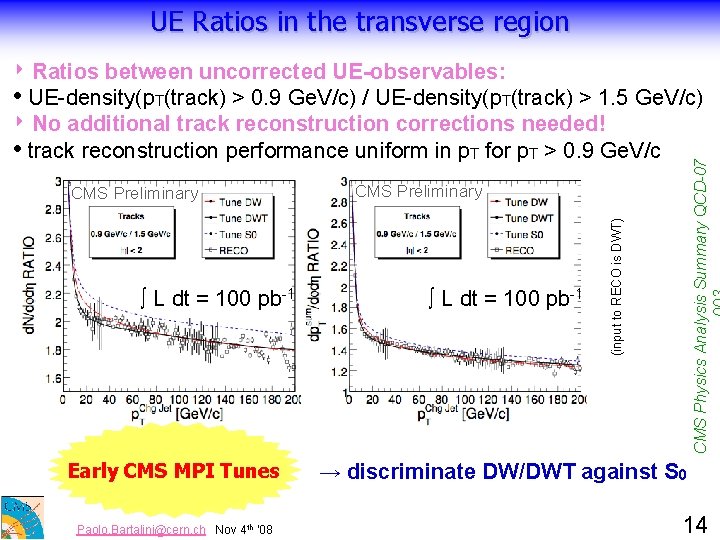
UE Ratios in the transverse region ∫ L dt = 100 pb-1 Early CMS MPI Tunes Paolo. Bartalini@cern. ch Nov 4 th ‘ 08 CMS Preliminary ∫ L dt = 100 pb-1 (input to RECO is DWT) CMS Preliminary CMS Physics Analysis Summary QCD-07 ‣ Ratios between uncorrected UE-observables: • UE-density(p. T(track) > 0. 9 Ge. V/c) / UE-density(p. T(track) > 1. 5 Ge. V/c) ‣ No additional track reconstruction corrections needed! • track reconstruction performance uniform in p. T for p. T > 0. 9 Ge. V/c → discriminate DW/DWT against S 0 14
Double Parton Scattering and PYTHIA 8/Herwig++ validation DP Component [F. Bechtel] Currently extending these DP studies to double boson, multi-HF, etc. Paolo. Bartalini@cern. ch Nov 4 th ‘ 08 15
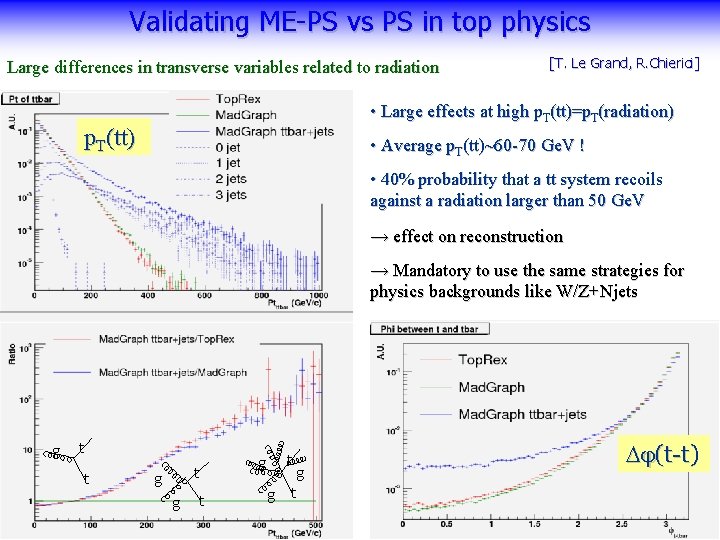
Validating ME-PS vs PS in top physics Large differences in transverse variables related to radiation [T. Le Grand, R. Chierici] • Large effects at high p. T(tt)=p. T(radiation) p. T(tt) • Average p. T(tt)~60 -70 Ge. V ! • 40% probability that a tt system recoils against a radiation larger than 50 Ge. V → effect on reconstruction → Mandatory to use the same strategies for physics backgrounds like W/Z+Njets g t t t g g t Paolo. Bartalini@cern. ch Nov 4 th ‘ 08 (t-t) 16
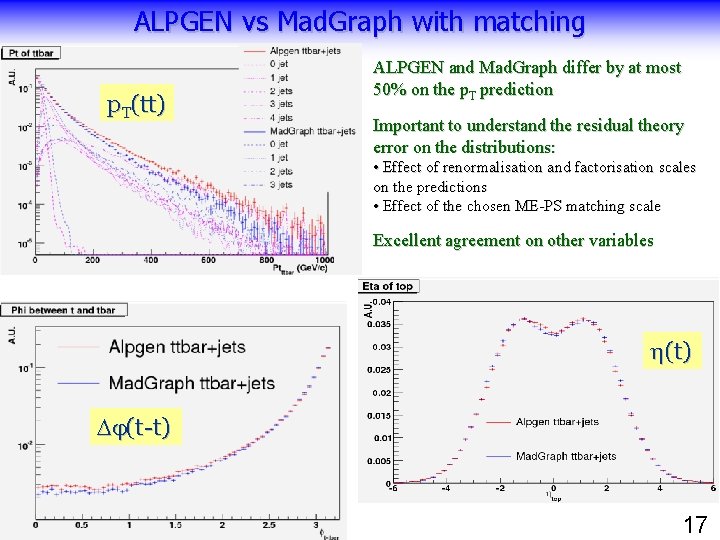
ALPGEN vs Mad. Graph with matching p. T(tt) ALPGEN and Mad. Graph differ by at most 50% on the p. T prediction Important to understand the residual theory error on the distributions: • Effect of renormalisation and factorisation scales on the predictions • Effect of the chosen ME-PS matching scale Excellent agreement on other variables (t) (t-t) Paolo. Bartalini@cern. ch Nov 4 th ‘ 08 17
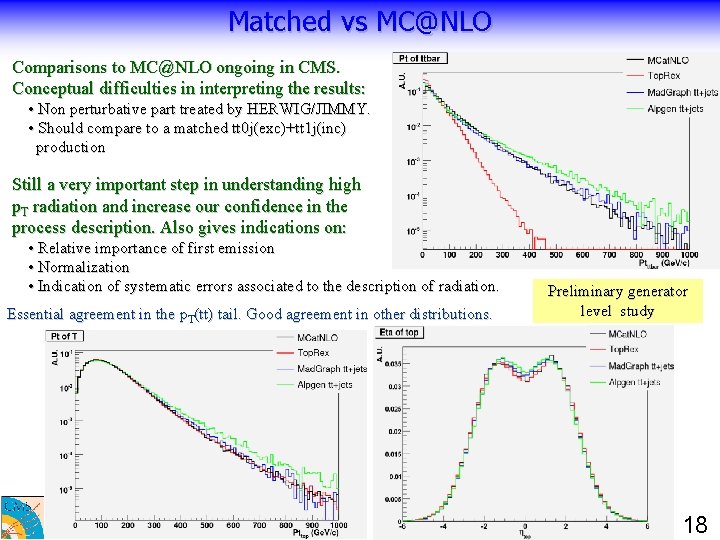
Matched vs MC@NLO Comparisons to MC@NLO ongoing in CMS. Conceptual difficulties in interpreting the results: • Non perturbative part treated by HERWIG/JIMMY. • Should compare to a matched tt 0 j(exc)+tt 1 j(inc) production Still a very important step in understanding high p. T radiation and increase our confidence in the process description. Also gives indications on: • Relative importance of first emission • Normalization • Indication of systematic errors associated to the description of radiation. Essential agreement in the p. T(tt) tail. Good agreement in other distributions. Paolo. Bartalini@cern. ch Nov 4 th ‘ 08 Preliminary generator level study 18
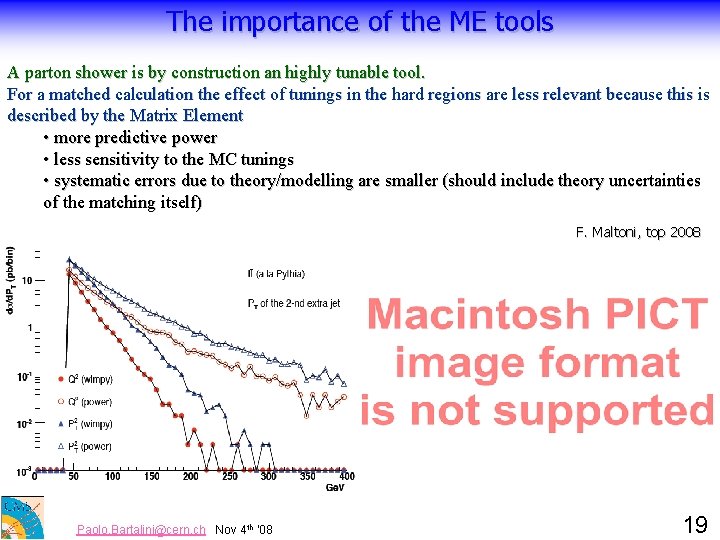
The importance of the ME tools A parton shower is by construction an highly tunable tool. For a matched calculation the effect of tunings in the hard regions are less relevant because this is described by the Matrix Element • more predictive power • less sensitivity to the MC tunings • systematic errors due to theory/modelling are smaller (should include theory uncertainties of the matching itself) F. Maltoni, top 2008 Paolo. Bartalini@cern. ch Nov 4 th ‘ 08 19
Monte Carlo Generators in CMS Strategies in production • Choice of the reference generators • Current and future massive productions • Conclusions Paolo. Bartalini@cern. ch Nov 4 th ‘ 08 20
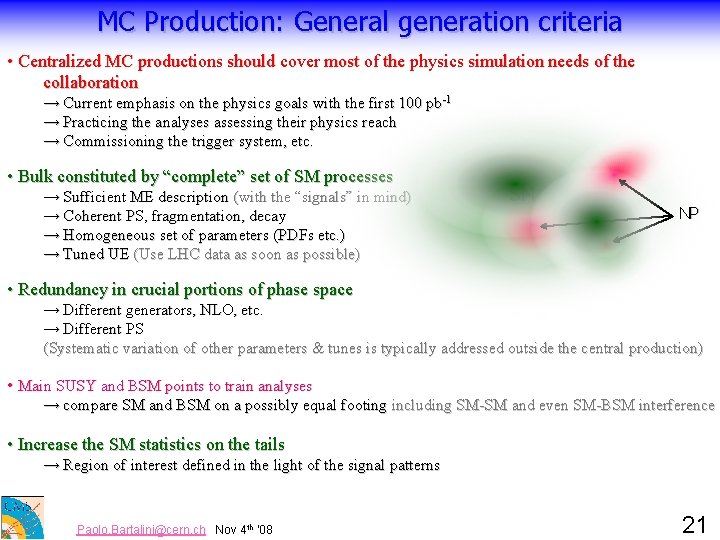
MC Production: General generation criteria • Centralized MC productions should cover most of the physics simulation needs of the collaboration → Current emphasis on the physics goals with the first 100 pb-1 → Practicing the analyses assessing their physics reach → Commissioning the trigger system, etc. • Bulk constituted by “complete” set of SM processes → Sufficient ME description (with the “signals” in mind) → Coherent PS, fragmentation, decay → Homogeneous set of parameters (PDFs etc. ) → Tuned UE (Use LHC data as soon as possible) SM NP • Redundancy in crucial portions of phase space → Different generators, NLO, etc. → Different PS (Systematic variation of other parameters & tunes is typically addressed outside the central production) • Main SUSY and BSM points to train analyses → compare SM and BSM on a possibly equal footing including SM-SM and even SM-BSM interference • Increase the SM statistics on the tails → Region of interest defined in the light of the signal patterns Paolo. Bartalini@cern. ch Nov 4 th ‘ 08 21
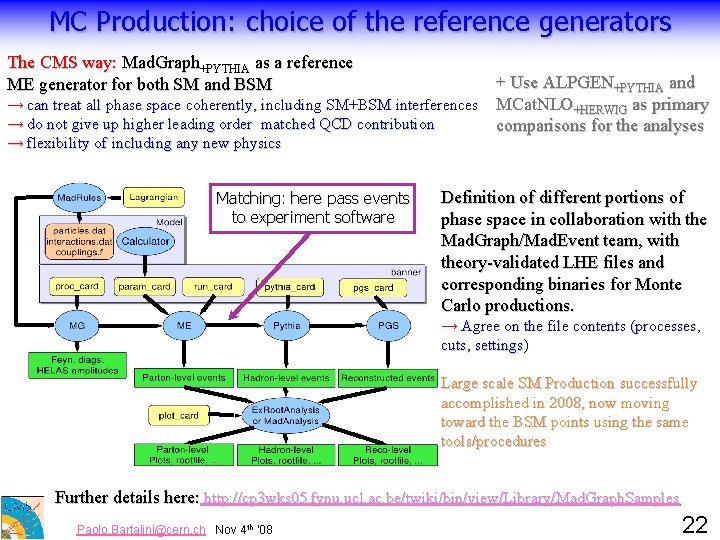
MC Production: choice of the reference generators The CMS way: Mad. Graph+PYTHIA as a reference ME generator for both SM and BSM + Use ALPGEN+PYTHIA and → can treat all phase space coherently, including SM+BSM interferences MCat. NLO+HERWIG as primary → do not give up higher leading order matched QCD contribution comparisons for the analyses → flexibility of including any new physics Matching: here pass events to experiment software Definition of different portions of phase space in collaboration with the Mad. Graph/Mad. Event team, with theory-validated LHE files and corresponding binaries for Monte Carlo productions. → Agree on the file contents (processes, cuts, settings) Large scale SM Production successfully accomplished in 2008, now moving toward the BSM points using the same tools/procedures Further details here: http: //cp 3 wks 05. fynu. ucl. ac. be/twiki/bin/view/Library/Mad. Graph. Samples Paolo. Bartalini@cern. ch Nov 4 th ‘ 08 22
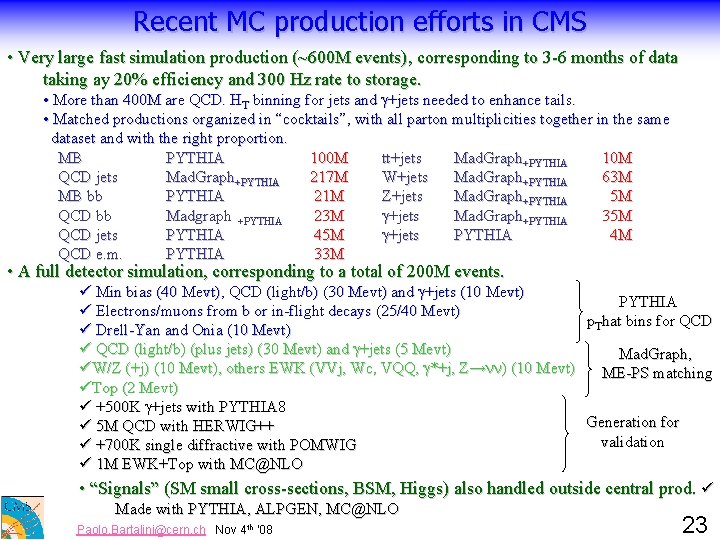
Recent MC production efforts in CMS • Very large fast simulation production (~600 M events), corresponding to 3 -6 months of data taking ay 20% efficiency and 300 Hz rate to storage. • More than 400 M are QCD. HT binning for jets and +jets needed to enhance tails. • Matched productions organized in “cocktails”, with all parton multiplicities together in the same dataset and with the right proportion. MB PYTHIA 100 M tt+jets Mad. Graph+PYTHIA 10 M QCD jets Mad. Graph+PYTHIA 217 M W+jets Mad. Graph+PYTHIA 63 M MB bb PYTHIA 21 M Z+jets Mad. Graph+PYTHIA 5 M QCD bb Madgraph +PYTHIA 23 M +jets Mad. Graph+PYTHIA 35 M QCD jets PYTHIA 45 M +jets PYTHIA 4 M QCD e. m. PYTHIA 33 M • A full detector simulation, corresponding to a total of 200 M events. Min bias (40 Mevt), QCD (light/b) (30 Mevt) and +jets (10 Mevt) PYTHIA Electrons/muons from b or in-flight decays (25/40 Mevt) p. That bins for QCD Drell-Yan and Onia (10 Mevt) QCD (light/b) (plus jets) (30 Mevt) and +jets (5 Mevt) Mad. Graph, W/Z (+j) (10 Mevt), others EWK (VVj, Wc, VQQ, *+j, Z→ ) (10 Mevt) ME-PS matching Top (2 Mevt) +500 K +jets with PYTHIA 8 Generation for 5 M QCD with HERWIG++ validation +700 K single diffractive with POMWIG 1 M EWK+Top with MC@NLO • “Signals” (SM small cross-sections, BSM, Higgs) also handled outside central prod. Made with PYTHIA, ALPGEN, MC@NLO Paolo. Bartalini@cern. ch Nov 4 th ‘ 08 23
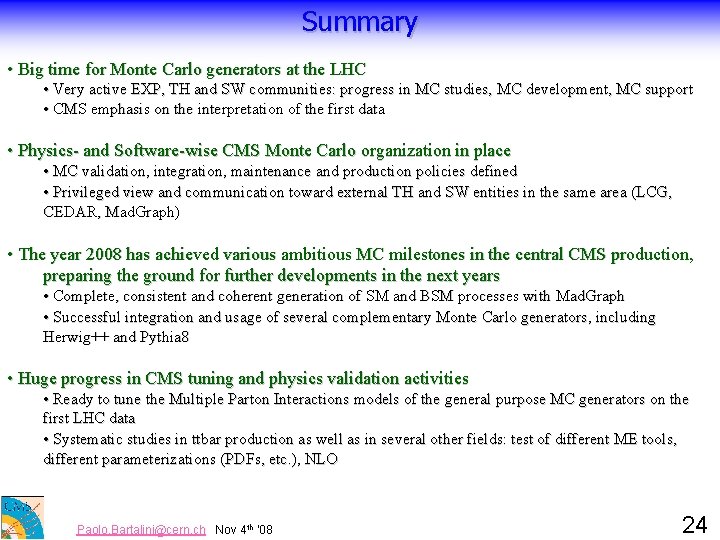
Summary • Big time for Monte Carlo generators at the LHC • Very active EXP, TH and SW communities: progress in MC studies, MC development, MC support • CMS emphasis on the interpretation of the first data • Physics- and Software-wise CMS Monte Carlo organization in place • MC validation, integration, maintenance and production policies defined • Privileged view and communication toward external TH and SW entities in the same area (LCG, CEDAR, Mad. Graph) • The year 2008 has achieved various ambitious MC milestones in the central CMS production, preparing the ground for further developments in the next years • Complete, consistent and coherent generation of SM and BSM processes with Mad. Graph • Successful integration and usage of several complementary Monte Carlo generators, including Herwig++ and Pythia 8 • Huge progress in CMS tuning and physics validation activities • Ready to tune the Multiple Parton Interactions models of the general purpose MC generators on the first LHC data • Systematic studies in ttbar production as well as in several other fields: test of different ME tools, different parameterizations (PDFs, etc. ), NLO Paolo. Bartalini@cern. ch Nov 4 th ‘ 08 24
Credits R. Chierici, F. Ambroglini, F. Bechtel, L. Fanò, R. Field, T. Le Grand, F. Maltoni S. Mrenna, C. Saout, J. Yarba, CMS generator contacts in the analysis groups, CMS generator integrators, CMS data operations group LCG generator group, etc… Paolo. Bartalini@cern. ch Nov 4 th ‘ 08 25
Backup Paolo. Bartalini@cern. ch Nov 4 th ‘ 08 26
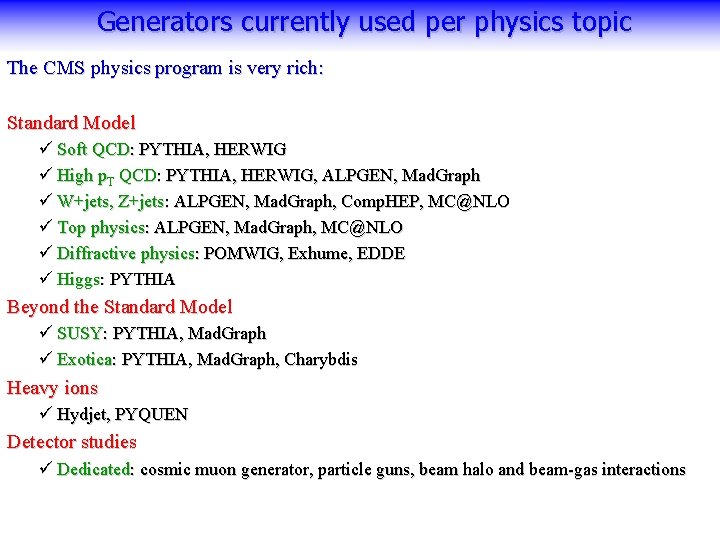
Generators currently used per physics topic The CMS physics program is very rich: Standard Model Soft QCD: PYTHIA, HERWIG High p. T QCD: PYTHIA, HERWIG, ALPGEN, Mad. Graph W+jets, Z+jets: ALPGEN, Mad. Graph, Comp. HEP, MC@NLO Top physics: ALPGEN, Mad. Graph, MC@NLO Diffractive physics: POMWIG, Exhume, EDDE Higgs: PYTHIA Beyond the Standard Model SUSY: PYTHIA, Mad. Graph Exotica: PYTHIA, Mad. Graph, Charybdis Heavy ions Hydjet, PYQUEN Detector studies Dedicated: cosmic muon generator, particle guns, beam halo and beam-gas interactions Paolo. Bartalini@cern. ch Nov 4 th ‘ 08 27
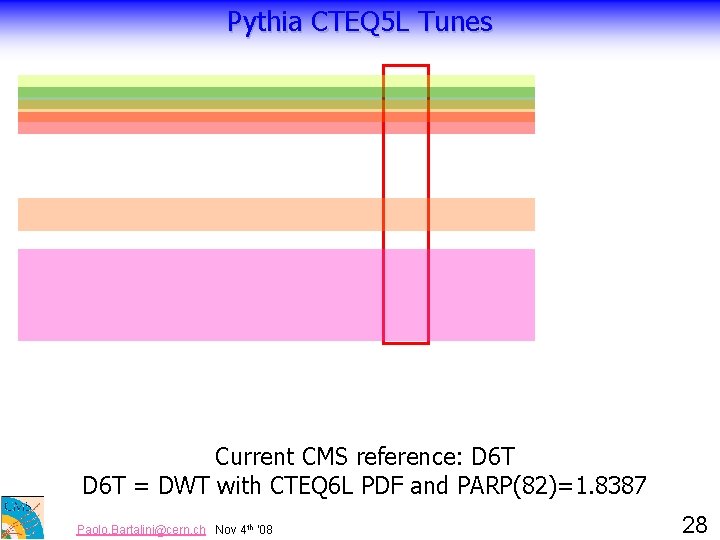
Pythia CTEQ 5 L Tunes PT 0= PT 0(Ecm/E 0)PARP(90) Current CMS reference: D 6 T = DWT with CTEQ 6 L PDF and PARP(82)=1. 8387 Paolo. Bartalini@cern. ch Nov 4 th ‘ 08 28
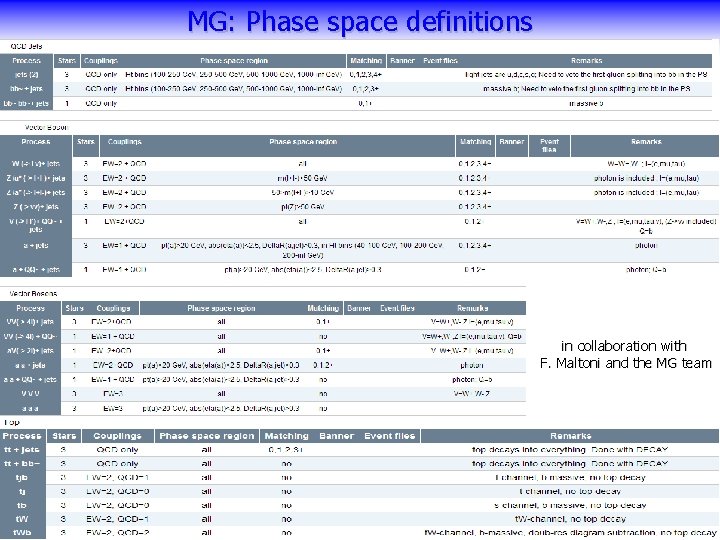
MG: Phase space definitions in collaboration with F. Maltoni and the MG team Paolo. Bartalini@cern. ch Nov 4 th ‘ 08 29
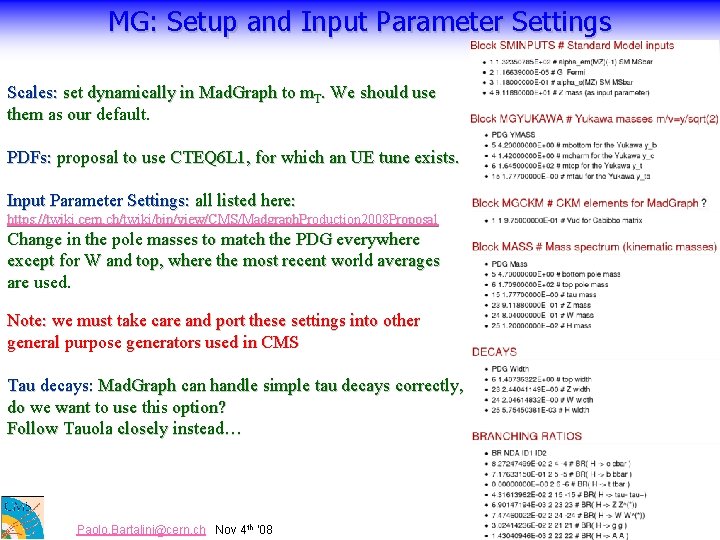
MG: Setup and Input Parameter Settings Scales: set dynamically in Mad. Graph to m. T. We should use them as our default. PDFs: proposal to use CTEQ 6 L 1, for which an UE tune exists. Input Parameter Settings: all listed here: https: //twiki. cern. ch/twiki/bin/view/CMS/Madgraph. Production 2008 Proposal Change in the pole masses to match the PDG everywhere except for W and top, where the most recent world averages are used. Note: we must take care and port these settings into other general purpose generators used in CMS Tau decays: Mad. Graph can handle simple tau decays correctly, do we want to use this option? Follow Tauola closely instead… Paolo. Bartalini@cern. ch Nov 4 th ‘ 08 30
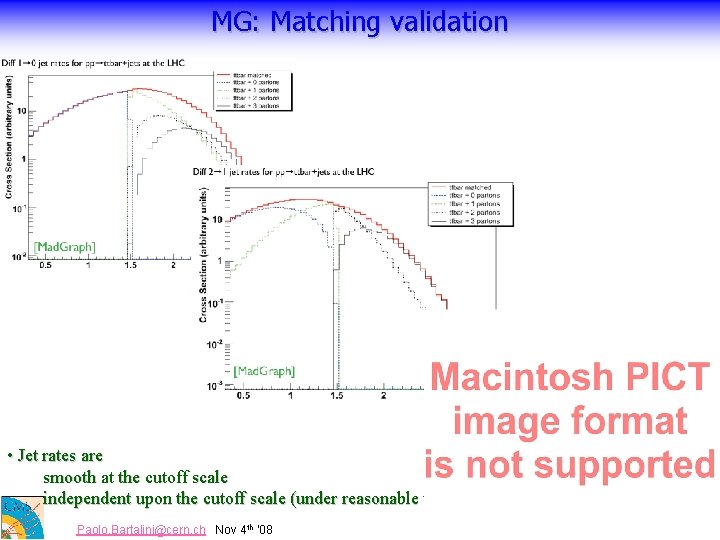
MG: Matching validation • Jet rates are smooth at the cutoff scale independent upon the cutoff scale (under reasonable variations) Paolo. Bartalini@cern. ch Nov 4 th ‘ 08 31