
MONTAGE OF AUSTRALIAN GEOSPATIAL ACTIVITIES Chris Body Nottingham
MONTAGE OF AUSTRALIAN GEOSPATIAL ACTIVITIES Chris Body Nottingham University, 11 June 08
• • • Background Geoscience Australia (GA) Office of Spatial Data Management (OSDM) Australian Spatial Councils Cooperative Research Centre – Spatial Information (CRC-SI) • National Initiatives Nottingham University, 11 June 08
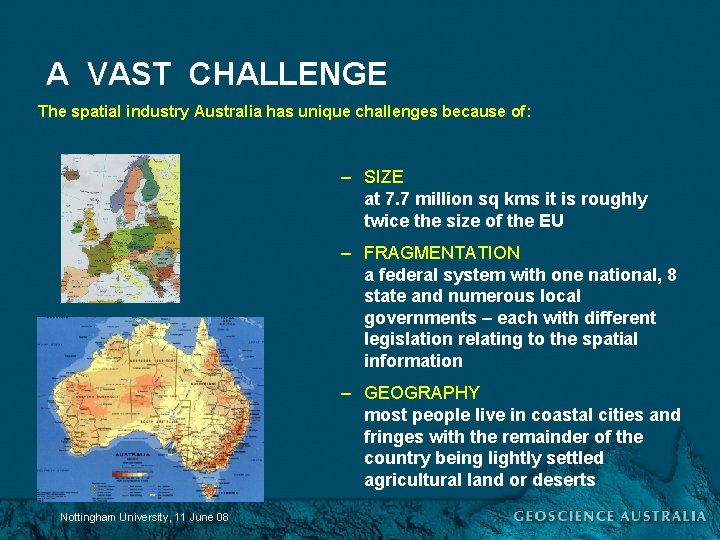
A VAST CHALLENGE The spatial industry Australia has unique challenges because of: – SIZE at 7. 7 million sq kms it is roughly twice the size of the EU – FRAGMENTATION a federal system with one national, 8 state and numerous local governments – each with different legislation relating to the spatial information – GEOGRAPHY most people live in coastal cities and fringes with the remainder of the country being lightly settled agricultural land or deserts Nottingham University, 11 June 08
TA 1100 -60 A_16 x 9. wmv Nottingham University, 11 June 08
GEOSCIENCE AUSTRALIA • Australia’s National Geoscience Research and Geospatial Information Agency (Resources, Energy and Tourism portfolio) • Undertakes geoscientific research and maintains, develops and encourages access to geoscientific and geospatial data • GA cover three broad areas: – Onshore – enhancing mineral exploration and environmental land-use planning – Offshore – providing pre-competitive data and information to assist in identifying new prospective basins for petroleum exploration and the geological storage of carbon dioxide, in Australia’s offshore jurisdiction – Spatial Information – spatial data of Australia from national mapping, remote sensing and geodesy Nottingham University, 11 June 08

GEOSCIENCE AUSTRALIA – PRIORITIES 2008 -09 • Deliver Geoscience component of the Australian Tsunami Warning System • Provide scientific and technical support for the 2009 offshore Petroleum acreage release • Provide Marine and Coastal Geoscience for the development of regional marine plans • Deliver Natural Risk Assessment methods and databases in support of the Disaster Mitigation Australia Package • Develop and promote a Carbon Dioxide capture and geological storage (CCS) Program Nottingham University, 11 June 08
GEOSCIENCE AUSTRALIA – PRIORITIES 2008 -09 • New 4 year Critical Infrastructure Modelling & Analysis Program • Complete large-scale topographic mapping to support Emergency Management mitigation with State Emergency Services, Land Information Agencies, Local Government & Australian Government Agencies • Deploy the Geoscience Australia component and coordinate the deployment of State & Territory components of the Global Navigation Satellite System – part of the Au. Scope National Collaborative Research Infrastructure Strategy Program • Provide data from the IRS-P 6 to Australian Government Agencies Nottingham University, 11 June 08
OFFICE OF SPATIAL DATA MANAGEMENT (OSDM) • History – Interdepartmental Committee (IDC) on Spatial Data Access (2000) – Commonwealth Policy on Spatial Data Access and Pricing (2001) • Provide fundamental spatial data free of change over the Internet • Marginal cost of transfer for package products • Without any copyright licence restrictions Nottingham University, 11 June 08
OFFICE OF SPATIAL DATA MANAGEMENT (OSDM) • Manage whole-of-Commonwealth Spatial Data Infrastructure – Data transfer arrangements with States & Territories – Single point of contact within the Commonwealth for Spatial Information Industry – Manage the public access system within the framework of the Australian Spatial Data Infrastructure Nottingham University, 11 June 08
OFFICE OF SPATIAL DATA MANAGEMENT (OSDM) • Spatial Data Access and Pricing Policy – Revision – Had some weaknesses • Limited in scope and doesn’t cover spatial information • Voluntary – covering only some spatial data held by government • Does not provide an effective legal framework • Lack of consistency in applying data licensing • The policy has no power to enforce compliance by individual agencies Nottingham University, 11 June 08

OFFICE OF SPATIAL DATA MANAGEMENT (OSDM) • Spatial Data Access and Pricing Policy – Revision (Draft) – Establish a framework to access from and supply data to States and Territories, supporting the National Information Sharing Strategy – Establish authoritative data and spatially enabled business process sources and identify custodian agencies – Mandate access to (and sharing of) spatial data – make restrictions on access the exception, not the norm – Adherence to agreed spatial and interoperability standards – Creative Commons Licensing Nottingham University, 11 June 08
AUSTRALIAN SPATIAL COUNCILS • ANZLIC – The Spatial Information Council – Peak inter-government council for coordination of spatial information policy and strategic issues – Represents all Australian Governments at Commonwealth, State and Territory Levels and the New Zealand Government • Intergovernment Committee Surveying & Mapping (ICSM) – Technical committee Nottingham University, 11 June 08
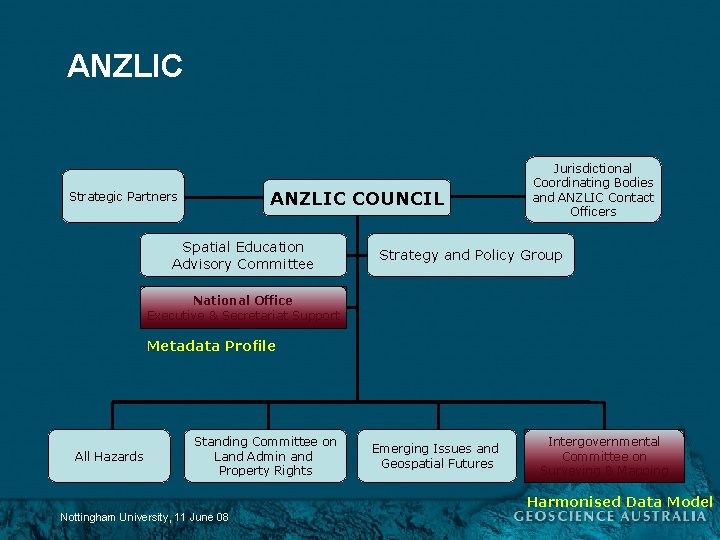
ANZLIC COUNCIL Strategic Partners Spatial Education Advisory Committee Jurisdictional Coordinating Bodies and ANZLIC Contact Officers Strategy and Policy Group National Office Executive & Secretariat Support Metadata Profile All Hazards Standing Committee on Land Admin and Property Rights Emerging Issues and Geospatial Futures Intergovernmental Committee on Surveying & Mapping Harmonised Data Model Nottingham University, 11 June 08
AUSTRALIAN SPATIAL COUNCILS • ICSM – 6 Permanent Working Groups • • • Cadastral Reform Geodesy Geographical Names in Australasia Tides and Mean Sea Level Topographic Information Data Framework – Harmonised Data Model (HDM) Nottingham University, 11 June 08

ANZLIC METADATA PROFILE • ANZLIC Metadata Profile Version 1. 1 – ISO 19115 & 19139 – Metadata Guidelines – Metadata Entry Tool (Geo. Network) Nottingham University, 11 June 08
HARMONISED DATA MODEL • • Initially developed in 2001 Reviewed in 2004 Implements ISO standards Core Elements – Topographic – Placenames – Cadastral – Street Address Nottingham University, 11 June 08
HARMONISED DATA MODEL • The HDM is accessed via ICSM website at https: //www. seegrid. csiro. au/subversion/xmml /ANZLIC_ICSM/Harmonised. Data. Model/trunk/ and https: //www. seegrid. csiro. au/subversion/xmml /ANZLIC_ICSM/Harmonised. Data. Model/trunk/ Documentation/index. htm Nottingham University, 11 June 08
COOPERATIVE RESEARCH CENTRE – SPATIAL INFORMATION • Part of the Australian Governments Cooperative Research Centre Program • Commenced in 2003 • 70 Participates – 8 Government Departments (Australian & State) – 6 Universities – 56 Companies Nottingham University, 11 June 08
COOPERATIVE RESEARCH CENTRE – SPATIAL INFORMATION • Major activities are: – Global Navigation Satellite Systems – Remote Sensing – Spatial Data Infrastructures – Visualisation Systems Nottingham University, 11 June 08
COOPERATIVE RESEARCH CENTRE – SPATIAL INFORMATION • Global Navigation Satellite System – Great reliance on these systems – Spending $700 M annually on GPS systems – Requires better coverage of ground positioning systems – To develop a single uniform positioning framework - deliver centimetre accuracy Nottingham University, 11 June 08
COOPERATIVE RESEARCH CENTRE – SPATIAL INFORMATION • Value of Spatial Information – (The impact of modern spatial information technologies on the Australian Economy - 2008) – ACIL Tasman – Prepared for CRCSI & ANZLIC • Terms of Reference – Quantify economic impact of spatial information to the Australian economy in 2006 -07 – Estimate the cost of inefficient access to data and identify the factors operating to create these inefficiencies – Consider future prospects for spatial data to contribute to Australia’s economic, social and environmental development Nottingham University, 11 June 08
COOPERATIVE RESEARCH CENTRE – SPATIAL INFORMATION • Outcomes – Industry revenue around $1. 37 billion annually – Industry gross value around $682 million – Constraints on access to data estimated to have reduced the direct productivity in certain sectors by 5%15% – Spatial information is likely to increase as it becomes a mainstream enterprise resource and consumer markets – Adoption and new applications in existing sectors could increase direct impacts in some sectors by up to 50% over the medium term. Larger impact is likely to be in new applications in a wider range of industries – http: //spatialinfocrc. org/pages/news. aspx Nottingham University, 11 June 08
GEOSCIENCE MARK-UP LANGUAGE (Geo. Sci. ML) • IUGS Commission for the Management and Application of Geoscience Information (CGI) established an initiative to develop a harmonised Geoscience data model and exchange format based on GML • Short term goal – representing geoscience information associated with geological maps and observations • Long term goal – extend to other geoscience data Nottingham University, 11 June 08
GEOSCIENCE MARK-UP LANGUAGE (Geo. Sci. ML) • Establishes a common suite of feature types based on geological criteria – Geological units – Geological structures – Fossils – Geological relationships – Earth materials – Geological fabrics Nottingham University, 11 June 08
GEOSCIENCE MARK-UP LANGUAGE (Geo. Sci. ML) • Specific objectives of the CGI working group is to: – Develop a conceptual model of geoscientific information drawing on existing data models – Implement an agreed subset of this model in an agreed schema language – Implement an XML/GML encoding of the model subset – Develop a testbed to illustrate the potential of the data model for interchange – Identify areas that require standardised classifications in order to enable interchange Nottingham University, 11 June 08
GEOSCIENCE MARK-UP LANGUAGE (Geo. Sci. ML) • Specific objectives of the CGI working group is to: – Develop a conceptual model of geoscientific information drawing on existing data models – Implement an agreed subset of this model in an agreed schema language – Implement an XML/GML encoding of the model subset – Develop a testbed to illustrate the potential of the data model for interchange – Identify areas that require standardised classifications in order to enable interchange Nottingham University, 11 June 08
GEOSCIENCE MARK-UP LANGUAGE (Geo. Sci. ML) • Four top level GML classes are used as starting points for the Geo. Sci. ML Model – Abstract Feature – Abstract Geometry – Metadata – Definition • Two additional classes specific to Geo. Sci. ML inherit directly from the top level Abstract. GML class – Geologic. Portrayal – Geologic. Object Nottingham University, 11 June 08
NATIONAL e. RESEARCHITECTURE TASKFORCE • Spatial Information Services Stack (SISS) – Develop some of the component services and functional capabilities needed to realise a spatial information data commons within Australia supporting linkages with academia, research, public and private sector data and service providers and users Nottingham University, 11 June 08
NATIONAL e. RESEARCHITECTURE TASKFORCE • Spatial Information Services Stack (SISS) – Leverage OGC and ISO standards that have been adopted by a number of National Collaborative Research Infrastructure Strategy (NCRIS) capability areas and institutions in Australia and worldwide for which various reference implementations already exist for information services and portal interfaces Nottingham University, 11 June 08
NATIONAL e. RESEARCHITECTURE TASKFORCE • Spatial Information Services Stack (SISS) – Combine and build on existing expertise in this foundation area in order to assist multiple NCRIS capability areas and institutions that have in geospatial web services middleware and clients – Establish capabilities to enable standards based networks by other communities (eg. Australian Bureau of Statistics National Data Network & CSIRO Water Resources Observation Network) Nottingham University, 11 June 08
THANK YOU Nottingham University, 11 June 08
- Slides: 31