
Monotube Damper www mandoparts com 0 Mono Tube
Monotube Damper (www. mandoparts. com) 0
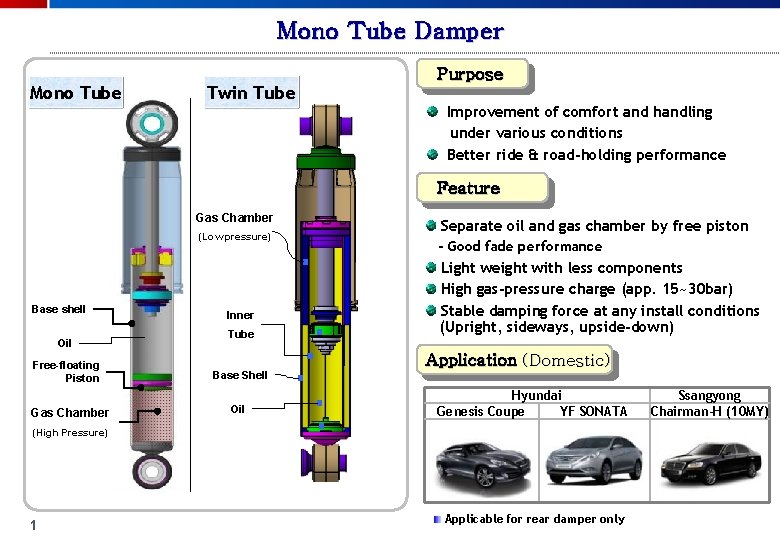
Mono Tube Damper Mono Tube Twin Tube Purpose Improvement of comfort and handling under various conditions Better ride & road-holding performance Feature Gas Chamber (Low pressure) Base shell Oil Free-floating Piston Gas Chamber Inner Tube Base Shell Oil Separate oil and gas chamber by free piston - Good fade performance Light weight with less components High gas-pressure charge (app. 15~30 bar) Stable damping force at any install conditions (Upright, sideways, upside-down) Application (Domestic) Hyundai Genesis Coupe YF SONATA (High Pressure) 1 Applicable for rear damper only Ssangyong Chairman-H (10 MY)
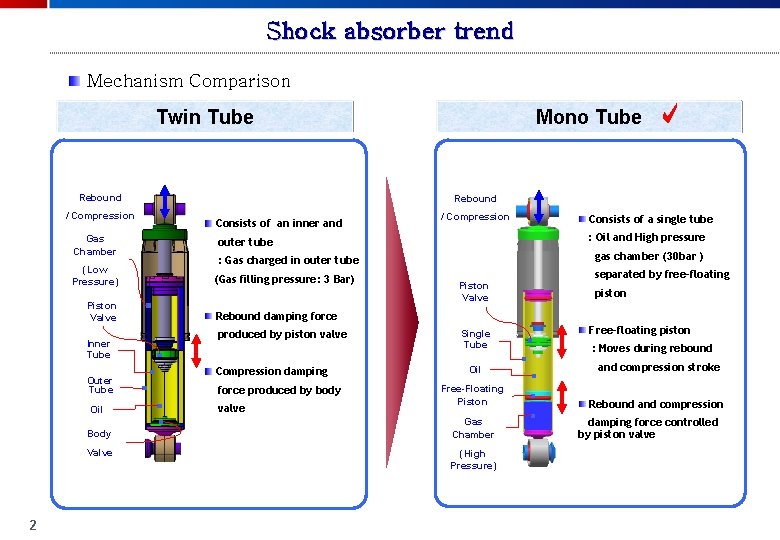
Shock absorber trend Mechanism Comparison Twin Tube Rebound / Compression Gas Chamber (Low Pressure) Piston Valve Inner Tube Outer Tube Oil Body Valve 2 Mono Tube Rebound Consists of an inner and / Compression : Oil and High pressure outer tube gas chamber (30 bar ) : Gas charged in outer tube (Gas filling pressure: 3 Bar) Consists of a single tube Piston Valve separated by free-floating piston Rebound damping force produced by piston valve Compression damping force produced by body valve Single Tube Free-floating piston : Moves during rebound Oil and compression stroke Free-Floating Piston Rebound and compression Gas Chamber (High Pressure) damping force controlled by piston valve
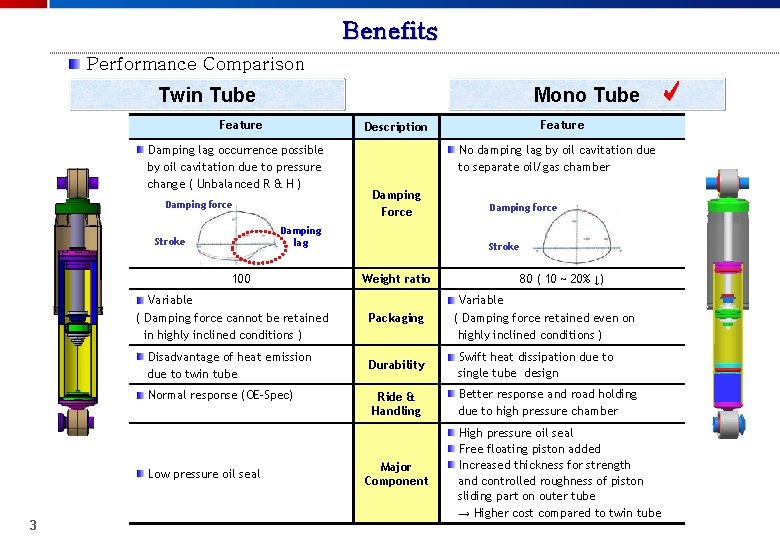
Benefits Performance Comparison Twin Tube Mono Tube Feature Damping lag occurrence possible by oil cavitation due to pressure change ( Unbalanced R & H ) Damping force 100 Damping Force Damping force Stroke Weight ratio 80 ( 10 ~ 20% ↓) Variable ( Damping force cannot be retained in highly inclined conditions ) Packaging Disadvantage of heat emission due to twin tube Durability Swift heat dissipation due to single tube design Ride & Handling Better response and road holding due to high pressure chamber Normal response (OE-Spec) Low pressure oil seal 3 No damping lag by oil cavitation due to separate oil/gas chamber Damping lag Stroke Feature Description Major Component Variable ( Damping force retained even on highly inclined conditions ) High pressure oil seal Free floating piston added Increased thickness for strength and controlled roughness of piston sliding part on outer tube → Higher cost compared to twin tube
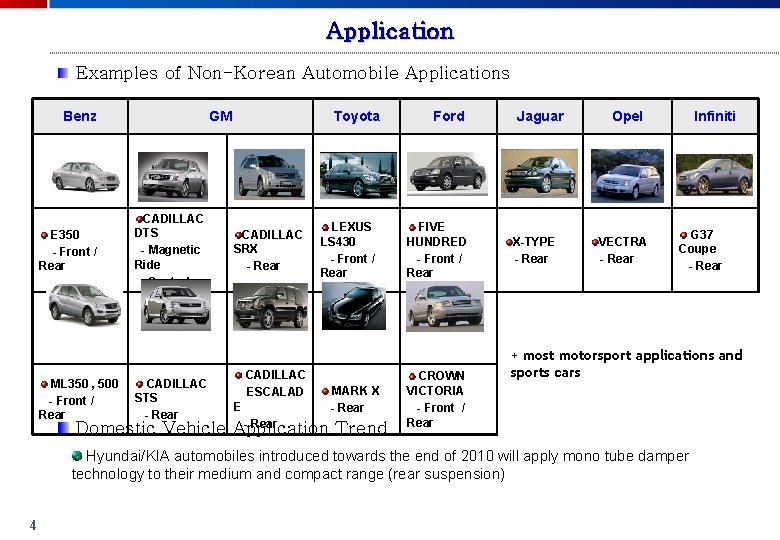
Application Examples of Non-Korean Automobile Applications Benz E 350 - Front / Rear ML 350 , 500 - Front / Rear GM CADILLAC DTS - Magnetic Ride Control CADILLAC STS - Rear Toyota CADILLAC SRX - Rear CADILLAC ESCALAD E LEXUS LS 430 - Front / Rear MARK X - Rear Domestic Vehicle Application Trend Ford FIVE HUNDRED - Front / Rear CROWN VICTORIA - Front / Rear Jaguar X-TYPE - Rear Opel VECTRA - Rear Infiniti G 37 Coupe - Rear + most motorsport applications and sports cars Hyundai/KIA automobiles introduced towards the end of 2010 will apply mono tube damper technology to their medium and compact range (rear suspension) 4
- Slides: 5