
MONOPOLY Unit 5 COMPARING CHARACTERISTICS Perfect Competition Monopoly
- Slides: 27
MONOPOLY Unit 5
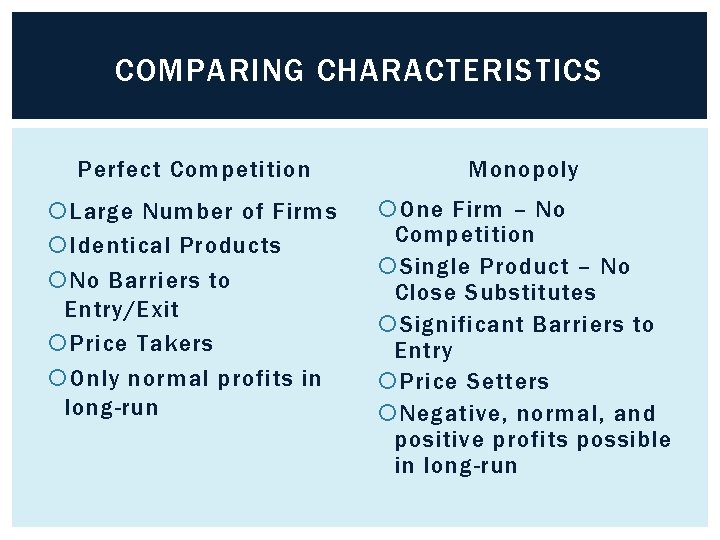
COMPARING CHARACTERISTICS Perfect Competition Monopoly Large Number of Firms Identical Products No Barriers to Entry/Exit Price Takers Only normal profits in long-run One Firm – No Competition Single Product – No Close Substitutes Significant Barriers to Entry Price Setters Negative, normal, and positive profits possible in long-run
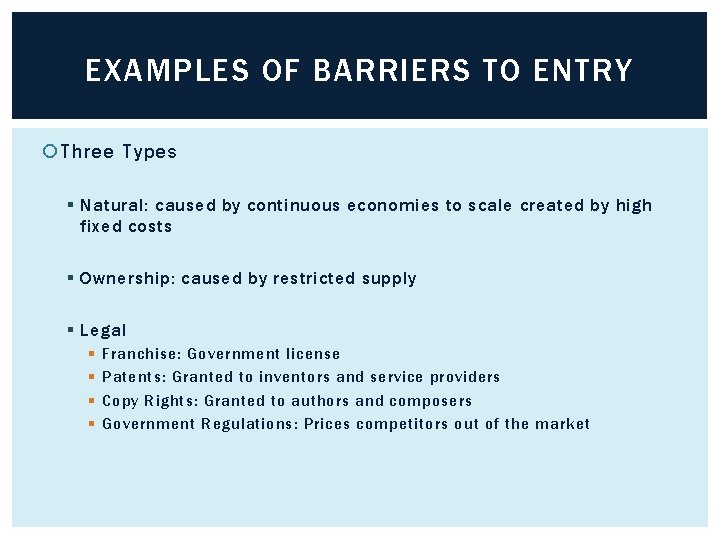
EXAMPLES OF BARRIERS TO ENTRY Three Types § Natural: caused by continuous economies to scale created by high fixed costs § Ownership: caused by restricted supply § Legal § § Franchise: Government license Patents: Granted to inventors and service providers Copy Rights: Granted to authors and composers Government Regulations: Prices competitors out of the market
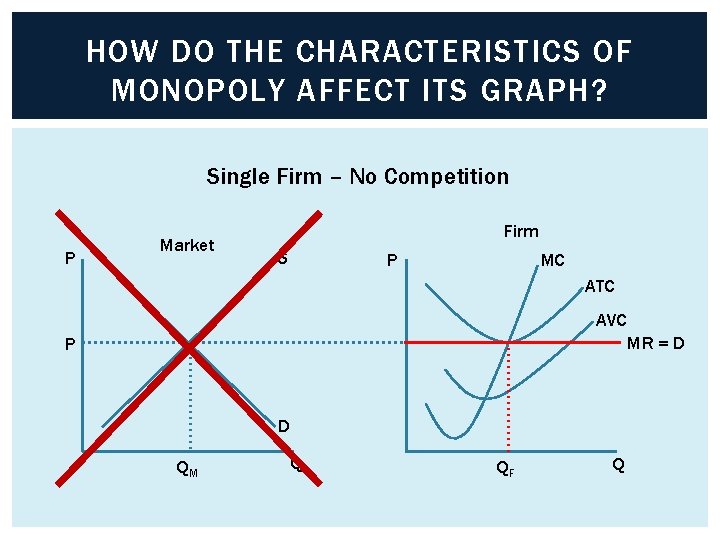
HOW DO THE CHARACTERISTICS OF MONOPOLY AFFECT ITS GRAPH? Single Firm – No Competition P Market Firm S P MC ATC AVC MR = D P D QM Q QF Q
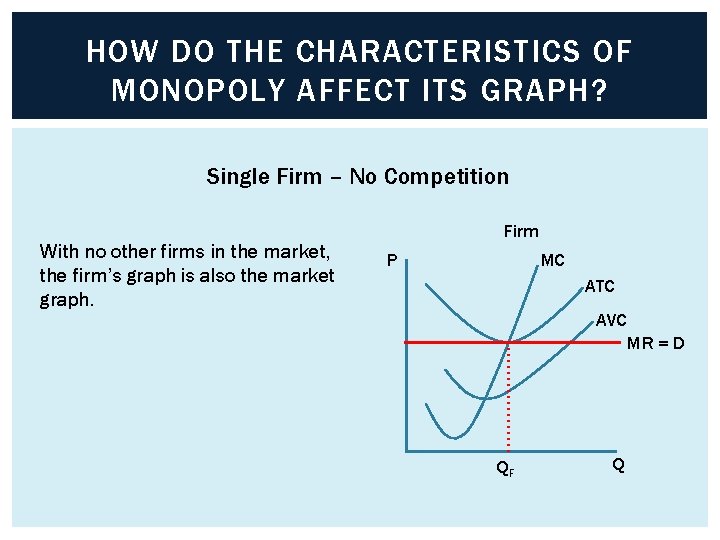
HOW DO THE CHARACTERISTICS OF MONOPOLY AFFECT ITS GRAPH? Single Firm – No Competition With no other firms in the market, the firm’s graph is also the market graph. Firm P MC ATC AVC MR = D QF Q
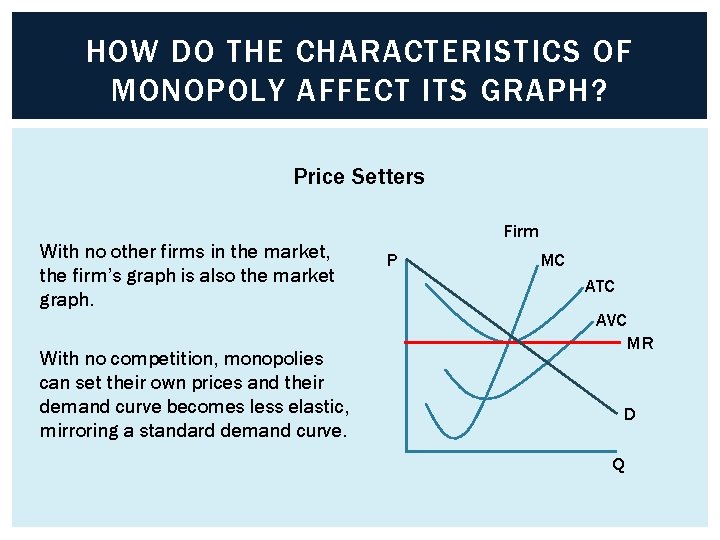
HOW DO THE CHARACTERISTICS OF MONOPOLY AFFECT ITS GRAPH? Price Setters With no other firms in the market, the firm’s graph is also the market graph. With no competition, monopolies can set their own prices and their demand curve becomes less elastic, mirroring a standard demand curve. Firm P MC ATC AVC MR D Q
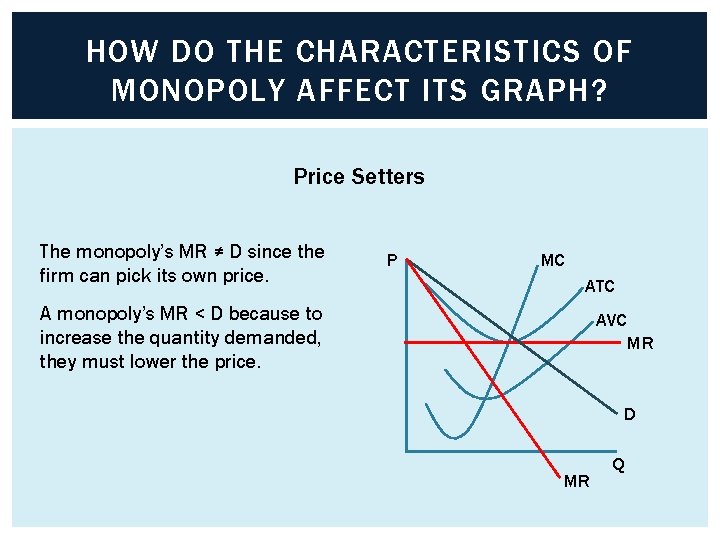
HOW DO THE CHARACTERISTICS OF MONOPOLY AFFECT ITS GRAPH? Price Setters The monopoly’s MR ≠ D since the firm can pick its own price. P MC ATC A monopoly’s MR < D because to increase the quantity demanded, they must lower the price. AVC MR D MR Q
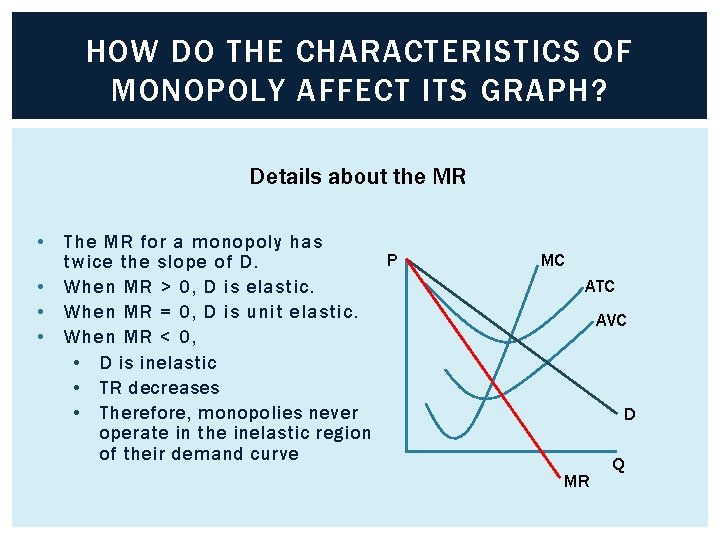
HOW DO THE CHARACTERISTICS OF MONOPOLY AFFECT ITS GRAPH? Details about the MR • • The MR for a monopoly has P twice the slope of D. When MR > 0, D is elastic. When MR = 0, D is unit elastic. When MR < 0, • D is inelastic • TR decreases • Therefore, monopolies never operate in the inelastic region of their demand curve MC ATC AVC D MR Q
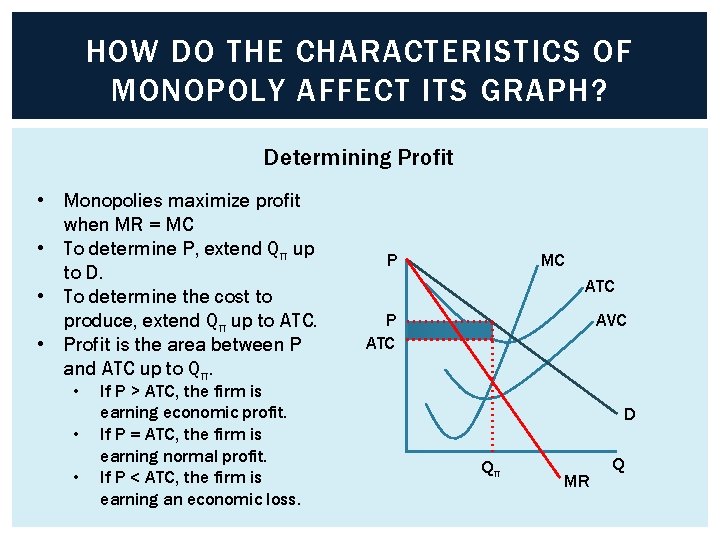
HOW DO THE CHARACTERISTICS OF MONOPOLY AFFECT ITS GRAPH? Determining Profit • Monopolies maximize profit when MR = MC • To determine P, extend Qπ up to D. • To determine the cost to produce, extend Qπ up to ATC. • Profit is the area between P and ATC up to Qπ. • • • If P > ATC, the firm is earning economic profit. If P = ATC, the firm is earning normal profit. If P < ATC, the firm is earning an economic loss. P MC ATC AVC P ATC D Qπ MR Q
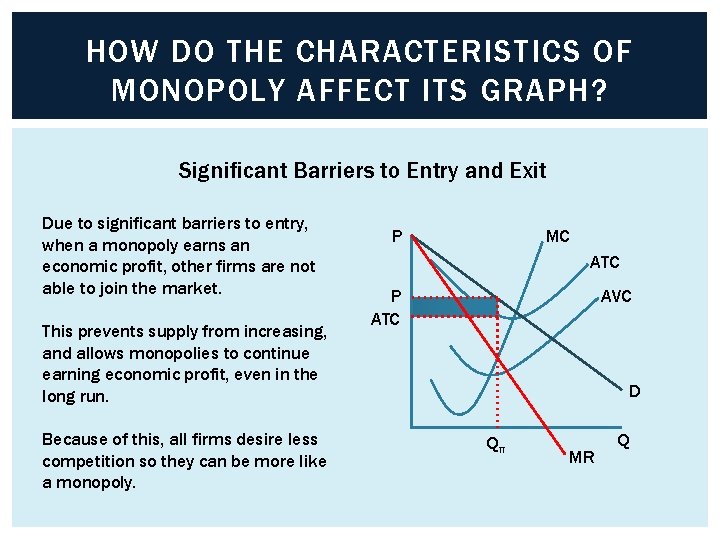
HOW DO THE CHARACTERISTICS OF MONOPOLY AFFECT ITS GRAPH? Significant Barriers to Entry and Exit Due to significant barriers to entry, when a monopoly earns an economic profit, other firms are not able to join the market. This prevents supply from increasing, and allows monopolies to continue earning economic profit, even in the long run. Because of this, all firms desire less competition so they can be more like a monopoly. P MC ATC AVC P ATC D Qπ MR Q
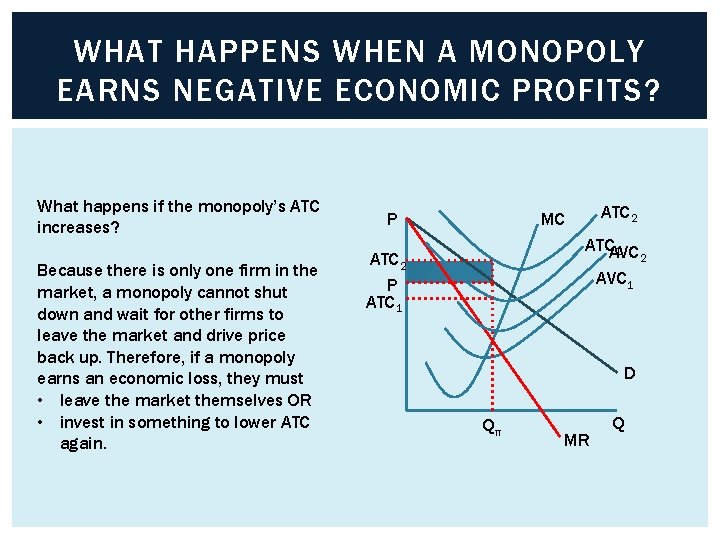
WHAT HAPPENS WHEN A MONOPOLY EARNS NEGATIVE ECONOMIC PROFITS? What happens if the monopoly’s ATC increases? Because there is only one firm in the market, a monopoly cannot shut down and wait for other firms to leave the market and drive price back up. Therefore, if a monopoly earns an economic loss, they must • leave the market themselves OR • invest in something to lower ATC again. P ATC 2 MC ATCAVC 1 2 AVC 1 ATC 2 P ATC 1 D Qπ MR Q
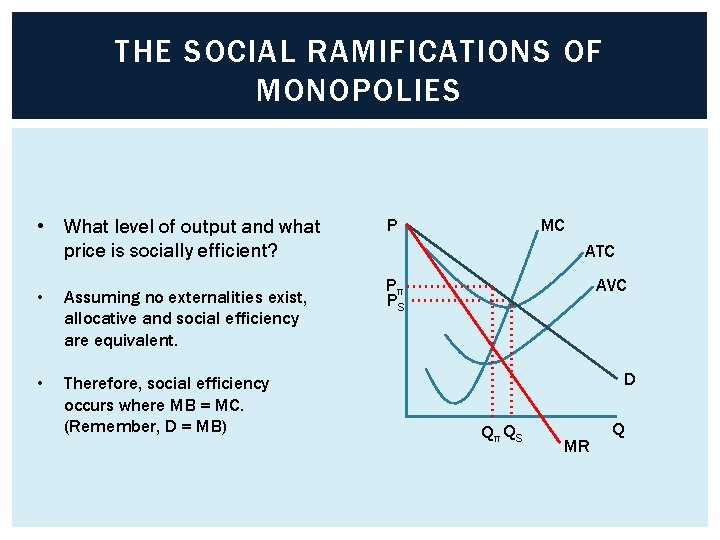
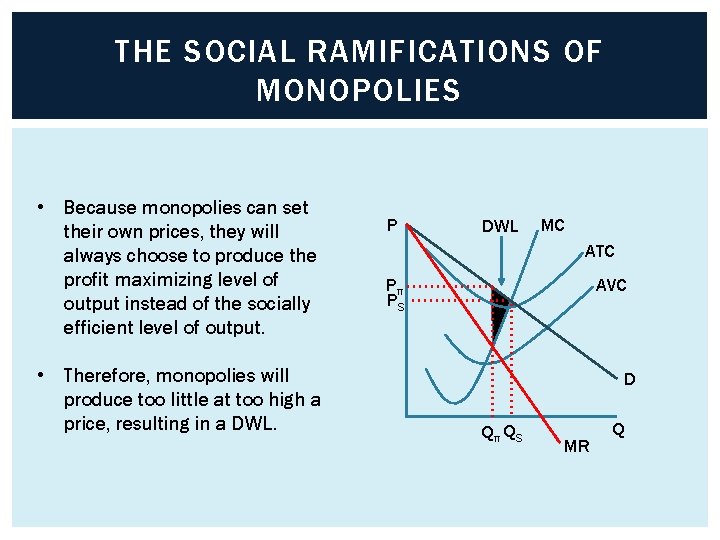
THE SOCIAL RAMIFICATIONS OF MONOPOLIES • What level of output and what price is socially efficient? • Assuming no externalities exist, allocative and social efficiency are equivalent. • Therefore, social efficiency occurs where MB = MC. (Remember, D = MB) P MC ATC AVC Pπ PS D Qπ QS MR Q
THE SOCIAL RAMIFICATIONS OF MONOPOLIES • Because monopolies can set their own prices, they will always choose to produce the profit maximizing level of output instead of the socially efficient level of output. • Therefore, monopolies will produce too little at too high a price, resulting in a DWL. P DWL MC ATC AVC Pπ PS D Qπ QS MR Q
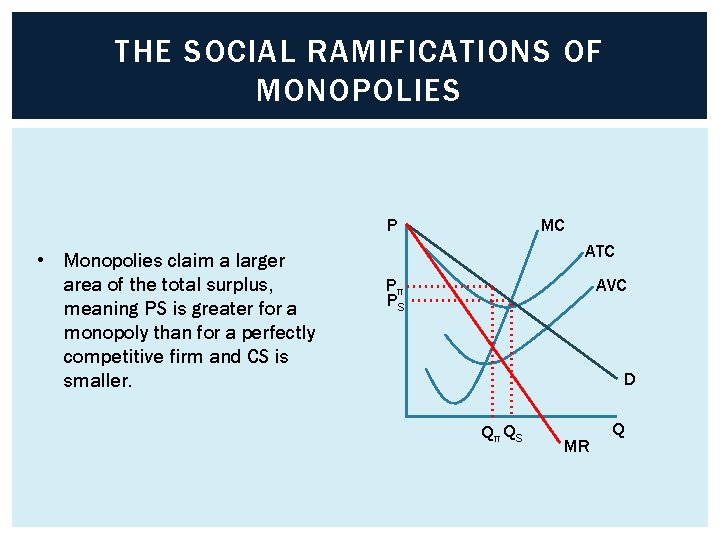
THE SOCIAL RAMIFICATIONS OF MONOPOLIES P • Monopolies claim a larger area of the total surplus, meaning PS is greater for a monopoly than for a perfectly competitive firm and CS is smaller. MC ATC AVC Pπ PS D Qπ QS MR Q
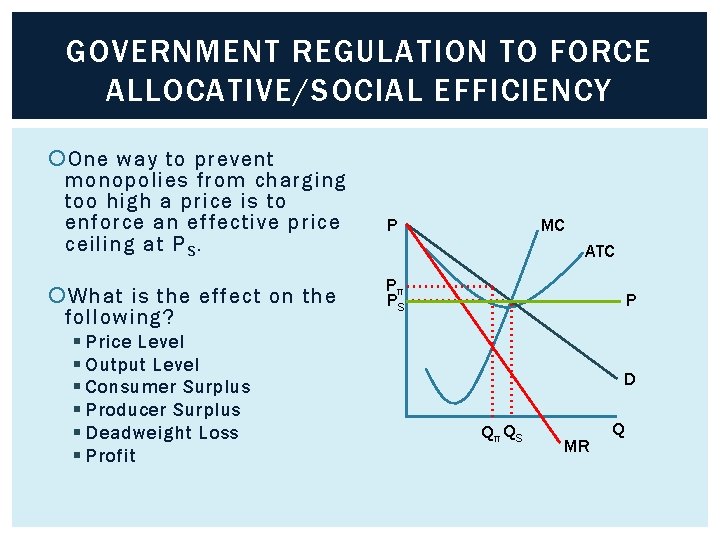
GOVERNMENT REGULATION TO FORCE ALLOCATIVE/SOCIAL EFFICIENCY One way to prevent monopolies from charging too high a price is to enforce an effective price ceiling at P S. What is the effect on the following? § Price Level § Output Level § Consumer Surplus § Producer Surplus § Deadweight Loss § Profit P MC ATC Pπ PS P D Qπ QS MR Q
PRICE DISCRIMINATION When firms charge a different price to different consumers or different prices for different quantities. Firms can only price discriminate if the product cannot be resold. Why? Examples: § Different Consumers § Business v. Pleasure Travel § Child and Senior Citizen Discounts § Different Quantities § Buy one get one half off § Bulk Discounts Why would monopolies provide the product at a lower price for some consumers?
PERFECT PRICE DISCRIMINATION Occurs when a firm charges each individual customer the exact highest price the customer is willing to pay. Why isn’t perfect price discrimination feasible?
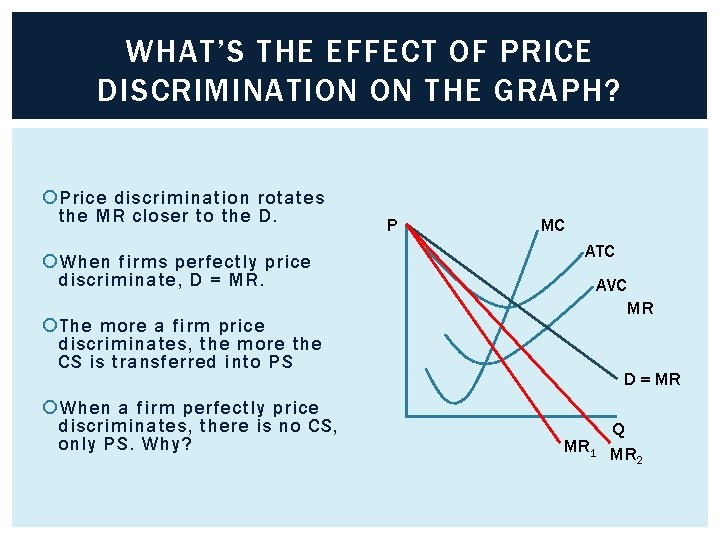
WHAT’S THE EFFECT OF PRICE DISCRIMINATION ON THE GRAPH? Price discrimination rotates the MR closer to the D. When firms perfectly price discriminate, D = MR. P MC ATC AVC MR The more a firm price discriminates, the more the CS is transferred into PS When a firm perfectly price discriminates, there is no CS, only PS. Why? D = MR MR 1 Q MR 2
NATURAL MONOPOLIES A monopoly that exists because of significant fixed costs (aka sunk costs) that serve as a barrier to entry for other firms. Ex: Utility companies and Rails If competition existed, each firm would face significant sunk costs, which means they would each have to charge a higher price than if just one firm provided the service. Why? § Continuous economies to scale (meaning ATC is downward sloping in the long run Natural monopolies make the market MORE socially efficient
IF (NON-NATURAL) MONOPOLIES ARE SO UNFAIR, WHY DO WE HAVE THEM? Listen to the following podcasts: § § When Patents Attack (from This American Life) The Patent War (from Planet Money) When Patents Hit the Podcast (from Planet Money) The Case Against Patents (from Planet Money) Blog Post: Should the US not only allow monopolies to exist, but support their existence by providing patents?
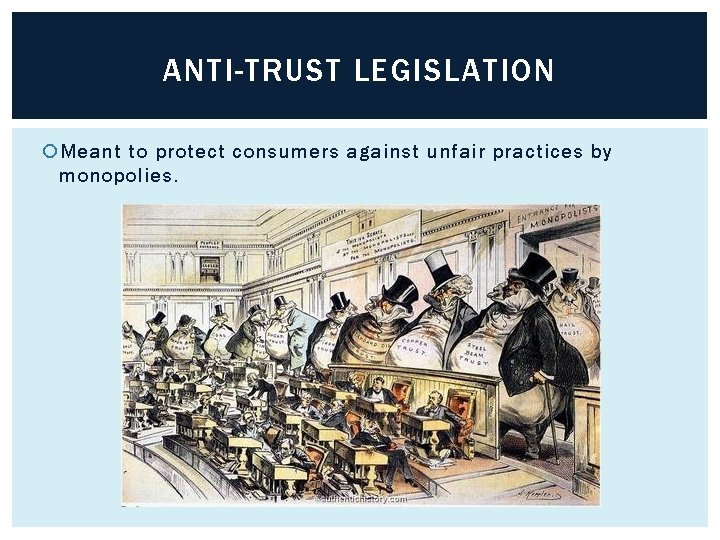
ANTI-TRUST LEGISLATION Meant to protect consumers against unfair practices by monopolies.
THREE PRIMARY REGULATORY IDEAS A price ceiling meant to force monopolies to increase production and decrease the price. § Produce at zero-economic profit (P = ATC) § Produce at productive efficiency (P = min ATC) § Produce at allocative efficiency (P = MC) Sketch a graph that illustrates what each of these regulations looks like.
PRODUCE AT ZERO-ECONOMIC PROFIT
PRODUCE AT PRODUCTIVE EFFICIENCY
PRODUCE AT ALLOCATIVE EFFICIENCY
SUBSIDIES Lump Sum Subsidy Lowers just the ATC Per-Unit Subsidy
COMPARING PERFECT COMPETITION AND MONOPOLY How do their characteristics differ? Which has a higher price level? Which has a higher level of output? Which is more efficient? How are their graphs different?