
Monopoly These slides supplement the textbook but should
Monopoly These slides supplement the textbook, but should not replace reading the textbook
What are the four types of markets? § Perfect competition § Monopoly § Monopolistic competition § Oligopoly 2
What is a monopoly firm? The only seller of a good or service with no close substitutes 3
What is a monopoly market? A market in which the monopoly firm operates 4
What is a barrier to entry? Any impediment that prevents new firms from competing on an equal basis with existing firms in an industry 5
What are some examples of a barrier to entry? § Legal restrictions § Economies of scale § Control of essential resources 6
Can a monopoly make an economic profit in the long run? Yes! Because of these barriers to entry 7
What is a patent? A legal barrier to entry that conveys to its holders the exclusive right to supply a product for 20 years 8
What is an innovation? The process of turning an invention into a marketable product 9
When does a firm experience economies of scale? When a firm increase resources in the long run and efficiency increases 10
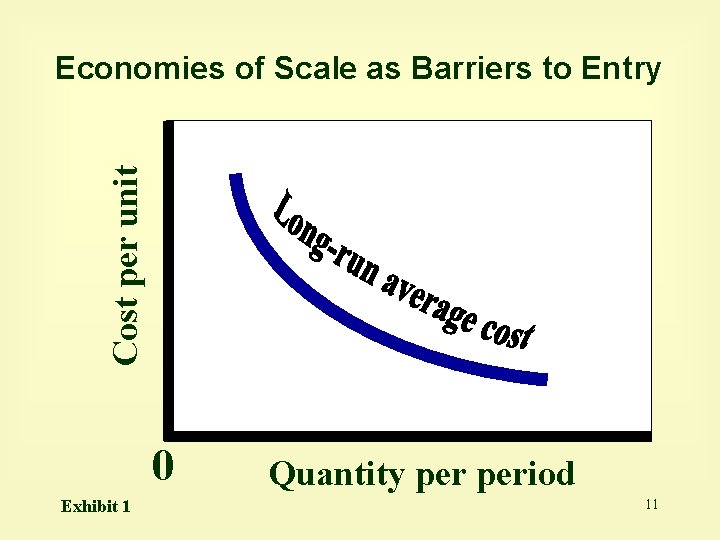
Cost per unit Economies of Scale as Barriers to Entry 0 Exhibit 1 Quantity period 11
What is a price searcher? A firm that has some control over the price it charges because its demand curve slopes downward 12
What is a single price monopoly? A Monopoly firm that is limited to charging the same price for each unit of output sold 13
What is the monopolist’s demand curve? The market demand curve 14
How is the demand curve derived for the single price monopoly? It’s average revenue curve 15
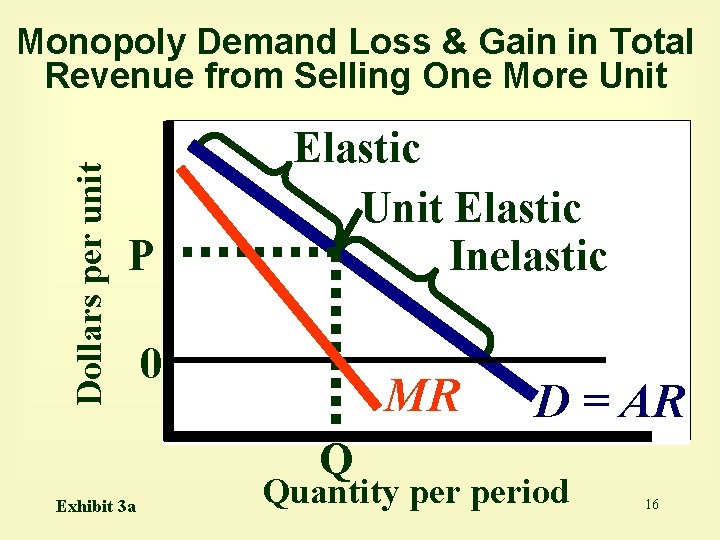
Dollars per unit Monopoly Demand Loss & Gain in Total Revenue from Selling One More Unit P Elastic Unit Elastic Inelastic 0 MR D = AR Q Exhibit 3 a Quantity period 16
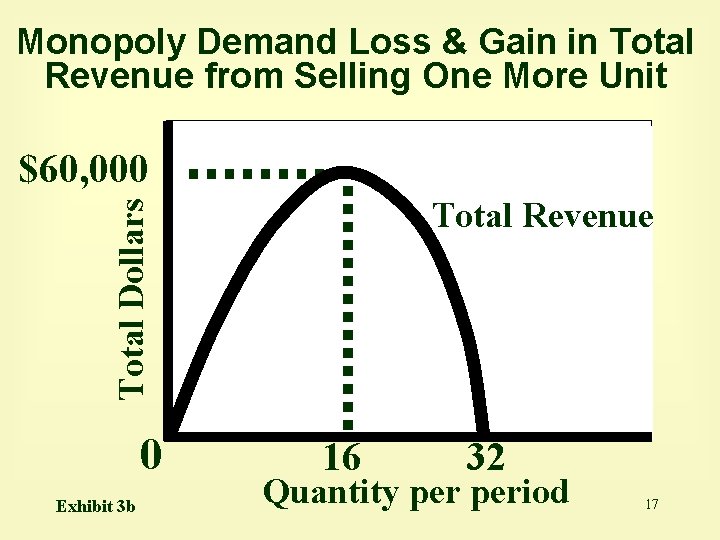
Monopoly Demand Loss & Gain in Total Revenue from Selling One More Unit $60, 000 Total Dollars Total Revenue 0 Exhibit 3 b 16 32 Quantity period 17
What is a natural monopoly? Due to economies of scale, one firm can operate at lower average cost than can two or more firms 18
How does the government foster monopolies? § Patents, trademarks, copyrights § Exclusive government franchises 19
What is the purpose of patents and copyrights? To give people and firms the incentive to invest their time and money into new products and creative works 20
What is a government franchise? A government granted right to be the sole seller of a product or service 21
When does the government grant a franchise? When it thinks the market in question is a natural monopoly 22
What are examples of a government franchise? § The U. S. Postal Service § Local telephone service § Local electric, gas, water utilities, garbage collection, cable TV 23
Is a government franchise a win-win deal for the protected company? Most often the No! government regulates its prices and profits 24
What is the government’s objective? For the monopoly to make a normal profit 25
Why is MR < P for all but the first unit of output for a single price monopoly? In order to sell additional units the firm not only has to lower price on the last unit, but on all previous units 26
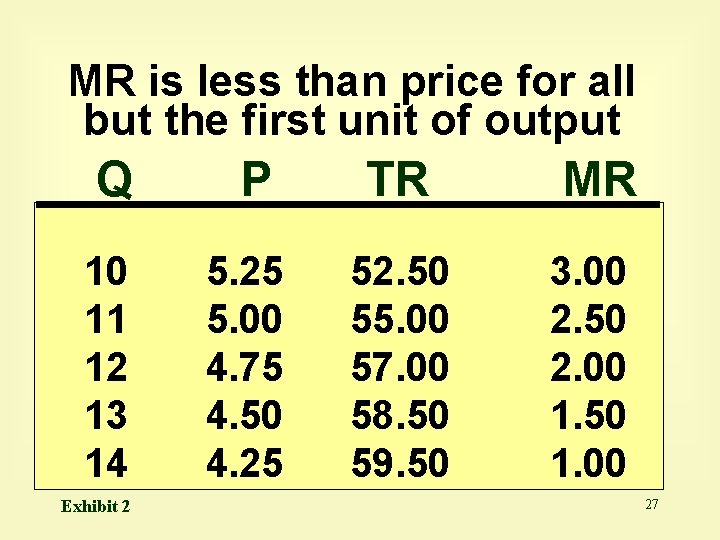
MR is less than price for all but the first unit of output Q P TR MR 10 11 12 13 14 5. 25 5. 00 4. 75 4. 50 4. 25 52. 50 55. 00 57. 00 58. 50 59. 50 3. 00 2. 50 2. 00 1. 50 1. 00 Exhibit 2 27
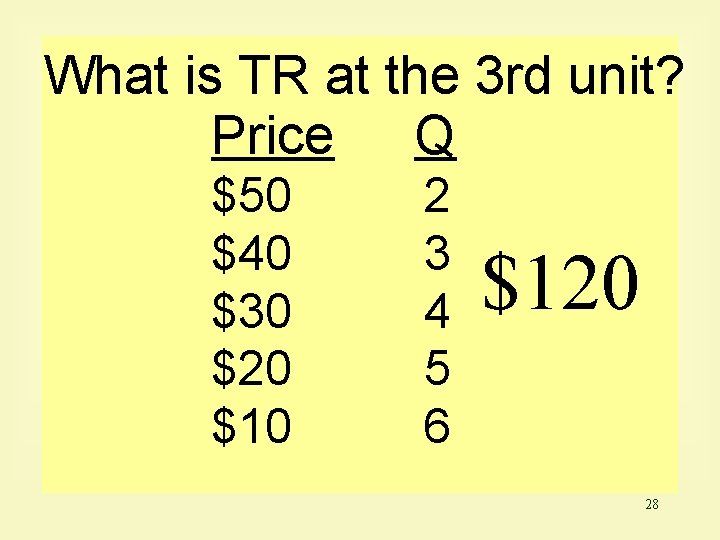
What is TR at the 3 rd unit? Price Q $50 $40 $30 $20 $10 2 3 4 5 6 $120 28
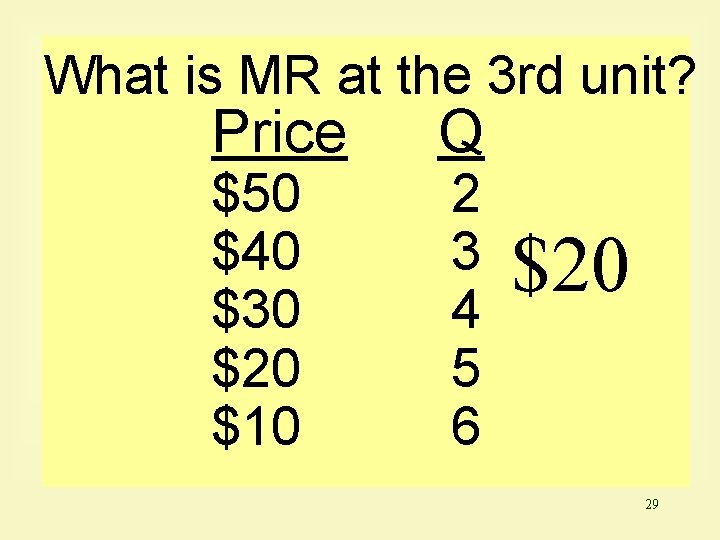
What is MR at the 3 rd unit? Price $50 $40 $30 $20 $10 Q 2 3 4 5 6 $20 29
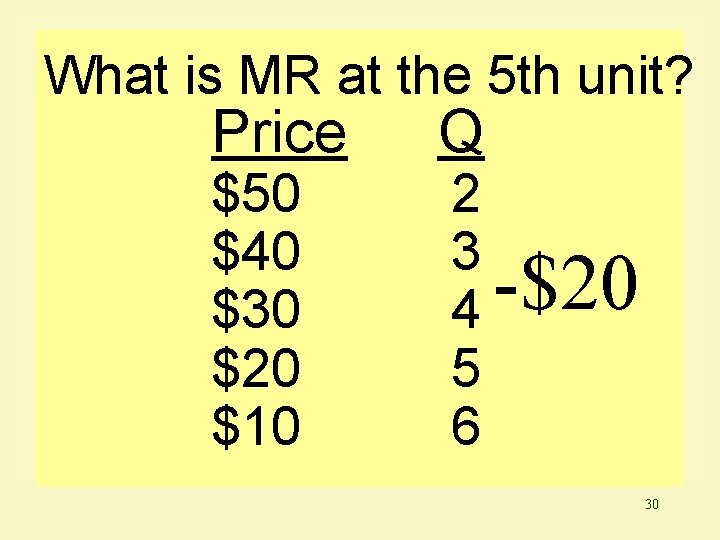
What is MR at the 5 th unit? Price $50 $40 $30 $20 $10 Q 2 3 -$20 4 5 6 30
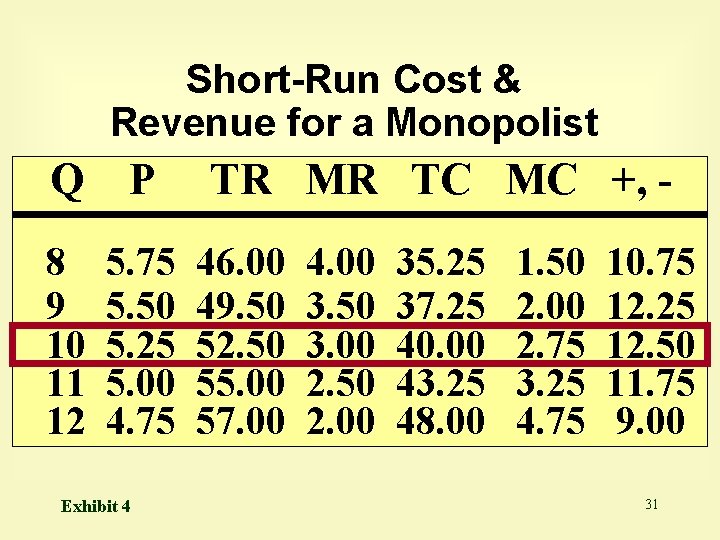
Short-Run Cost & Revenue for a Monopolist Q P 8 9 10 11 12 5. 75 5. 50 5. 25 5. 00 4. 75 Exhibit 4 TR MR TC MC +, 46. 00 49. 50 52. 50 55. 00 57. 00 4. 00 3. 50 3. 00 2. 50 2. 00 35. 25 37. 25 40. 00 43. 25 48. 00 1. 50 2. 00 2. 75 3. 25 4. 75 10. 75 12. 25 12. 50 11. 75 9. 00 31
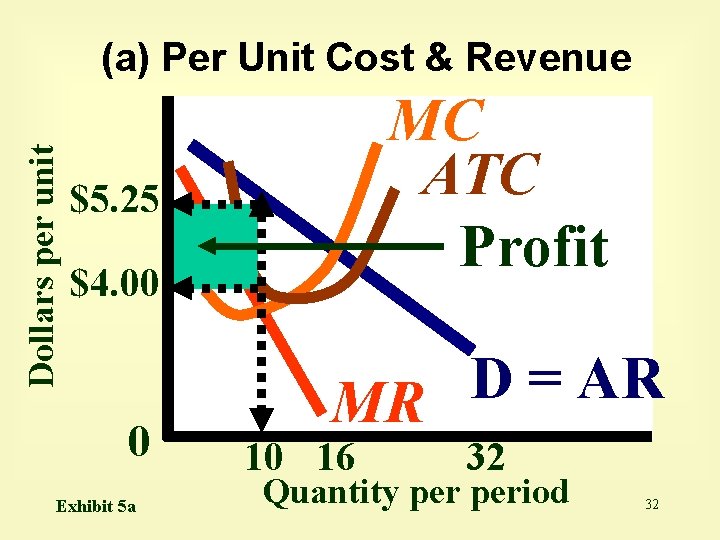
Dollars per unit (a) Per Unit Cost & Revenue MC ATC Profit $5. 25 $4. 00 0 Exhibit 5 a D = AR MR 10 16 32 Quantity period 32
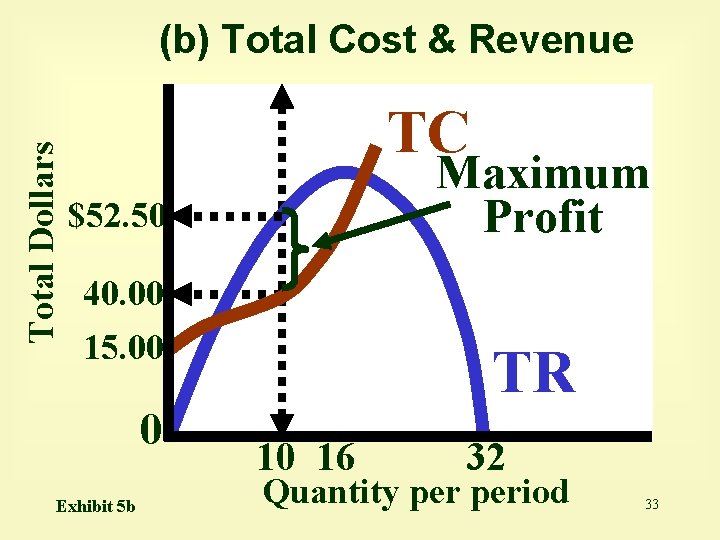
Total Dollars (b) Total Cost & Revenue TC Maximum Profit $52. 50 40. 00 15. 00 0 Exhibit 5 b TR 10 16 32 Quantity period 33
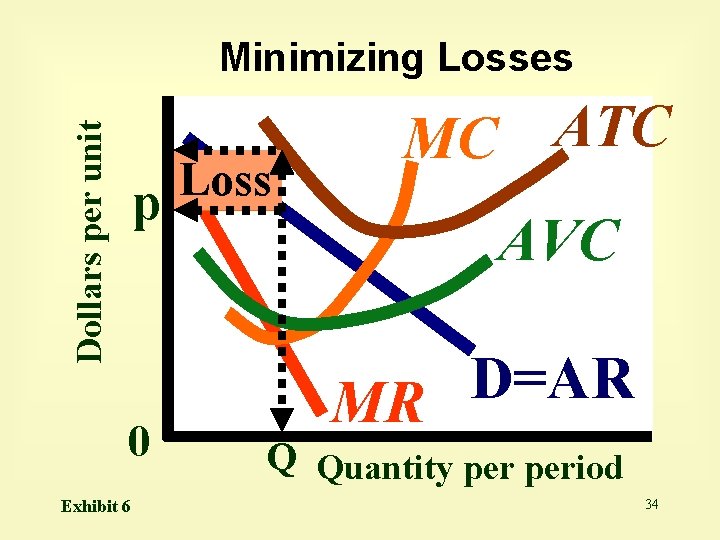
Dollars per unit Minimizing Losses Loss p 0 Exhibit 6 MC ATC AVC D=AR MR Q Quantity period 34
When will a monopolist shut down? If no price covers average variable cost 35
Can a monopolist earn an economic profit? YES 36
Why do monopolies often earn zero economic profit? Government regulation 37
How to compare perfect competition & monopoly? § Higher prices & less output under monopoly § Resource allocation 38
Why does a monopoly charge a higher price and produce a lower quantity than perfect competition? Because of the different slopes of their demand MR curves 39
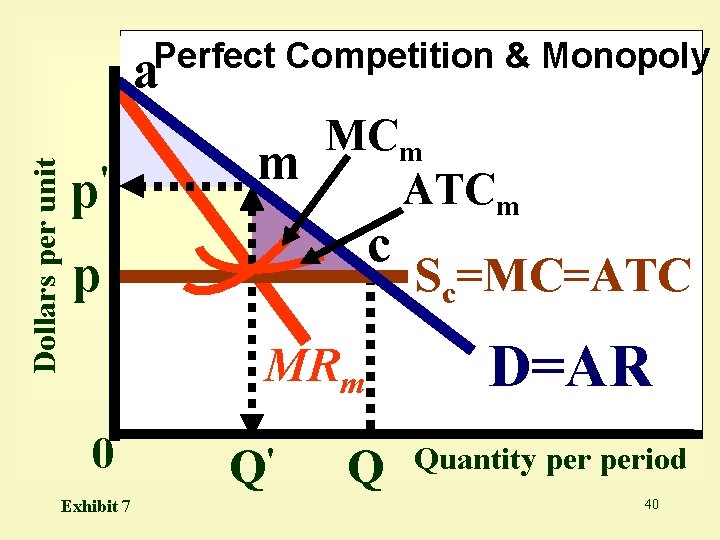
Perfect Competition & Monopoly Dollars per unit a ' p m MCm ATCm c p MRm 0 Exhibit 7 Q' Q Sc=MC=ATC D=AR Quantity period 40
What is rent seeking? Activities undertaken by individuals or firms to influence public policy in a way that will distribute income to them 41

END
Appendix
What is price discrimination? Selling the same good for different prices to different consumers as a way to increase profit 44
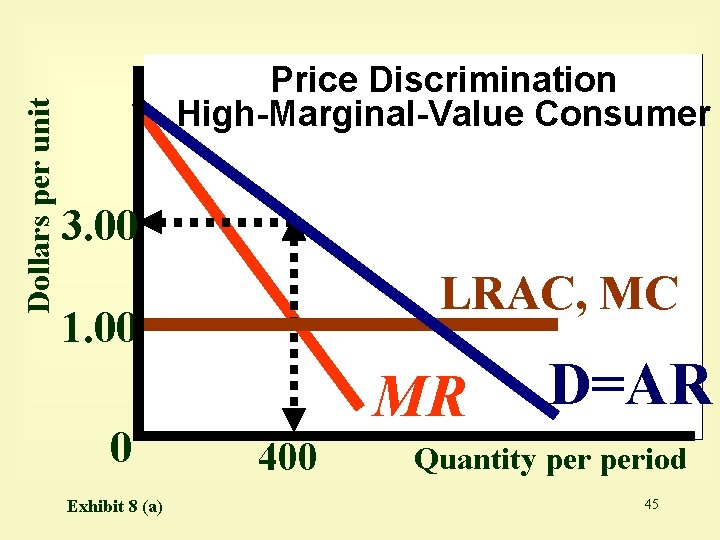
Dollars per unit Price Discrimination High-Marginal-Value Consumer 3. 00 LRAC, MC 1. 00 0 Exhibit 8 (a) MR 400 D=AR Quantity period 45
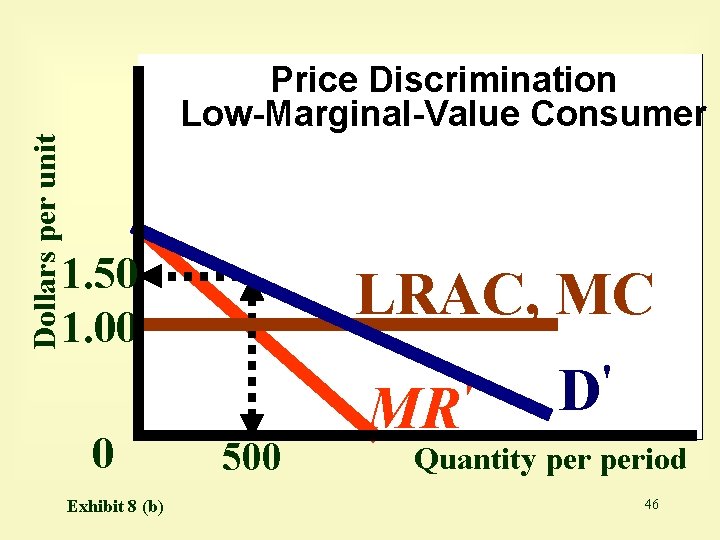
Dollars per unit Price Discrimination Low-Marginal-Value Consumer 1. 50 1. 00 0 Exhibit 8 (b) LRAC, MC 500 ' MR ' D Quantity period 46
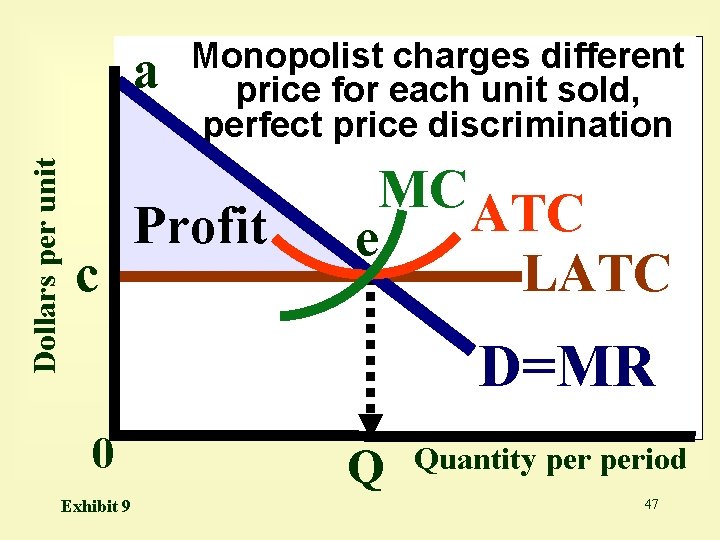
Dollars per unit a c Monopolist charges different price for each unit sold, perfect price discrimination Profit MC ATC e LATC D=MR 0 Exhibit 9 Q Quantity period 47
What does producer surplus represent for the perfectly discriminating monopolist? Economic profit 48
What is deadweight loss? A loss of consumer and producer surplus that is not transferred to anyone else; it can result from the monopolization of an industry 49
- Slides: 49