
MONOPOLY DEFINITION A monopoly exists when a specific

- Slides: 5
MONOPOLY
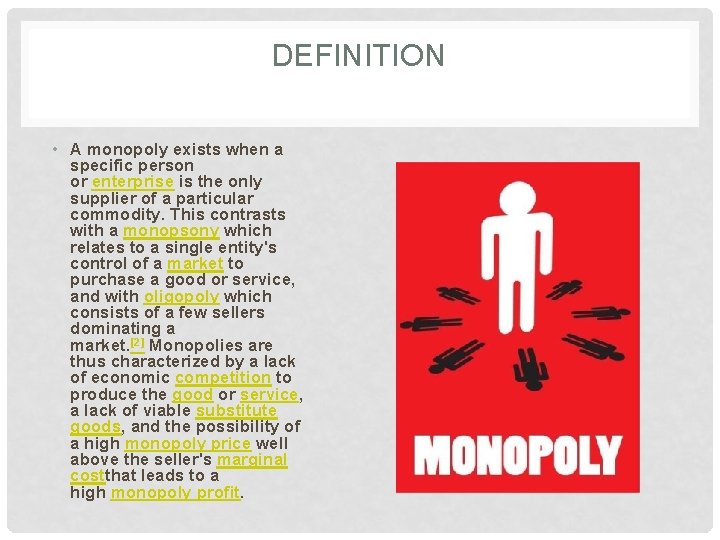
DEFINITION • A monopoly exists when a specific person or enterprise is the only supplier of a particular commodity. This contrasts with a monopsony which relates to a single entity's control of a market to purchase a good or service, and with oligopoly which consists of a few sellers dominating a market. [2] Monopolies are thus characterized by a lack of economic competition to produce the good or service, a lack of viable substitute goods, and the possibility of a high monopoly price well above the seller's marginal costthat leads to a high monopoly profit.
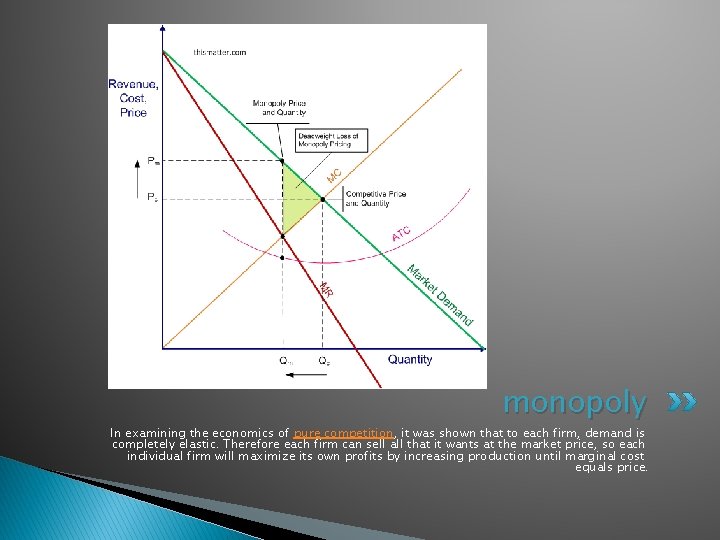
monopoly In examining the economics of pure competition, it was shown that to each firm, demand is completely elastic. Therefore each firm can sell all that it wants at the market price, so each individual firm will maximize its own profits by increasing production until marginal cost equals price.
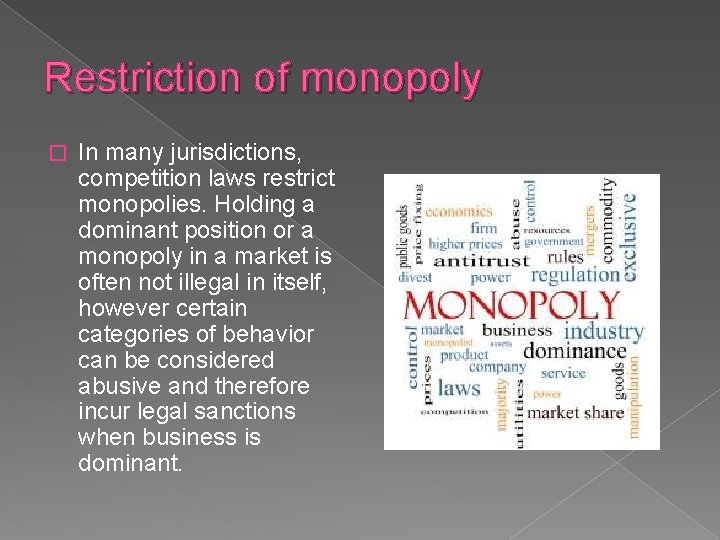
Restriction of monopoly � In many jurisdictions, competition laws restrict monopolies. Holding a dominant position or a monopoly in a market is often not illegal in itself, however certain categories of behavior can be considered abusive and therefore incur legal sanctions when business is dominant.
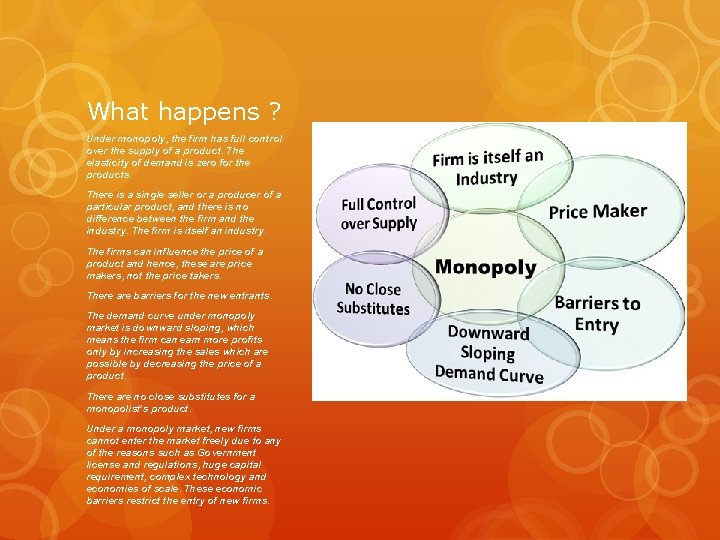
What happens ? Under monopoly, the firm has full control over the supply of a product. The elasticity of demand is zero for the products. There is a single seller or a producer of a particular product, and there is no difference between the firm and the industry. The firm is itself an industry. The firms can influence the price of a product and hence, these are price makers, not the price takers. There are barriers for the new entrants. The demand curve under monopoly market is downward sloping, which means the firm can earn more profits only by increasing the sales which are possible by decreasing the price of a product. There are no close substitutes for a monopolist’s product. Under a monopoly market, new firms cannot enter the market freely due to any of the reasons such as Government license and regulations, huge capital requirement, complex technology and economies of scale. These economic barriers restrict the entry of new firms.