
Monohybrid Inheritance Section 11 Monohybrid Inheritance l l
Monohybrid Inheritance Section 11
Monohybrid Inheritance l l l Gregor Mendel (1822 -1884): - Used varieties of pea plant - Ensured large numbers were used - Studied only 1 characteristic - Observed 3: 1 phenotypic ratio Principle of segregation: ‘ the alleles of a gene exist in pairs but when gametes are formed, the numbers of each pair pass into different gametes. Thus each gamete contains only one allele of each gene.
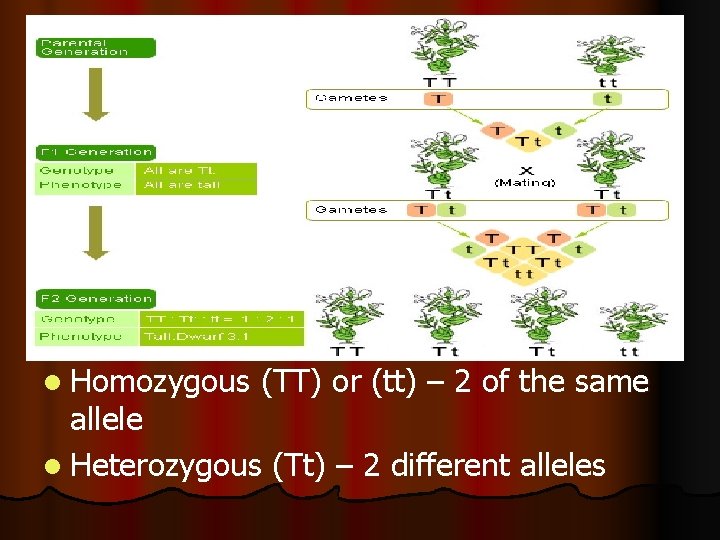
l Homozygous (TT) or (tt) – 2 of the same allele l Heterozygous (Tt) – 2 different alleles
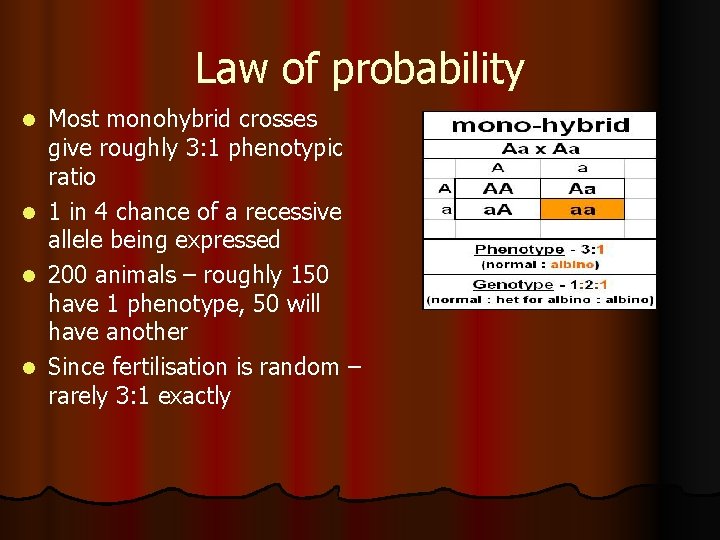
Law of probability l l Most monohybrid crosses give roughly 3: 1 phenotypic ratio 1 in 4 chance of a recessive allele being expressed 200 animals – roughly 150 have 1 phenotype, 50 will have another Since fertilisation is random – rarely 3: 1 exactly

Monohybrid Inheritance in humans l l l l l Family trees used to predict genetic trends E. g. tongue rolling Rhesus D antigen: D-antigen – found on some blood cells Present = Rhesus positive blood (Rh+) Absent = Rhesus negative (Rh-) Rh- people produce anti-D antibodies –’sensitised’ Antigen-D present (DD/Dd) Antigen-D absent (dd)
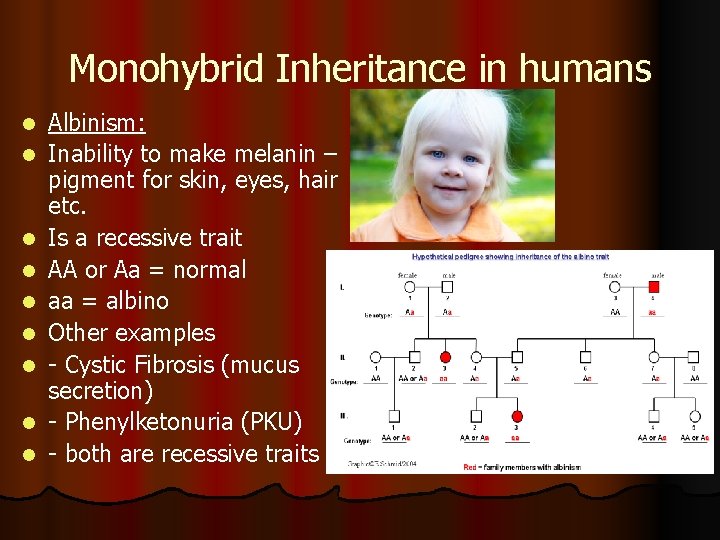
Monohybrid Inheritance in humans l l l l l Albinism: Inability to make melanin – pigment for skin, eyes, hair etc. Is a recessive trait AA or Aa = normal aa = albino Other examples - Cystic Fibrosis (mucus secretion) - Phenylketonuria (PKU) - both are recessive traits
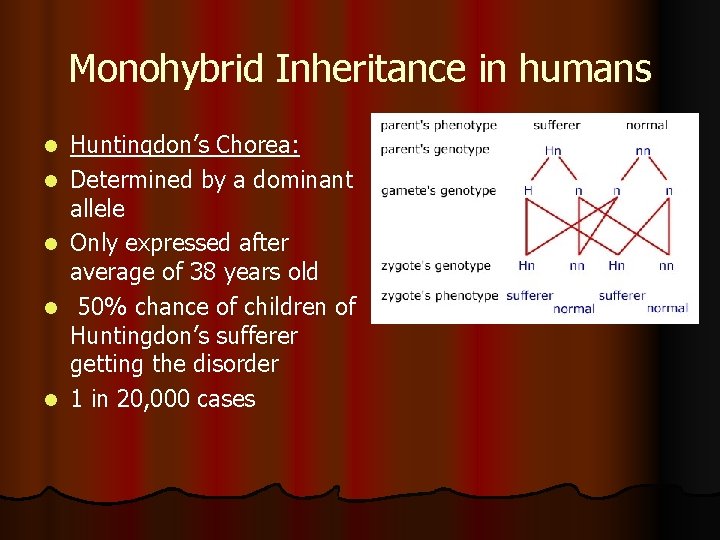
Monohybrid Inheritance in humans l l l Huntingdon’s Chorea: Determined by a dominant allele Only expressed after average of 38 years old 50% chance of children of Huntingdon’s sufferer getting the disorder 1 in 20, 000 cases
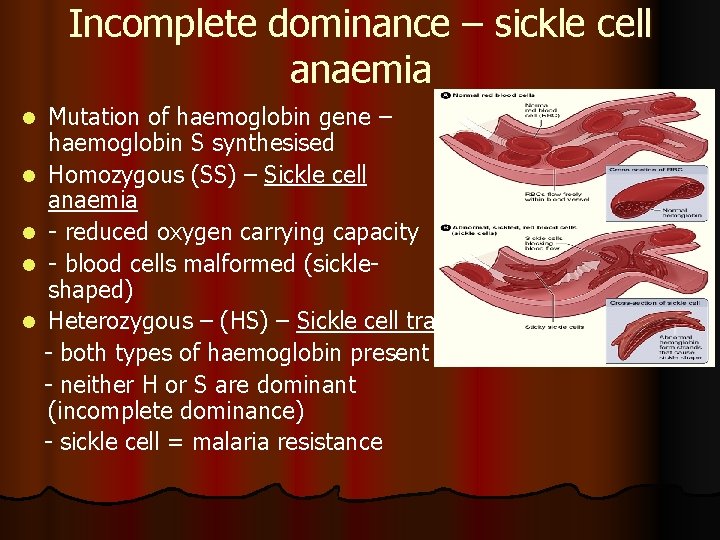
Incomplete dominance – sickle cell anaemia Mutation of haemoglobin gene – haemoglobin S synthesised l Homozygous (SS) – Sickle cell anaemia l - reduced oxygen carrying capacity l - blood cells malformed (sickleshaped) l Heterozygous – (HS) – Sickle cell trait - both types of haemoglobin present - neither H or S are dominant (incomplete dominance) - sickle cell = malaria resistance l
Incomplete / Co-Dominance l l l l Incomplete – both alleles expressed in the phenotype, but unevenly - sickle-cell: more H than S expressed Co-Dominance - both alleles equally expressed in the phenotype - AB blood – exactly 50: 50 split - MN blood - another blood type antigen - no antibodies produced - equal expression (equal dominance
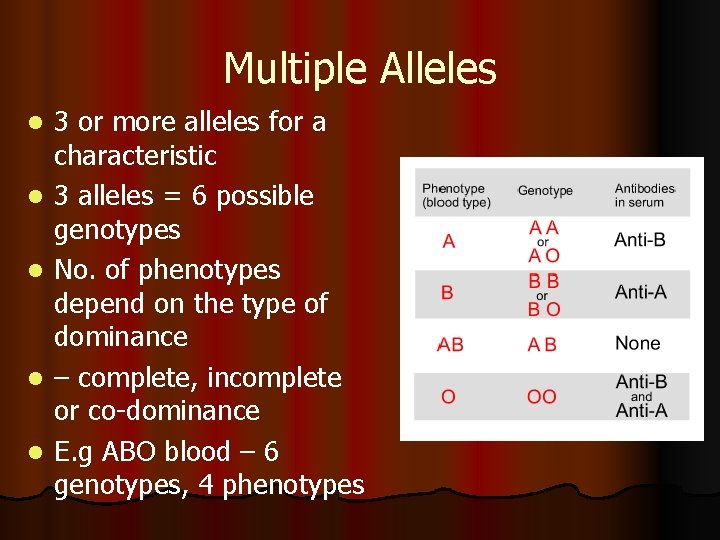
Multiple Alleles l l l 3 or more alleles for a characteristic 3 alleles = 6 possible genotypes No. of phenotypes depend on the type of dominance – complete, incomplete or co-dominance E. g ABO blood – 6 genotypes, 4 phenotypes
- Slides: 10