
MONOHYBRID CROSSES AND CODOMINANCE Patterns of Inheritance LEARNING
MONOHYBRID CROSSES AND CODOMINANCE Patterns of Inheritance
LEARNING OUTCOMES (i) genetic diagrams to show patterns of inheritance To include monogenic inheritance, dihybrid inheritance, multiple alleles, sex linkage and codominance.
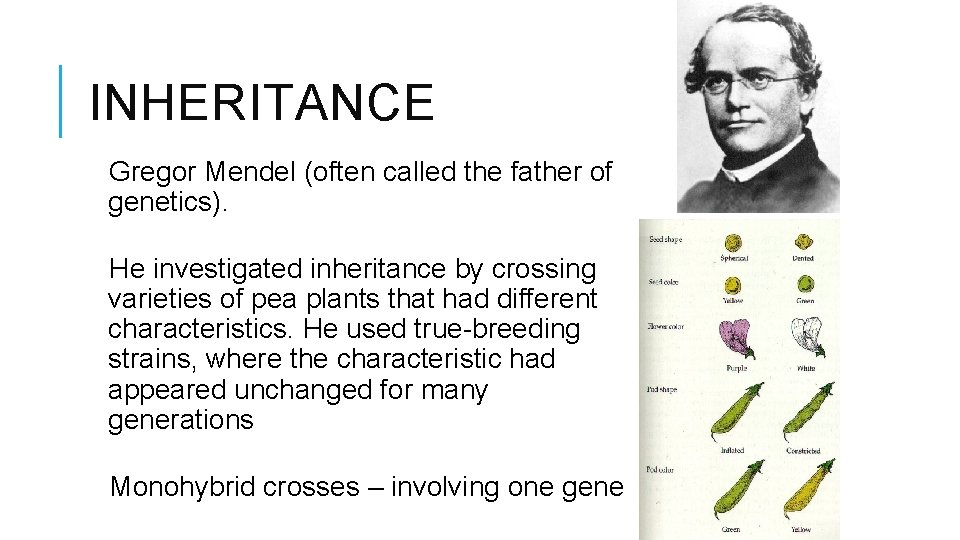
INHERITANCE Gregor Mendel (often called the father of genetics). He investigated inheritance by crossing varieties of pea plants that had different characteristics. He used true-breeding strains, where the characteristic had appeared unchanged for many generations Monohybrid crosses – involving one gene
MONOHYBRID CROSSES Mendel was looking at one characteristic P 1 (parental generation) True- breeding for a particular characteristic All the offspring from this cross, the first generation are known as the F 1 generation. Crossing this first generation gives the second generation known as the F 2 generation.
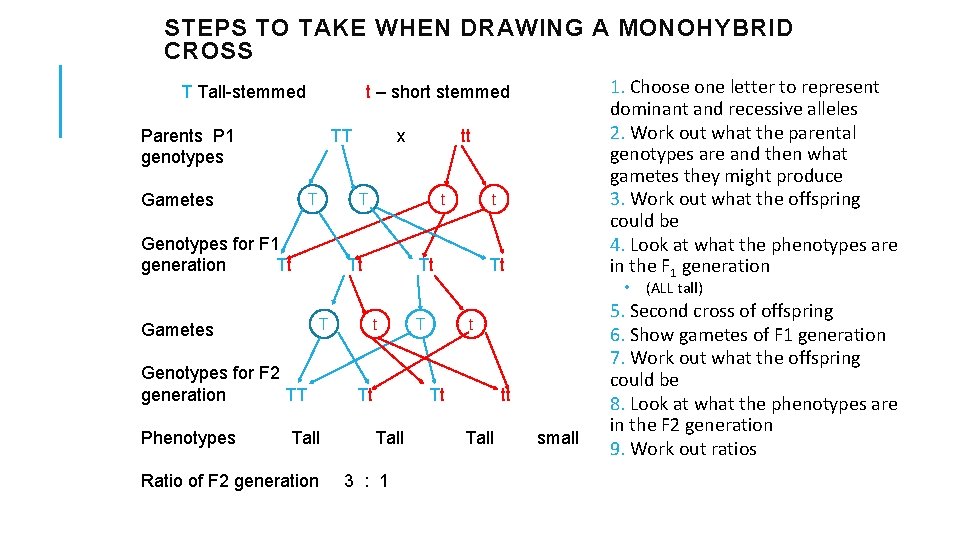
STEPS TO TAKE WHEN DRAWING A MONOHYBRID CROSS T Tall-stemmed Parents P 1 genotypes TT Gametes 1. Choose one letter to represent dominant and recessive alleles 2. Work out what the parental genotypes are and then what gametes they might produce 3. Work out what the offspring could be 4. Look at what the phenotypes are in the F 1 generation t – short stemmed T x tt T Genotypes for F 1 generation Tt t Tt Tt • T Gametes Genotypes for F 2 generation TT Phenotypes Tall Ratio of F 2 generation t Tt Tall 3 : 1 tt Tall small (ALL tall) 5. Second cross of offspring 6. Show gametes of F 1 generation 7. Work out what the offspring could be 8. Look at what the phenotypes are in the F 2 generation 9. Work out ratios
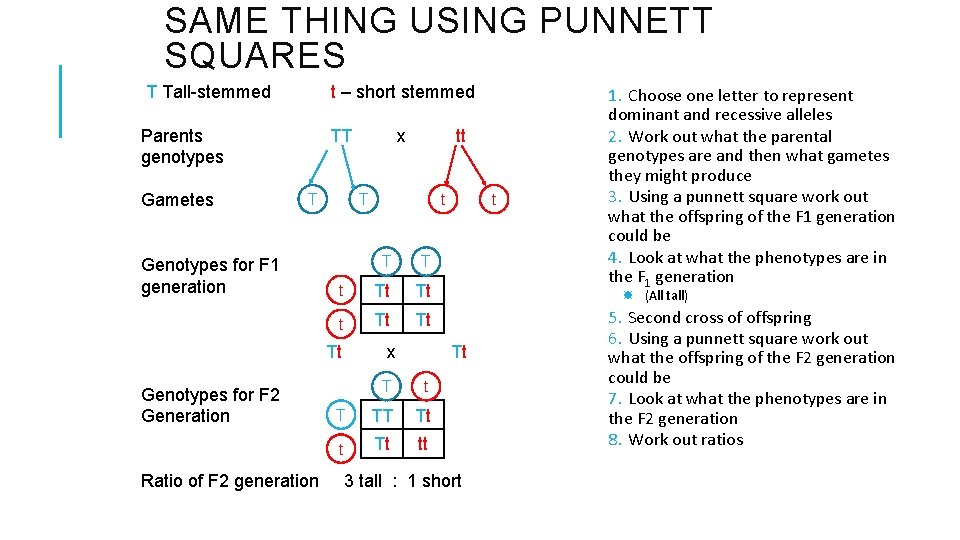
SAME THING USING PUNNETT SQUARES T Tall-stemmed t – short stemmed Parents genotypes TT Gametes T Genotypes for F 1 generation Ratio of F 2 generation tt T T t Tt Tt Tt Genotypes for F 2 Generation x x t (All tall) Tt T TT Tt tt 1. Choose one letter to represent dominant and recessive alleles 2. Work out what the parental genotypes are and then what gametes they might produce 3. Using a punnett square work out what the offspring of the F 1 generation could be 4. Look at what the phenotypes are in the F 1 generation 3 tall : 1 short 5. Second cross of offspring 6. Using a punnett square work out what the offspring of the F 2 generation could be 7. Look at what the phenotypes are in the F 2 generation 8. Work out ratios
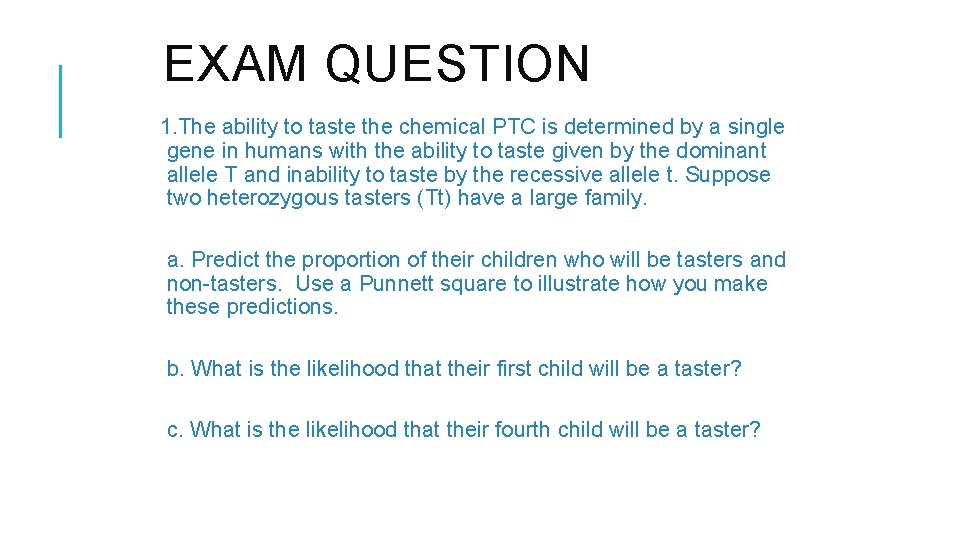
EXAM QUESTION 1. The ability to taste the chemical PTC is determined by a single gene in humans with the ability to taste given by the dominant allele T and inability to taste by the recessive allele t. Suppose two heterozygous tasters (Tt) have a large family. a. Predict the proportion of their children who will be tasters and non-tasters. Use a Punnett square to illustrate how you make these predictions. b. What is the likelihood that their first child will be a taster? c. What is the likelihood that their fourth child will be a taster?
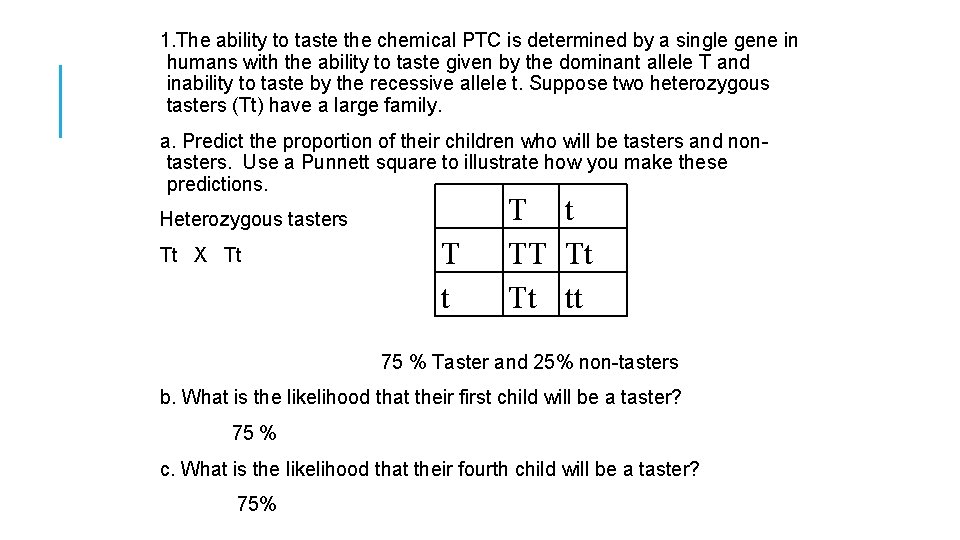
1. The ability to taste the chemical PTC is determined by a single gene in humans with the ability to taste given by the dominant allele T and inability to taste by the recessive allele t. Suppose two heterozygous tasters (Tt) have a large family. a. Predict the proportion of their children who will be tasters and nontasters. Use a Punnett square to illustrate how you make these predictions. Heterozygous tasters Tt X Tt T t TT Tt Tt tt 75 % Taster and 25% non-tasters b. What is the likelihood that their first child will be a taster? 75 % c. What is the likelihood that their fourth child will be a taster? 75%
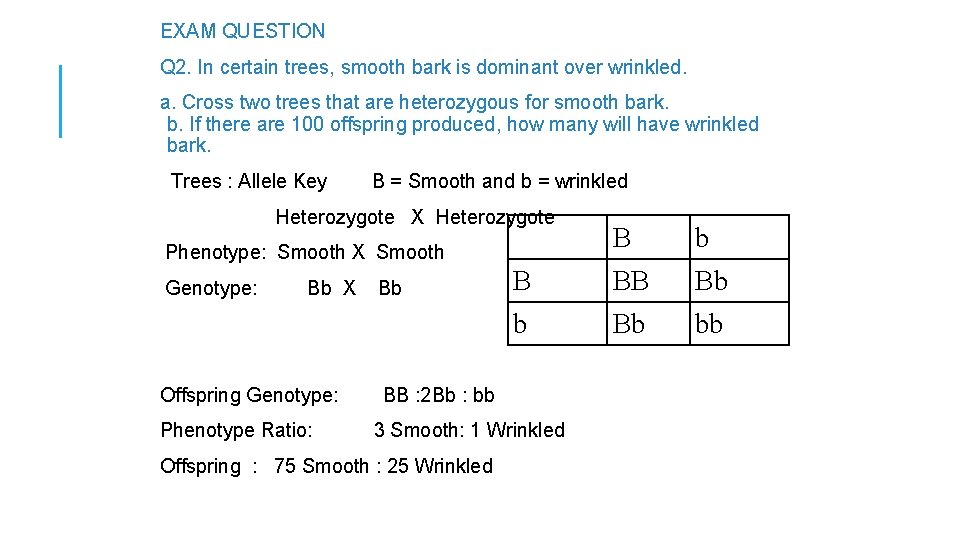
EXAM QUESTION Q 2. In certain trees, smooth bark is dominant over wrinkled. a. Cross two trees that are heterozygous for smooth bark. b. If there are 100 offspring produced, how many will have wrinkled bark. Trees : Allele Key B = Smooth and b = wrinkled Heterozygote X Heterozygote B b B BB Bb bb Phenotype: Smooth X Smooth Genotype: Bb X Offspring Genotype: Phenotype Ratio: Bb BB : 2 Bb : bb 3 Smooth: 1 Wrinkled Offspring : 75 Smooth : 25 Wrinkled
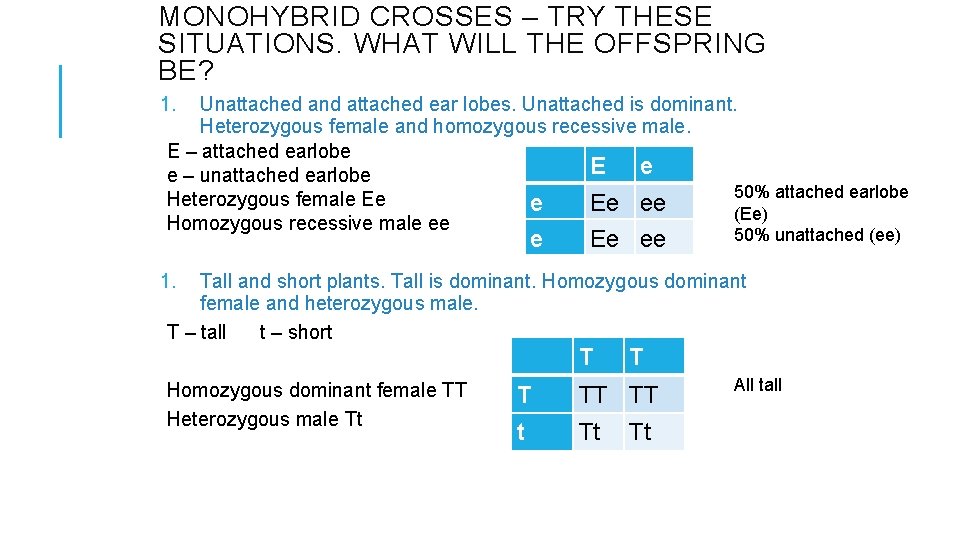
MONOHYBRID CROSSES – TRY THESE SITUATIONS. WHAT WILL THE OFFSPRING BE? 1. Unattached and attached ear lobes. Unattached is dominant. Heterozygous female and homozygous recessive male. E – attached earlobe E e e – unattached earlobe 50% attached earlobe Heterozygous female Ee ee (Ee) Homozygous recessive male ee e Ee ee 50% unattached (ee) 1. Tall and short plants. Tall is dominant. Homozygous dominant female and heterozygous male. T – tall t – short T Homozygous dominant female TT Heterozygous male Tt T T TT TT t Tt Tt All tall
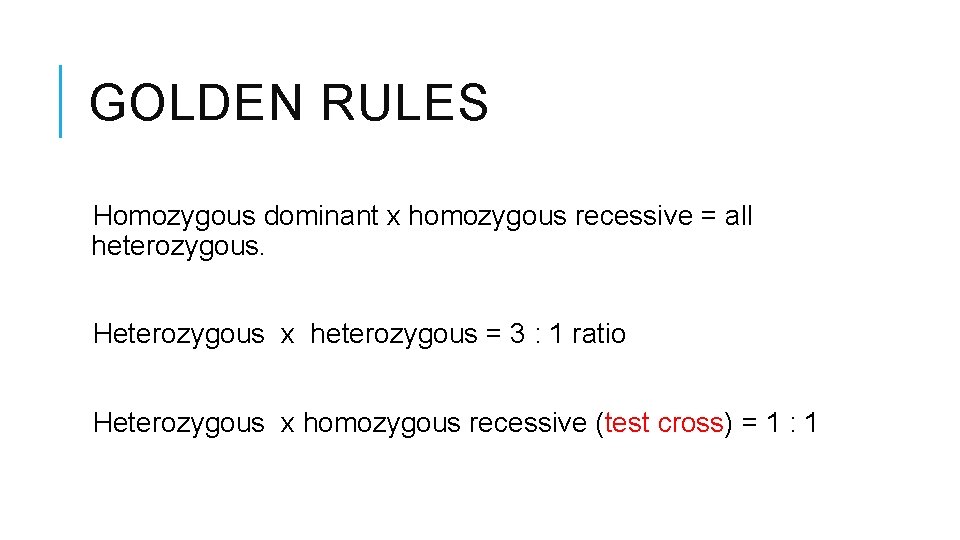
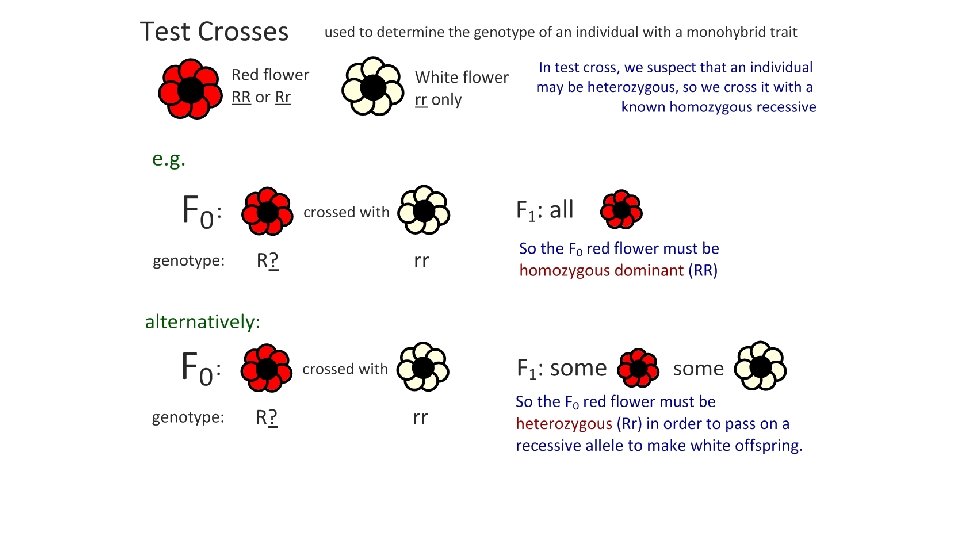
GOLDEN RULES Homozygous dominant x homozygous recessive = all heterozygous. Heterozygous x heterozygous = 3 : 1 ratio Heterozygous x homozygous recessive (test cross) = 1 : 1
TEST CROSS This is used to determine the genotype of an individual showing the dominant characteristic. In our example of tall and short stemmed plants, a plant with the phenotype tall could have the following genotypes §homozygous TT or § heterozygous Tt Both plants would look the same, a test cross can be used to identify the genotype.
CODOMINANCE What is codominance? When both alleles are present they both affect the phenotype (equally dominant)

SNAPDRAGON FLOWERS An example of codominance: both alleles are expressed in the phenotype when the plant is heterozygous Alleles code for red or white When one of each allele is present then the flower is pink (some flowers could be red and white spotted)
SNAPDRAGON FLOWERS – MORE DETAIL Homozygous Red The 2 alleles for red flowers code for an enzyme which catalyses red pigment formation, hence the flowers are red Homozygous White The 2 alleles for white flowers do not code for the enzyme, so no pigment is produced, hence the flowers are white Heterozygous The one red allele codes for some pigment, but only enough to make the flower pink, not red
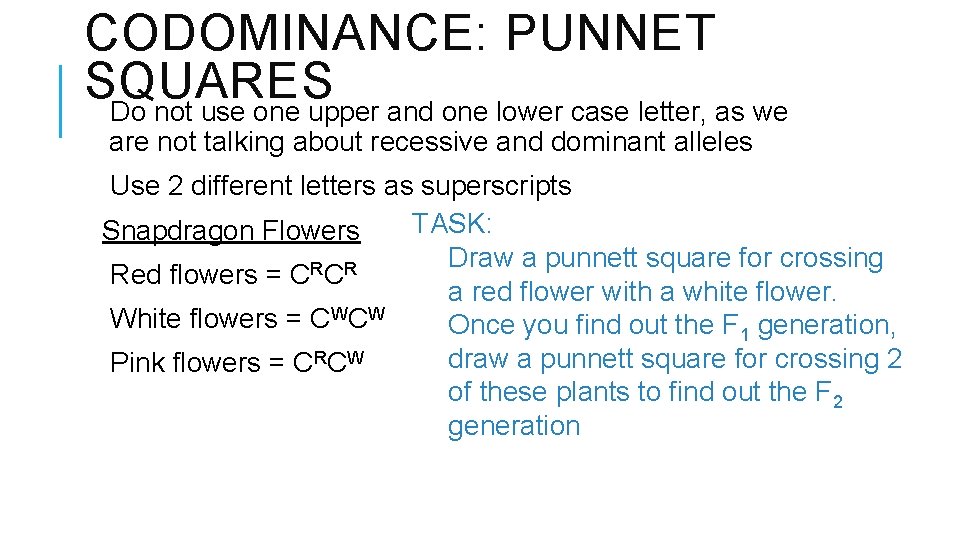
CODOMINANCE: PUNNET SQUARES Do not use one upper and one lower case letter, as we are not talking about recessive and dominant alleles Use 2 different letters as superscripts TASK: Snapdragon Flowers Draw a punnett square for crossing R R Red flowers = C C a red flower with a white flower. White flowers = CWCW Once you find out the F 1 generation, draw a punnett square for crossing 2 Pink flowers = CRCW of these plants to find out the F 2 generation

CODOMINANCE Crossing a red flower with a white flower Male gametes Female gametes CR CR CW C RC W W All offspring are pink
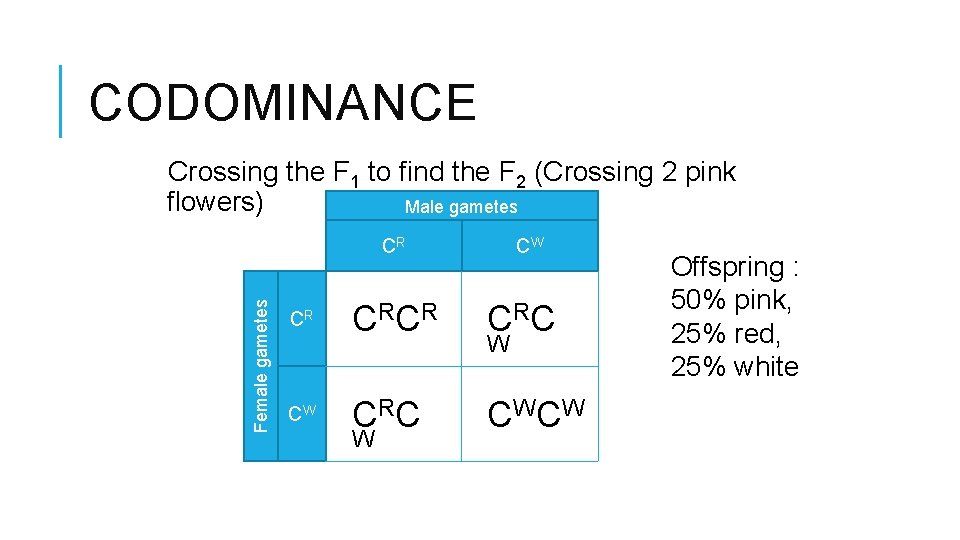
CODOMINANCE Crossing the F 1 to find the F 2 (Crossing 2 pink flowers) Male gametes Female gametes CR CW CR C RC CW CW W W Offspring : 50% pink, 25% red, 25% white
HOMEWORK Research and prepare a leaflet on sickle cell anaemia. It should include Symptoms in tissues (2) Causes at the genetic level (2) Affect on protein structure (1) Codominance (2) Worldwide distribution and the link to malaria (2) Why does the sickle cell allele persist? (1) REMEMBER to review your notes and practice exam questions from the textbook!!!
LEARNING OUTCOMES (i) genetic diagrams to show patterns of inheritance To include monogenic inheritance, dihybrid inheritance, multiple alleles, sex linkage and codominance.
- Slides: 22