
Monochromatic plane waves LL 2 section 48 Plane
- Slides: 15
Monochromatic plane waves LL 2 section 48
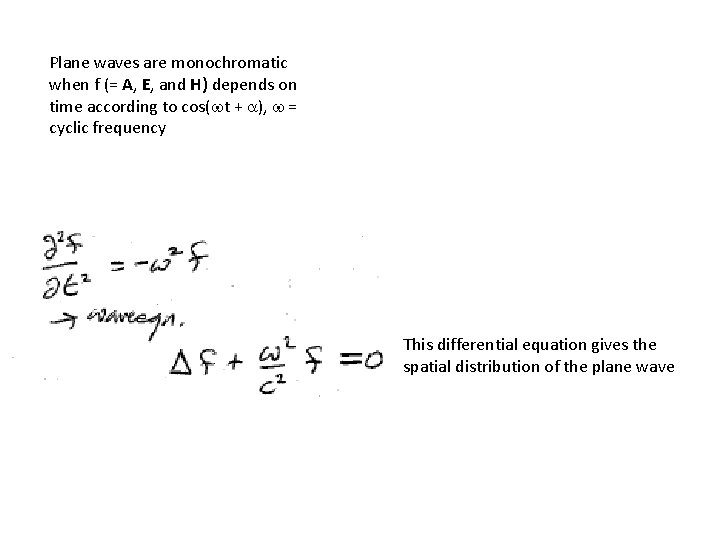
Plane waves are monochromatic when f (= A, E, and H) depends on time according to cos(wt + a), w = cyclic frequency This differential equation gives the spatial distribution of the plane wave
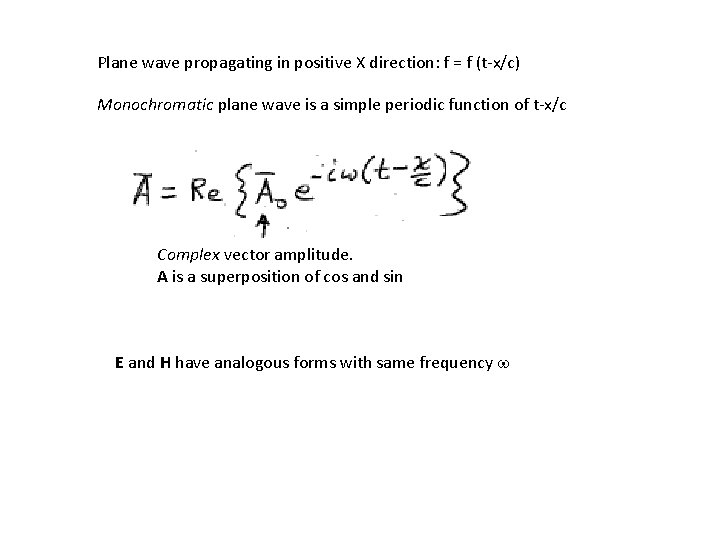
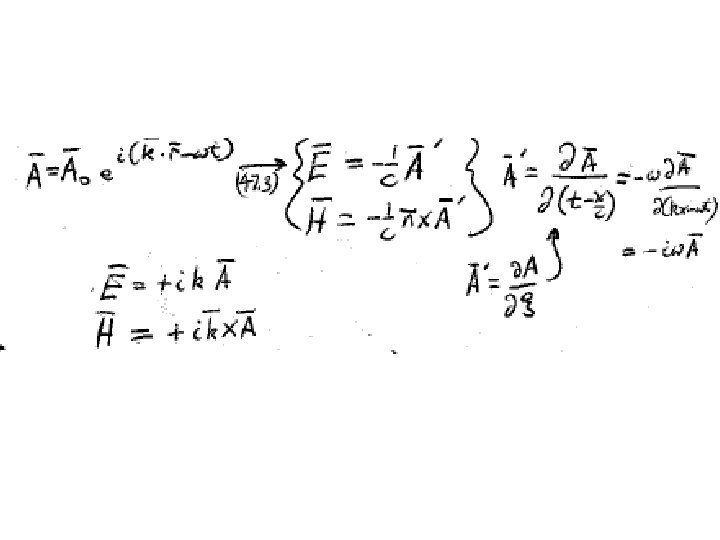
Plane wave propagating in positive X direction: f = f (t-x/c) Monochromatic plane wave is a simple periodic function of t-x/c Complex vector amplitude. A is a superposition of cos and sin E and H have analogous forms with same frequency w
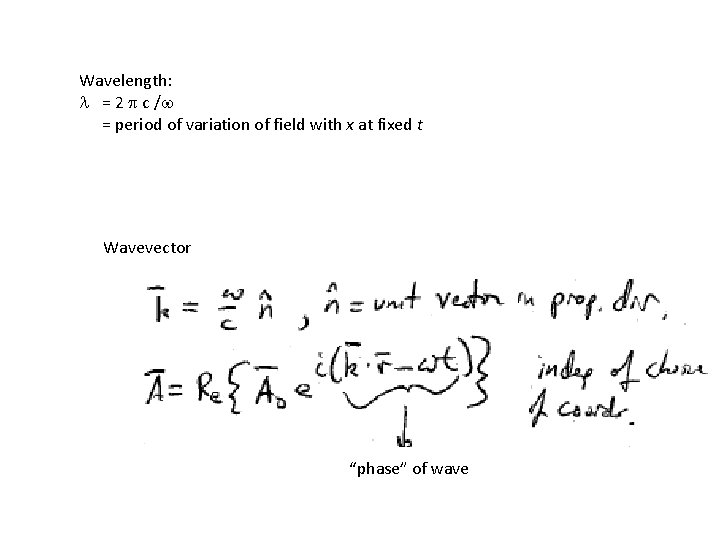
Wavelength: l = 2 p c /w = period of variation of field with x at fixed t Wavevector “phase” of wave
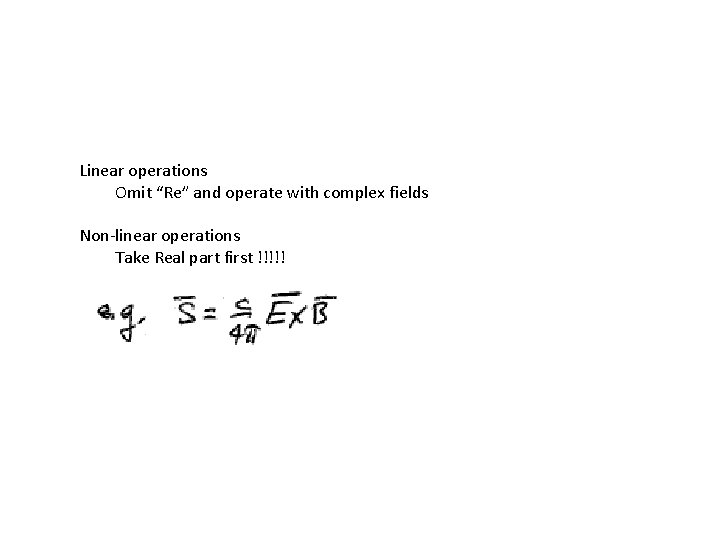
Linear operations Omit “Re” and operate with complex fields Non-linear operations Take Real part first !!!!!
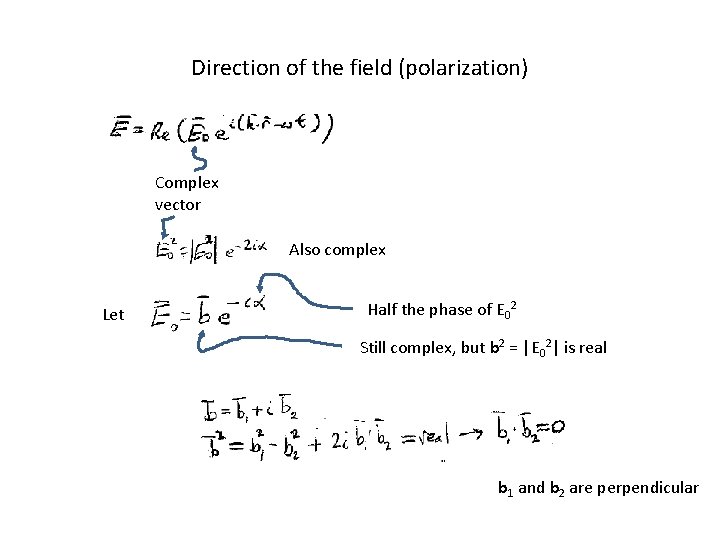
Direction of the field (polarization) Complex vector Also complex Let Half the phase of E 02 Still complex, but b 2 = |E 02| is real b 1 and b 2 are perpendicular
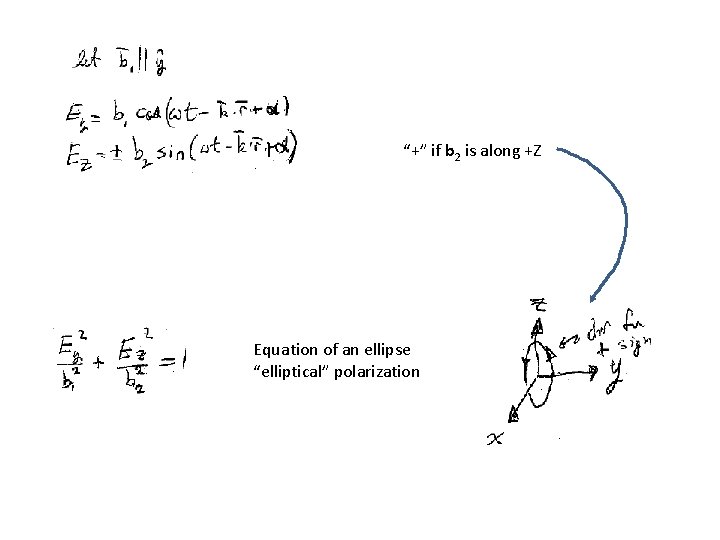
“+” if b 2 is along +Z Equation of an ellipse “elliptical” polarization
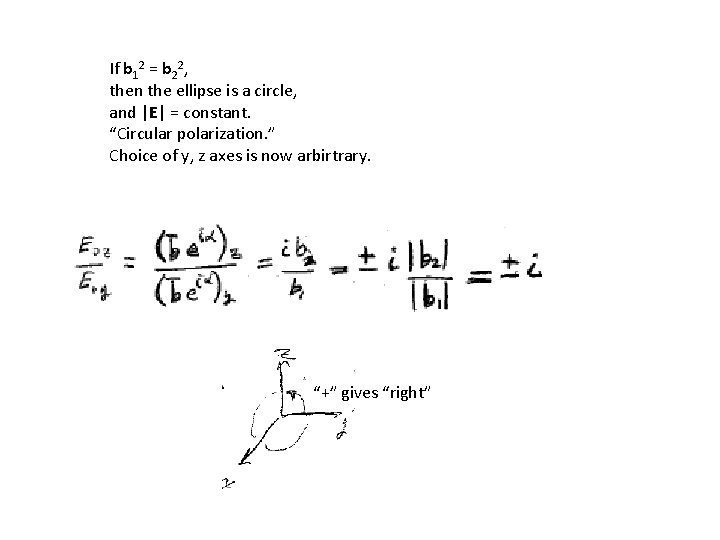
If b 12 = b 22, then the ellipse is a circle, and |E| = constant. “Circular polarization. ” Choice of y, z axes is now arbirtrary. “+” gives “right”
If b 1 or b 2 = 0, then ellipse is a line. “Linear polarization” “plane polarized” Any elliptical polarization is a superposition of plane polarized waves.
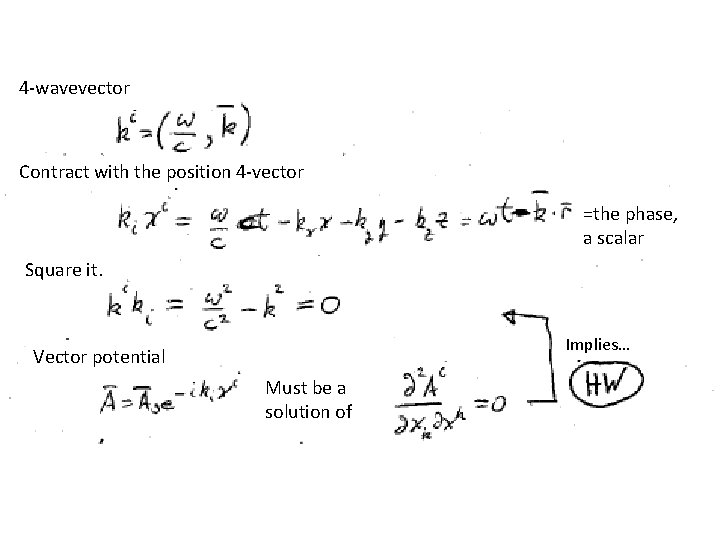
4 -wavevector Contract with the position 4 -vector =the phase, a scalar Square it. Implies… Vector potential Must be a solution of
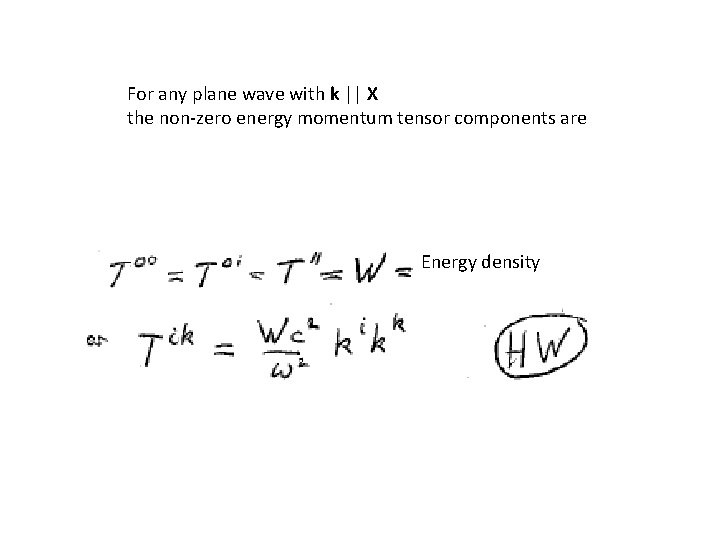
For any plane wave with k || X the non-zero energy momentum tensor components are Energy density
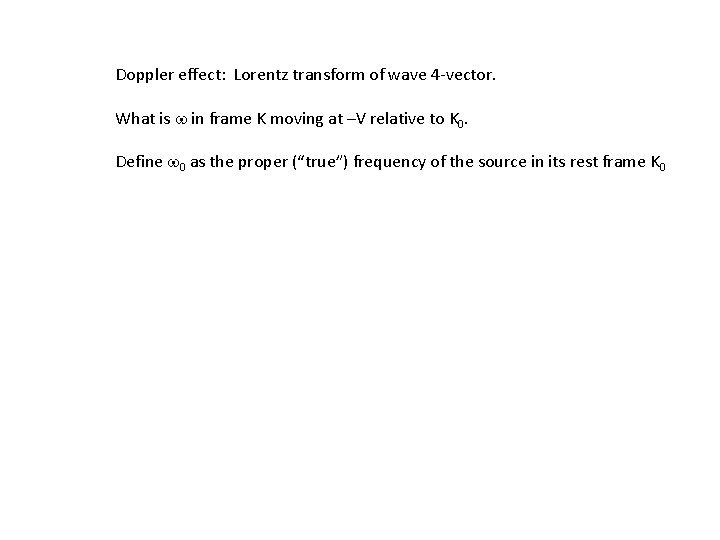
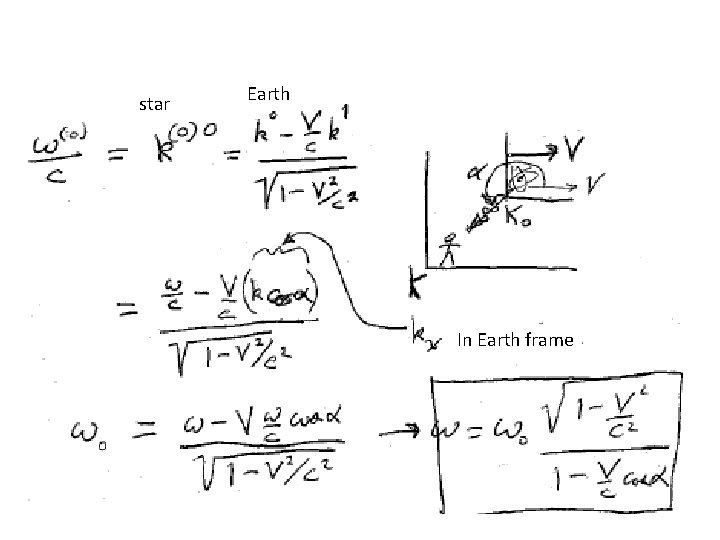
Doppler effect: Lorentz transform of wave 4 -vector. What is w in frame K moving at –V relative to K 0. Define w 0 as the proper (“true”) frequency of the source in its rest frame K 0
star Earth In Earth frame
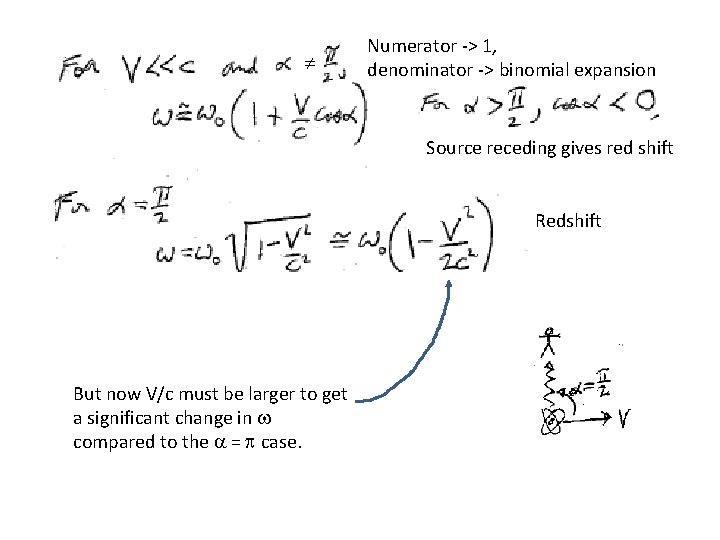
¹ Numerator -> 1, denominator -> binomial expansion Source receding gives red shift Redshift But now V/c must be larger to get a significant change in w compared to the a = p case.