
Monitoring system of the LHCb electromagnetic calorimeter NEC
Monitoring system of the LHCb electromagnetic calorimeter NEC’ 2007, Varna, Bulgaria Ivan Korolko (ITEP Moscow)
Outline • • LHCb detector LHCb CALO monitoring system
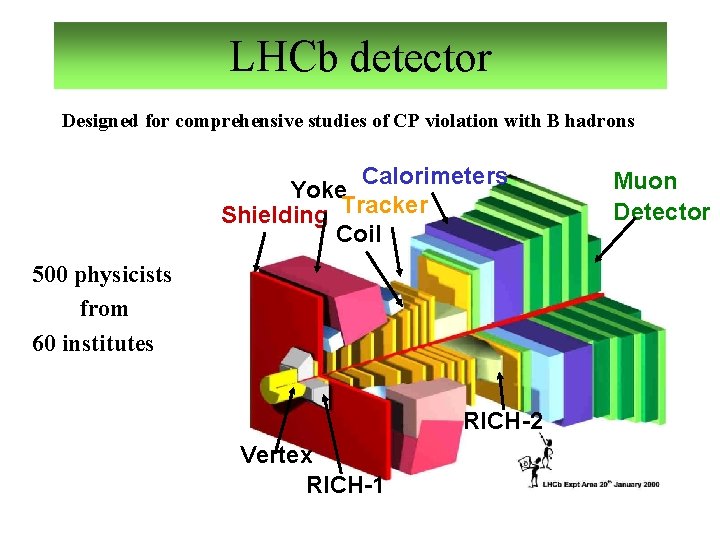
LHCb detector Designed for comprehensive studies of CP violation with B hadrons Calorimeters Yoke Shielding Tracker Coil 500 physicists from 60 institutes RICH-2 Vertex RICH-1 Muon Detector

LHCb in numbers LHCb nominal Luminosity rate of p-p interactions HLT output RAW data per year → 2 x 1032 cm-2 s-1 → 2 x 10⁷ per second → 2000 Hz → 2 x 10¹⁰ events (500 TB) Events with b quarks acceptance for b-events Br. for CP channels Number of CP channels → 105 per second (!) → 5 -10% → ~10 -5 → ~50 ~5 signal events in every second of LHCb operation – GREAT! Have to select them from 1. 5 x 10⁷ background events Signature of LHCb signals is not very bright (Pt , vertex)
LHCb calorimeter system Sensitive Pad Detector - triggering, photons Preshower - triggering, electrons ECAL - triggering, photons, π0 HCAL - triggering Participating (in CALO) Russian institutes: IHEP, INR, ITEP
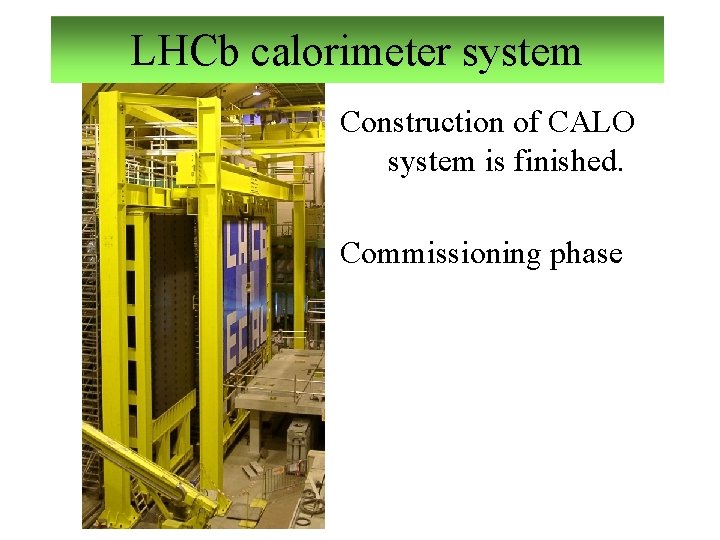
LHCb calorimeter system Construction of CALO system is finished. Commissioning phase
Monitoring system We have to measure small CP effects • • Stability of trigger algorithms Effective reconstruction (S/B ratio) Robust monitoring is vital for LHCb operation • • • Temperature variations Radiation induced degradation HV instability
Monitoring system LHCb grid system for Monte-Carlo simulation and analysis PHENIX HERA-B LHCb • • – - laser based monitoring LEDs controlled with Pi. N diodes Long term stability Possibility to calibrate CALO system with MIPs
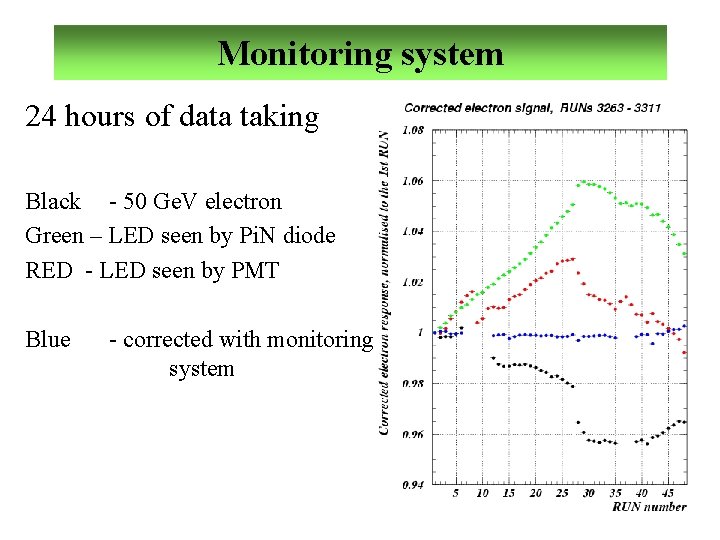
Monitoring system 24 hours of data taking Black - 50 Ge. V electron Green – LED seen by Pi. N diode RED - LED seen by PMT Blue - corrected with monitoring system
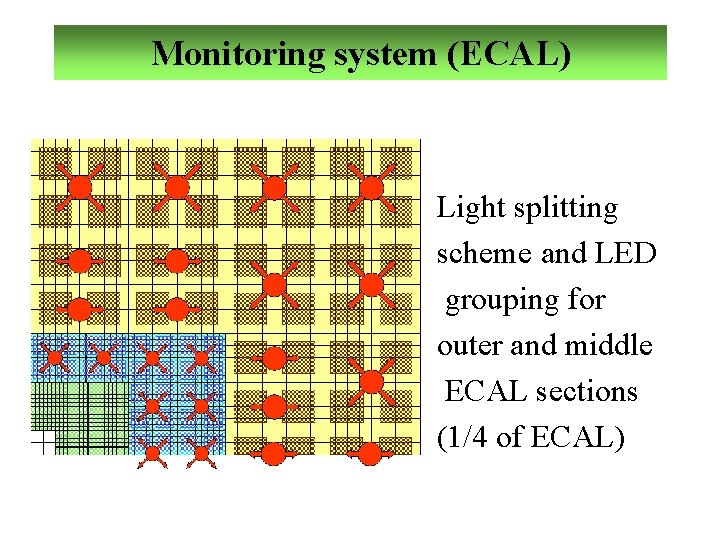
Monitoring system (ECAL) Light splitting scheme and LED grouping for outer and middle ECAL sections (1/4 of ECAL)
Monitoring system (ECAL) ~6000 ECAL channels are monitored with 536 LEDs controlled with 128 Pi. N diodes long term stability – better than 0. 3%
- Slides: 11