
Monitoring Saturns Upper Atmosphere Density Variations Using Helium
- Slides: 16
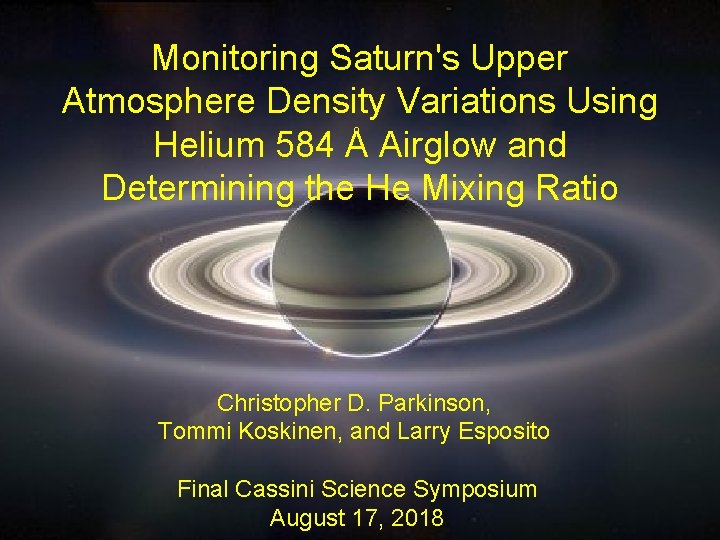
Monitoring Saturn's Upper Atmosphere Density Variations Using Helium 584 Å Airglow and Determining the He Mixing Ratio Christopher D. Parkinson, Tommi Koskinen, and Larry Esposito Final Cassini Science Symposium August 17, 2018
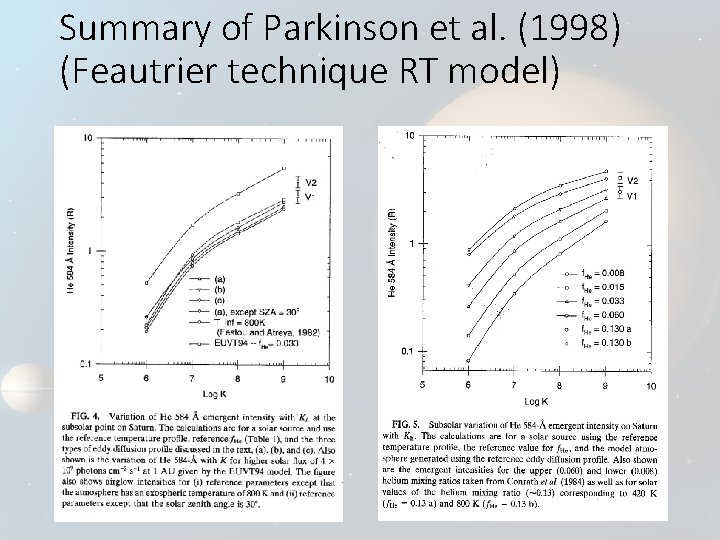
Principal Parameters • The principal parameters involved in determining the He 584 Å albedo are: • • f. He, the helium volume mixing ratio well below the homopause, the eddy diffusion coefficient at the homopause, Kh, the solar He 584 Å flux and line shape, and the atmospheric temperature profile, T(z). • Parkinson et al. (1998) used a reference model atmosphere where f. He = 0. 033 ± 0. 025 from the Voyager IRIS measurements (Conrath et al. , 1984), but also explored other values. For their reference conditions they chose Kh = 106 - 109 cm 2 s-1. 2
Previous Results • The first Saturnian He 584 Å dayglow emission observation was from Voyager 1 (Broadfoot et al. , 1981) with a diskaveraged value of 3. 1 ± 0. 4 R. Voyager 2 reported a diskaveraged value of 4. 2 ± 0. 5 R (Sandel et al. , 1982) • Parkinson et al. (1998) found that Kh “is likely to be greater than 108 cm 2 s-1” for reference model atmospheres. • Need for a more detailed analysis using new measurements (i. e. Cassini UVIS) • Issues and Uncertainties (Parkinson et al. , 1998) • Problems with Voyager calibration? Were there unknown uncertainties in the airglow measurement due to calibration? • integrated He 584Å solar line flux • planetary mixing ratio of He in the deep atmosphere
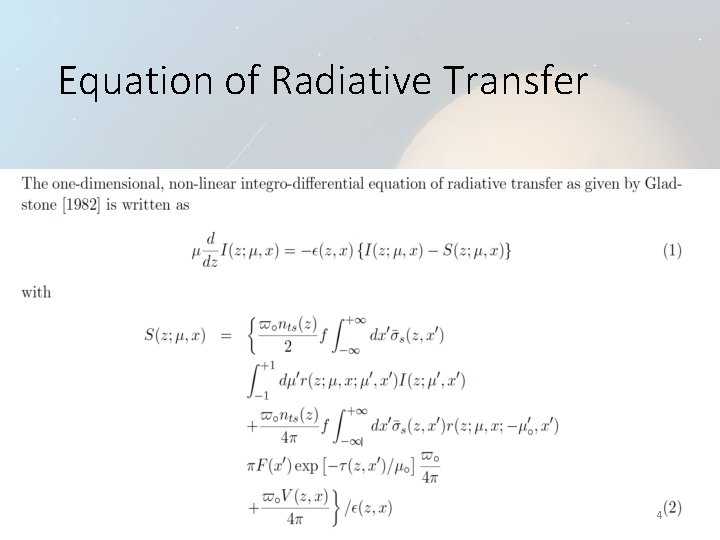
Equation of Radiative Transfer 4
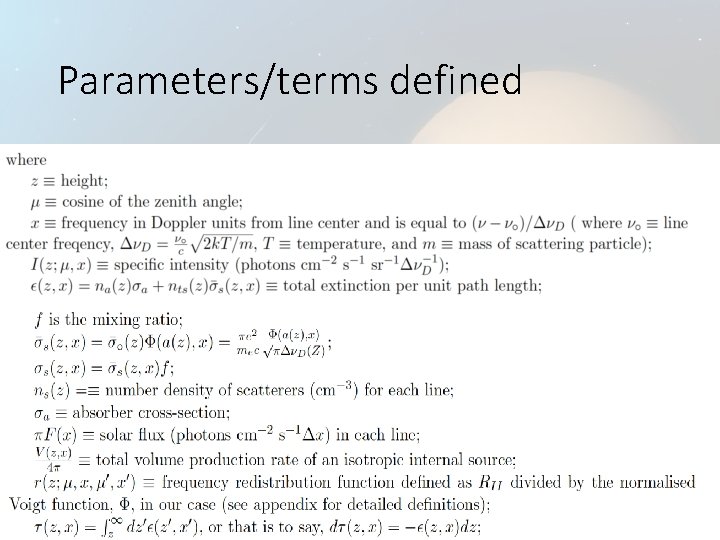
Parameters/terms defined 5
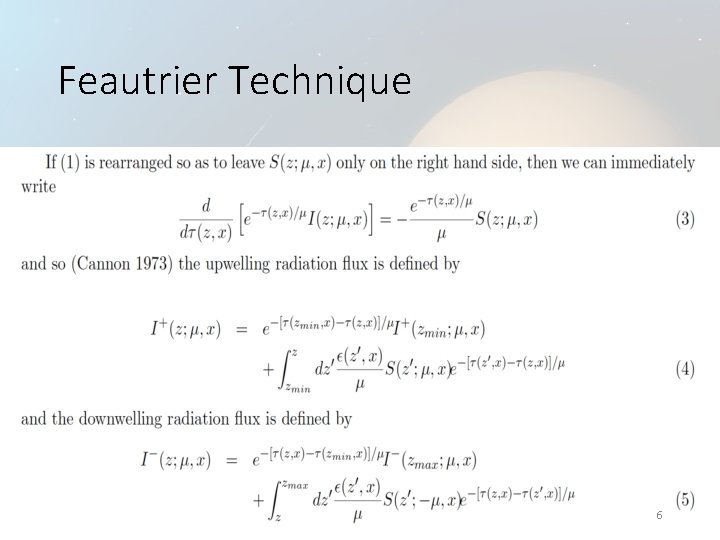
Feautrier Technique 6
Summary of Parkinson et al. (1998) (Feautrier technique RT model)
New Direction • These reference model atmospheres are superseded by those determined by Koskinen et al. (2015) giving precise stellar occultation values for the mixing ratios of He, atomic H, H 2, and CH 4. • Also evaluated are hitherto unprecedented accurate temperature and eddy mixing profiles, T(z) and Kz. • Koskinen et al. (2018) predict f. He = 0. 11 +/- 0. 02; vary our model atmosphere using new T(z) and Kz over this range for input to RT model. • Apply resonance scattering model to the He 584 Å problem using the Feautrier technique to solve the equation of radiative transfer assuming partial frequency redistribution (Gladstone, 1982; 8 Parkinson et al. , 1998; Parkinson et al. , 2006; 2016)
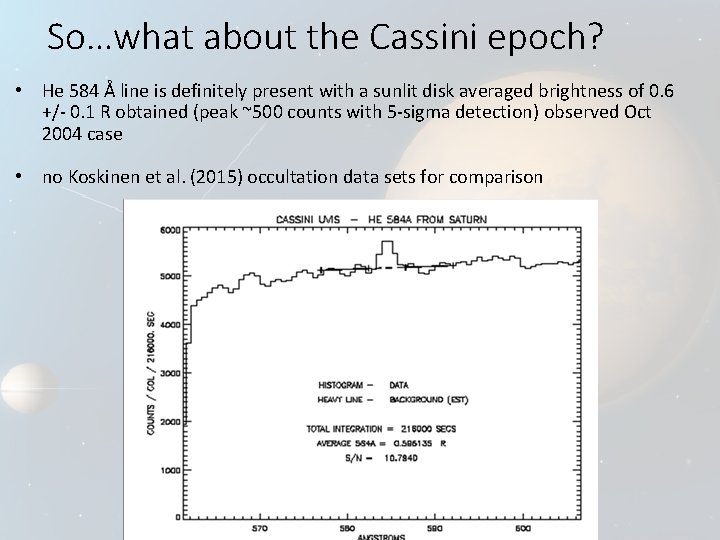
So…what about the Cassini epoch? • He 584 Å line is definitely present with a sunlit disk averaged brightness of 0. 6 +/- 0. 1 R obtained (peak ~500 counts with 5 -sigma detection) observed Oct 2004 case • no Koskinen et al. (2015) occultation data sets for comparison
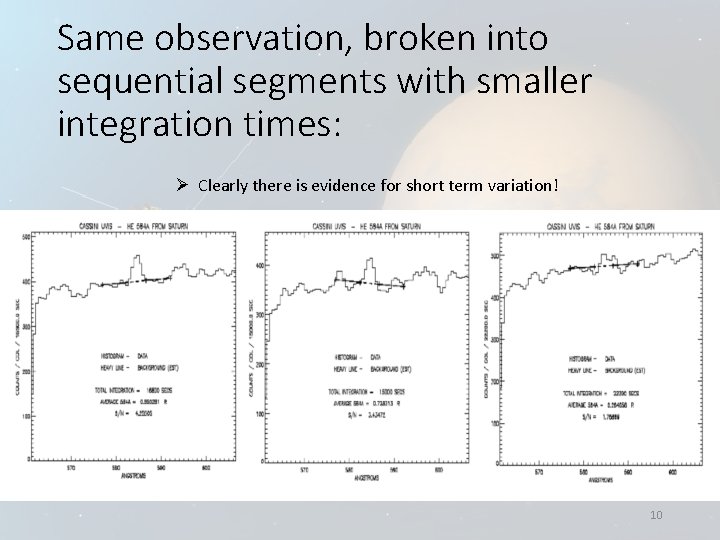
Same observation, broken into sequential segments with smaller integration times: Ø Clearly there is evidence for short term variation! 10
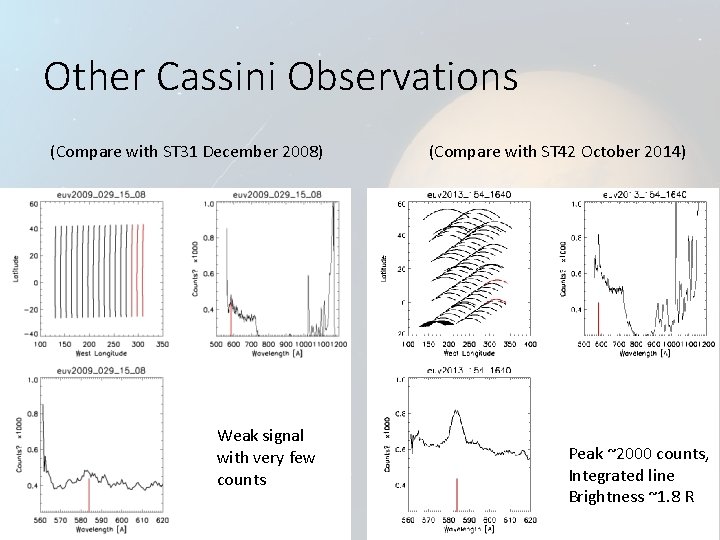
Other Cassini Observations (Compare with ST 31 December 2008) Weak signal with very few counts (Compare with ST 42 October 2014) Peak ~2000 counts, Integrated line Brightness ~1. 8 R 11
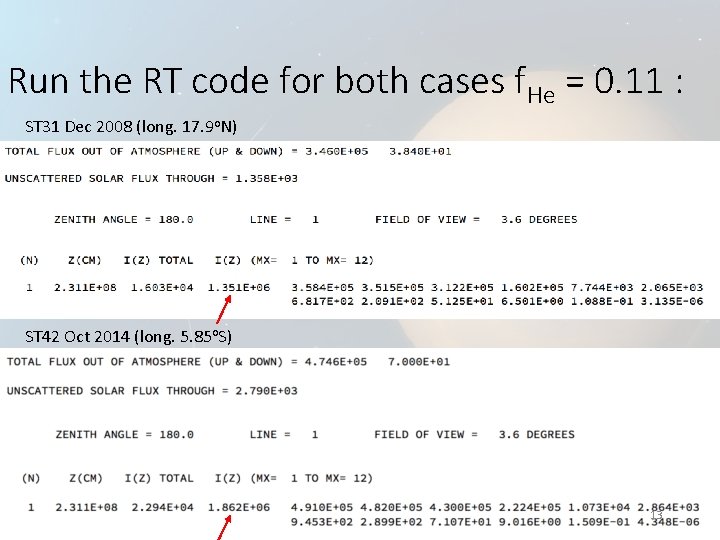
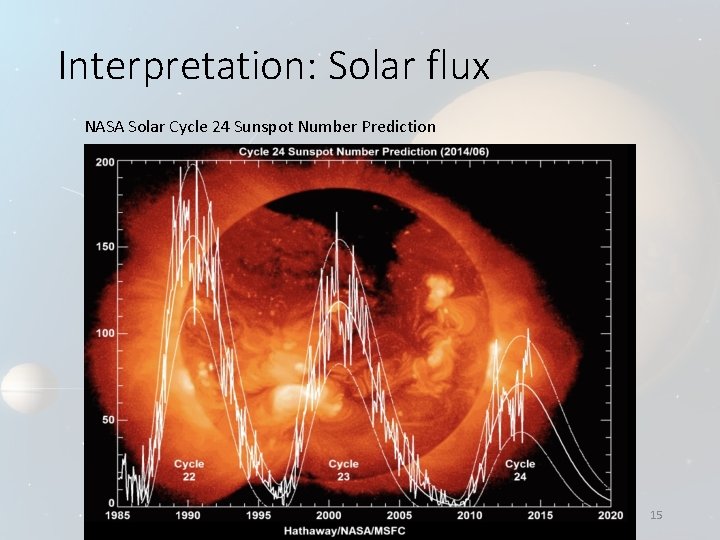
Choose stellar occultation cases corresponding to: 1. ST 31 Dec 2008 (long. 17. 9 o. N) 2. ST 42 Oct 2014 (long. 5. 85 o. S) • Case 1 corresponds closely to solar minimum • Case 2 corresponds closely to solar maximum • Obtain solar flux values obtained from TIMED/SEE solar EUV experiment 12
Run the RT code for both cases f. He = 0. 11 : ST 31 Dec 2008 (long. 17. 9 o. N) ST 42 Oct 2014 (long. 5. 85 o. S) 13
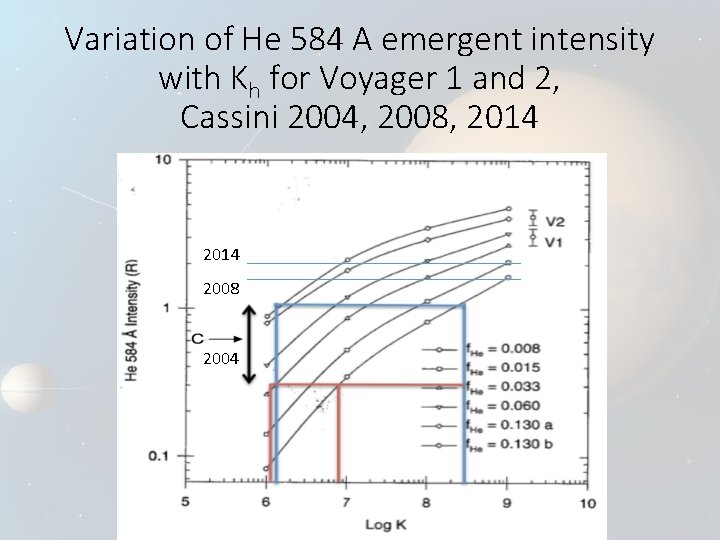
Variation of He 584 A emergent intensity with Kh for Voyager 1 and 2, Cassini 2004, 2008, 2014 2008 2004
Interpretation: Solar flux NASA Solar Cycle 24 Sunspot Number Prediction 15
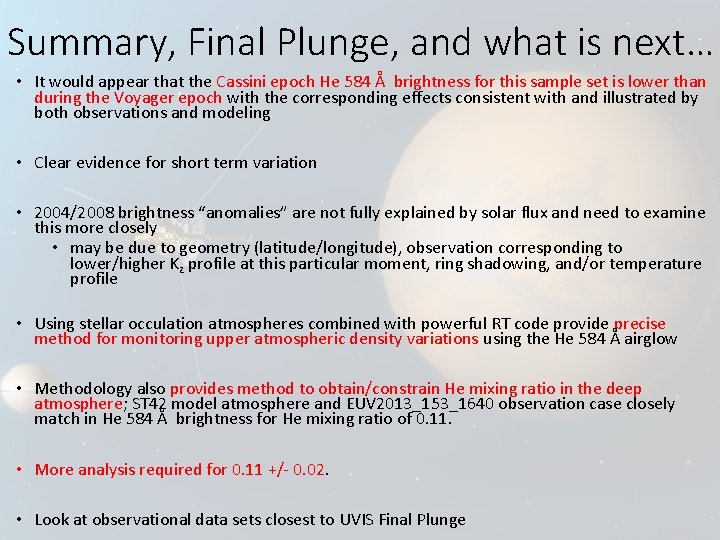
Summary, Final Plunge, and what is next… • It would appear that the Cassini epoch He 584 Å brightness for this sample set is lower than during the Voyager epoch with the corresponding effects consistent with and illustrated by both observations and modeling • Clear evidence for short term variation • 2004/2008 brightness “anomalies” are not fully explained by solar flux and need to examine this more closely • may be due to geometry (latitude/longitude), observation corresponding to lower/higher Kz profile at this particular moment, ring shadowing, and/or temperature profile • Using stellar occulation atmospheres combined with powerful RT code provide precise method for monitoring upper atmospheric density variations using the He 584 Å airglow • Methodology also provides method to obtain/constrain He mixing ratio in the deep atmosphere; ST 42 model atmosphere and EUV 2013_153_1640 observation case closely match in He 584 Å brightness for He mixing ratio of 0. 11. • More analysis required for 0. 11 +/- 0. 02. • Look at observational data sets closest to UVIS Final Plunge