
Monitoring Reporting and Verification in the EU ETS
- Slides: 13
Monitoring, Reporting and Verification in the EU ETS: Status and Implementation Stakeholder Day on the EU MRG Cologne 12 May 2005 Marco Loprieno Climate Change Unit European Commission, DG Environment European Commission: DG Environment
Monitoring…. at the heart of the EU ETS l Companies must monitor and report their GHG emissions from 1 January 2005 onwards l Installations must have a permit, with monitoring and reporting requirements set out therein, from 1 January 2005 onwards European Commission: DG Environment
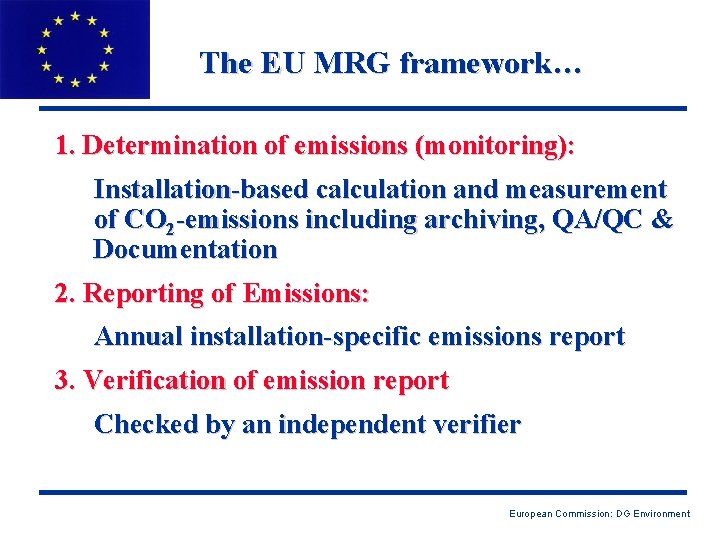
The EU MRG framework… 1. Determination of emissions (monitoring): Installation-based calculation and measurement of CO 2 -emissions including archiving, QA/QC & Documentation 2. Reporting of Emissions: Annual installation-specific emissions report 3. Verification of emission report Checked by an independent verifier European Commission: DG Environment
The Objectives of the EU-MRG l Transparency l Consistency with national inventories l Cost-effective, sufficiently flexible approaches for different sectors, technologies, installation sizes and ages l Total uncertainty within acceptable ranges European Commission: DG Environment
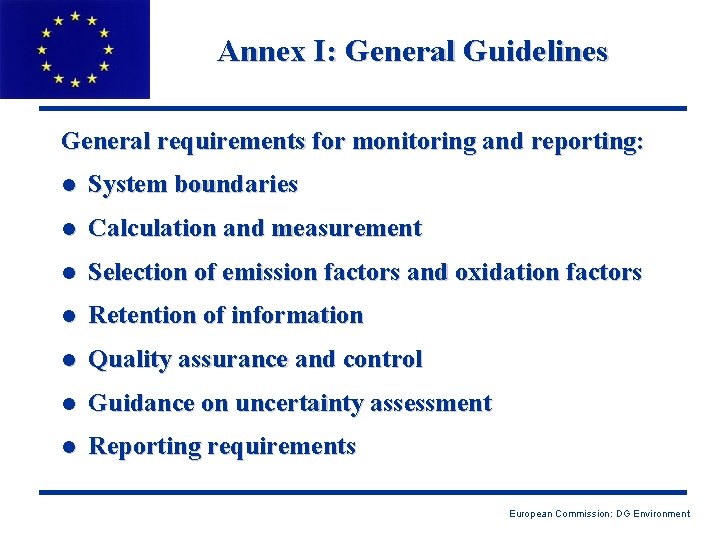
Annex I: General Guidelines General requirements for monitoring and reporting: l System boundaries l Calculation and measurement l Selection of emission factors and oxidation factors l Retention of information l Quality assurance and control l Guidance on uncertainty assessment l Reporting requirements European Commission: DG Environment
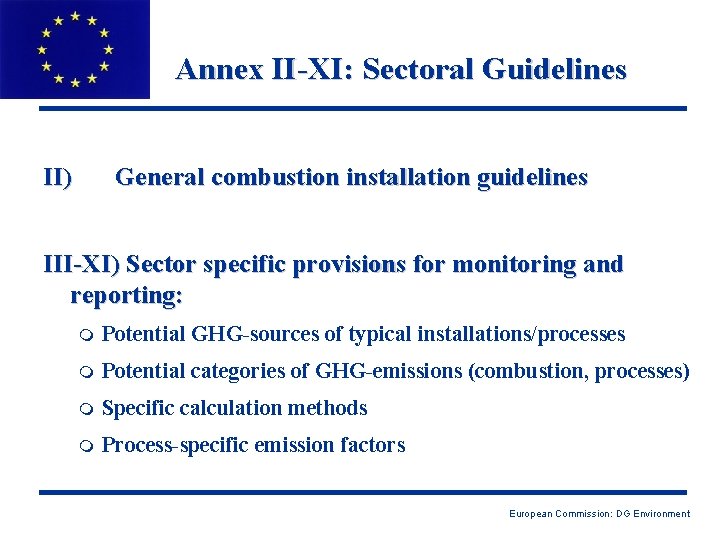
Annex II-XI: Sectoral Guidelines II) General combustion installation guidelines III-XI) Sector specific provisions for monitoring and reporting: m Potential GHG-sources of typical installations/processes m Potential categories of GHG-emissions (combustion, processes) m Specific calculation methods m Process-specific emission factors European Commission: DG Environment
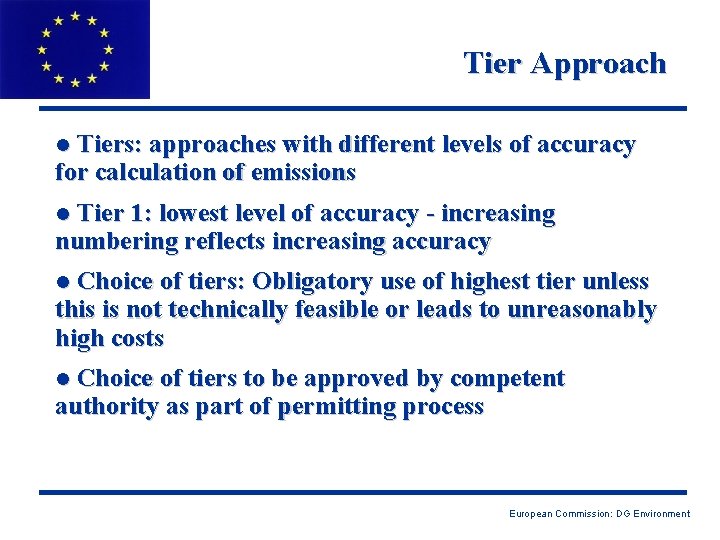
Tier Approach l Tiers: approaches with different levels of accuracy for calculation of emissions l Tier 1: lowest level of accuracy - increasing numbering reflects increasing accuracy l Choice of tiers: Obligatory use of highest tier unless this is not technically feasible or leads to unreasonably high costs l Choice of tiers to be approved by competent authority as part of permitting process European Commission: DG Environment
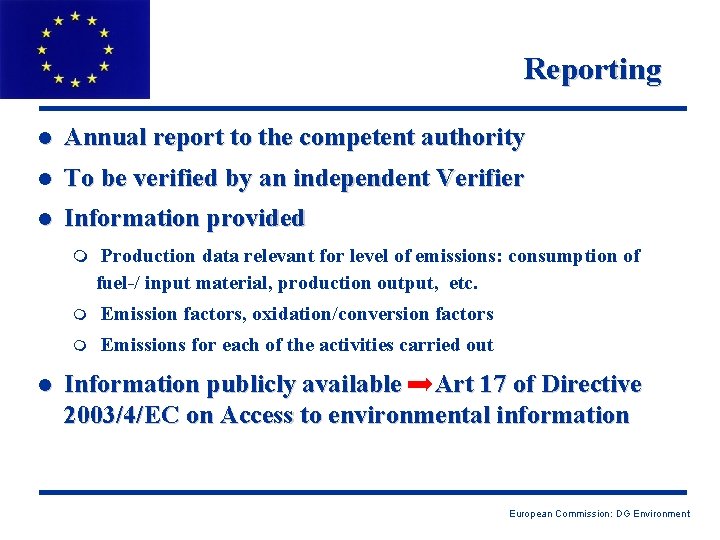
Reporting l Annual report to the competent authority l To be verified by an independent Verifier l Information provided m Production data relevant for level of emissions: consumption of fuel-/ input material, production output, etc. l m Emission factors, oxidation/conversion factors m Emissions for each of the activities carried out Information publicly available Art 17 of Directive 2003/4/EC on Access to environmental information European Commission: DG Environment
Verification & Accreditation No harmonised verification and accreditation requirements in Directive l Some Member States have already set up systems for verifying allocation data l Mutual recognition of verifiers left to the discretion of individual Member States l Possibilities for harmonising verification regime for second trading period? l European Commission: DG Environment
ETS Next Steps No far-reaching changes to the allocation process foreseen for the 2 nd round of NAPs l Fine tuning l Looking to the future, cautious about making alterations to the scheme – policy debate should not get carried away l. . . Commission review of MRG l European Commission: DG Environment
MRG Next Steps EU-MRG are the legally binding framework for monitoring and reporting within the EUETS l 1 st report in March 2006 – but monitoring started on 1 January 2005 l Fine-tuning of Guidelines for 2 nd Period l Input from stakeholders who have hands-on experience of the scheme is crucial l European Commission: DG Environment
MRG Next Steps Report from Stakeholder Day to MS l Update from ECOFYS Study (end of the year/ beginning next year) l From now on MRG on the agenda of discussion with MS l DG ENV Monitoring Web Page l Commission review of MRG – Proposal by mid 2006 – Adoption: end 2006 l European Commission: DG Environment
MRG Next Steps DG ENV Monitoring Web Page: l EU-MRG language version l FAQs on Monitoring & Reporting l Results of Stakeholder Consultation http: //europa. eu. int/comm/environment/climat/ emission/mrg_en. htm Contact: marco. loprieno@cec. eu. int European Commission: DG Environment