
Monitoring Mediterranean grass phenology from digital terrestrial camera

- Slides: 9
Monitoring Mediterranean grass phenology from digital terrestrial camera and Sentinel-2 vegetation indices in an oak-grass savanna ecosystem M. P. González-Dugo, P. J. Gómez-Giráldez, M. J. Pérez. Palazón, M. J. Polo
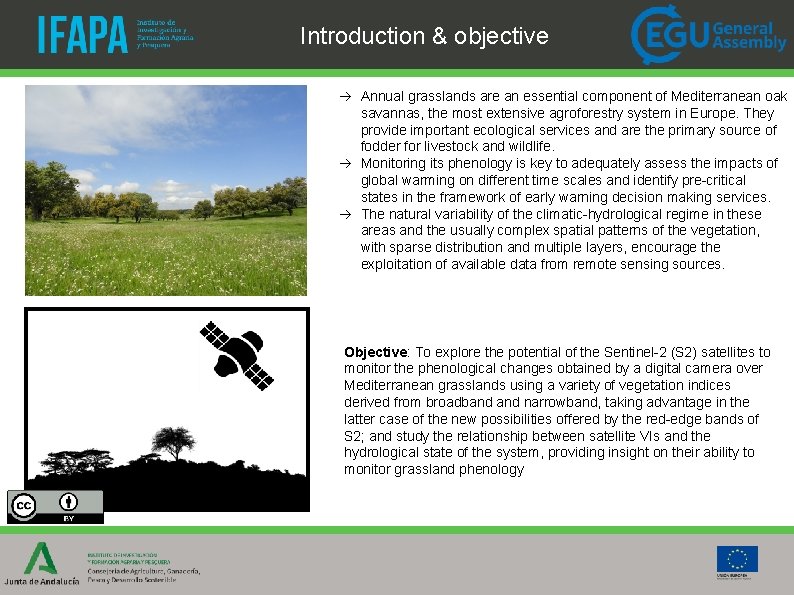
Introduction & objective à Annual grasslands are an essential component of Mediterranean oak savannas, the most extensive agroforestry system in Europe. They provide important ecological services and are the primary source of fodder for livestock and wildlife. à Monitoring its phenology is key to adequately assess the impacts of global warming on different time scales and identify pre-critical states in the framework of early warning decision making services. à The natural variability of the climatic-hydrological regime in these areas and the usually complex spatial patterns of the vegetation, with sparse distribution and multiple layers, encourage the exploitation of available data from remote sensing sources. Objective: To explore the potential of the Sentinel-2 (S 2) satellites to monitor the phenological changes obtained by a digital camera over Mediterranean grasslands using a variety of vegetation indices derived from broadband narrowband, taking advantage in the latter case of the new possibilities offered by the red-edge bands of S 2; and study the relationship between satellite VIs and the hydrological state of the system, providing insight on their ability to monitor grassland phenology
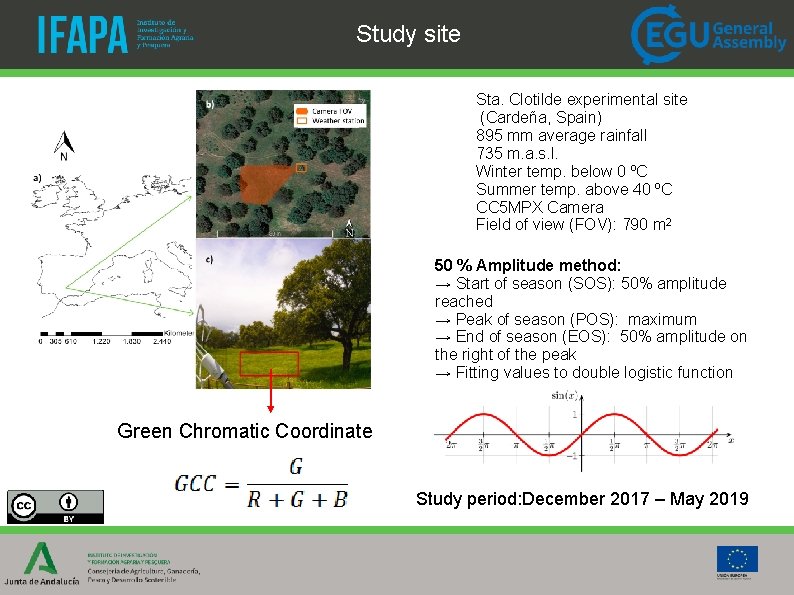
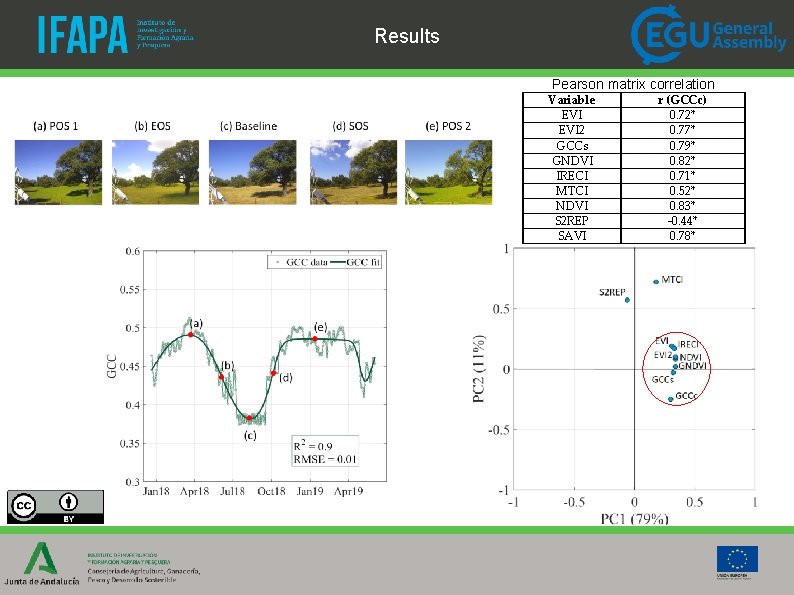
Study site Sta. Clotilde experimental site (Cardeña, Spain) 895 mm average rainfall 735 m. a. s. l. Winter temp. below 0 ºC Summer temp. above 40 ºC CC 5 MPX Camera Field of view (FOV): 790 m 2 50 % Amplitude method: → Start of season (SOS): 50% amplitude reached → Peak of season (POS): maximum → End of season (EOS): 50% amplitude on the right of the peak → Fitting values to double logistic function Green Chromatic Coordinate Study period: December 2017 – May 2019
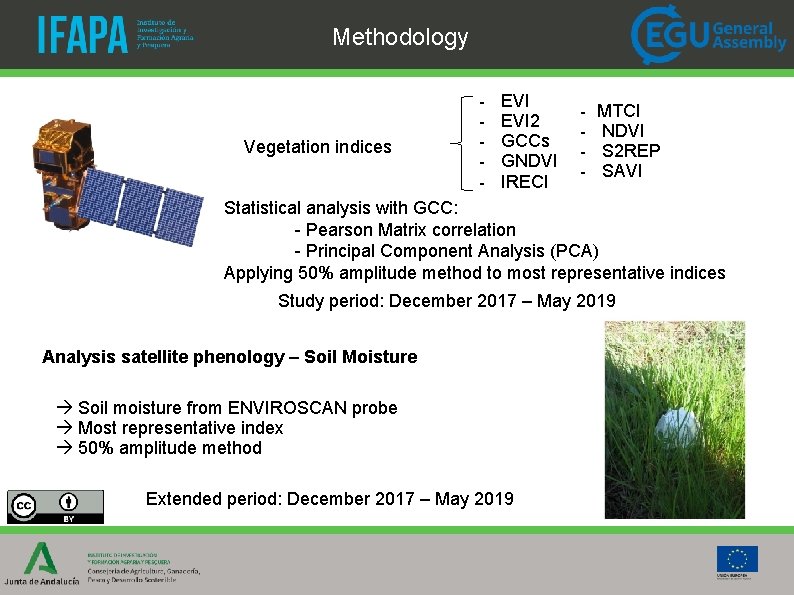
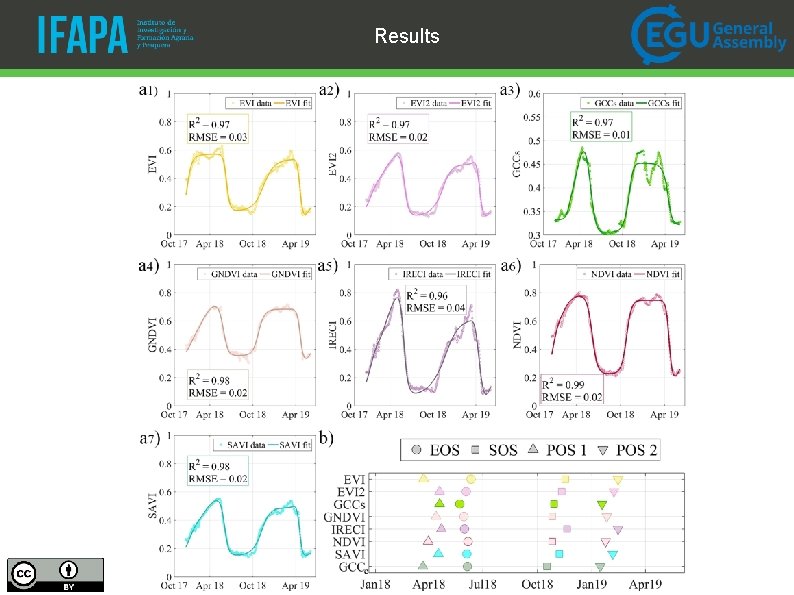
Methodology Vegetation indices - EVI 2 GCCs GNDVI IRECI - MTCI NDVI S 2 REP SAVI Statistical analysis with GCC: - Pearson Matrix correlation - Principal Component Analysis (PCA) Applying 50% amplitude method to most representative indices Study period: December 2017 – May 2019 Analysis satellite phenology – Soil Moisture à Soil moisture from ENVIROSCAN probe à Most representative index à 50% amplitude method Extended period: December 2017 – May 2019
Results Pearson matrix correlation Variable EVI 2 GCCs GNDVI IRECI MTCI NDVI S 2 REP SAVI r (GCCc) 0. 72* 0. 77* 0. 79* 0. 82* 0. 71* 0. 52* 0. 83* -0. 44* 0. 78*
Results
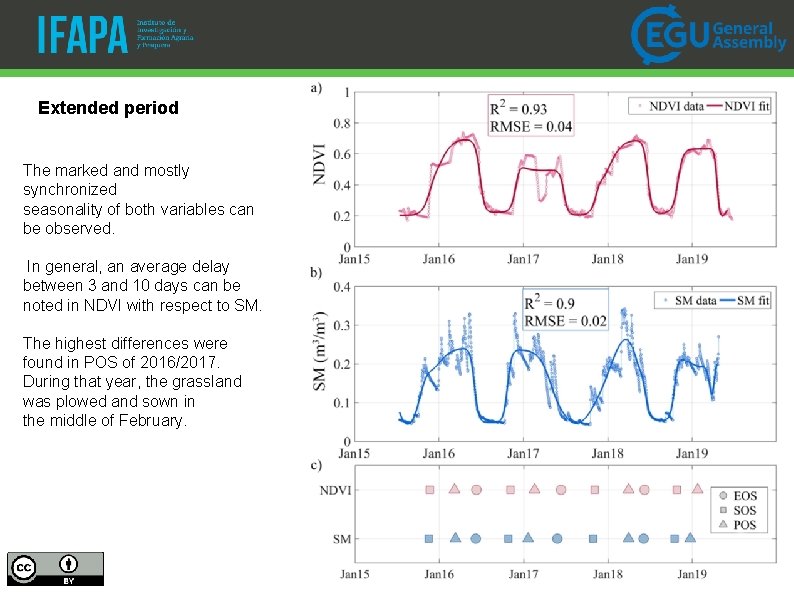
Extended period The marked and mostly synchronized seasonality of both variables can be observed. In general, an average delay between 3 and 10 days can be noted in NDVI with respect to SM. The highest differences were found in POS of 2016/2017. During that year, the grassland was plowed and sown in the middle of February. Results
Conclusions à The estimation of phenology using field measured GCCc and the 50% amplitude method corresponded well with the visual inspection à NDVI was the satellite index that best reproduced the behavior of GCCc, with the highest correlation (r = 0. 83) and less than 10 days of difference for all the phenological parameters studied à NDVI and SM behavior during the four growing seasons showed a high synchronization à This results suggest the possibilities of monitoring the hydric state of the soil using the phenological parameters obtained from S 2 NDVI under certain conditions
Thank you for your attention Acknowledgements: Sens. Dehesa (PP. PEI. IDF 201601. 16) project cofunded at 80% by the European Regional Development Fund (ERDF), Operative Program of Andalusia 2014 -2020 and additional support was provided by the project "Control and early warning of critical ecohydrological states in areas of Dehesa and high mountains through terrestrial photography", funded by the Biodiversity Foundation, Spanish Ministry of Agriculture, Fisheries, Food, and Environment.