
Monitoring Io volcanic Activity Franck Marchis Conor Laver

- Slides: 27
Monitoring Io volcanic Activity Franck Marchis Conor Laver, Imke de Pater (UC -Berkeley) Collaborators: A. Davies, E. Hom, R. Lopes.
Outline • 2001 -2002 monitoring (not again! published Marchis et al. 2005) • 2003 -2004 Monitoring • What happened in 2005? • First OSIRIS data • Future AO for Keck and beyond
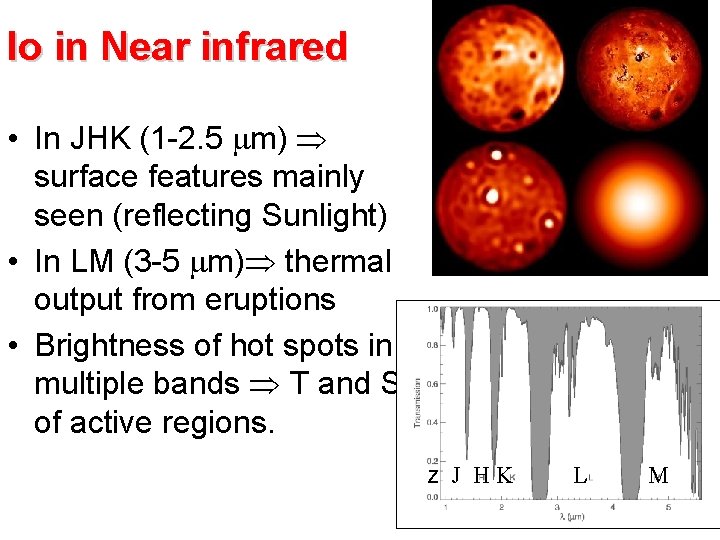
Io in Near infrared • In JHK (1 -2. 5 m) surface features mainly seen (reflecting Sunlight) • In LM (3 -5 m) thermal output from eruptions • Brightness of hot spots in multiple bands T and SA of active regions. z J HK L M
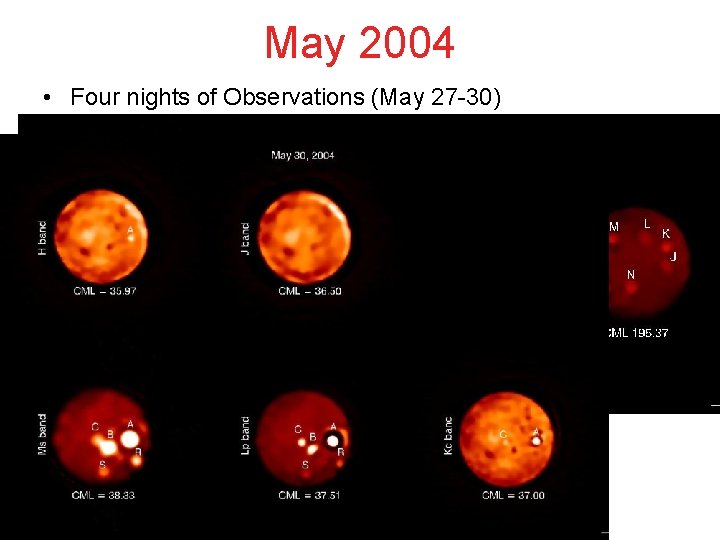
2003 -2004 Monitoring The Keck Adaptive Optics instrument which provides high angular resolution images is a perfect tool to monitor the volcanic activity of Io. Data: Observations were recorded in imaging mode using the NIRC-2 infrared camera mounted on the Keck-10 m AO system through several filters spanning 1 -5 m on January 26, 2003, March 8, 2003, and May 27 -30, 2004. • • At l < 2. 5 m in J (1. 2 m), H (1. 6 m), K (2. 2 m) bands, albedo surface features (paterae, pyroclastic deposit fields) are visible with a spatial resolution ~150 km At l > 3 m, Lp (3. 7 m) & Ms (4. 8 m) bands, thermal signatures of active volcanoes (T~500 K) dominate the image. Analysis: After enhancing the image sharpness with AIDA (Hom et al. , 2005) or MISTRAL (Mugnier et al. , 2004) algorithms, the position and brightness of individual hot spots were determined.
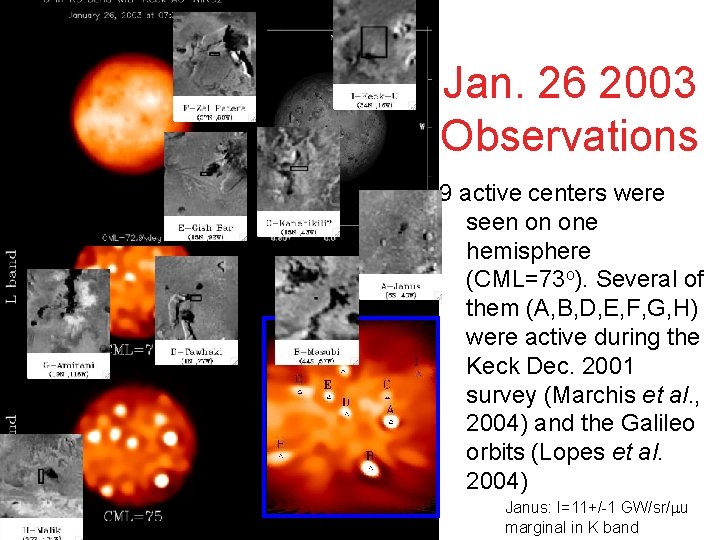
Jan. 26 2003 Observations 9 active centers were seen on one hemisphere (CML=73 o). Several of them (A, B, D, E, F, G, H) were active during the Keck Dec. 2001 survey (Marchis et al. , 2004) and the Galileo orbits (Lopes et al. 2004) Janus: I=11+/-1 GW/sr/ u marginal in K band
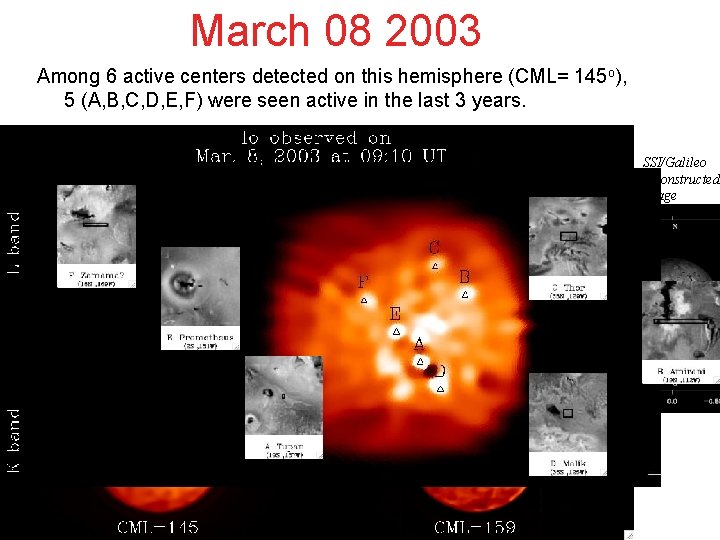
March 08 2003 Among 6 active centers detected on this hemisphere (CML= 145 o), 5 (A, B, C, D, E, F) were seen active in the last 3 years. SSI/Galileo reconstructed image
May 2004 • Four nights of Observations (May 27 -30)
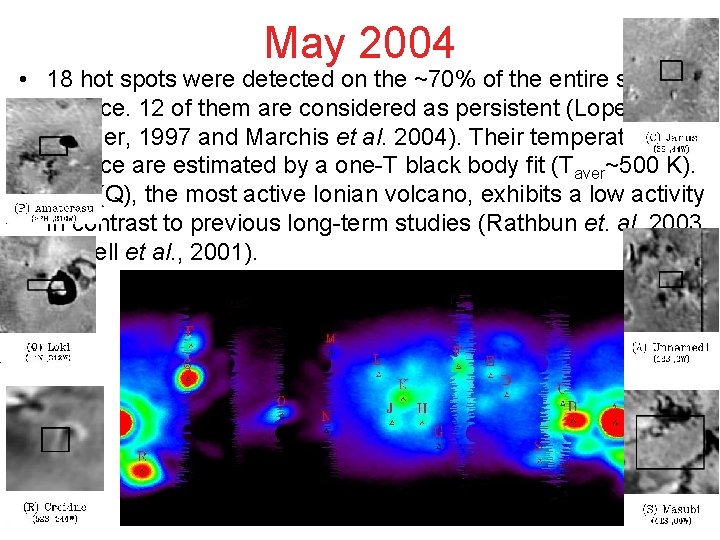
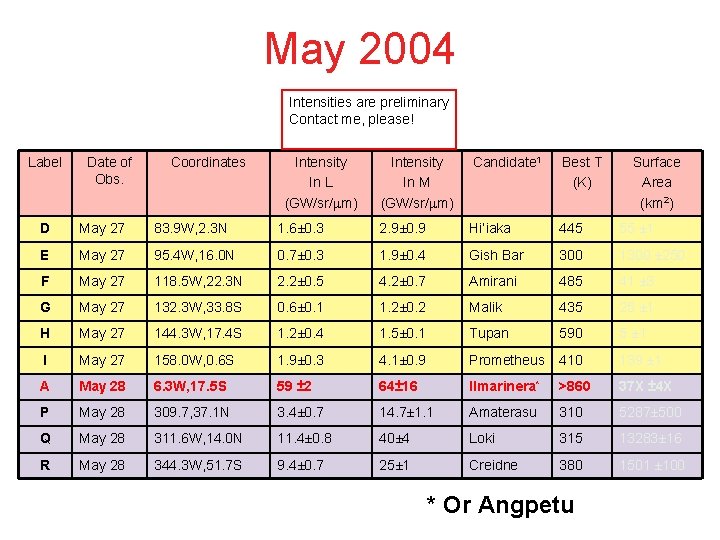
May 2004 • 18 hot spots were detected on the ~70% of the entire satellite surface. 12 of them are considered as persistent (Lopes. Gautier, 1997 and Marchis et al. 2004). Their temperature and surface are estimated by a one-T black body fit (Taver~500 K). 360 180 Loki (Q), the most active Ionian volcano, exhibits a low activity in contrast to previous long-term studies (Rathbun et. al. , 2003, Howell et al. , 2001).
May 2004 Intensities are preliminary Contact me, please! Label Date of Obs. Coordinates Intensity In L (GW/sr/ m) Intensity In M (GW/sr/ m) Candidate 1 Best T (K) Surface Area (km 2) D May 27 83. 9 W, 2. 3 N 1. 6± 0. 3 2. 9± 0. 9 Hi’iaka 445 55 ± 1 E May 27 95. 4 W, 16. 0 N 0. 7± 0. 3 1. 9± 0. 4 Gish Bar 300 1300 ± 250 F May 27 118. 5 W, 22. 3 N 2. 2± 0. 5 4. 2± 0. 7 Amirani 485 41 ± 3 G May 27 132. 3 W, 33. 8 S 0. 6± 0. 1 1. 2± 0. 2 Malik 435 25 ± 1 H May 27 144. 3 W, 17. 4 S 1. 2± 0. 4 1. 5± 0. 1 Tupan 590 5 ± 1 I May 27 158. 0 W, 0. 6 S 1. 9± 0. 3 4. 1± 0. 9 Prometheus 410 139 ± 1 A May 28 6. 3 W, 17. 5 S 59 ± 2 64± 16 Ilmarinera* >860 37 X ± 4 X P May 28 309. 7, 37. 1 N 3. 4± 0. 7 14. 7± 1. 1 Amaterasu 310 5287± 500 Q May 28 311. 6 W, 14. 0 N 11. 4± 0. 8 40± 4 Loki 315 13283± 16 R May 28 344. 3 W, 51. 7 S 9. 4± 0. 7 25± 1 Creidne 380 1501 ± 100 * Or Angpetu
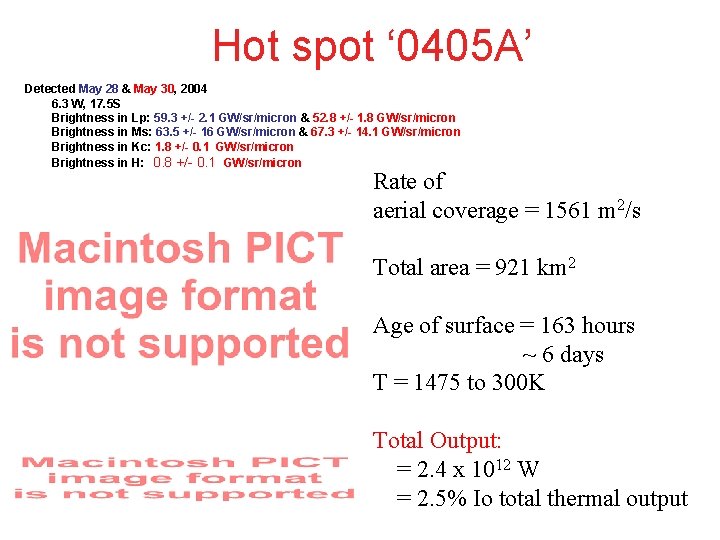
Hot spot ‘ 0405 A’ Detected May 28 & May 30, 2004 6. 3 W, 17. 5 S Brightness in Lp: 59. 3 +/- 2. 1 GW/sr/micron & 52. 8 +/- 1. 8 GW/sr/micron Brightness in Ms: 63. 5 +/- 16 GW/sr/micron & 67. 3 +/- 14. 1 GW/sr/micron Brightness in Kc: 1. 8 +/- 0. 1 GW/sr/micron Brightness in H: 0. 8 +/- 0. 1 GW/sr/micron Rate of aerial coverage = 1561 m 2/s Total area = 921 km 2 Age of surface = 163 hours ~ 6 days T = 1475 to 300 K Total Output: = 2. 4 x 10¹² W = 2. 5% Io total thermal output
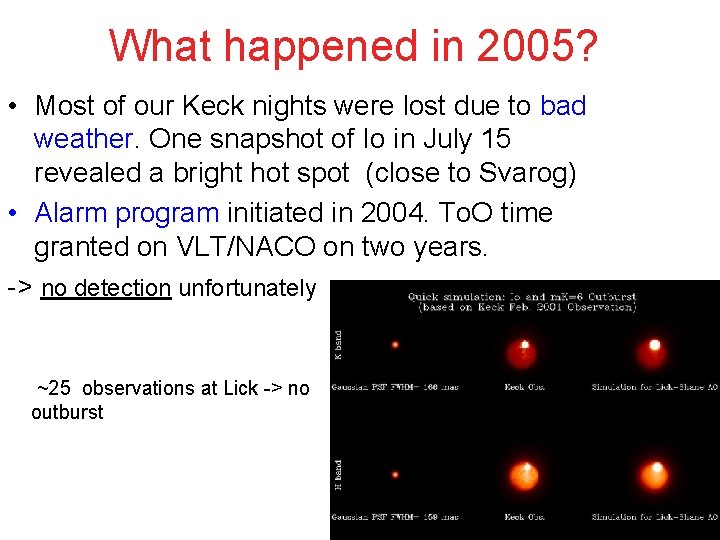
What happened in 2005? • Most of our Keck nights were lost due to bad weather. One snapshot of Io in July 15 revealed a bright hot spot (close to Svarog) • Alarm program initiated in 2004. To. O time granted on VLT/NACO on two years. -> no detection unfortunately ~25 observations at Lick -> no outburst
OSIRIS instrument • Integral Field spectrograph designed to work with Keck OA • Commissioned in 2005 B, offered in 2006 A • R~3400 with an angular resolution of 0. 1” in z, J H K band
OSIRIS
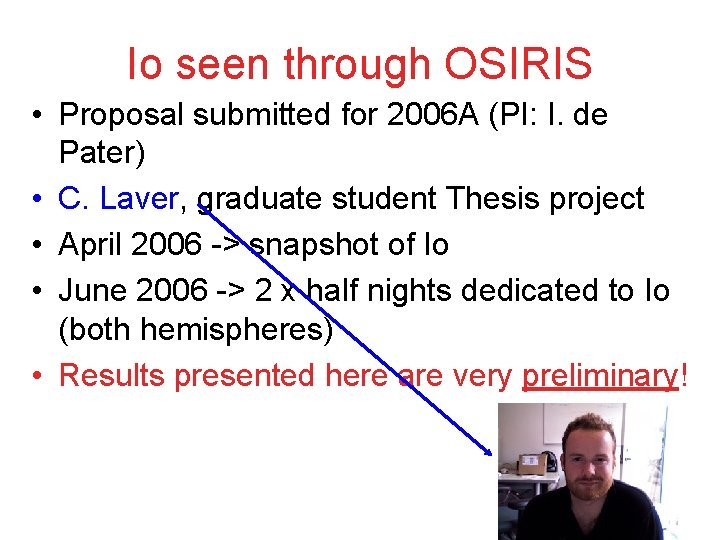
Io seen through OSIRIS • Proposal submitted for 2006 A (PI: I. de Pater) • C. Laver, graduate student Thesis project • April 2006 -> snapshot of Io • June 2006 -> 2 x half nights dedicated to Io (both hemispheres) • Results presented here are very preliminary!
April 2006 Run • • Mode used Kbb (1. 965 m -2. 381 m) 0. 05” scale -> FOV= 0. 56” x 2. 24” Mosaic composed of 2 images 20060417 at 09: 13 UT – Center on Sigurd patera (CML=258 o in planetocentric) – CML= 360 -258 = 102 o in planetographic referential
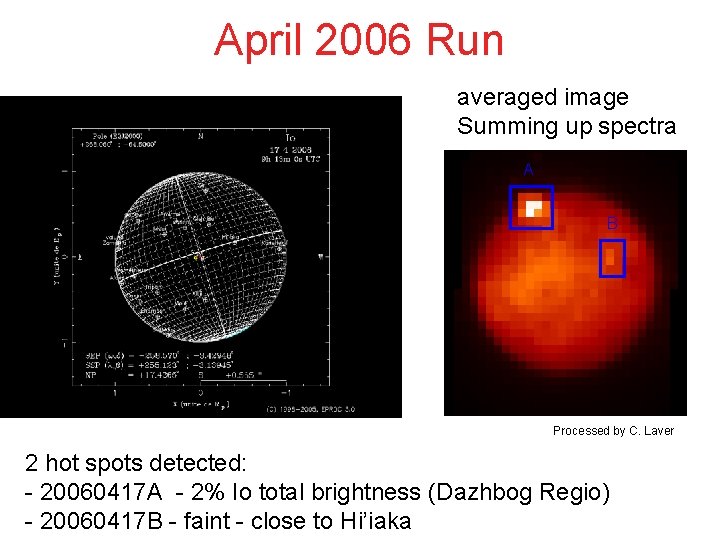
April 2006 Run averaged image Summing up spectra A B Processed by C. Laver 2 hot spots detected: - 20060417 A - 2% Io total brightness (Dazhbog Regio) - 20060417 B - faint - close to Hi’iaka
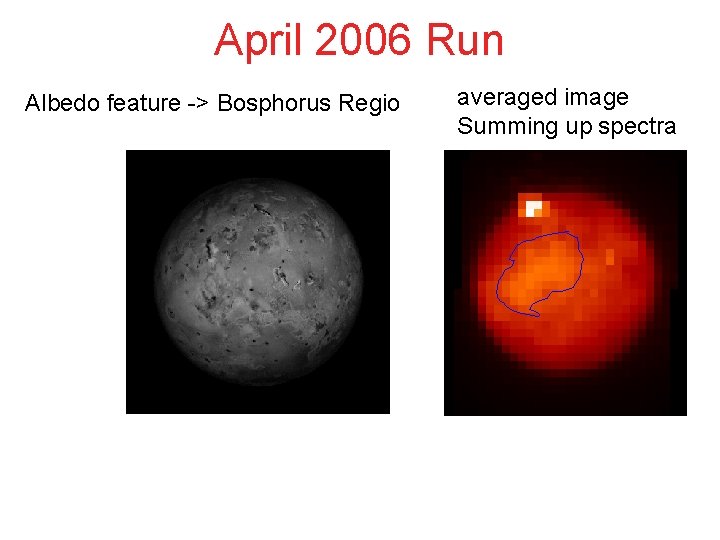
April 2006 Run Albedo feature -> Bosphorus Regio averaged image Summing up spectra
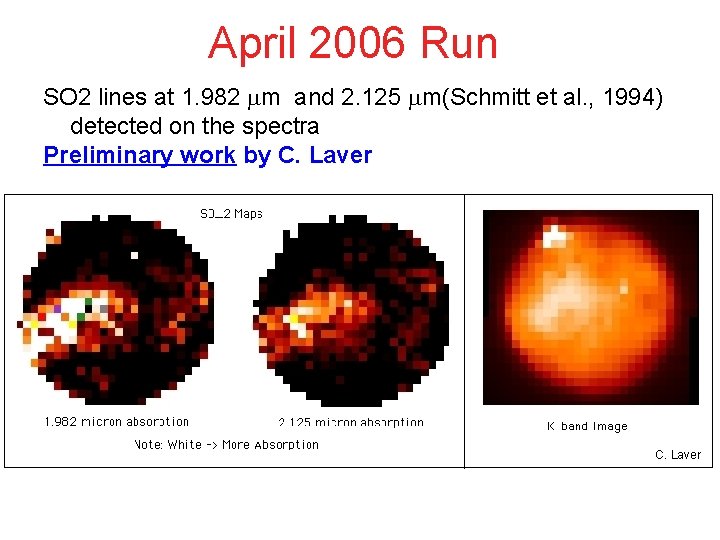
April 2006 Run SO 2 lines at 1. 982 m and 2. 125 m(Schmitt et al. , 1994) detected on the spectra Preliminary work by C. Laver
June 2006 Run • • Observations in Hbb (1. 473 -1. 803 m), Kbb (1. 965 -2. 381) FOV: 0. 32” x 1. 28” (0. 01” / pixel) Global mosaic made of 6 images ~40 min/spectra 2 half-nights – 20060601 – 20060602 centered ~SEP longitude of ~100 degrees Animation by C. Laver 72 images through Kbb No tellurical correction yets ~40 min to scan
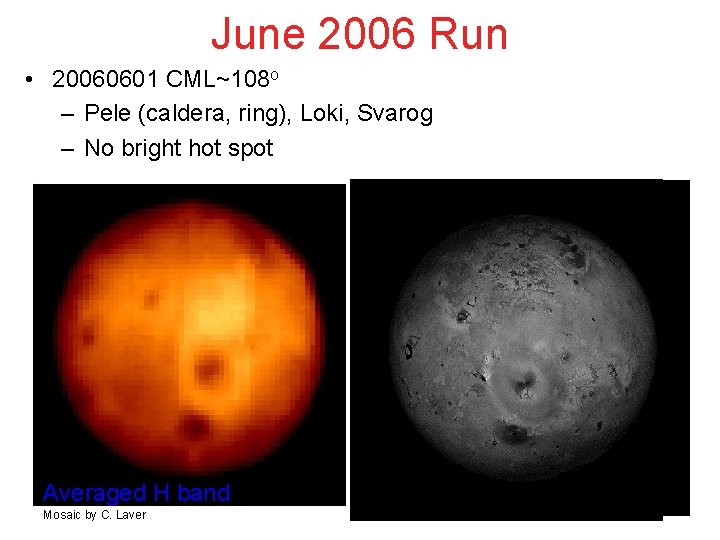
June 2006 Run • 20060601 CML~108 o – Pele (caldera, ring), Loki, Svarog – No bright hot spot Averaged H band Mosaic by C. Laver Averaged K band
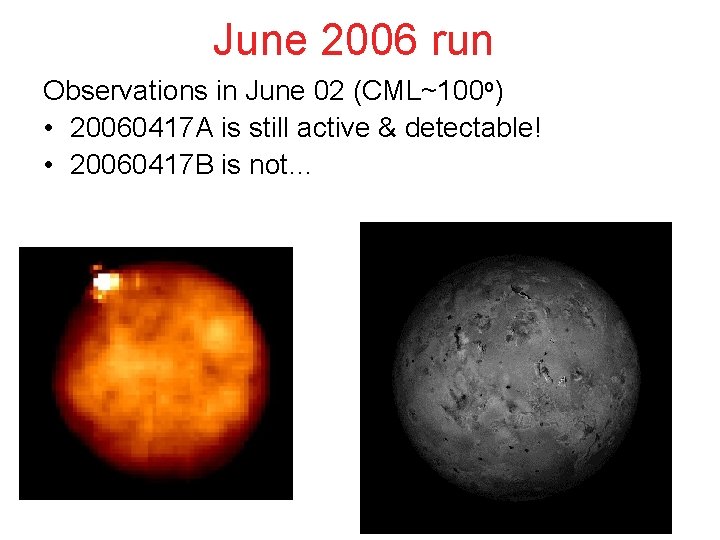
June 2006 run Observations in June 02 (CML~100 o) • 20060417 A is still active & detectable! • 20060417 B is not…
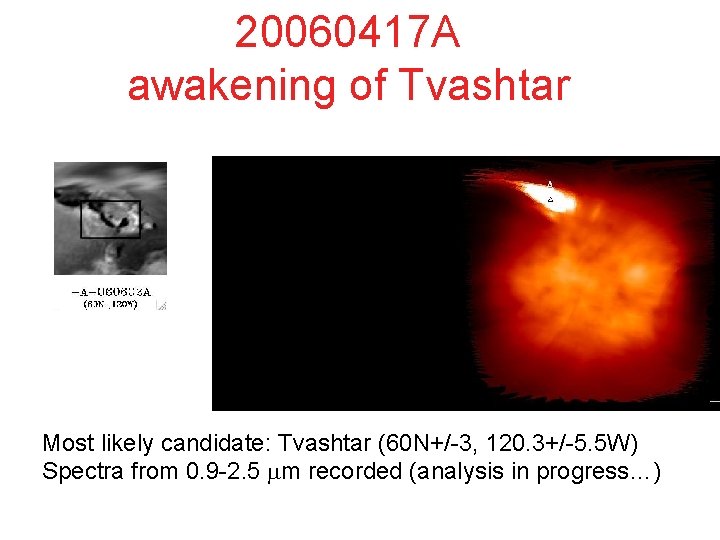
20060417 A awakening of Tvashtar Most likely candidate: Tvashtar (60 N+/-3, 120. 3+/-5. 5 W) Spectra from 0. 9 -2. 5 m recorded (analysis in progress…)
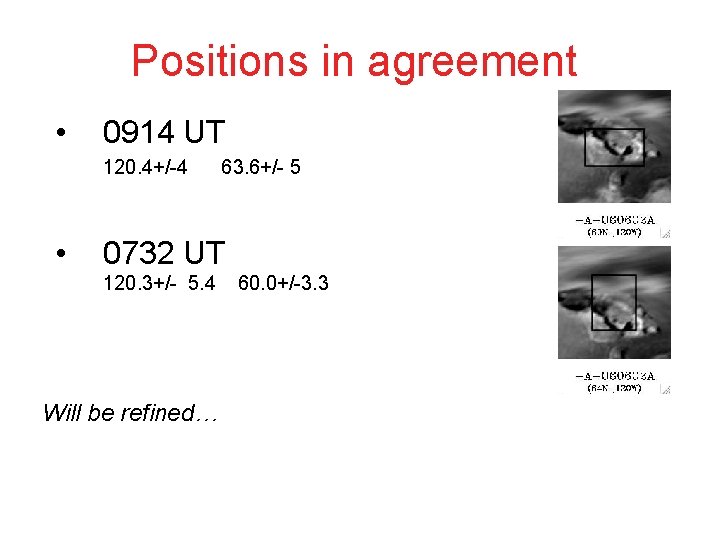
Positions in agreement • 0914 UT 120. 4+/-4 • 63. 6+/- 5 0732 UT 120. 3+/- 5. 4 Will be refined… 60. 0+/-3. 3
Future work • OSIRIS data – Hot spectra – Compositional maps (SO 2 and others? ) • NIRC 2 observations – Continue to monitor Io when at telescope – Publish our 2003 -2005 monitoring result • Observations in coordination with New Horizon flyby submitted to ESO (VLT/NACO) – Imaging (PI. J. Spencer) – Spectroscopy (PI: K. L. Jessup) • New Generation of AO at Keck – Make sure that planetary science will be considered
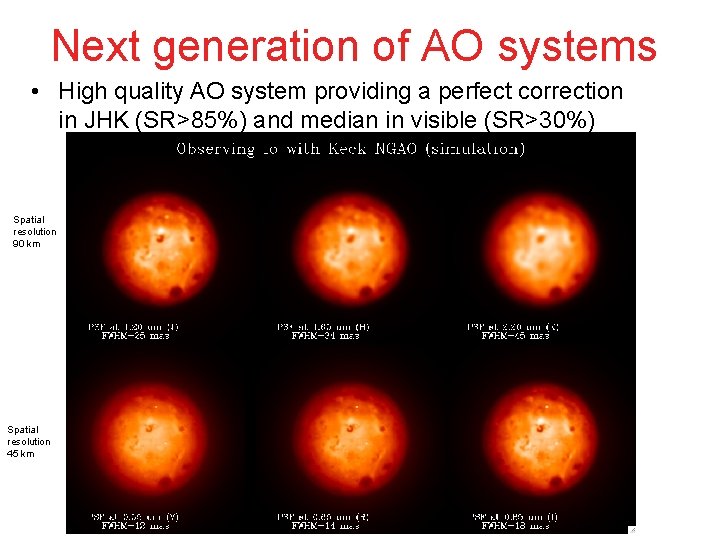
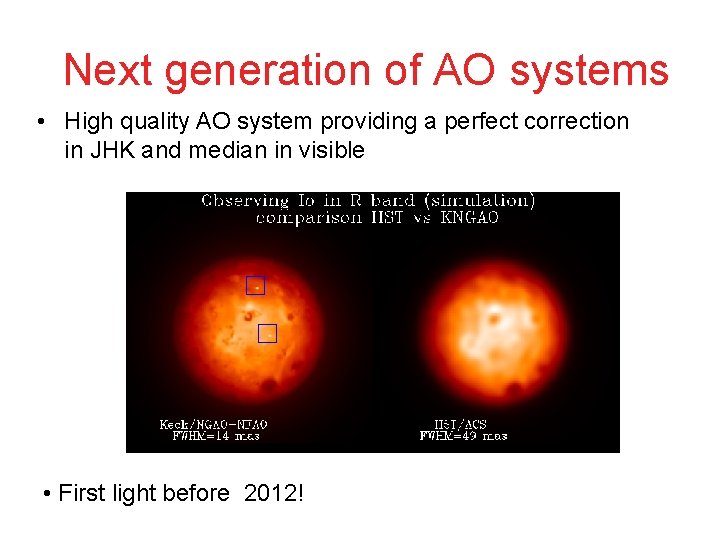
Next generation of AO systems • High quality AO system providing a perfect correction in JHK (SR>85%) and median in visible (SR>30%) Spatial resolution 90 km Spatial resolution 45 km
Next generation of AO systems • High quality AO system providing a perfect correction in JHK and median in visible • First light before 2012!
Next Generation of groundbased telescopes TMT - available in 2014 ? Spatial resolution 45 km in NIR 10 km in visible