
MONITORING ENVIRONMENTAL IMPACTS OF OFFSHORE WIND FARMS IN
- Slides: 18
MONITORING ENVIRONMENTAL IMPACTS OF OFFSHORE WIND FARMS IN THE BELGIAN PART OF THE NORTH SEA TOP PREDATORS Authors: Dick Botteldooren, Robin Brabant, Wouter Courtens, Elisabeth Debusschere, Steven Degraer, Luc Dekoninck, Valérie Dulière, Jan Haelters, Kris Hostens, Alain Norro, Thierry Onkelinx, Bob Rumes, Eric Stienen, Sofie Vandendriessche, Marc Van de walle, Nicolas Vanermen, Timothy Van Renterghem, Hilbran Verstraete, Laurence Vigin, Magda Vincx Presented by Jan Haelters & Nicolas Vanermen LEARNING FROM THE PAST TO OPTIMISE FUTURE MONITORING
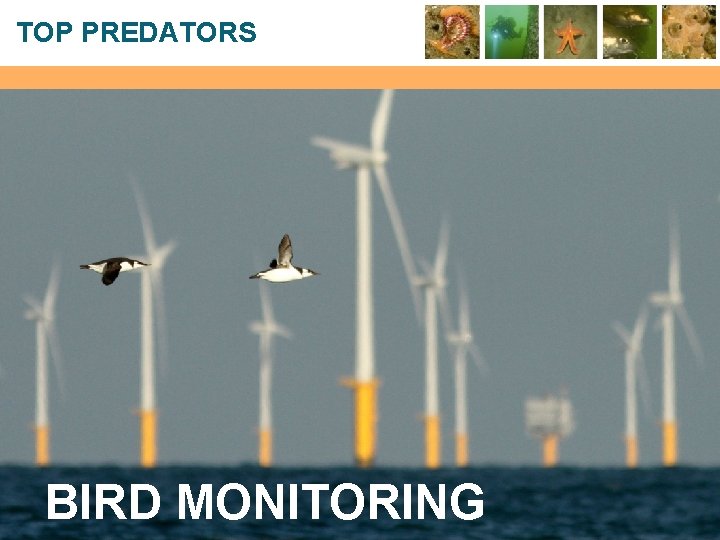
TOP PREDATORS BIRD MONITORING
TOP PREDATORS BIRD MONITORING Belgian part of the North Sea: • Important wintering area for northern breeding seabirds • Foraging habitat for local tern and gull populations • Major migration corridor for 1 -1, 3 million seabirds Offshore wind farm development may lead to… • …habitat loss and barrier effects hampering migration & local flight movements due to avoidance behaviour • …increased bird mortality due to collisions, further catalysed by attraction effects
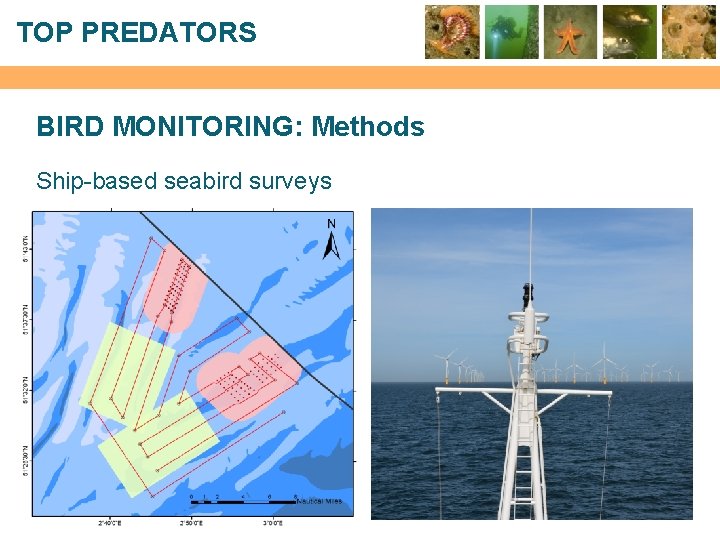
TOP PREDATORS BIRD MONITORING: Methods Ship-based seabird surveys • BACI-designed monthly surveys through impact & control areas output ~ bird densities • Primary goal: seabird displacement assessment habitat loss versus attraction effects • Results on densities of flying birds may also serve as input in collision risk modelling (CRM, Band 2012)
TOP PREDATORS BIRD MONITORING: Methods Ship-based seabird surveys
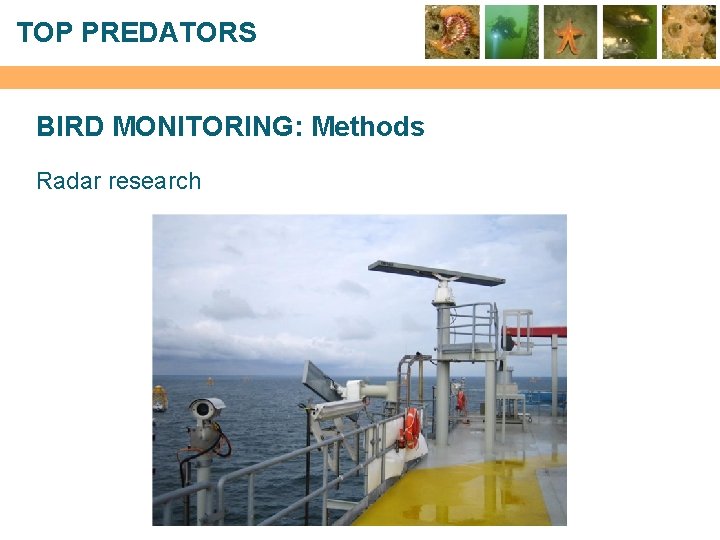
TOP PREDATORS BIRD MONITORING: Methods Radar research • Horizontal radar: • Tracks bird flights in a horizontal pane … • … primarily to assess barrier effects and macro-avoidance rates • Vertical radar: • Measures bird flux through a vertical pane … • … and serves as input for CRM
TOP PREDATORS BIRD MONITORING: Methods Radar research
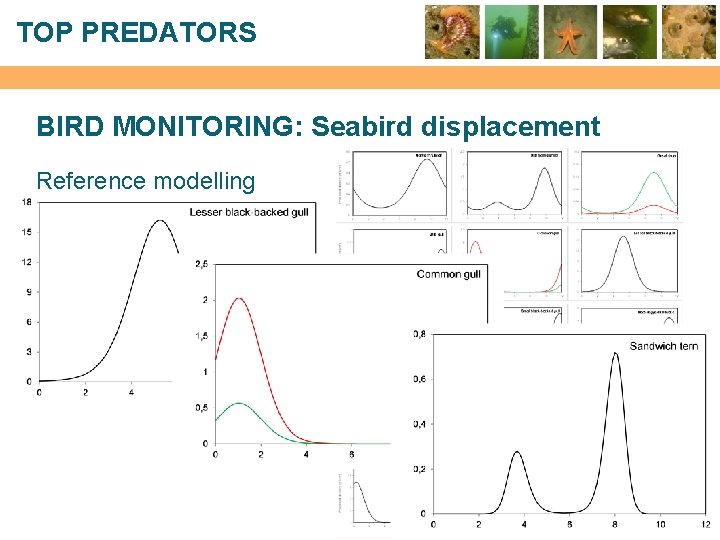
TOP PREDATORS BIRD MONITORING: Seabird displacement Modelling SAS data Ship-based seabird survey count results: • Data aggregation to day totals per area (control / impact) to avoid autocorrelation • Zero-inflated negative binomial modelling to incorporate high variance and excess in zero-count Model coviariates: • Seasonality: modelled as a sine curve, including month • Period: two-level factor variable BA • Area: two-level factor variable CI • Displacement effect: interaction between BA & CI
TOP PREDATORS BIRD MONITORING: Seabird displacement Reference modelling
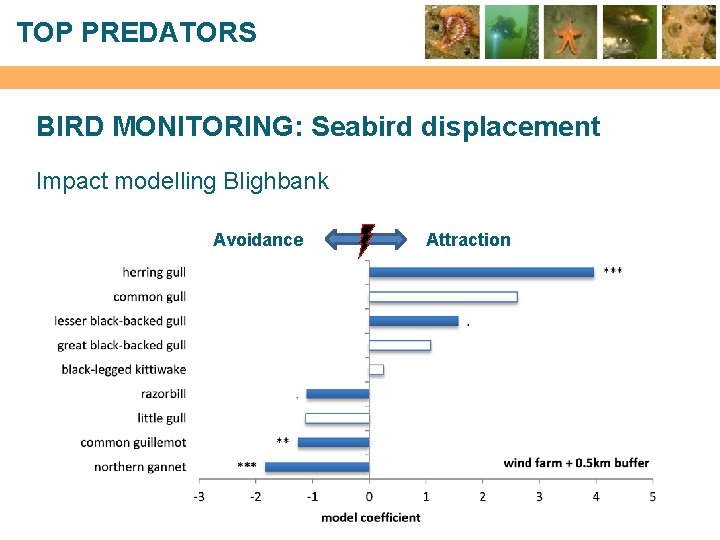
TOP PREDATORS BIRD MONITORING: Seabird displacement Impact modelling Blighbank Avoidance Attraction
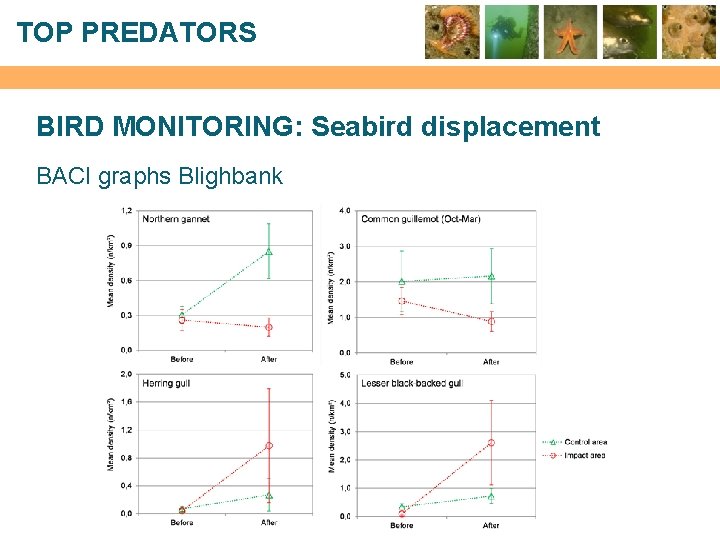
TOP PREDATORS BIRD MONITORING: Seabird displacement BACI graphs Blighbank
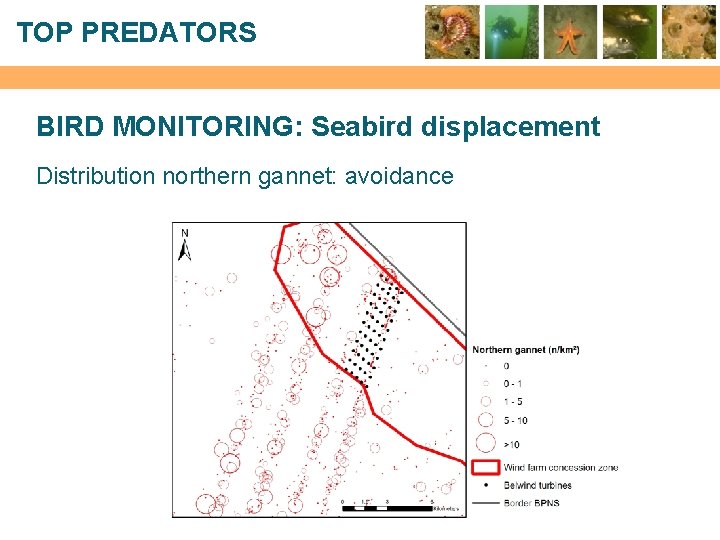
TOP PREDATORS BIRD MONITORING: Seabird displacement Distribution northern gannet: avoidance
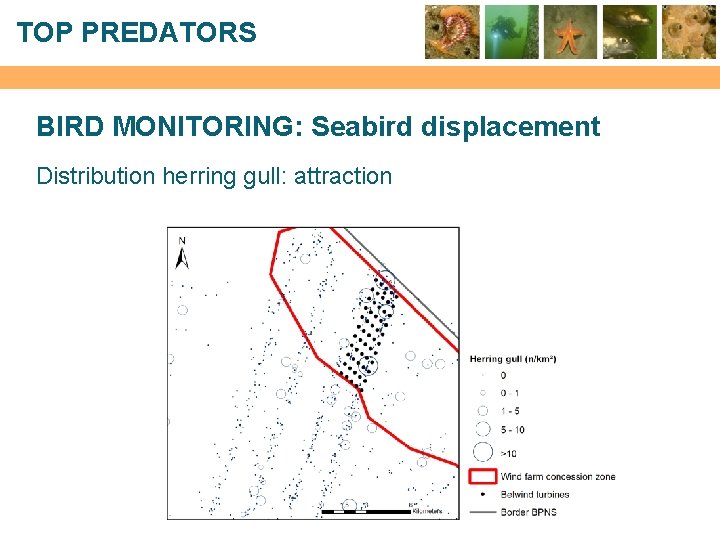
TOP PREDATORS BIRD MONITORING: Seabird displacement Distribution herring gull: attraction
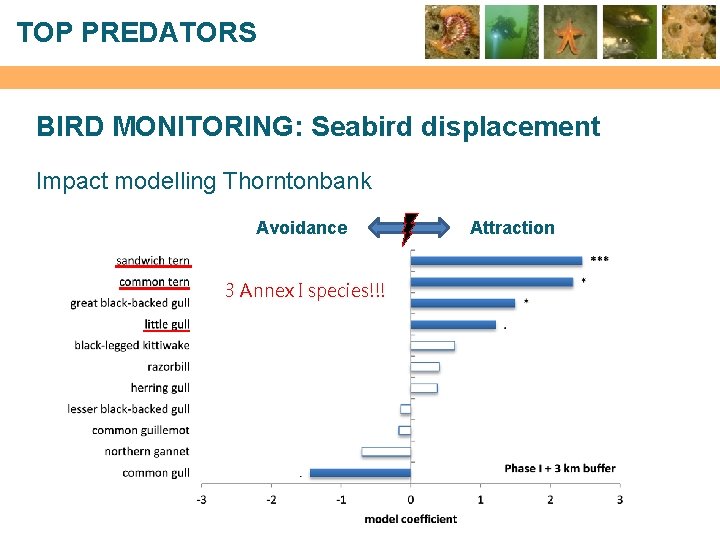
TOP PREDATORS BIRD MONITORING: Seabird displacement Impact modelling Thorntonbank Avoidance 3 Annex I species!!! Attraction
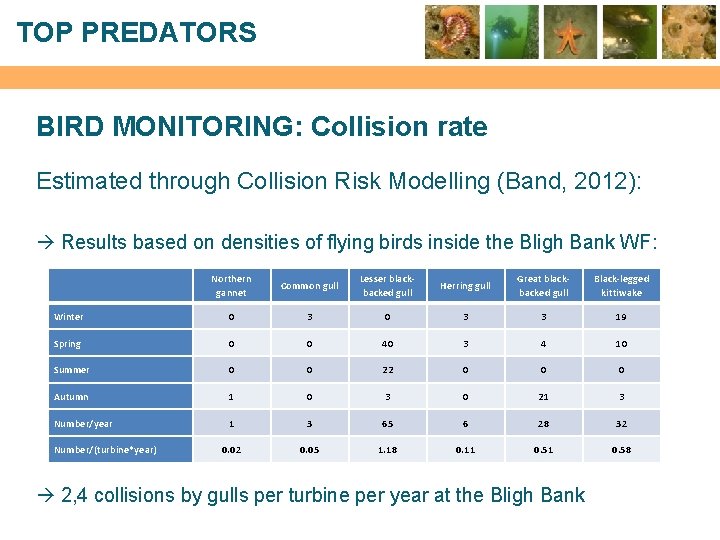
TOP PREDATORS BIRD MONITORING: Collision rate Estimated through Collision Risk Modelling (Band, 2012): Results based on densities of flying birds inside the Bligh Bank WF: Northern gannet Common gull Lesser blackbacked gull Herring gull Great blackbacked gull Black-legged kittiwake Winter 0 3 3 19 Spring 0 0 40 3 4 10 Summer 0 0 22 0 0 0 Autumn 1 0 3 0 21 3 Number/year 1 3 65 6 28 32 0. 05 1. 18 0. 11 0. 58 Number/(turbine*year) 2, 4 collisions by gulls per turbine per year at the Bligh Bank
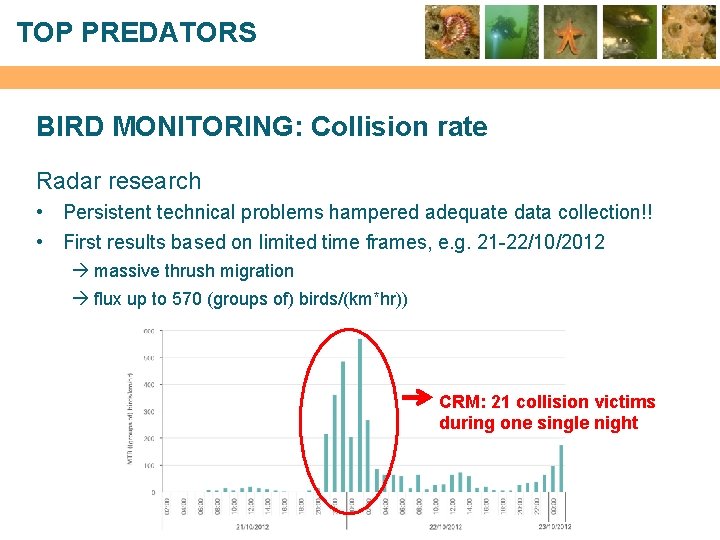
TOP PREDATORS BIRD MONITORING: Collision rate Radar research • Persistent technical problems hampered adequate data collection!! • First results based on limited time frames, e. g. 21 -22/10/2012 massive thrush migration flux up to 570 (groups of) birds/(km*hr)) CRM: 21 collision victims during one single night
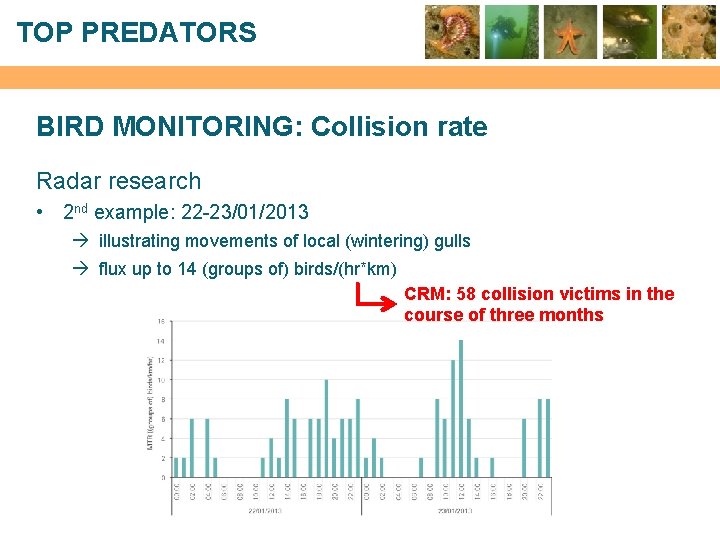
TOP PREDATORS BIRD MONITORING: Collision rate Radar research • 2 nd example: 22 -23/01/2013 illustrating movements of local (wintering) gulls flux up to 14 (groups of) birds/(hr*km) CRM: 58 collision victims in the course of three months
TOP PREDATORS FUTURE MONITORING • Continuation of the radar monitoring program to… • • • further improve radar signal in collaboration with radar developers assess bird fluxes over a wide range of conditions to improve CRM results perform a before-after study of the norther concession zone to assess barrier effects and macro-avoidance behaviour • Need for accurate assessment of actual number of collisions to calibrate theoretical CRM • Upscaling of additional mortality to a population level • Continuation of the baseline BACI monitoring of local seabird densities, and further reveal attraction-avoidance effects through enhanced power