
Monitoring and reporting for CCS in the EU

- Slides: 17
Monitoring and reporting for CCS in the EU ETS: Inclusion under Art. 24 of ETS Directive Dr Paul Zakkour, ERM Energy & Climate Change Services Ad hoc Group on CCS MRGs DTI, London, 6 th June 2007 Delivering sustainable solutions in a more competitive world
Overview • Background to MRG issues and developments • Assume all in attendance aware of 1 st efforts and the “permitting” based approach • Approach to opt-in via Art 24 • Monitoring and reporting approach • Above ground elements • Below ground monitoring approach • Enhanced oil recovery • Outstanding issues Delivering sustainable solutions in a more competitive world
Background to development of M&R guidelines • Revised MRGs invites: “Recognition of activities relating to carbon capture and storage is not provided for…but will depend on an amendment of Directive 2003/87/EC or by the inclusion of those activities pursuant to Article 24 [opt-in]. ” • Directive won’t be amended before Phase II • Projects due to commence before 2013 need to opt-in under Art. 24 • Chasing a moving target! Opt-in runs in parallel with both: • EU ETS Directive review – end 2007 • EU CCS Legal framework – autumn 2007 Delivering sustainable solutions in a more competitive world
Developing an activity/installation definition • Opt-in requirements: • Define installation/activity • Consider effects on environmental integrity of scheme • Other issues (internal market etc) • EC preferred approach: Single activity covering CO 2 generation, capture, transport & storage • Creates issues for permitting, ownership etc • Still unresolved at this point on how to handle this issue Delivering sustainable solutions in a more competitive world
Emission sources for CCS • Fugitive emissions: can occur across whole CCS chain (capture, transport, injection) • Indirect emissions: additional power requirements for capture, transportation, injection (energy penalty, booster stations etc. ) • Seepage from storage reservoirs: short and long term seepage issues to consider • Break-through CO 2 in EOR: need to consider the relevant emission sources and how to monitor • Emission sources form the basis for defining installation boundaries which in turn form the basis for defining the optin activity Delivering sustainable solutions in a more competitive world
Fugitive emissions • Calculate CO 2 emissions using approved M&R plan for installation, based on primary fuel input to operations • Measure (metering to custody transfer standard): • exports of CO 2 to pipeline • imports of CO 2 to injection facility • Reconcile: estimate fugitive losses across the chain using a mass balance calculation Delivering sustainable solutions in a more competitive world
Indirect emissions • Energy penalty for capture: accounted for by calculating CO 2 produced at installation using primary fuel inputs • Can use existing guidelines (Decision C(2004)130) for all “installations” covered by scheme • Booster stations: • >20 MW thermal input = installation in its own right • <20 MW thermal input = outside scope of EU ETS • Need to avoid double counting • Treatment of gas-fired booster stations still requires clarification (“technical connection”) Delivering sustainable solutions in a more competitive world
Seepage from storage sites • “Permanence”: most problematic aspect! • Range of literature looking at ex ante methods to account for possible future seepage: • Discounting of emissions (like DCF) • Default factors • Temporary crediting (like for LULUCF) • Creates a number of problems: • Assume storage site will leak; • That the timeframe and flux rate can be determined ex ante • Discount factor could be so small to = <1 EUA / yr etc. Delivering sustainable solutions in a more competitive world
Seepage from storage sites • Current approach to include storage site in EU ETS as activity/installation • Creates obligation to monitor and make-good any emissions from storage • Differs from previous proposal whereby obligation written into storage site permit • MRG requirements could be fulfilled by adhering to CCS Directive monitoring requirements • In either case, still need to consider storage site M&R approach Delivering sustainable solutions in a more competitive world
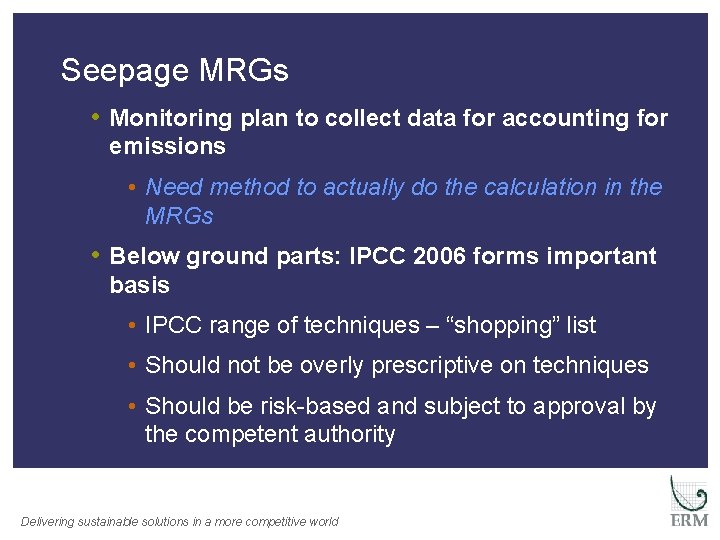
Seepage MRGs • Monitoring plan to collect data for accounting for emissions • Need method to actually do the calculation in the MRGs • Below ground parts: IPCC 2006 forms important basis • IPCC range of techniques – “shopping” list • Should not be overly prescriptive on techniques • Should be risk-based and subject to approval by the competent authority Delivering sustainable solutions in a more competitive world
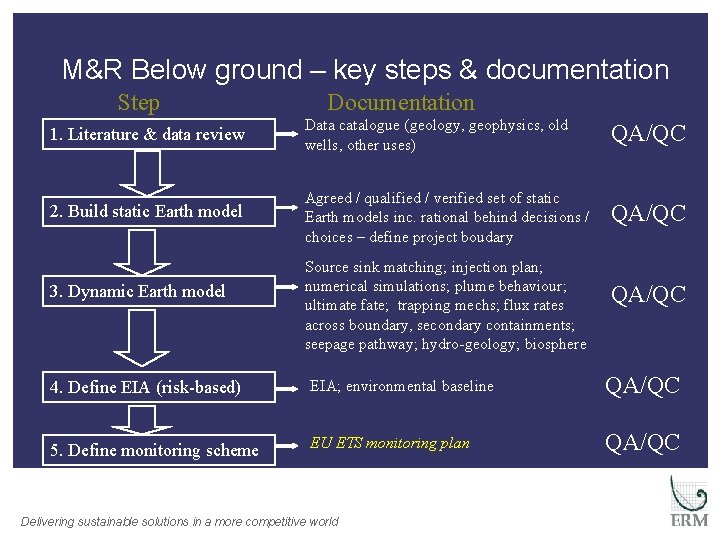
M&R Below ground – key steps & documentation Step Documentation 1. Literature & data review Data catalogue (geology, geophysics, old wells, other uses) QA/QC 2. Build static Earth model Agreed / qualified / verified set of static Earth models inc. rational behind decisions / choices – define project boudary QA/QC 3. Dynamic Earth model Source sink matching; injection plan; numerical simulations; plume behaviour; ultimate fate; trapping mechs; flux rates across boundary, secondary containments; seepage pathway; hydro-geology; biosphere QA/QC 4. Define EIA (risk-based) EIA; environmental baseline QA/QC 5. Define monitoring scheme EU ETS monitoring plan QA/QC Delivering sustainable solutions in a more competitive world
QA/QC procedure • Does this MRG scheme for storage sites work? Delivering sustainable solutions in a more competitive world
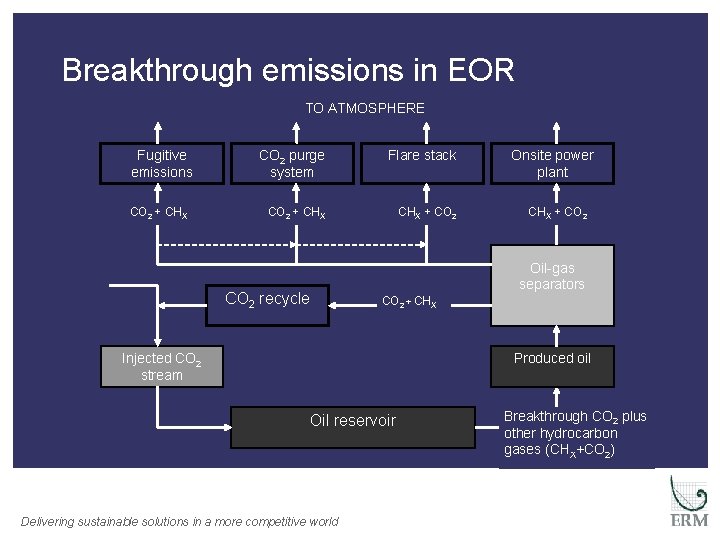
Breakthrough emissions in EOR TO ATMOSPHERE Fugitive emissions CO 2 + CHX CO 2 purge system Flare stack CO 2 + CHX + CO 2 recycle Onsite power plant CHX + CO 2 Oil-gas separators CO 2 + CHX Injected CO 2 stream Produced oil Oil reservoir Delivering sustainable solutions in a more competitive world Breakthrough CO 2 plus other hydrocarbon gases (CHX+CO 2)
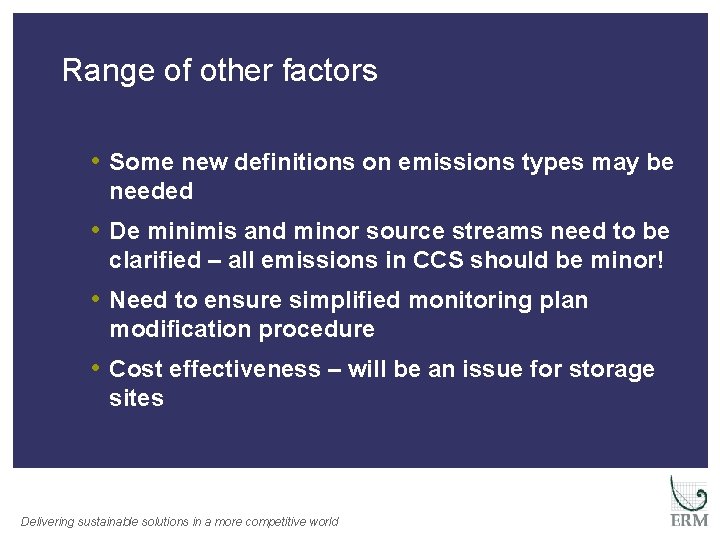
Range of other factors • Some new definitions on emissions types may be needed • De minimis and minor source streams need to be clarified – all emissions in CCS should be minor! • Need to ensure simplified monitoring plan modification procedure • Cost effectiveness – will be an issue for storage sites Delivering sustainable solutions in a more competitive world
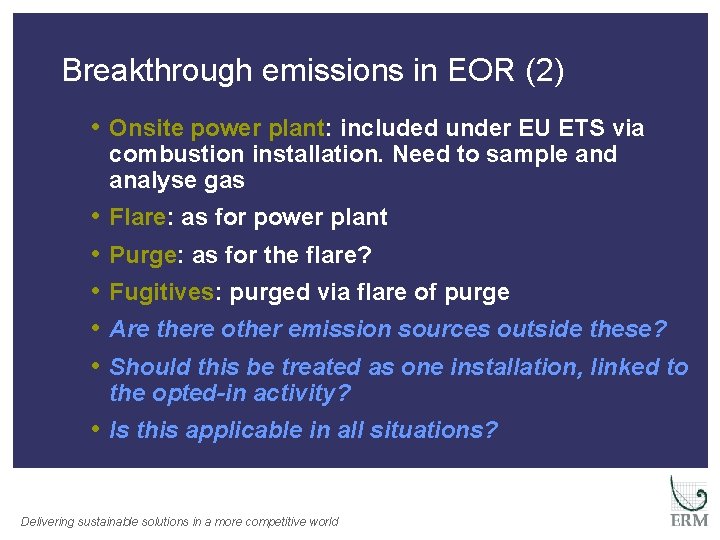
Breakthrough emissions in EOR (2) • Onsite power plant: included under EU ETS via combustion installation. Need to sample and analyse gas • Flare: as for power plant • Purge: as for the flare? • Fugitives: purged via flare of purge • Are there other emission sources outside these? • Should this be treated as one installation, linked to the opted-in activity? • Is this applicable in all situations? Delivering sustainable solutions in a more competitive world
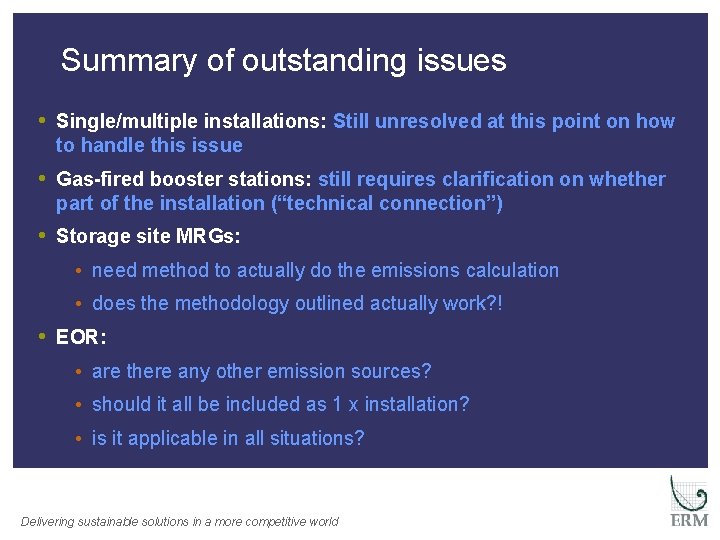
Summary of outstanding issues • Single/multiple installations: Still unresolved at this point on how to handle this issue • Gas-fired booster stations: still requires clarification on whether part of the installation (“technical connection”) • Storage site MRGs: • need method to actually do the emissions calculation • does the methodology outlined actually work? ! • EOR: • are there any other emission sources? • should it all be included as 1 x installation? • is it applicable in all situations? Delivering sustainable solutions in a more competitive world
Monitoring and reporting for CCS in the EU ETS: Inclusion under Art. 24 of ETS Directive THANK YOU Dr Paul Zakkour, ERM Energy & Climate Change Services Ad hoc Group on CCS MRGs DTI, London, 6 th June 2007 Delivering sustainable solutions in a more competitive world