
Monitoring and Evaluation of Maternal and Child Nutrition

- Slides: 45
Monitoring and Evaluation of Maternal and Child Nutrition
Session Objectives By the end of this session participants will be able to: § Apply basic M&E concepts to maternal and child nutrition interventions § Design and use M&E frameworks for nutrition programs § Identify nutrition interventions and common indicators for assessing their results § Describe M&E challenges of nutrition programs
Session Overview § Defining malnutrition § The problem of malnutrition § Interventions and strategies § M&E frameworks for nutrition programs § Common indicators & data sources § M&E challenges
Defining Malnutrition § Malnutrition: generic term includes both undernutrition and overnutrition § Undernutrition: is insufficient consumption to maintain good health caused by (any or all) § insufficient food § poor quality diet § disease § Undernutrition can lead to impaired growth, weak immune function and death if not treated
Defining Malnutrition § Overnutrition is the excess consumption of food, which can lead to obesity and chronic diseases such as heart disease and diabetes. § Most nutrition programs in developing countries have targeted undernutrition, which is the focus of this module. § However, many countries are beginning to experience dual malnutrition epidemics with high levels of both undernutrition and overnutrition.
The Problem § Maternal and child undernutrition is the underlying cause of 3. 5 million deaths, 35% of the disease burden in children younger than 5, larger than any other risk category. § 20% of children younger than 5 years in low- and middleincome countries are underweight (low weight for age). § 32% were stunted (low height for age).
The Problem § Among micronutrient deficiencies, the largest disease burdens among children under 5 are attributed to vitamin A and zinc. § Iron deficiency anemia is highly prevalent (est. ~25% of pregnant women) and a risk factor for maternal mortality. § Iodine deficiency is the primary cause of preventable mental retardation in children and is associated with miscarriage, stillbirths and infant mortality.
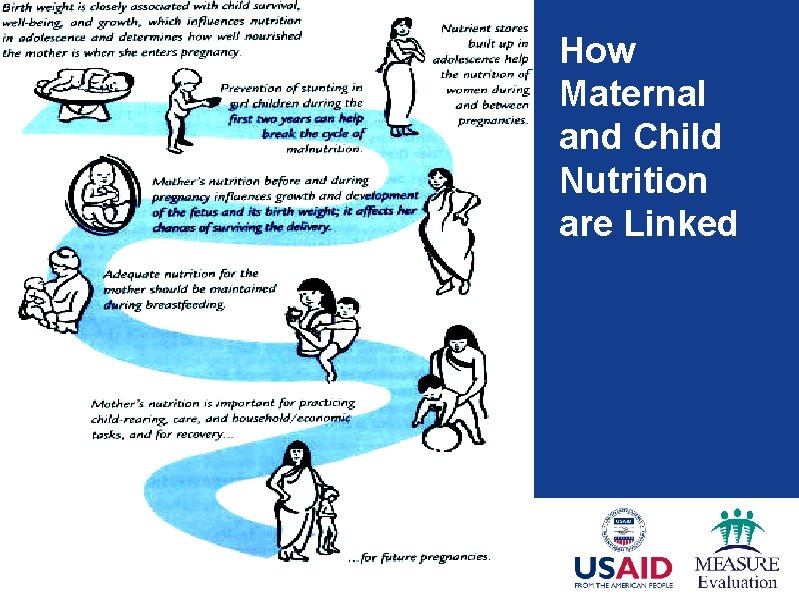
How Maternal and Child Nutrition are Linked
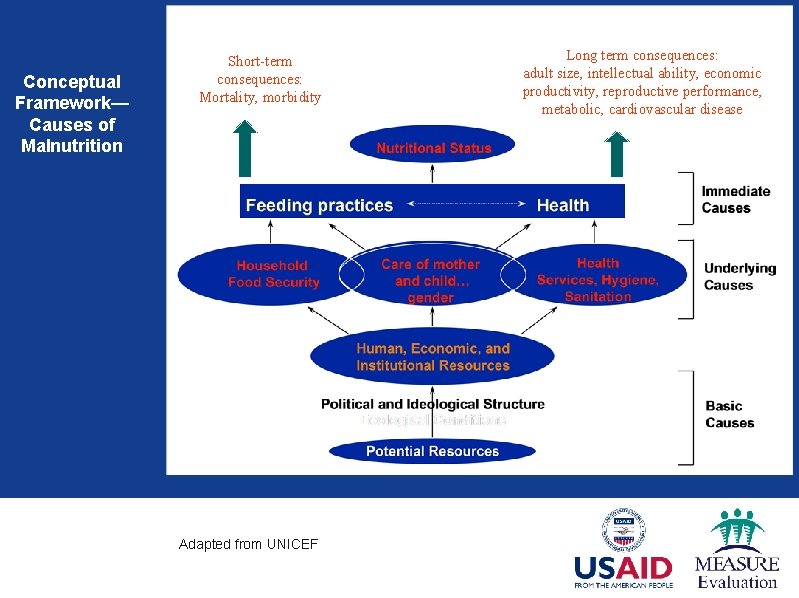
Conceptual Framework— Causes of Malnutrition Short-term consequences: Mortality, morbidity Adapted from UNICEF Long term consequences: adult size, intellectual ability, economic productivity, reproductive performance, metabolic, cardiovascular disease
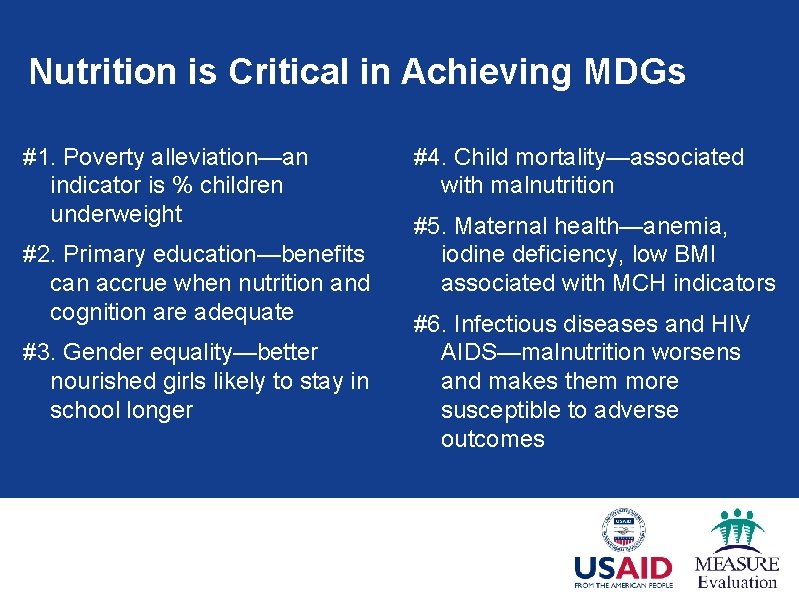
Nutrition is Critical in Achieving MDGs #1. Poverty alleviation—an indicator is % children underweight #2. Primary education—benefits can accrue when nutrition and cognition are adequate #3. Gender equality—better nourished girls likely to stay in school longer #4. Child mortality—associated with malnutrition #5. Maternal health—anemia, iodine deficiency, low BMI associated with MCH indicators #6. Infectious diseases and HIV AIDS—malnutrition worsens and makes them more susceptible to adverse outcomes
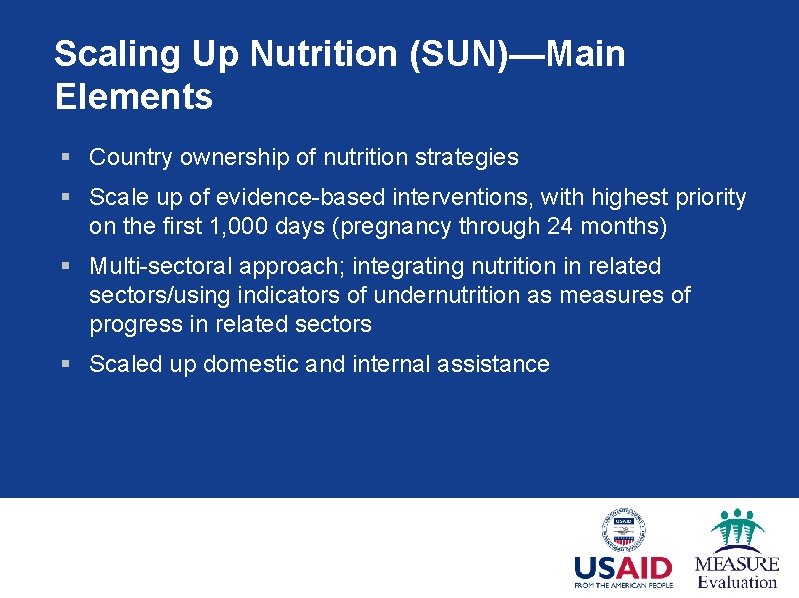
Scaling Up Nutrition (SUN)—Main Elements § Country ownership of nutrition strategies § Scale up of evidence-based interventions, with highest priority on the first 1, 000 days (pregnancy through 24 months) § Multi-sectoral approach; integrating nutrition in related sectors/using indicators of undernutrition as measures of progress in related sectors § Scaled up domestic and internal assistance
Interventions and Strategies
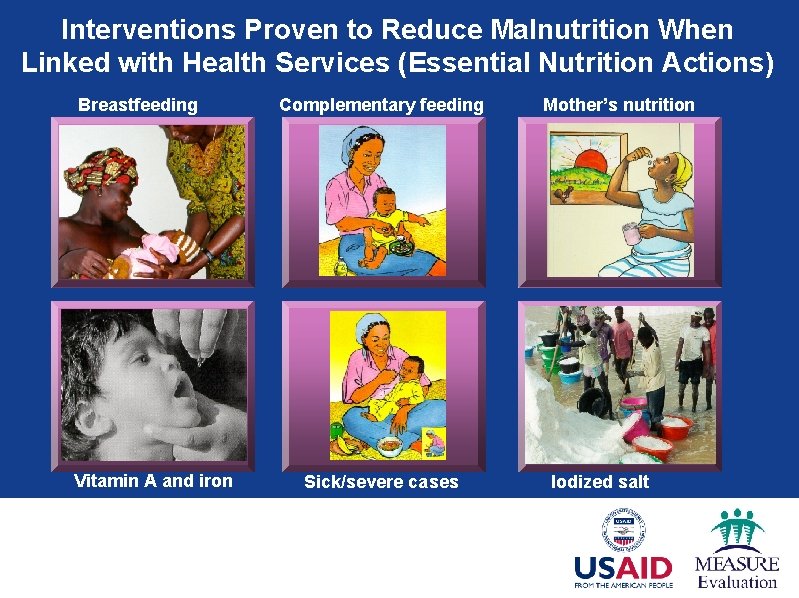
Interventions Proven to Reduce Malnutrition When Linked with Health Services (Essential Nutrition Actions) Breastfeeding Vitamin A and iron Complementary feeding Sick/severe cases Mother’s nutrition Iodized salt
Monitoring and Evaluation Frameworks for Nutrition Programs
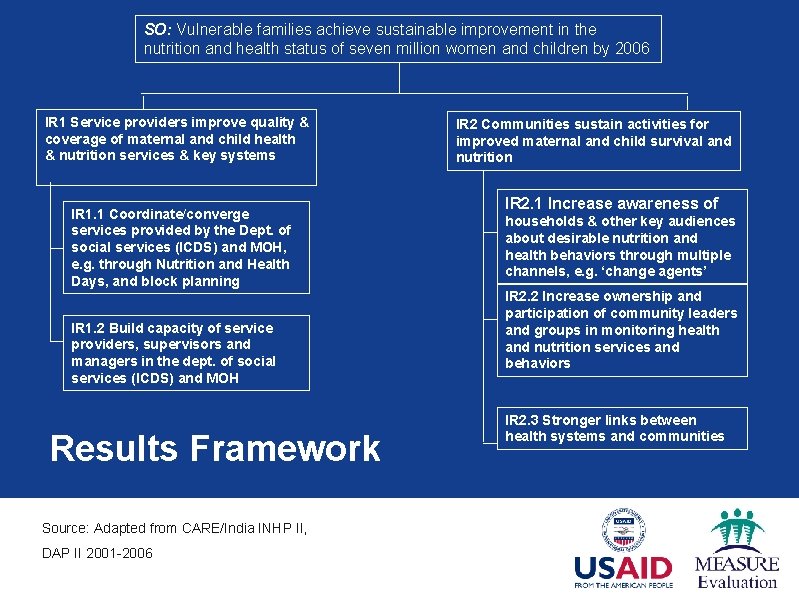
SO: Vulnerable families achieve sustainable improvement in the nutrition and health status of seven million women and children by 2006 IR 1 Service providers improve quality & coverage of maternal and child health & nutrition services & key systems IR 1. 1 Coordinate/converge services provided by the Dept. of social services (ICDS) and MOH, e. g. through Nutrition and Health Days, and block planning IR 1. 2 Build capacity of service providers, supervisors and managers in the dept. of social services (ICDS) and MOH Results Framework Source: Adapted from CARE/India INHP II, DAP II 2001 -2006 IR 2 Communities sustain activities for improved maternal and child survival and nutrition IR 2. 1 Increase awareness of households & other key audiences about desirable nutrition and health behaviors through multiple channels, e. g. ‘change agents’ IR 2. 2 Increase ownership and participation of community leaders and groups in monitoring health and nutrition services and behaviors IR 2. 3 Stronger links between health systems and communities
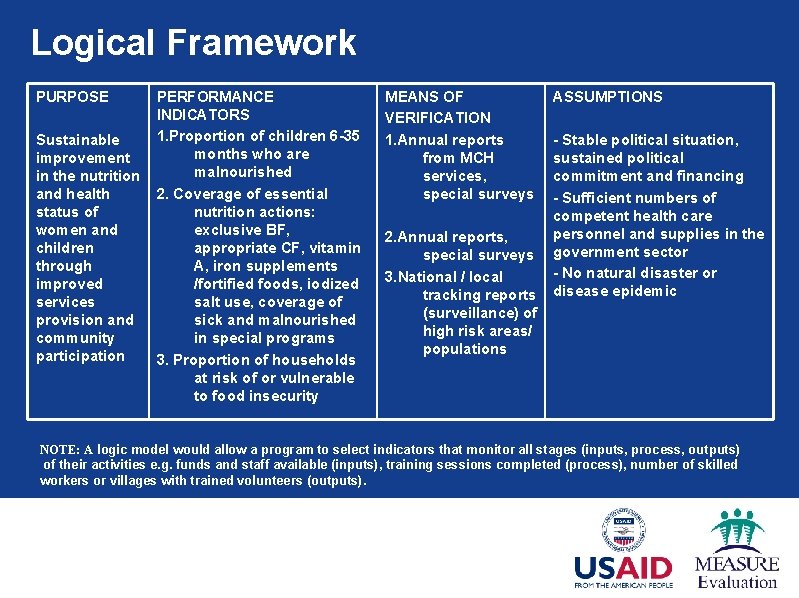
Logical Framework PURPOSE Sustainable improvement in the nutrition and health status of women and children through improved services provision and community participation PERFORMANCE INDICATORS 1. Proportion of children 6 -35 months who are malnourished 2. Coverage of essential nutrition actions: exclusive BF, appropriate CF, vitamin A, iron supplements /fortified foods, iodized salt use, coverage of sick and malnourished in special programs 3. Proportion of households at risk of or vulnerable to food insecurity MEANS OF VERIFICATION 1. Annual reports from MCH services, special surveys ASSUMPTIONS - Stable political situation, sustained political commitment and financing - Sufficient numbers of competent health care personnel and supplies in the 2. Annual reports, special surveys government sector - No natural disaster or 3. National / local tracking reports disease epidemic (surveillance) of high risk areas/ populations NOTE: A logic model would allow a program to select indicators that monitor all stages (inputs, process, outputs) of their activities e. g. funds and staff available (inputs), training sessions completed (process), number of skilled workers or villages with trained volunteers (outputs).
Common Indicators and Data Sources
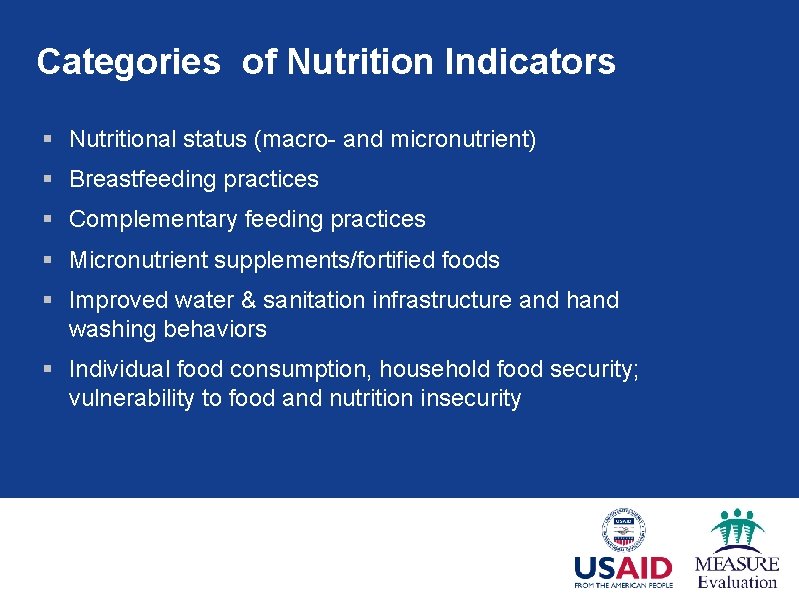
Categories of Nutrition Indicators § Nutritional status (macro- and micronutrient) § Breastfeeding practices § Complementary feeding practices § Micronutrient supplements/fortified foods § Improved water & sanitation infrastructure and hand washing behaviors § Individual food consumption, household food security; vulnerability to food and nutrition insecurity
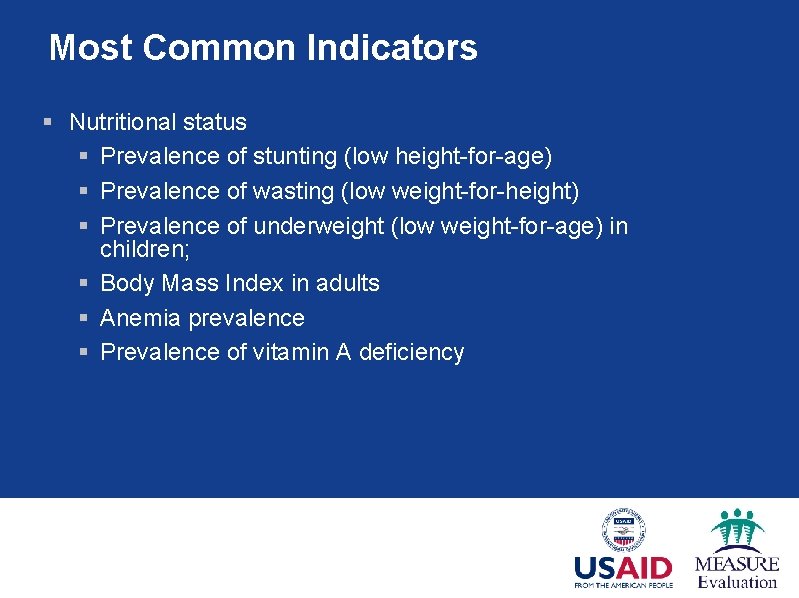
Most Common Indicators § Nutritional status § Prevalence of stunting (low height-for-age) § Prevalence of wasting (low weight-for-height) § Prevalence of underweight (low weight-for-age) in children; § Body Mass Index in adults § Anemia prevalence § Prevalence of vitamin A deficiency
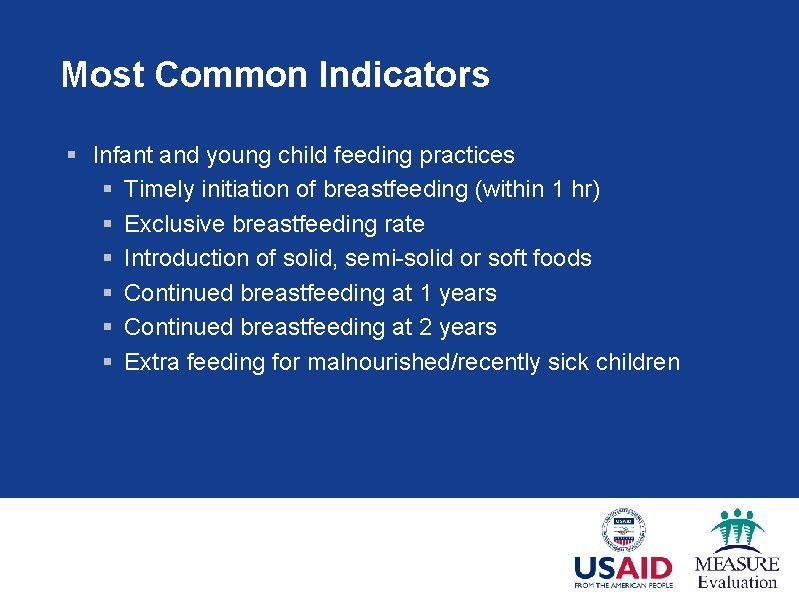
Most Common Indicators § Infant and young child feeding practices § Timely initiation of breastfeeding (within 1 hr) § Exclusive breastfeeding rate § Introduction of solid, semi-solid or soft foods § Continued breastfeeding at 1 years § Continued breastfeeding at 2 years § Extra feeding for malnourished/recently sick children
Most Common Indicators § Micronutrient Interventions § Vitamin A supplementation § Iron supplementation § Coverage with iodized salt, other fortified foods § Zinc supplementation for tx of diarrhea § Household Food Security/Vulnerability § Daily meal frequency of family/individuals § Dietary diversity or dietary adequacy § Perceived adequacy of food reserves in the home/community
Data Collection Systems Routine § Sentinel food and nutrition surveillance § Institutional health records- clinics, schools, GMP § Feeding & cash or food transfer programs records- daily/weekly/monthly attendance Non-Routine § Population-based surveys § Special surveys § Emergency appraisals, rapid assessments § Experimental and operational research
Anthropometric Measures (1) Children: § Weight-for-age (underweight) § Reflects chronic or acute malnutrition or both § Height-for-age (stunting) § Reflect chronic (prolonged, cumulative) malnutrition § Weight-for-height (wasting) § Reflects acute and recent malnutrition
Anthropometric Measurements (2) Adults: § Body Mass Index (BMI) § Low weight-for-height ( kg/m 2) reflects chronic &/or acute § Mid-upper arm circumference (MUAC) § Thin reflects chronic &/or acute
Data Sources for Anthropometry § MCH programs/clinic records § School feeding- school heights. § Food and nutrition, epidemiological surveillance § Poverty mapping/school height census - heights for chronic, weights for current § Reports from emergency/refugee programs § Household surveys
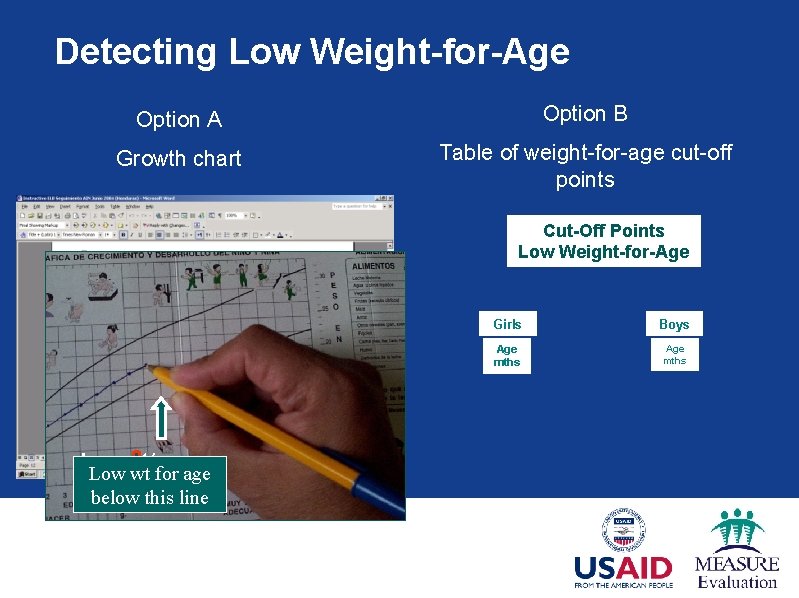
Detecting Low Weight-for-Age Option A Option B Growth chart Table of weight-for-age cut-off points Cut-Off Points Low Weight-for-Age Low wt/age Low wt for age below this line Girls Boys Age mths
Statistical Presentation of Anthropometric Indicators § Prevalence § Percent below a cut-off, such as <-2 SD or < -3 SD § Mean Z-score values (in SD units) § Z score refers to how far and in what direction the measure deviates from the median of the NCHS/WHO international reference standard
Exercise: Interpreting Standard DHS Nutrition Status Tables § If 50% of children are stunted (e. g. height-for-age Zscores less than -2) what does this indicate? § What if, in the same population, 30% are underweight and 15% are wasted? § Which child is more vulnerable to die: a -3 sd wasted or a -3 sd stunted child? Why? In which age group? § By which characteristics would you recommend disaggregating these data?
Feeding Practices § Percentage of infants less than 24 months of age who were put to the breast within one hour of delivery § Percentage of infants aged 0 -5 months who were fed exclusively with breast milk in the last 24 hours § Percentage of infants aged 6 -8 months who received solid or semi-solid food the previous day
Feeding Practices § Percentage of infants and young children 6 to 23 months of age who receive a minimum acceptable diet: § 6 to 8 months of age : Breastmilk + other food at least 2 times per day + 4 or more food groups § 9 to 23 months of age : Breastmilk + other food at least 3 times per day + 4 or more food groups § For non-breastfed infants 6 to 23 months of age : 2 milk feedings + diversity and frequency of meals as above by age group
Coverage Indicators for Micronutrient Programs § Percent of children aged 6 -59 months who received a high dose vitamin A supplement in the last 6 months § Percent of households consuming adequately iodized (i. e. 15+ ppm of iodine) salt § Percent of pregnant women who received the recommended number of iron/folate supplements during pregnancy
Choices in Program M&E Design § Which age groups to measure? § Anthropometry, infant and young child feeding § How to obtain valid measurements § Anthropometry; micronutrients; infant and young child feeding § Timing § Trends; seasonality § Evaluation design
Examples of Flaws in Nutrition Evaluations § No comparison groups § No pretest or baseline § No control for age, e. g. < 6 mo. , < 2 and 3+ yrs § Not accounting for confounding factors § Seasons not comparable § Not controlling for mortality reduction § Non-representative samples, small samples § Pilot projects, not replicable
Economic Analysis in Nutrition M&E § Cost-effectiveness analysis § compares two or more alternatives for achieving coverage or scale or behavior change, or a process outcome such as training to build capacity § Answers the question ‘Which is the more efficient option? ’ § Used more in evaluations § Cost-benefit § compares the resources required to achieve impact and the monetary value of that impact § Answers the question ‘Is the investment worthwhile? ’ § Based on many assumptions with limited empirical evidence
Additional Considerations § Gender: § Intra-household dynamics § Micronutrient requirements/deficiencies differ by sex § Geography: § Ecological zones § Proximity to markets
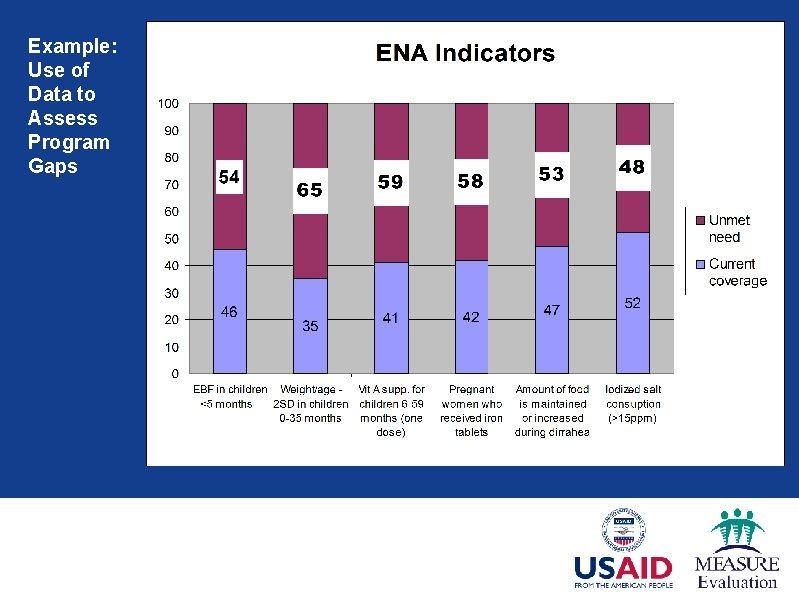
Example: Use of Data to Assess Program Gaps
M&E Challenges
Challenges of M&E § Multisectoral programs (attributing outcome? ) § Clinical Indicators § May need large samples (e. g. , xerophthalmia, feeding practices for 6 -8 month old infants) § May be sensitive to enumerator training (e. g. , goiter) § Measurement of iron deficiency (lack of specificity) § Selection bias (institution-based sample)
Challenges: Comparisons & Trends § Sample design § Sample size § Cutoff points & standards § Seasonality
References § § § Arimond, Mary and Marie T. Ruel. 2003. Generating Indicators of Appropriate Feeding of Children 6 through 23 Months from the KPC 2000+. Washington, D. C. : Food and Nutrition Technical Assistance Project, Academy for Educational Development. Black RE. 2008. Maternal and child undernutrition: global and regional exposures and health consequences. Lancet, 371: 243 -60. Bhutta ZA et al. 2008. What works? Interventions for maternal and child undernutrition and survival. Lancet, 371: 417 -40. Cogill, Bruce. 2003. Anthropometric Indicators Measurement Guide. Washington, D. C. : Food and Nutrition Technical Assistance Project, Academy for Educational Development. Wasantwisut, Emorn. 2002. Recommendations for monitoring and evaluating vitamin A programs: outcome indicators. Journal of Nutrition, 132: 2940 S-2942 S. Ruel, M. T. , K. H. Brown, and L. E. Caulfield. 2003. Moving Forward with Complementary Feeding: Indicators and Research Priorities. Food Consumption and Nutrition Division Discussion Paper #146. Washington, D. C. : International Food Policy Research Institute.
References § § § Victora CG et al. 2008. Maternal anc child undernutrition: consequences for adult health and human capital. Lancet, 371: 340 -57. WHO. 2001 a. Assessment of Iodine Deficiency Disorders and Monitoring their Elimination: A Guide for Programme Managers. Second Edition. WHO/NHD/01. 1. Geneva: World Health Organization. WHO Multicentre Growth Reference Study Group. WHO Child Growth Standards: Length/height-for-age, weight-for-length, weightfor-height and body mass index-for-age: Methods and development. Geneva: World Health Organization, 2006 WHO. 2001 b. Iron Deficiency Anaemia: Assessment, Prevention and Control - A Guide for Programme Managers. WHO/NHD/01. 3. Geneva: World Health Organization. WHO. Indicators for assessing infant and young child feeding practices part 1: definitions. Geneva, World Health Organization, 2008.
Madagascar Nutrition Case Study During 1996– 2002, Madagascar followed a comprehensive model, the “essential nutrition actions” (ENA) framework, which coordinated efforts from the community level through national policy making, and included both government and nongovernment entities. The model was first implemented in two districts in the Antananarivo and Fianarantsoa provinces. It focused on a set of proven interventions covering micronutrients and dietary practices for mother and young children. From 1995 to 1998, the overall focus was placed on designing mechanisms that linked nutrition interventions more directly with other child health and RH services, and national- and community-level actions. Further instructions are provided in the handout.
MEASURE Evaluation is funded by the U. S. Agency for International Development (USAID) and implemented by the Carolina Population Center at the University of North Carolina at Chapel Hill in partnership with Futures Group, ICF Macro, John Snow, Inc. , Management Sciences for Health, and Tulane University. Views expressed in this presentation do not necessarily reflect the views of USAID or the U. S. government. MEASURE Evaluation is the USAID Global Health Bureau's primary vehicle for supporting improvements in monitoring and evaluation in population, health and nutrition worldwide.