
Monica Fedeli Edward Taylor Introducing Action Research to
- Slides: 18
Monica Fedeli Edward Taylor Introducing Action Research to the Regina Paciso Center
Action Research! �When you think of action research what comes to mind? �Examples? �Based on your experience what makes for a successful action research project?
Action Research �Practitioner research �Interpreting a particular phenomenon/problem �Solving local, practical problems �Reflecting on the practices �Transforming and emancipating professionals �Examples A teacher exploring the impact of new education intervention An extension worker promoting a community development project (Merriam & Tisdell, 2015)
Principles of Action Research 1. Focuses on a “problematic situation” Solve the problem Enhance the positive Improvement of practice Action research is oriented toward some action or cycle of actions that organizational or community members …are taking… to address a particular problematic situation. ” (Herr & Anderson, 2015, p. 4)
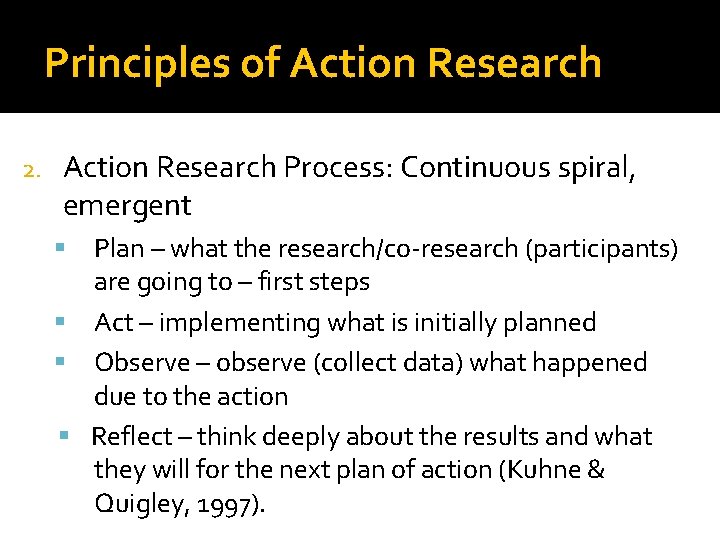
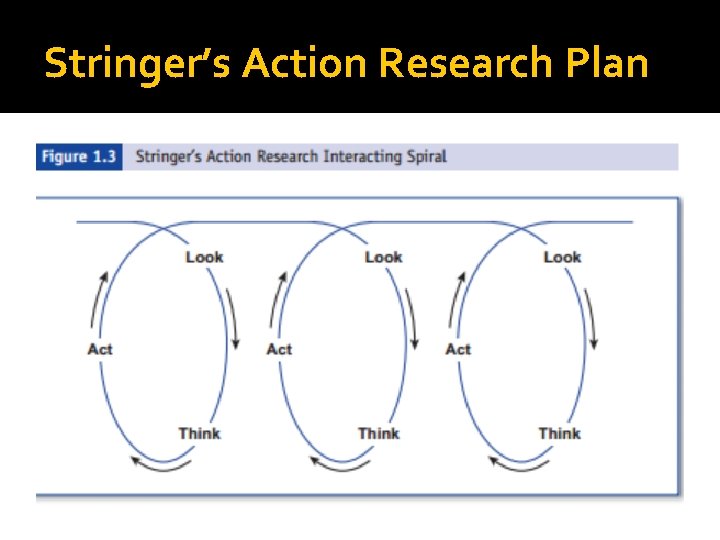
Principles of Action Research 2. Action Research Process: Continuous spiral, emergent Plan – what the research/co-research (participants) are going to – first steps Act – implementing what is initially planned Observe – observe (collect data) what happened due to the action Reflect – think deeply about the results and what they will for the next plan of action (Kuhne & Quigley, 1997).
Principles of Action Research 3. To some degree the researcher involves participants as co-investigators/researchers. Influencing factors ▪ Shared ownership ▪ Context ▪ Different phases of the study “Active participation is the key to feelings of ownership that motivates people to invest their time and energy to help shape the nature and quality of the acts, activities and behaviors in which they engage” (Stringer, 2014, p. 31)
Principles of Action Research 4. Researcher - Insider/Outsider Insider to an organization - (a teacher doing action research in her classroom) Collaborative researcher – (engaging a group of teachers within a school) Outsider – working as researcher within a community that is not your own “Action research seeks to develop and maintain social and interpersonal interactions that are non-exploitive and enhance the social and emotional lives of all people who participate” (Stringer, 2014, p. 23).
Principles of Action Research 5. Collect and analyze multiple forms of data Most use qualitative forms of data (interviews, field notes, focus groups, document analysis) Quantitative surveys (e. g. , assessing the a community problem from the perspective of community members)
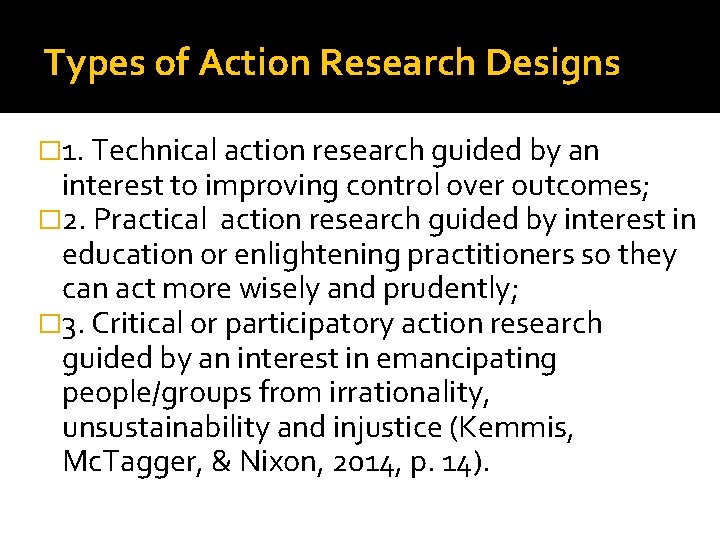
Types of Action Research Designs � 1. Technical action research guided by an interest to improving control over outcomes; � 2. Practical action research guided by interest in education or enlightening practitioners so they can act more wisely and prudently; � 3. Critical or participatory action research guided by an interest in emancipating people/groups from irrationality, unsustainability and injustice (Kemmis, Mc. Tagger, & Nixon, 2014, p. 14).
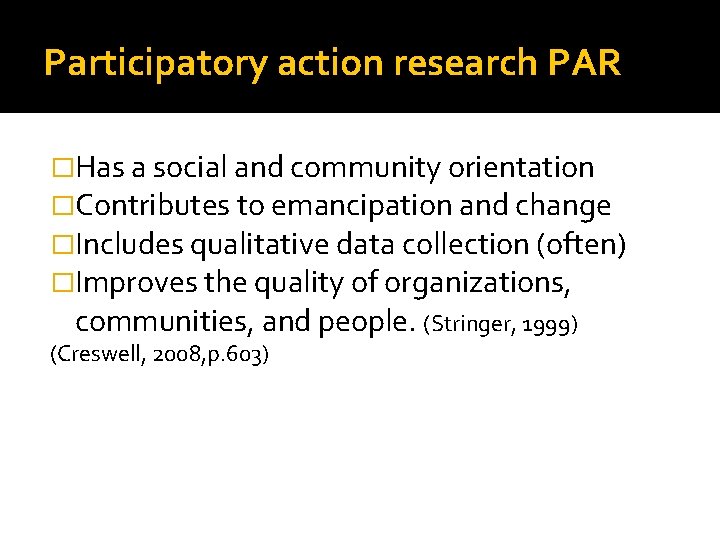
Participatory action research PAR �Has a social and community orientation �Contributes to emancipation and change �Includes qualitative data collection (often) �Improves the quality of organizations, communities, and people. (Stringer, 1999) (Creswell, 2008, p. 603)
Stringer’s Action Research Plan
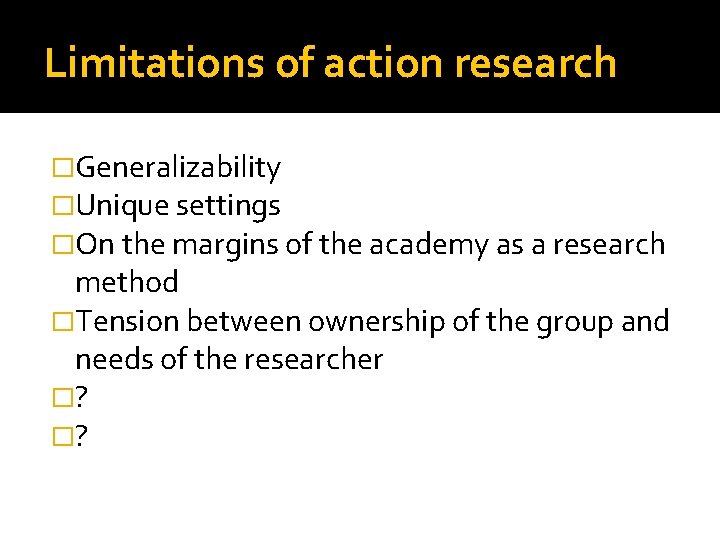
Limitations of action research �Generalizability �Unique settings �On the margins of the academy as a research method �Tension between ownership of the group and needs of the researcher �? �?
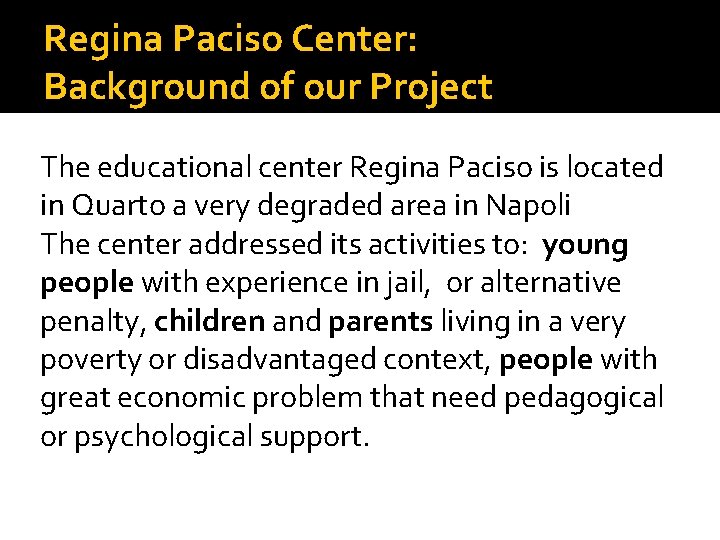
Regina Paciso Center: Background of our Project The educational center Regina Paciso is located in Quarto a very degraded area in Napoli The center addressed its activities to: young people with experience in jail, or alternative penalty, children and parents living in a very poverty or disadvantaged context, people with great economic problem that need pedagogical or psychological support.
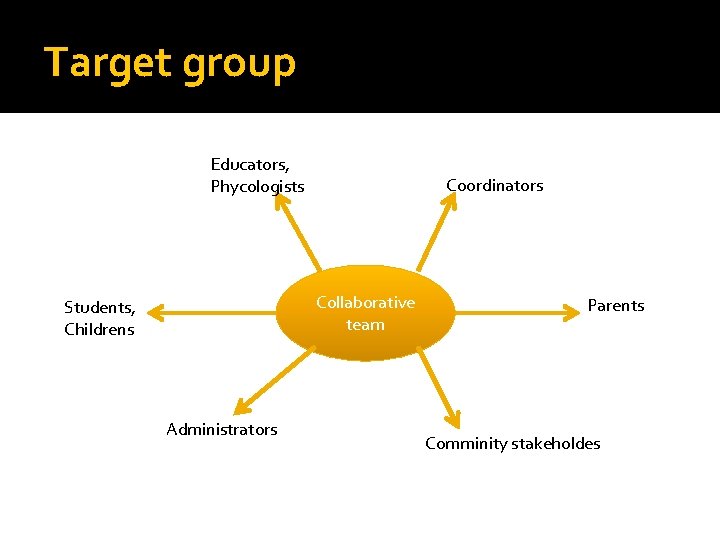
Target group Educators, Phycologists Coordinators Collaborative team Students, Childrens Administrators Parents Comminity stakeholdes
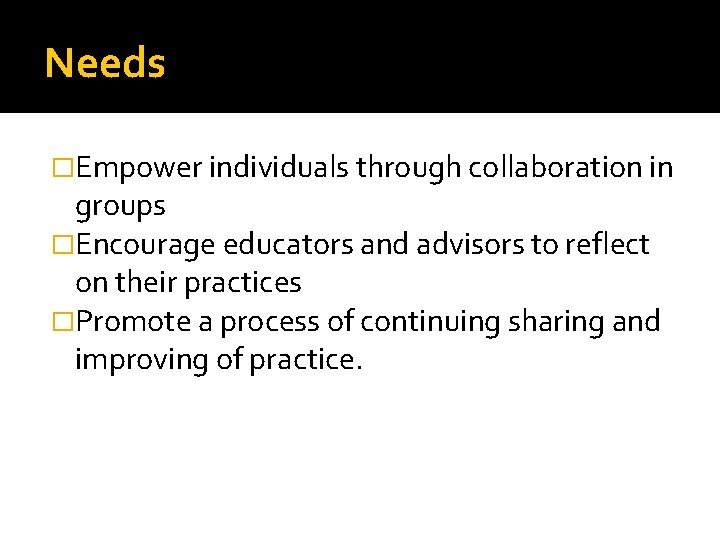
Needs �Empower individuals through collaboration in groups �Encourage educators and advisors to reflect on their practices �Promote a process of continuing sharing and improving of practice.
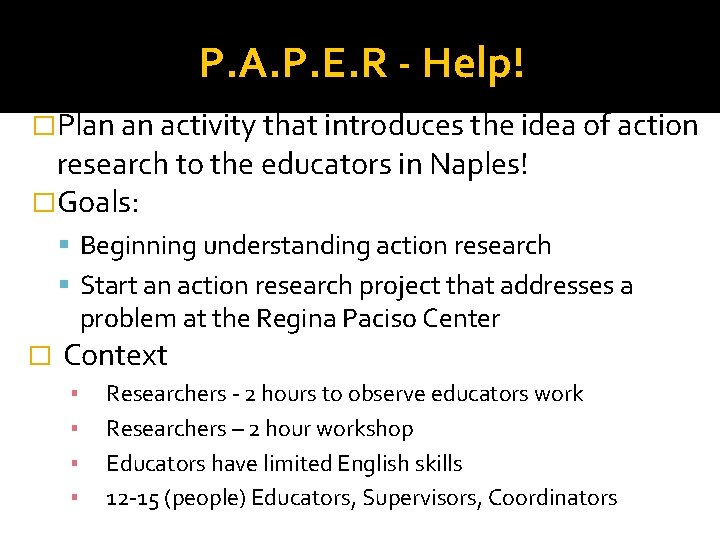
P. A. P. E. R - Help! �Plan an activity that introduces the idea of action research to the educators in Naples! �Goals: Beginning understanding action research Start an action research project that addresses a problem at the Regina Paciso Center � Context ▪ ▪ Researchers - 2 hours to observe educators work Researchers – 2 hour workshop Educators have limited English skills 12 -15 (people) Educators, Supervisors, Coordinators
Each Group’s Task: �Develop an outline of a plan and schedule for the 2 hour workshop �Brief explanation of activities �Identify major challenges
Useful information for producers of research �Design and recognize the phases �Remember that the researcher will be the participant in his/her research project �Collect data and analyze it �Consider a full array of data-collection types (quantitative-qualitative) �Decide on the point of entry �Construct a realistic plan of action for this educational setting (Reviewed from: Creswell, 2008, p. 616)