
Mongol Eurasia and Its Aftermath 1200 1500 C


- Slides: 73
Mongol Eurasia and Its Aftermath 1200 -1500 C. E.
The Rise of the Mongols 1200 -1260 C. E.
Nomadism in Central and Inner Asia • Nomadic groups depended on scarce water and pasture resources. • There were many conflicts in times of scarcity. – Many alliances formed and much migration at this time because of conflict.
Mongol Groups • Strongly hierarchical organization headed by a single leader or khan. • Khans had to ask that their decisions be ratified by a council of leaders. • Powerful Mongol groups demanded and received tribute in goods and slaves from those less powerful. – Some groups lived on tribute alone.
Federations • Various Mongol groups formed complex federations that were often tied to marriage alliances. • Women from prestigious families often played an important role in negotiating these alliances.
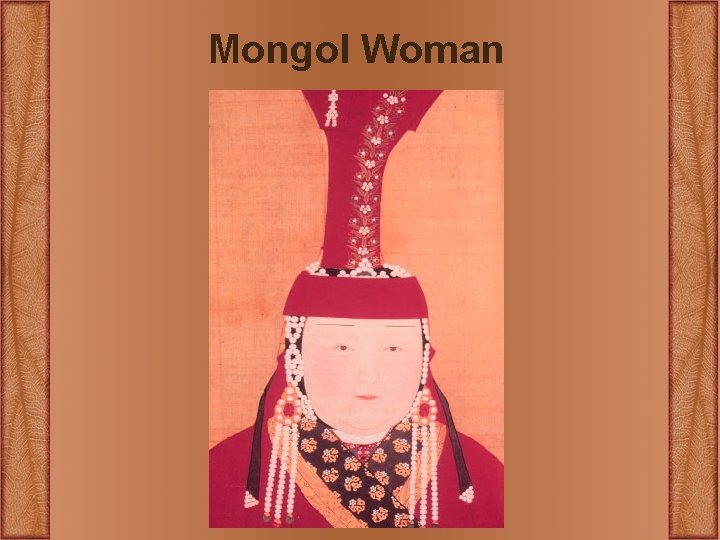
Mongol Woman
Seasonal Movements • Movements of Mongol tribes brought them into contact with: – Manichaeism – Judaism – Christianity – Buddhism – Islam • Mongols accepted religious pluralism.
Sky God • Mongol khans were thought to represent the Sky God. – He transcended all cultures and religions • Khans were thus conceived of as universal rulers who both transcended and used the various religions of their subjects.
Economic Self-Sufficiency • Nomads strove for economic self-sufficiency. • Relied on trade with settled people for: – – – Iron Wood Cotton Grain Silk • When trade relations were interrupted, nomads would wage war on settled agriculturalists.
Mongol Conquests • 1206 - 1234 – Genghis Khan and his successors conquered all of North China. – Mongols were threatening Southern Song. • 1234 -1265 – Mongol realms united as the khans of the Golden Horde, the Jagadai domains of Central Asia, and the Il-khans all recognized the authority of the Great Khan of Mongolia.
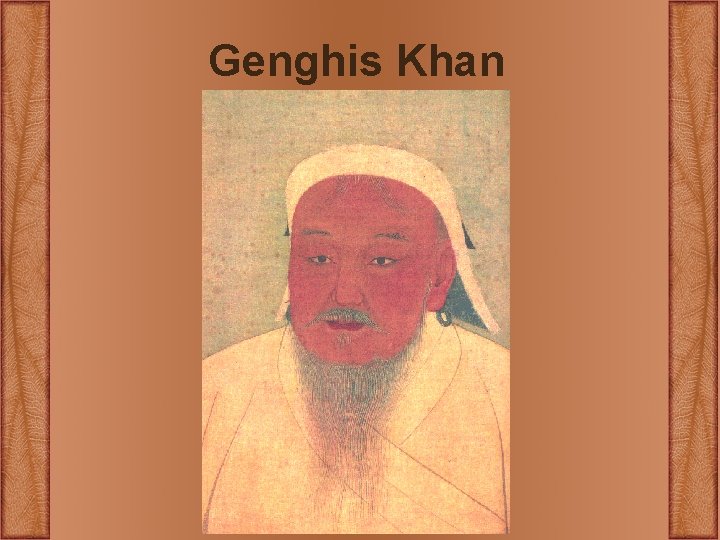
Genghis Khan
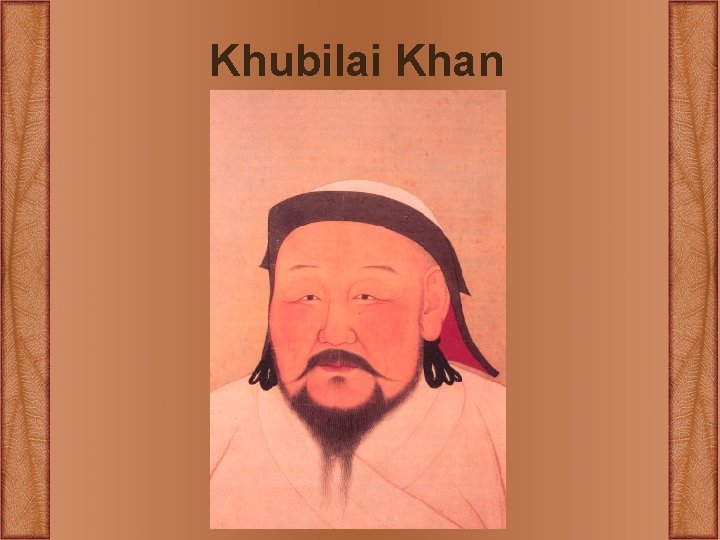
Khubilai • Declared himself Great Khan in 1265 – Other Khans refused to accept him – Jagadai Khanate harbored a particular animosity towards him. • Khubilai founded the Yuan Empire with a capital at Beijing in 1271. • In 1279, he conquered the Southern Song. – After 1279, Yuan attempted to extend its control to Southeast Asia. • Annam and Champa forced to pay tribute to the Yuan
Khubilai Khan
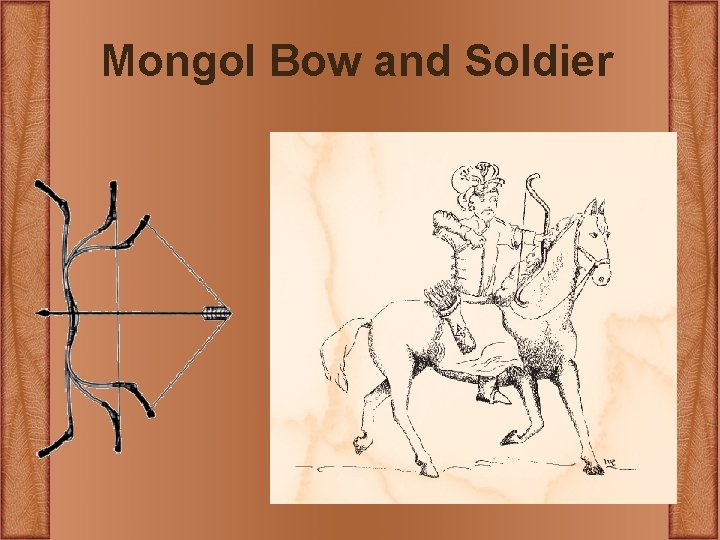
Mongol Ability • Factors that contribute to the Mongols’ ability to conquer such vast territories: – – – – Superior horsemanship Better bows Following arrows with cavalry charge Easily learned new military techniques Adopted new military technology Incorporated non-Mongol soldiers into armies Reputation for slaughter of those who did not surrender – Ability to take advantage of rivalries among enemies
Mongol Bow and Soldier
Overland Trade • Mongol conquests opened overland trade routes. • Brought about an unprecedented commercial integration of Eurasia. • The growth of long-distance trade under the Mongols led to significant transfer of military and scientific knowledge between Europe, the Middle East, China, Iran, and Japan.
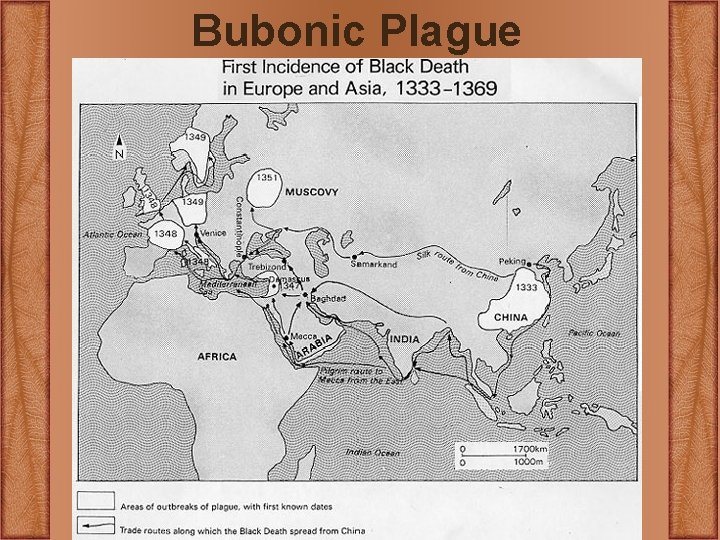
Bubonic Plague • Plague and other diseases spread over the trade routes of the Mongol Empire. • Plague that had lingered in Yunnan was transferred to: – Central and north China. Then… – Central Asia. Then… – Kaffa. Then… – The rest of the Mediterranean world.
Bubonic Plague
Mongols and Islam 1260 -1500
Mongol Rivalry • 1260 s – the Il-Khan Mongol Empire controlled parts of Armenia and all of Azerbaijan, Mesopotamia, and Iran. • Relations between Buddhist/shamanist Mongols and Muslim subjects were tense. – Mongols murdered last Abbasid caliph and because Mongol religious beliefs and customs were contrary to those of Islam.
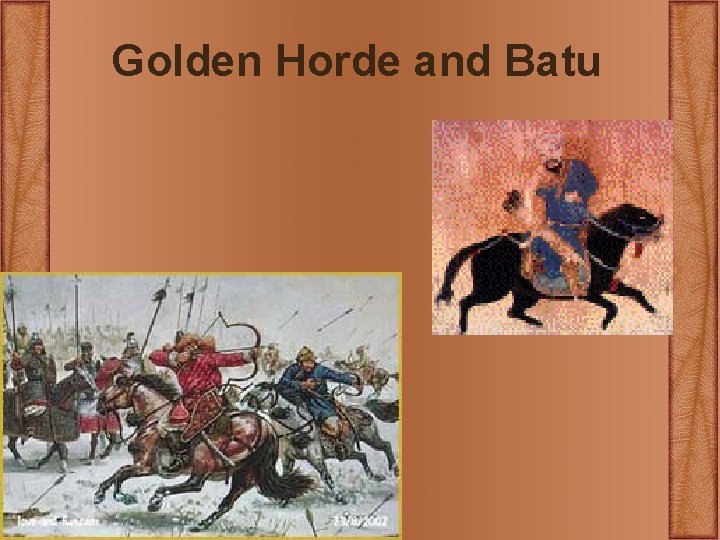
1260 s in Russia • Under domination of Golden Horde, led by Genghis Khan’s grandson Batu – Batu converted to Islam and announced his intention to avenge the last caliph. • This was the first conflict between Mongol domains.
Golden Horde and Batu
Batu’s Conflict • European leaders attempted to make an alliance with the Il-khans to drive Muslims out of Syria, Lebanon, and Palestine. • Il-khans sought European help in driving the Golden Horde out of the Caucasus. • Plans for an alliance never came to fruition because the Il-khan ruler Ghazan became a Muslim in 1295.
Taxation • Goal of Il-khan State = collect as much tax revenue as possible – Did this through tax farming system • Tax farming system able to deliver large amounts of grain, cash, and silk. – But…over-taxation led to increases in the price of grain and shrinking tax base • 1295 – severe economic crisis!!
Ending the Economic Crisis • Tried tax reduction program and issuing paper money. – These failed • Economic depression until 1349. • Il-khan domains fragmented as Mongol nobles fought each other for scarce resources. – Mongols from Golden Horde attacked and dismembered the Il-khan empire.
Decline • Il-khan and Golden Horde declined in the fourteenth century. • Timur, the last Central Asian conqueror, built the Jagadai Khanate in central and western Eurasia. – The Timurids ruled the Middle East for several generations.
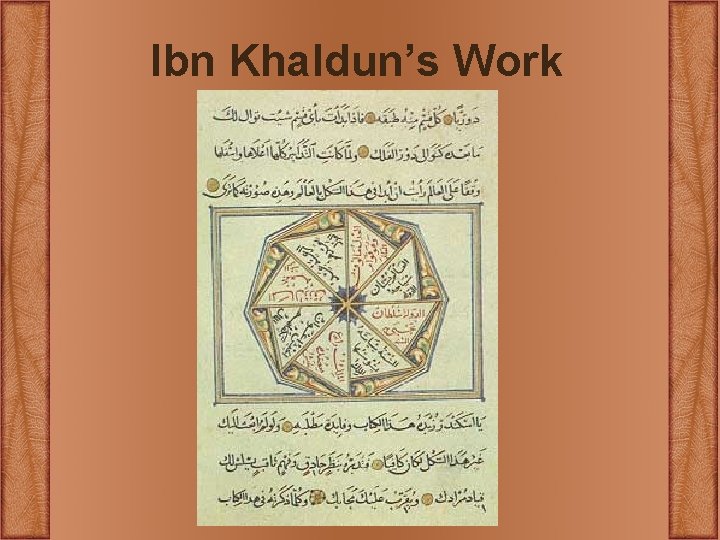
Writing about History • Juvaini wrote the first comprehensive account of the rise of the Mongols under Genghis Khan. • Juvaini inspired the work of Rashid al. Din, who wrote a history of the world. – Rashid al-Din was a Muslim who served as an adviser to the In-khan ruler. • Timurids supported many historians including Moroccan Ibn Khaldun.
Ibn Khaldun’s Work
Muslims under Mongol Rulership • Made great strides in astronomy, calendar-making, and prediction of eclipses. • Used epicycles to explain movement of moon around earth. • Invented more precise astronomical instruments.
Mathematics • Adapted Indian numerical system • Devised method of indicating decimal fractions • Calculated ∏ more accurately. • All of these advances were passed along to Europe and had a significant effect on the development of European science and mathematics.
Regional Responses in Western Eurasia
Russia and Rule from Afar • After defeating the Kievan Rus, the Mongols of the Golden Horde made a capital at the mouth of the Volga. – Volga was also the end of the overland caravan route from Central Asia. • Mongols ruled Russia “from afar. ” – Orthodox church left in place – Russian princes were agents • Main goal = get as much tax revenue as possible from the Russians
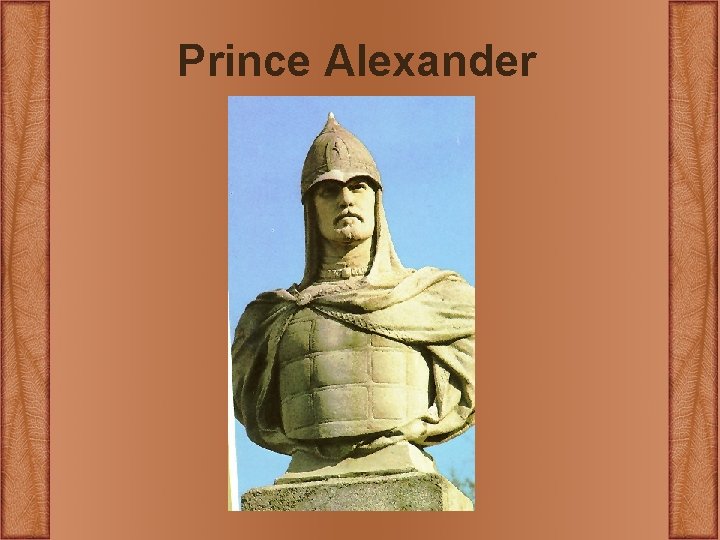
Prince Alexander of Novgorod • Assisted Mongols in conquest of Russia. – Mongols favored Novgorod and Moscow as a result • After Mongols destroyed Ukrainian countryside, Russian population shifted from Kiev to Novgorod and Russia. – Moscow became new center of Russian civilization.
Prince Alexander
Mongol Rule – Good or Bad? • Some historians say the negative effects are because of economic depression and cultural isolation. • Others say Russian princes were responsible for over-taxation, they were isolated by the church, and that government did not change under Mongol rule.
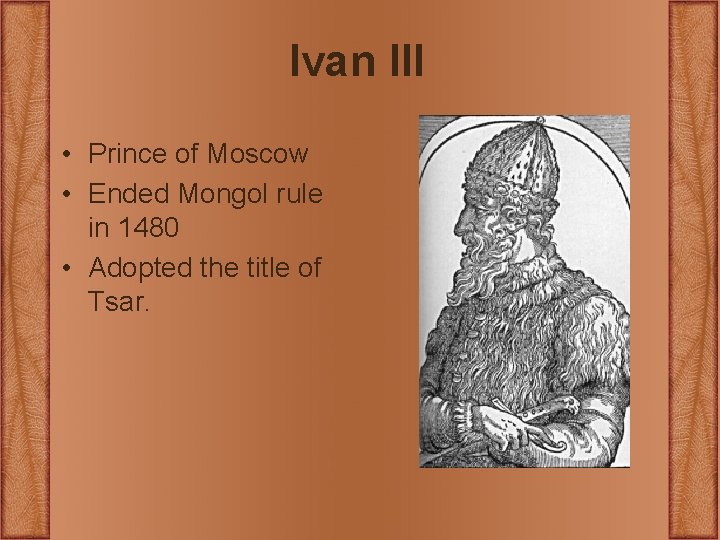
Ivan III • Prince of Moscow • Ended Mongol rule in 1480 • Adopted the title of Tsar.
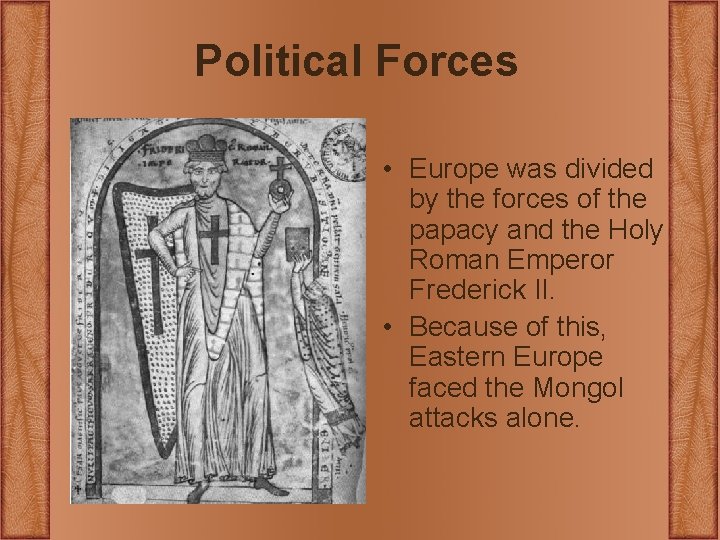
Political Forces • Europe was divided by the forces of the papacy and the Holy Roman Emperor Frederick II. • Because of this, Eastern Europe faced the Mongol attacks alone.
Attacking Europe • Mongol armies that attacked Europe were an international force including: – Mongols, Turks, Chinese, Iranians, Europeans – Forces led by Mongol generals. • Armies made it to the outskirts of Vienna. • Withdrew in December 1241 to elect a new leader.
Diplomacy and Trade • After the Mongol withdrawal, Europeans initiated a variety of diplomatic and trade overtures to the Mongols. • Contact between the two increased through the thirteenth century. • Brought knowledge of many things to Europeans, but they questioned customs and beliefs as a result of the plague.
Centralized States • Rise and fall of Mongol domination in the thirteenth and fourteenth centuries was accompanied by the rise of stronger centralized states including Lithuania and other Balkan kingdoms.
Anatolia • Functioned as a route by which Islamic culture was transferred to Europe via Constantinople. • The Ottomans, who established themselves in eastern Anatolia in the 1300 s, expanded eastward in the 1400 s and conquered Constantinople in 1453.
Mongol Domination in China 1271 -1368
Before the Mongols in China • Politically fragmented • Three states: – Tanggut – Jin – Southern Song • Mongols unified these states and restored or preserved the characteristic features of Chinese government.
Khubilai Khan and China • Khubilai Khan understood and practiced Chinese traditions of government. • Constructed a Chinese-style capital at Beijing and a summer capital at Shangdu, where he could practice riding and shooting.
Government Innovations • Tax Farming • Use of Western Asian Muslims as officials • Hierarchical system of legally defined status groups in terms of race and function – Confucians had a relatively weak role – Merchants and doctors were elevated
Prosperity • • • China’s cities and ports prospered Trade recovered Merchants flourished Chinese gentry elite moved to cities Urban culture was created – Popular entertainment – Vernacular literature – Mandarin dialect of Chinese language
Rural Areas • Cotton growing, spinning, and weaving were introduced to China from Hainan Island. • Mongols encouraged construction of irrigation systems. • Farmers were overtaxed and brutalized while dams and dikes were neglected.
Population Decline • • Declined by as much as 40% Northern China saw biggest loss Yangzi Valley saw an increase Possible reasons for this: – Warfare – Flooding of Yellow River – North-south migration – Spread of diseases including the Plague
Scientific Exchange • Exchange of knowledge was especially common between Iran and China because of: – Good relations – Similar economic policies – Interest in sponsoring intellectual pursuits • China imported Il-khan science and technology • Il-khans imported Chinese scholars and texts
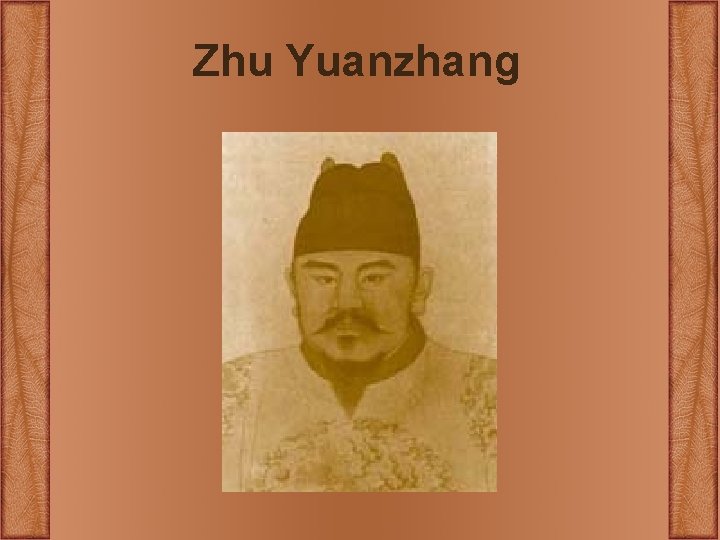
Fall of Yuan Empire • 1368 – Chinese leader Zhu Yuanzhang brought an end to years of chaos and rebellion by overthrowing the Mongols. • He established the Ming Empire. • Mongols held power in Mongolia, Turkestan, and Central Asia. – Were able to disrupt Chinese overland trade.
Zhu Yuanzhang
Early Ming Empire 1368 -1500
Establishing the Ming • Founded by Zhu Yuanzhang in 1368 – He had previously been a monk, soldier, and bandit • Regime established capital in Nanjing and made efforts to: – reject the culture of the Mongols – Close off trade relations with Central Asia and Middle East – Reassert primacy of Confucian ideology
Yuan Practices • Ming actually continued many institutions and practices that had been introduced during the Yuan. • Areas of continuity include: – Provincial structure – Use of hereditary professional categories – Mongol calendar – Use of Beijing as a capital
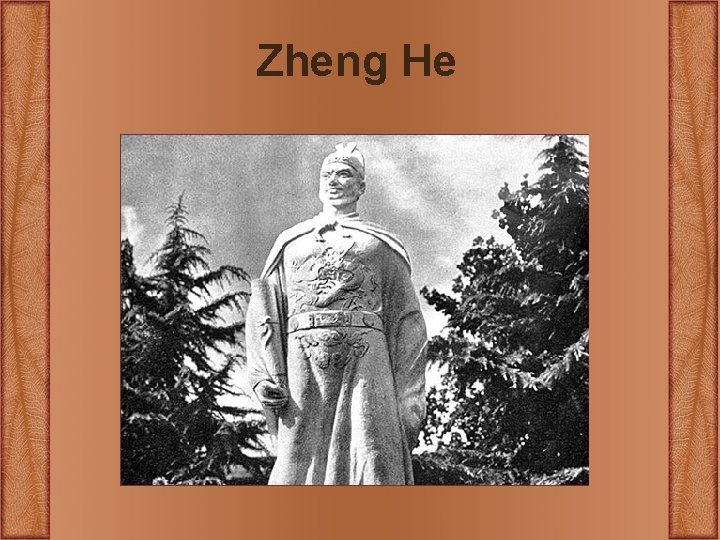
Reestablishing Trade • 1405 -1433 – Ming dispatched a series of expeditions to Southeast Asia and the Indian Ocean under the Muslim admiral Zheng He. • Goals: – Reestablish trade links with Middle East – Bring Southeast Asian countries and overseas Chinese populations under Chinese control.
Zheng He’s Expeditions • Retraced routes that were well established. • Imported some luxury goods to China • Added as many as 50 countries to China’s list of tributaries • Not a significant increase in longdistance trade, so this was not profitable.
Zheng He
Technology • Less technological innovation at this time than during the Song. • Chinese lost knowledge of how to make highquality bronze and steel. • Reasons for slowdown: – – – High cost of metals and wood Revival of civil service examination system Labor glut Lack of pressure Fear of technology transfer
Innovation in Asia Korea and Japan moved ahead of China in technological innovation. • Korea excelled in: – – Firearms Shipbuilding Meteorology Calendar making • Japan excelled in: – Mining – Metallurgy – Novel household goods
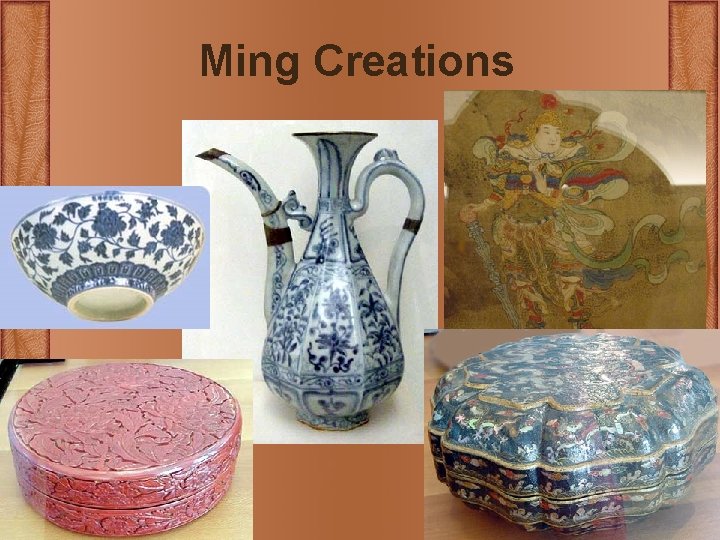
Ming Achievement • Period of great wealth, consumerism, and cultural brilliance. • Vernacular novels written at this time: – Water Margin – Romance of the Three Kingdoms • Also known for porcelain-making, and for other goods like furniture, lacquered screens, and silk.
Ming Creations
Centralization and Militarism in East Asia 1200 -1500
Korea, Mongols, and Koryo • Leaders initially resisted Mongol invasions but gave up in 1258 when king of Koryo surrendered and joined his family to the Mongols by marriage. • Koryo kings fell under the influence of the Mongols.
Profit • Korea profited from exchange with the Yuan in which new technologies were introduced. Some examples include: – Cotton – Astronomy – Gunpowder – Calendar making – Celestial clocks
Collapse and Rise • Koryo collapsed shortly after the fall of the Yuan. • Replaced by Yi dynasty. • Yi reestablished local identity and restored the status of Confucian scholarship. • Maintained Mongol administrative practices and institutions.
Innovations of the Yi • • • Moveable type in copper frames Meteorological science Local calendar Use of fertilizer Engineering of reservoirs Grew many cash crops at this time
Korean Military Technology • Patrol ships with mounted cannons • Gunpowder arrow-launchers • Armored ships
Mongol Invasion of Japan • Happened in 1274 and was unsuccessful. • Decentralized lords of Kamakura Japan developed a greater sense of unity as a result. • Shogun centralized planning and preparation for a second assault.
Second Mongol Invasion • Happened in 1281. Defeated by defensive preparations and a typhoon. • Kamakura regime continued to prepare for further invasions, but these were very expensive.
Kamakura Shogunate Falls • Destroyed in a civil war. • Ashikaga shogunate established in 1338. • Ashikaga period was a weak shogunal state, but they had strong provincial lords. – These lords developed markets, religious institutions, schools, increased agricultural production, and artistic creativity.
Onin War • War took place in 1477. • After this war, the shogunate exercised no power and the provinces were controlled by independent regional lords who fought with each other. • Regional lords also carried out trade with continental Asia.
Emergence of Vietnam • Divided into two states: – Chinese-influenced Annam in the north – Indian-influenced Champa in the south • Mongols extracted tribute from both states • After fall of Yuan Empire, the two states began to fight with each other
Rule by Chinese and Annam • Ming ruled Annam through puppet government for almost 30 years in the early fifteenth century until their control was thrown off in 1428. • By 1500 Annam had completely conquered Champa and established a Chinese-style government over all Vietnam.