
Money Laundering and Corruption Mike Levi Maria Dakolias




- Slides: 21
Money Laundering and Corruption Mike Levi Maria Dakolias Ted Greenberg June 8, 2006 5 -1
5 -2
Objectives • Define money laundering • How AML supports anti-corruption 5 -3
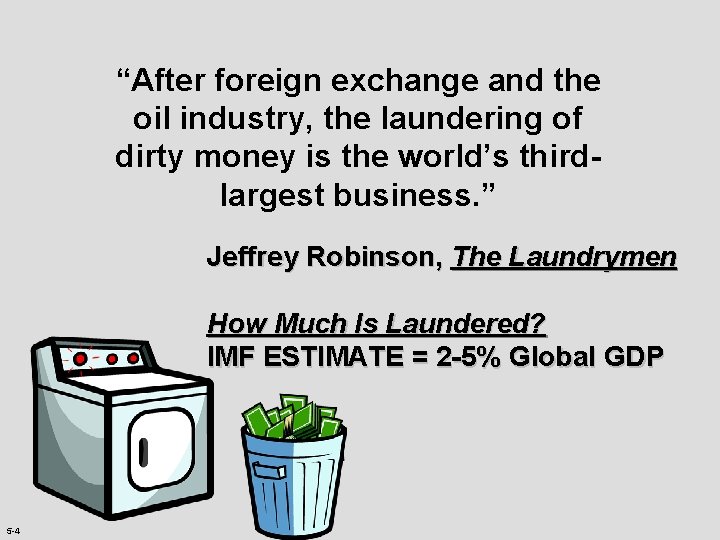
“After foreign exchange and the oil industry, the laundering of dirty money is the world’s thirdlargest business. ” Jeffrey Robinson, The Laundrymen How Much Is Laundered? IMF ESTIMATE = 2 -5% Global GDP 5 -4
What is Money Laundering? • Definition: The process of disguising the proceeds of crime in an effort to conceal their illicit origins and legitimize their future use. • Objective: To conceal true ownership and origin of the proceeds, a desire to maintain control, a need to change the form of the proceeds. • Techniques: They can be simple, diverse, complex, subtle, but secret. Proceeds = any economic advantage derived directly or indirectly from criminal offenses 5 -5
Money Laundering Cycle 1. Predicate Crimes • • Corruption and Bribery Fraud Organized crime Drug and human trafficking Environmental crime Terrorism Other serious crimes… 4. INTEGRATION 2. PLACEMENT • The last stage in the laundering process. • Occurs when the laundered proceeds are distributed back to the criminal. • Creates appearance of legitimate wealth. • Initial introduction of criminal proceeds into the stream of commerce • Most vulnerable stage of money laundering process 3. LAYERING • Involves distancing the money from its criminal source: • movements of $ into different accounts • movements of money to different countries • Increasingly difficult to detect 5 -6
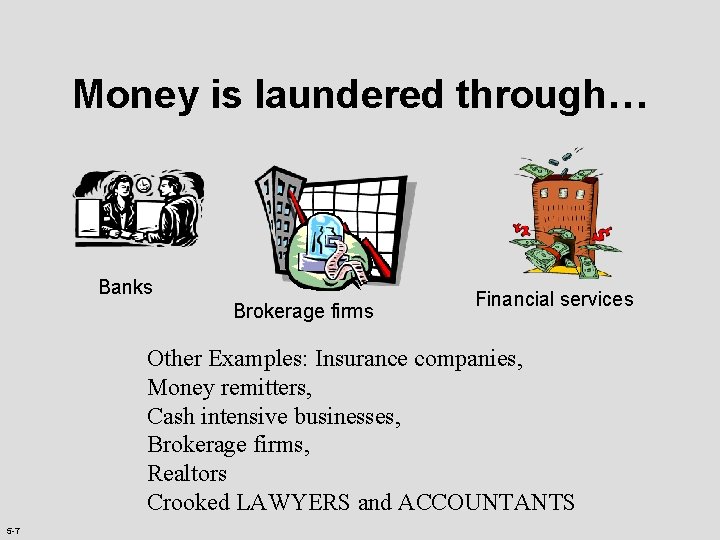
Money is laundered through… Banks Brokerage firms Financial services Other Examples: Insurance companies, Money remitters, Cash intensive businesses, Brokerage firms, Realtors Crooked LAWYERS and ACCOUNTANTS 5 -7
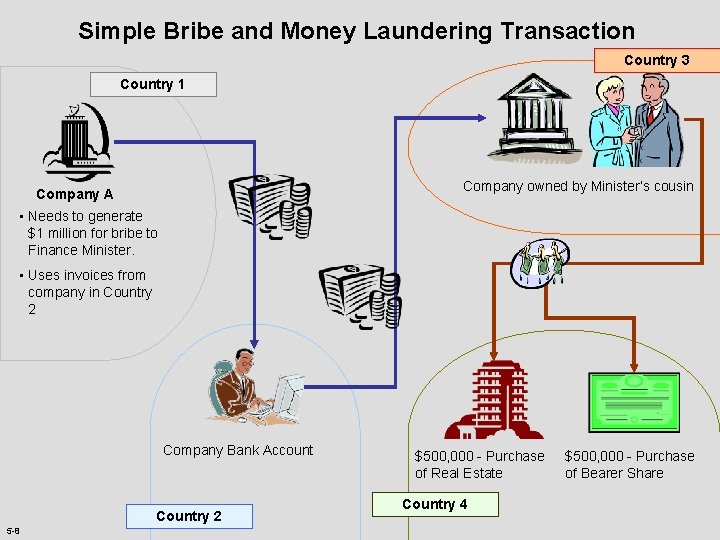
Simple Bribe and Money Laundering Transaction Country 3 Country 1 Company owned by Minister’s cousin Company A • Needs to generate $1 million for bribe to Finance Minister. • Uses invoices from company in Country 2 Company Bank Account Country 2 5 -8 $500, 000 - Purchase of Real Estate Country 4 $500, 000 - Purchase of Bearer Share
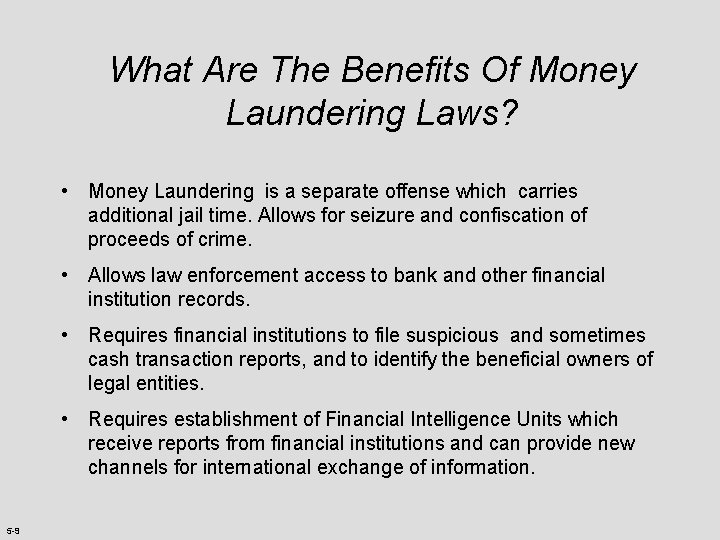
What Are The Benefits Of Money Laundering Laws? • Money Laundering is a separate offense which carries additional jail time. Allows for seizure and confiscation of proceeds of crime. • Allows law enforcement access to bank and other financial institution records. • Requires financial institutions to file suspicious and sometimes cash transaction reports, and to identify the beneficial owners of legal entities. • Requires establishment of Financial Intelligence Units which receive reports from financial institutions and can provide new channels for international exchange of information. 5 -9
Key Questions 5 -10 • How does anti-money laundering make it riskier for corruptors/corruptees? • How much can AML deter corruption? • What are the measures that will contribute to increase risk and prevention of corruption?
Incentives to Launder 5 -11 • Large amount of proceeds from corruption that need to be hidden • Low confidence in the security of assets in country • Asset disclosure requirements • Political instability or possible regime change • Greater risk for corruptors and corruptees of investigation and prosecution
Where are we in 2006? 5 -12 • Tighter controls on AML globally • Fewer secrecy havens • Greater international cooperation and pressure to adopt international standards (FATF and FSAPS by IMF/WB) • Private sector generally proactive in monitoring their business relationships
The Case of Switzerland • Originally known for its extreme bank secrecy • Evolution of reputational risk assessment of Swiss financial sector. Began to freeze assets. • Recent Cases with Swiss Banks: – Marcos: returned $700 million – Abache: returned $200 million – Montesinos: returned $77. 5 million 5 -13
What are some of the Challenges? 5 -14 • Developing political will at senior levels of government. • Tighter AML can be costly and reduce resources from other needs. • Building capacity in developing countries for investigation and prosecution. • Knowing your client is not always easy. Knowing your client’s client is difficult to impossible. • Coordination among countries law enforcement, financial intelligence units, regulators, and judiciaries. • Application of AML regime in a cash based economy.
Conclusion 5 -15 • Results unkown—don’t know whethere has been a reduction in corruption because of AML (no database of Money Laundering Cases) • It is easier to prosecute AML even when local jurisdictions are not able (i. e. ML is usually multi-jurisdictional) • AML is a compliment to anti-corruption programs but it is not a silver bullet
Thank You. 5 -16
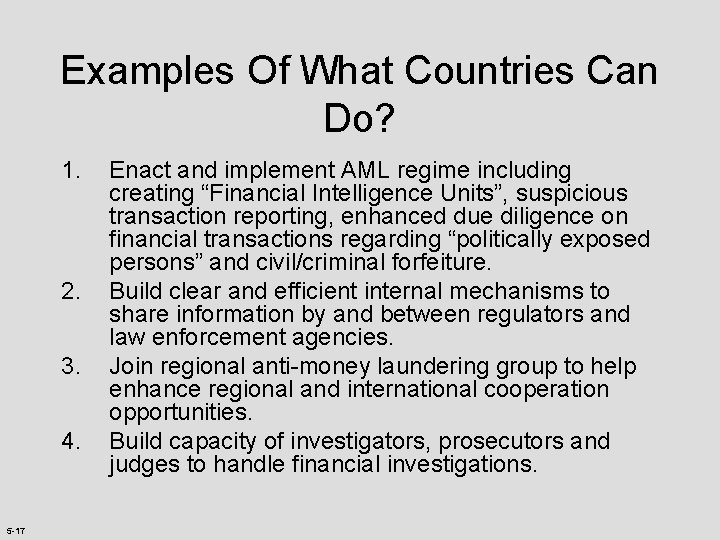
Examples Of What Countries Can Do? 1. 2. 3. 4. 5 -17 Enact and implement AML regime including creating “Financial Intelligence Units”, suspicious transaction reporting, enhanced due diligence on financial transactions regarding “politically exposed persons” and civil/criminal forfeiture. Build clear and efficient internal mechanisms to share information by and between regulators and law enforcement agencies. Join regional anti-money laundering group to help enhance regional and international cooperation opportunities. Build capacity of investigators, prosecutors and judges to handle financial investigations.
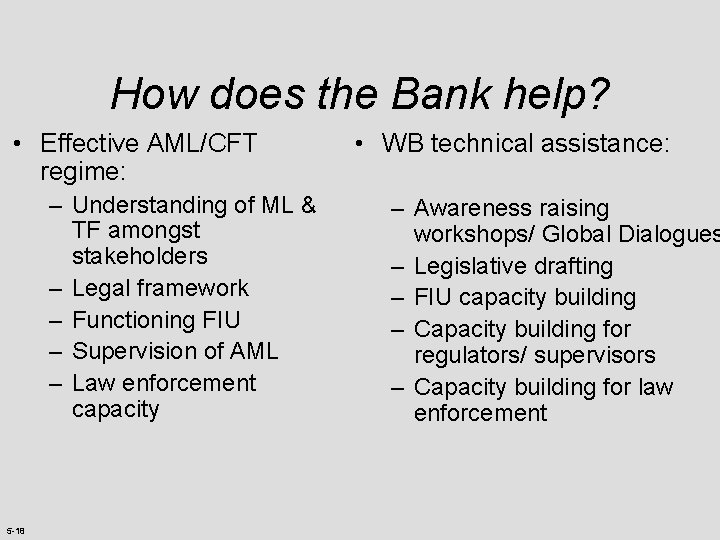
How does the Bank help? • Effective AML/CFT regime: – Understanding of ML & TF amongst stakeholders – Legal framework – Functioning FIU – Supervision of AML – Law enforcement capacity 5 -18 • WB technical assistance: – Awareness raising workshops/ Global Dialogues – Legislative drafting – FIU capacity building – Capacity building for regulators/ supervisors – Capacity building for law enforcement
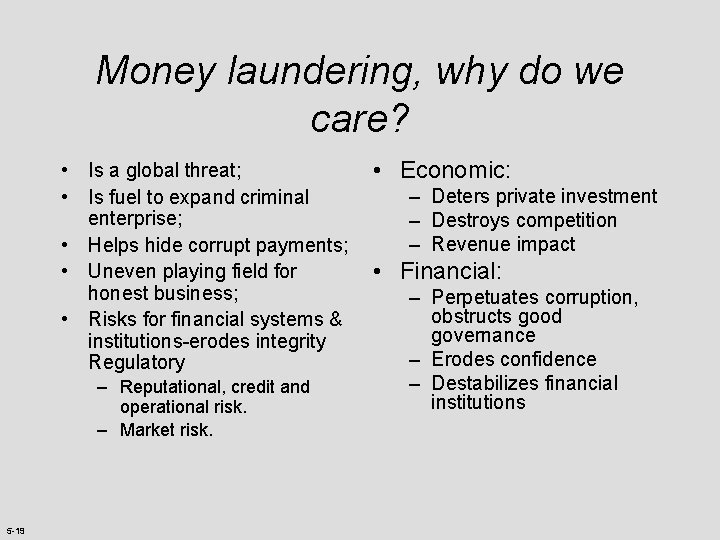
Money laundering, why do we care? • Is a global threat; • Is fuel to expand criminal enterprise; • Helps hide corrupt payments; • Uneven playing field for honest business; • Risks for financial systems & institutions-erodes integrity Regulatory – Reputational, credit and operational risk. – Market risk. 5 -19 • Economic: – Deters private investment – Destroys competition – Revenue impact • Financial: – Perpetuates corruption, obstructs good governance – Erodes confidence – Destabilizes financial institutions
Money laundering is any transaction which seeks to conceal or disguise proceeds from illegal activities. Proceeds = any economic advantage derived directly or indirectly from criminal offenses. 5 -20
Money laundering, why do we care? • Is a global threat; • Is fuel to expand criminal enterprise; • Helps hide corrupt payments; • Uneven playing field for honest business; • Risks for financial systems & institutions-erodes integrity Regulatory – Reputational, credit and operational risk. – Market risk. 5 -21 • Economic: – Deters private investment – Destroys competition – Revenue impact • Financial: – Perpetuates corruption, obstructs good governance – Erodes confidence – Destabilizes financial institutions