
MONEY BANKING MONEY Functions of Money Medium of

MONEY & BANKING

MONEY
Functions of Money Medium of exchange Exchange $ for g & s Standard of value Allow for value comparison Store of value Saving for future use
Characteristics of Money Our $ is generally acceptable Can be counted and measured accurately Durable Convenient Inexpensive to produce Easy to control supply in our economy
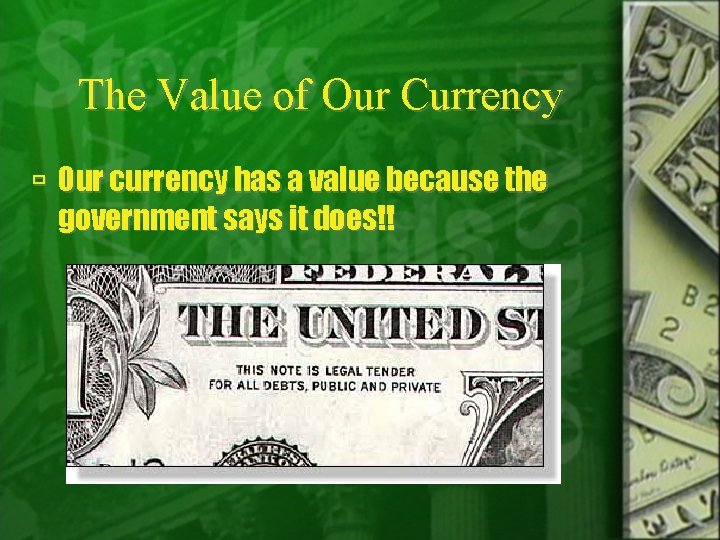
The Value of Our Currency Our currency has a value because the government says it does!!
Our banking system
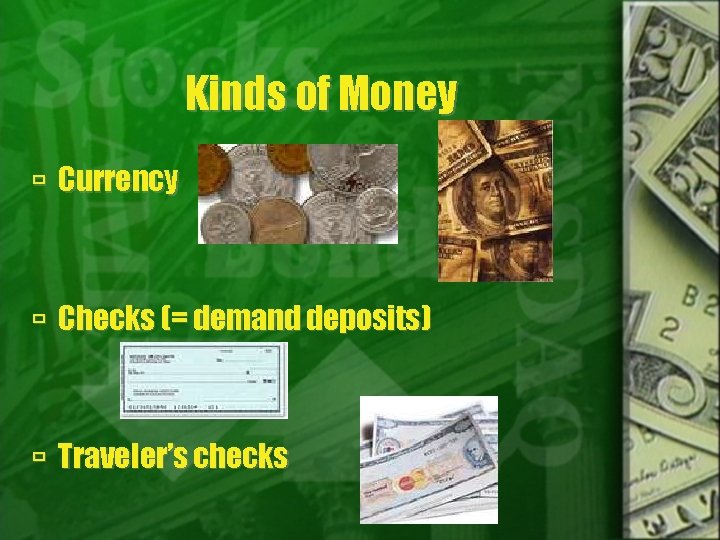
Kinds of Money Currency Checks (= demand deposits) Traveler’s checks
Banks and the Money Supply Money supply– total amount of $ available for use as a medium of exchange Banks– VITAL in our economy Banks hold currency and offer demand deposit services
Bank Services Checking accounts Easy…secure. . good records Savings accounts NOT a demand deposit… notice for large withdrawals required Earn interest Allow banks to make loans Loans Most important role in economy An amount of $ borrowed for certain period of time Pay $ back PLUS interest Helps economy to grow… helps people to start or expand businesses
Banks are a MAJOR business in our economy.
Other Financial Institutions Savings & Loans associations Functions like banks Mutual Savings banks Owned by depositors where profits are paid to them Credit Unions Serves ONLY its members Members usually work for one company or a unit of government
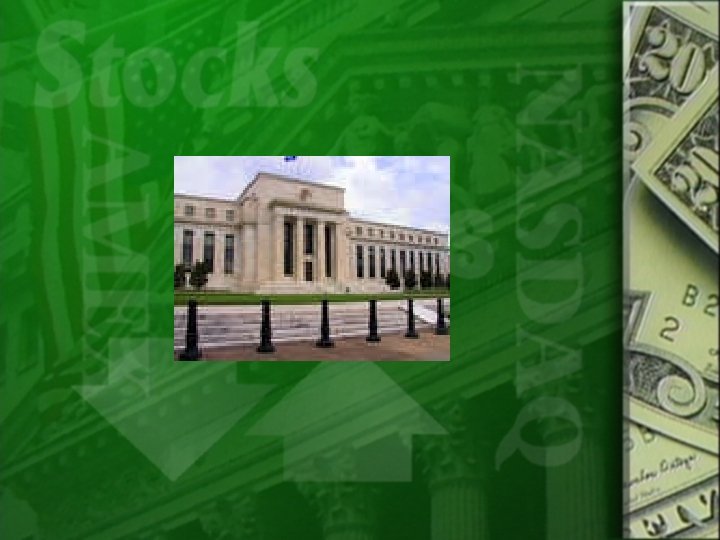
The Federal Reserve System
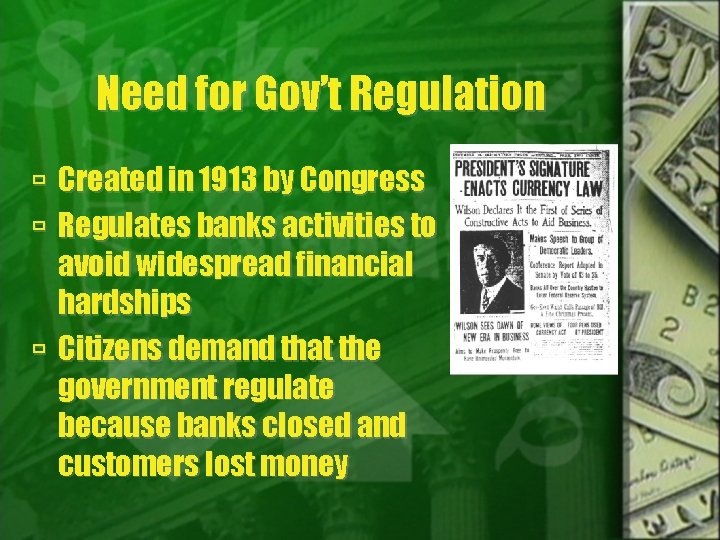
Need for Gov’t Regulation Created in 1913 by Congress Regulates banks activities to avoid widespread financial hardships Citizens demand that the government regulate because banks closed and customers lost money
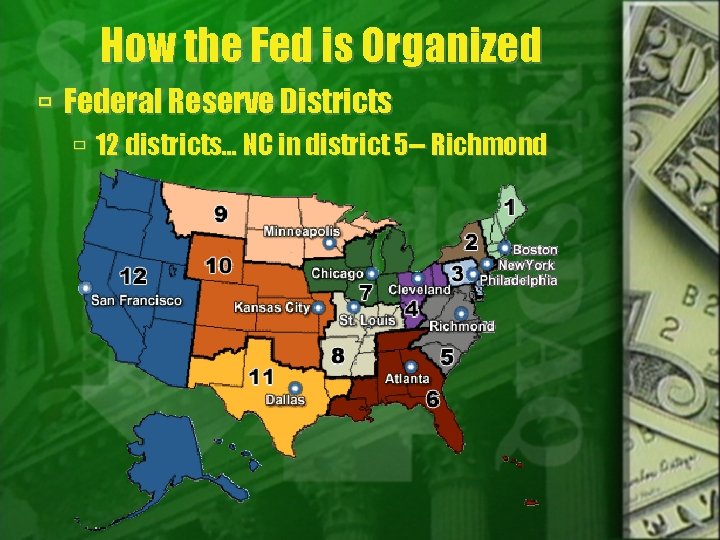
How the Fed is Organized Federal Reserve Districts 12 districts… NC in district 5 -- Richmond
How the Fed is Organized cont’d Run by a Board of Governors 7 members- appointed by President for 14 year terms Open Market Committee 7 (B of G) and the presidents of 5 FR Banks Regulate nation’s $ supply Federal Advisory Council 12 bankers (private)– one from each district Advise B of G and Open Market Council on nation’s business and banking problems
Functions of the Fed Provide Services Collects and clears checks Wire $-- Fedwire Supply currency to banks Store tax money paid by citizens Gov’t checking accounts Federal gov’t debt records Bonds (!!) Government’s bank Supervise banks Sets minimum amount of funds that must be kept on deposit
Functions of the Fed cont’d Makes loans to banks Charge banks a special interest rate Protect individuals and businesses that use banks Truth in Lending Laws Control money supply Controls nation’s money supply by influencing amount of $ people borrow
Inflation– rise in price of goods and services Recession– slowdown in economic activity controls money supply in order to keep a balance between inflation and recession
Banking History Early History: 1 st attempt - 1791 to 1836 not successful -- States rights issue Without a national banking system, there were hundreds of different currencies and rapid inflation of prices
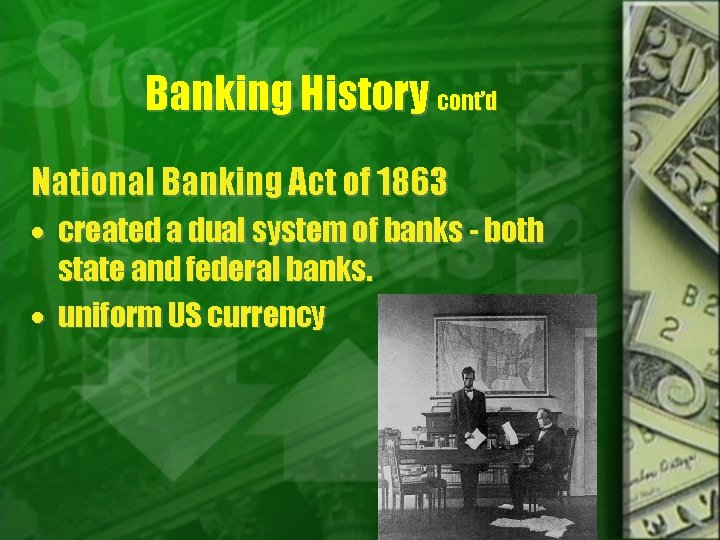
Banking History cont’d National Banking Act of 1863 created a dual system of banks - both state and federal banks. uniform US currency
Banking History cont’d Glass-Steagall Banking Act 1933 Great Depression reaction Created the FDIC to insure all deposits up to $100, 000 … changed in 2008 to $250, 000 Helps prevent “runs” on banks
Banking History cont’d Savings and Loan Crisis of the late 1980 s The government relaxed regulations on banks in the late 1970 s Many banks failed due to bad investments. The United States government stepped in to bail out the S & Ls It cost the government about $200 billion
Banking History cont’d Gramm-Leach-Bliley Act of 1999 Permits bank holding companies more freedom to engage in a wider series of financial options Forces banks to put in safeguards to protect your money
- Slides: 24