
Money Banking Financial Markets Topic 6 How can
Money, Banking, & Financial Markets Topic 6
How can you make the most of your money? Read the options listed below and decide whether you think each one is a sound or unsound answer to that question. Then list the top three options you might choose, and why you chose them. • 1. Spending money on having fun • 2. Spending money on your education • 3. Buying something, such as a home or a car, that you will own for a long time • 4. Saving money in a way that has low risk but low potential reward • 5. Investing money in a way that has high risk but potentially high reward • 6. Investing money in a way that has high reward but prevents you from accessing the money for a long time
Money • What is money?
Money • Money: anything that serves as a medium of exchange, a unit of account, and a store of value.
• Why do you think that it is means for money to be a “medium of exchange? ” Hint: What does it mean to exchange something?
. What do you think it means for money to serve as a “unit of account? Hint: What is a unit?
Why do you think that it is important for money to serve as a “store of value? ” Hint: What does it mean to “store” something?
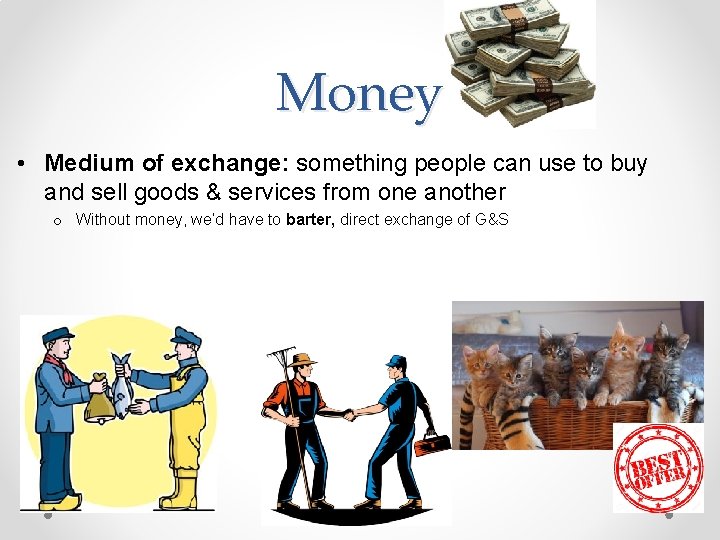
Money • Medium of exchange: something people can use to buy and sell goods & services from one another o Without money, we’d have to barter, direct exchange of G&S
Money • Unit of Account: provides a means for comparing the values of g&s • Store of value: money keeps its value if you decide to hold on to it instead of spending it o Money will still be valuable and recognized as a medium of exchange in the future ***With one big exception*** Sometime economies experience rapid inflation, general increase in prices & money then does not function well as a store of value
History of Money Barter: Most likely dates back tens of thousands of years, maybe even beginnings of early modern humans 9000 -6000 BC, Oldest form of money?
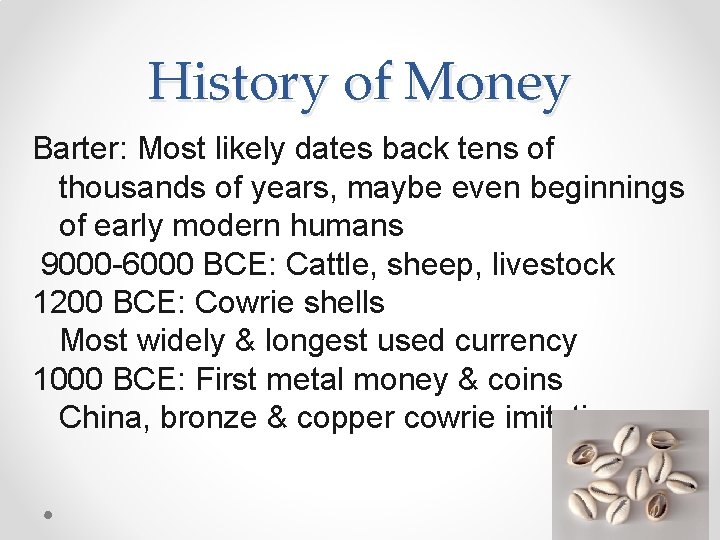
History of Money Barter: Most likely dates back tens of thousands of years, maybe even beginnings of early modern humans 9000 -6000 BCE: Cattle, sheep, livestock 1200 BCE: Cowrie shells Most widely & longest used currency 1000 BCE: First metal money & coins China, bronze & copper cowrie imitations

History of Money 500 BCE: Modern coinage Outside of China developed out of silver, stamped with gods & emperors ~800 CE: Paper currency 1816: Gold standard England, bank notes represented a certain amount of gold 1930: End of the gold standard Today: Electronic money?
6 Characteristics of Money 1. 2. 3. 4. 5. Money is durable Money is portable Money is divisible Money is uniform There is a limited supply of $$$ - The Federal Reserve System 6. Money is acceptable as a form of payment - By everyone in the economy
Types of Money • Commodity money v. Fiat money Objects that have value in and of themselves & are also used as money “Legal tender” Has value because a government has decreed that it is an acceptable means to pay debts

Representative Money • Representative money: objects have value solely because the holder can exchange them for something else of value Specie: coins made of gold or silver
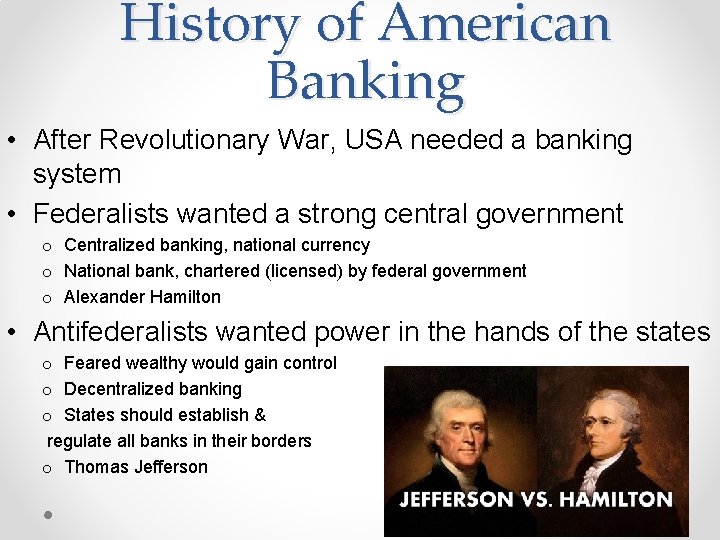
History of American Banking • After Revolutionary War, USA needed a banking system • Federalists wanted a strong central government o Centralized banking, national currency o National bank, chartered (licensed) by federal government o Alexander Hamilton • Antifederalists wanted power in the hands of the states o Feared wealthy would gain control o Decentralized banking o States should establish & regulate all banks in their borders o Thomas Jefferson
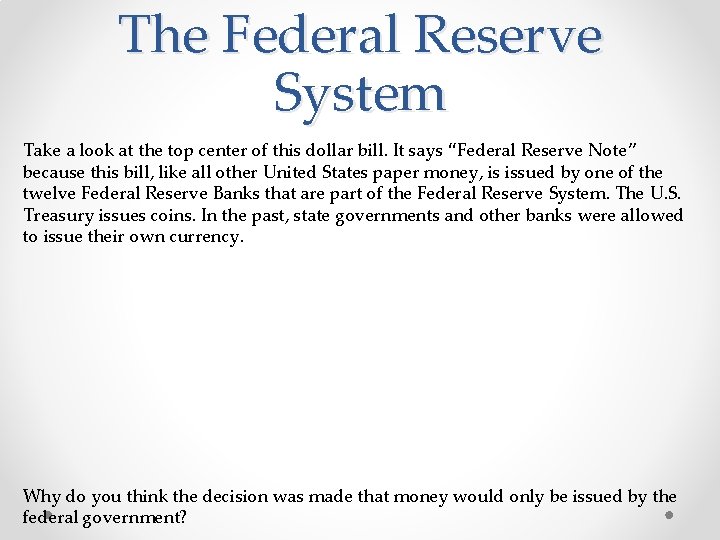
The Federal Reserve System Take a look at the top center of this dollar bill. It says “Federal Reserve Note” because this bill, like all other United States paper money, is issued by one of the twelve Federal Reserve Banks that are part of the Federal Reserve System. The U. S. Treasury issues coins. In the past, state governments and other banks were allowed to issue their own currency. Why do you think the decision was made that money would only be issued by the federal government?
Federal Reserve The Federal Reserve System is the central bank of the USA • • Acts as the spokesperson for the country’s monetary policy • Monetary Policy: the actions that the Fed takes to influence the level of real GDP & the rate of inflation in the economy
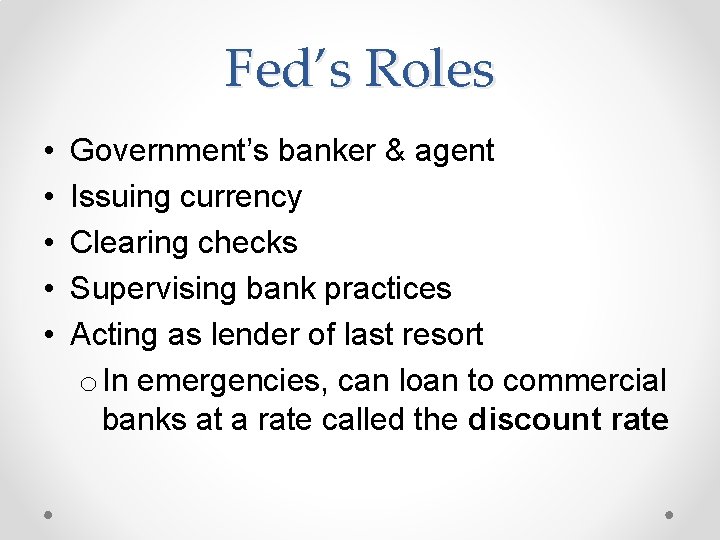
Fed’s Roles • • • Government’s banker & agent Issuing currency Clearing checks Supervising bank practices Acting as lender of last resort o In emergencies, can loan to commercial banks at a rate called the discount rate
Fed’s Roles • After 2008 subprime mortgage crisis, financial system ceased to function effectively • Fed responded by increasing its involvement in the economy
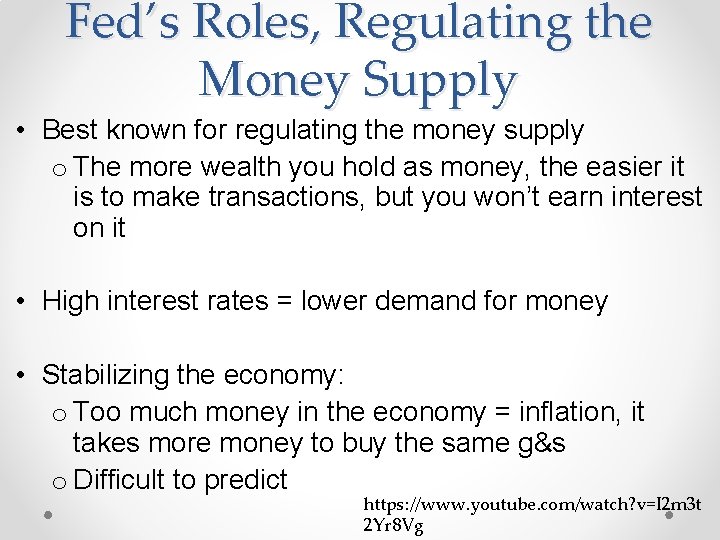
Fed’s Roles, Regulating the Money Supply • Best known for regulating the money supply o The more wealth you hold as money, the easier it is to make transactions, but you won’t earn interest on it • High interest rates = lower demand for money • Stabilizing the economy: o Too much money in the economy = inflation, it takes more money to buy the same g&s o Difficult to predict https: //www. youtube. com/watch? v=I 2 m 3 t 2 Yr 8 Vg
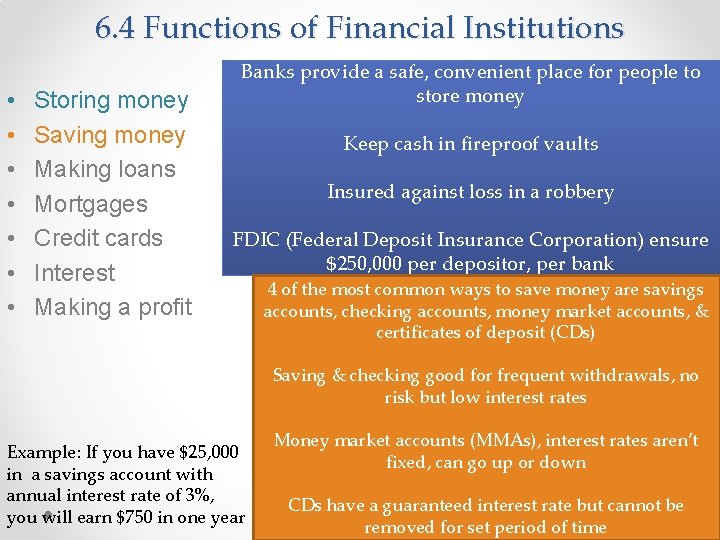
6. 4 Functions of Financial Institutions • • Storing money Saving money Making loans Mortgages Credit cards Interest Making a profit Banks provide a safe, convenient place for people to store money Keep cash in fireproof vaults Insured against loss in a robbery FDIC (Federal Deposit Insurance Corporation) ensure $250, 000 per depositor, per bank 4 of the most common ways to save money are savings accounts, checking accounts, money market accounts, & certificates of deposit (CDs) Saving & checking good for frequent withdrawals, no risk but low interest rates Example: If you have $25, 000 in a savings account with annual interest rate of 3%, you will earn $750 in one year Money market accounts (MMAs), interest rates aren’t fixed, can go up or down CDs have a guaranteed interest rate but cannot be removed for set period of time
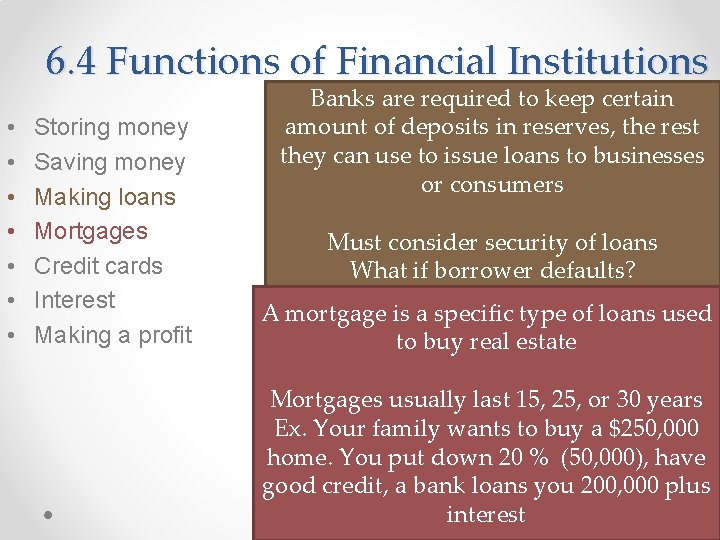
6. 4 Functions of Financial Institutions • • Storing money Saving money Making loans Mortgages Credit cards Interest Making a profit Banks are required to keep certain amount of deposits in reserves, the rest they can use to issue loans to businesses or consumers Must consider security of loans What if borrower defaults? A mortgage is a specific type of loans used to buy real estate Mortgages usually last 15, 25, or 30 years Ex. Your family wants to buy a $250, 000 home. You put down 20 % (50, 000), have good credit, a bank loans you 200, 000 plus interest
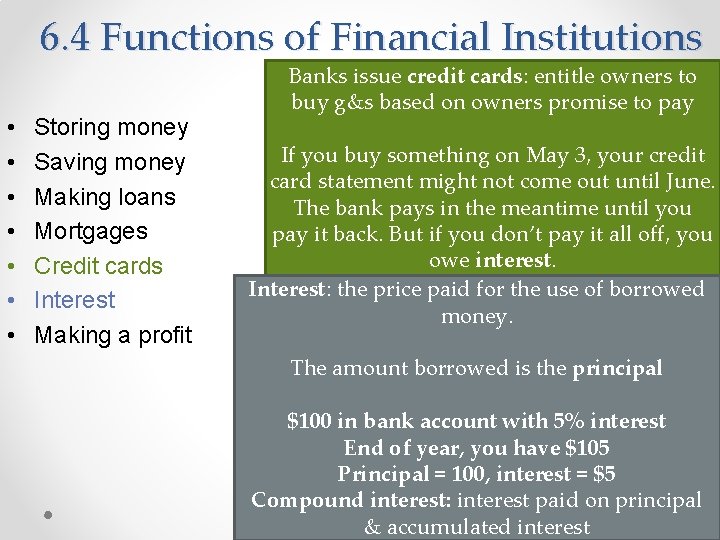
6. 4 Functions of Financial Institutions • • Storing money Saving money Making loans Mortgages Credit cards Interest Making a profit Banks issue credit cards: entitle owners to buy g&s based on owners promise to pay If you buy something on May 3, your credit card statement might not come out until June. The bank pays in the meantime until you pay it back. But if you don’t pay it all off, you owe interest. Interest: the price paid for the use of borrowed money. The amount borrowed is the principal $100 in bank account with 5% interest End of year, you have $105 Principal = 100, interest = $5 Compound interest: interest paid on principal & accumulated interest
• If you have a $100 debt and it accrues 10% interest every month, then the first month you will be charged ten dollars (100 x 0. 10). With compound interest, that ten dollars is added to your original debt, so now you have $110 of debt. The second month you are again charged 10% interest, which this time comes out to eleven dollars (110 x 0. 10), so now you have $121 of debt. Footer Text 12/20/2021 25
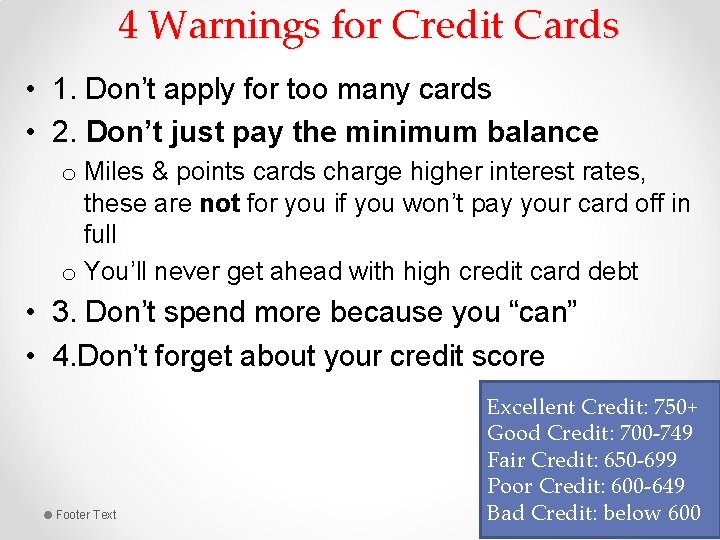
4 Warnings for Credit Cards • 1. Don’t apply for too many cards • 2. Don’t just pay the minimum balance o Miles & points cards charge higher interest rates, these are not for you if you won’t pay your card off in full o You’ll never get ahead with high credit card debt • 3. Don’t spend more because you “can” • 4. Don’t forget about your credit score Footer Text Excellent Credit: 750+ Good Credit: 700 -749 Fair Credit: 650 -699 Poor Credit: 600 -649 26 Bad Credit: 12/20/2021 below 600
6. 4 Functions of Financial Institutions • • Storing money Saving money Making loans Mortgages Credit cards Interest Making a profit Largest source of income for banks is interest they receive from customers who take out loans The amount of interest they pay out is less than the amount they charge on loans
Investing • There are benefits & risks to savings & investment • Investment: act of redirecting resources from being consumed today so that they may create benefits in the future o Invest in stocks, education, capital, etc.
• The Financial System In order for investment to take place, an economy must have a financial system o The network of structures & mechanisms that allows the transfer of money between savers & borrowers
Financial Intermediaries • Institutions that help channel funds from savers to borrowers o Banks, savings & loan associations, credit unions, & finance companies: Take deposits from savers & lend out some of these funds to businesses & individuals. o Mutual funds: pool savings of many individuals & invest in a variety of stocks, bonds, & financial assets. o Hedge funds: private investment organization that employs risky strategies that often make huge profits for investors (usually wealthy) o Life insurance: provide financial protection for family of beneficiaries, lend out portion of premiums they collect o Pension funds: Income that retirees receive after certain age or working # of years. Employers contribute to fund or withhold % of employees wages or both. Pension fund managers invest deposits
• “The risk/return tradeoff could easily be called the ‘ability-to-sleep-at-night test. ’ While some people can handle the equivalent of financial skydiving without batting an eye, others are terrified to climb the financial ladder without a secure harness. Deciding what amount of risk you can take while remaining comfortable with your investments is very important…. ”
Bonds • Bonds are sold by governments or corporations to finance projects • Bonds are basically loans or IOUs that represent debt that the seller, or issuer, must repay to an investor. o They typically pay the investor a fixed amount of interest at regular intervals for a specific amount of time o Low risk, but low rate of return
3 Components of Bonds • Coupon Rate: interest rate that a bond issuer will pay to a bondholder • Maturity: the time at which payment to a bondholder is due o Varies but usually 10, 20, or 30 years • Par Value: assigned by the issuer, is the amount to be paid to the bondholder at maturity o Aka face value or principal
You buy a bond for $1000 • Coupon rate: 5%, paid to the bondholder annually • Maturity: 10 years • Par value: $1000
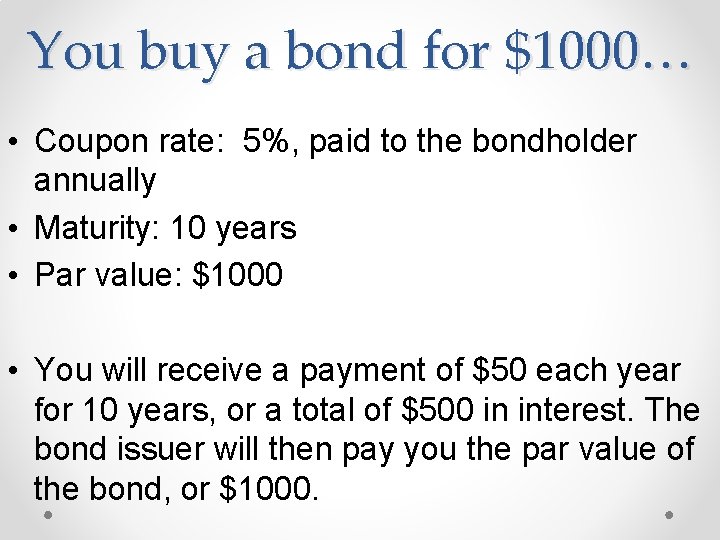
You buy a bond for $1000… • Coupon rate: 5%, paid to the bondholder annually • Maturity: 10 years • Par value: $1000 • You will receive a payment of $50 each year for 10 years, or a total of $500 in interest. The bond issuer will then pay you the par value of the bond, or $1000.
- Slides: 35